

On October 5, I wrote that the Homeland Security Investigations surge in nine states was “individualized by design: a list of names, worked one at a time.” That described the September surge. HSI’s own weekly reports from May and June, released October 7, describe a new top down approach.
An HSI email of May 26, summarizing that week’s report, says the report “emphasizes a network-based investigative approach, prioritizing organization and facilitation analysis over individual leads, now stated as a strategic direction.”
The June 1 report shows what that meant. HSI reviewed dozens of nonprofits; on a foundation’s 20 funds and some 41 New Jersey groups, it found no derogatory information. In the same report, it weighed sending undercover agents to voter-registration groups.
And it logged two data intakes: 50.6 million records from the Justice Department, and 48.4 million “obtained by DAS Heather Honey1 through independent sources of information.”
The reports come from ICE’s first interim production to the Democracy Forward Foundation in its records suit, Democracy Forward Foundation v. DHS (D.D.C. No. 1:26-cv-02624-BAH): 166 pages, dated October 1, published October 7. The weekly reports carry the header “Homeland Security Investigations / Countering Transnational Organized Crime” and the title “HSI Election Integrity Investigations.” The June 15 report puts the program “through the Cross Border Financial Crime Center (CBFCC)” and lists among its aims “detecting organized facilitation networks.”
The June 1 report is the one week in the production in which the nonprofit review was released. In the other weeks that carry the section, it is withheld under FOIA exemption (b)(7)(E), which covers law-enforcement techniques.
The production opens on a letter. Colorado’s secretary of state, Jena Griswold, had asked on March 9 for confirmation that ICE officers and special agents would stay away from voting and election-administration locations in 2026. Todd Lyons, as the senior official performing the duties of ICE’s director, answered. The copy in this production is undated and unsigned: “there is no reason for ICE officers and special agents to be deployed to polling places.” (Colorado’s Secretary of State, announcing the reply on May 27, dated the letter it received May 11, 2026, and quoted it in slightly different words: “there is no reason for ICE personnel to be deployed to polling places.”) Two sentences later: “However, ICE Homeland Security Investigations (HSI) plays an important role in investigating voter fraud, and will continue to perform this vital mission.”
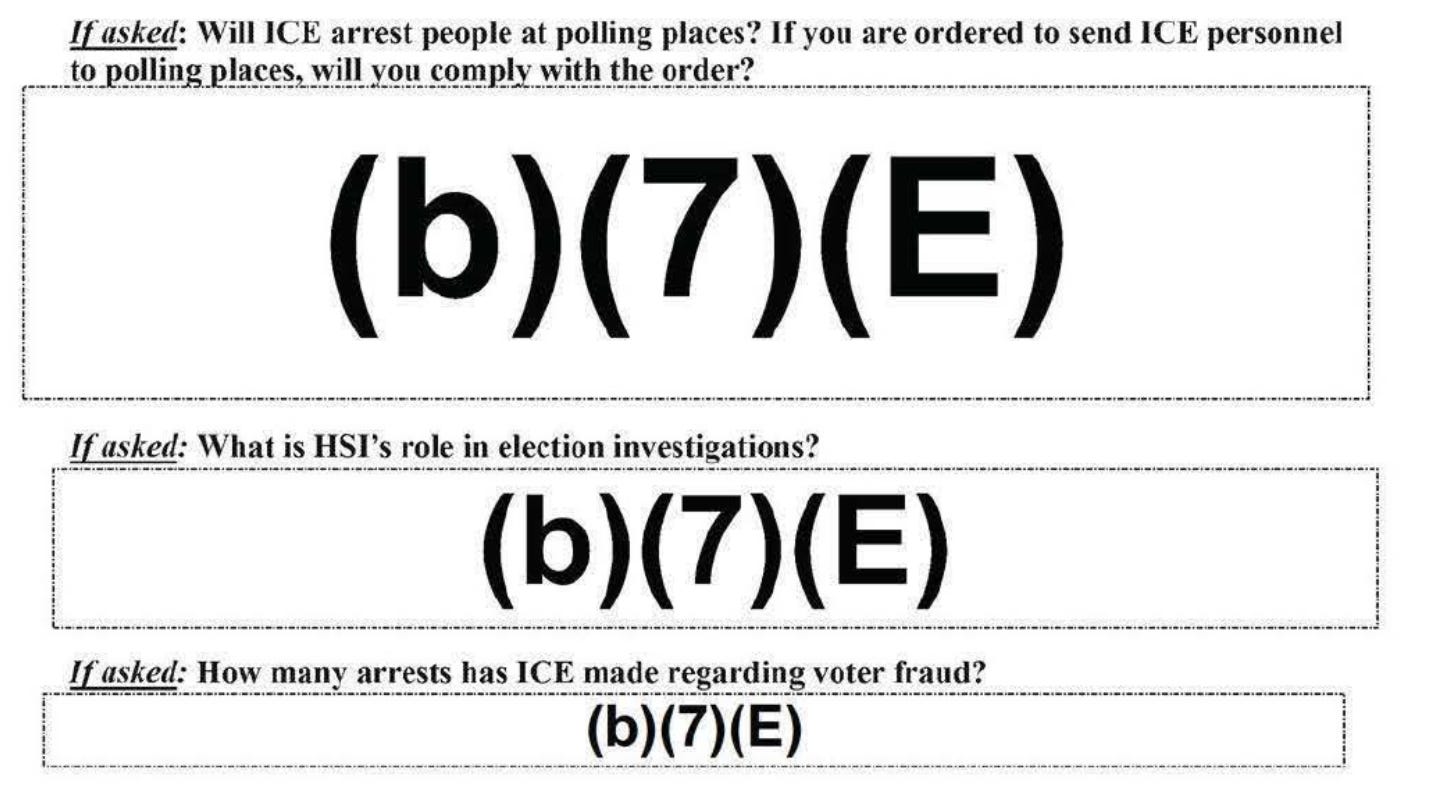
ICE’s prepared talking points on “ICE’s Role in Elections and at Polling Facilities,” on an undated page in the same production, say “There is no reason for ICE officers and agents to be deployed to polling places, unless a threat arises,” and “so far this year HSI has made 36 criminal arrests and 56 administrative arrests related to voter fraud.” The prepared answer to “If you are ordered to send ICE personnel to polling places, will you comply with the order?” is withheld in full under (b)(7)(E); the page does not say which order.
Please help support the investigation,
subscribers like you are what makes this publication work.
The nonprofits
The section is headed “Research Updates – Nonprofit and NGO Review.”
Pennsylvania: 82 NGOs reviewed, two of them “flagged for further investigation.” The next sentence is about something else: “Acclaim Systems Testing: Visa sponsorship reviewed; no voter fraud determined.” That finding belongs to one company’s visa-sponsorship review. Of the 82, the report names two flagged and records no result for the rest.
Amalgamated: “research was conducted on 20 out of 56 funds linked to the DC-based nonprofit Assets Under Movement (also known as Amalgamated Charitable Foundation and Amalgamated Foundation).” The report gives its reason. Amalgamated Foundation “is a client of Community Building Strategies, LLC, an Ohio company connected to Black Fork Strategies, LLC, which is suspected of voter registration fraud in Ohio.” It does not say who holds the suspicion. Its finding: “No suspicious financial activities or derogatory information were identified in Assets Under Movement’s 20 funds.” The same day, research began on 22 more of the Ohio firm’s clients: three Minnesota organizations (the state teachers’ union and two faith-based organizing networks), one in Michigan, and the rest in Arizona, California, D.C., Missouri, New York, Ohio and Texas. The report records only that the research began.
New Jersey: “approximately 41 New Jersey NGOs found on Candid and CauseIQ” — two nonprofit directories — “that engage in voter registration activities, along with three organizations identified via open-source research.” The result: “No derogatory information was found on any of the NGOs in ICM, Athena, or Fincen.” FinCEN is the Treasury’s financial-crimes network.
Then: “26 organizations flagged via Tip Line; under review.”
In Ohio, HSI Cleveland and the FBI had “identified seven companies that serve as consolidation centers associated with BFS for data obtained by canvassers throughout Ohio.” A separate Columbus inquiry had found a group that “ceased activity in 2008” and concluded: “All investigative leads have been exhausted no further action is anticipated.”
The proposal
The next section is “Organizations and Potential UC Operations.” A unit the documents call IBFU, never spelled out, “continues to engage closely with CBFCC Intel, which has previously conducted reviews of various nonprofit and NGO organizations.” The objective is “to determine potential opportunities to leverage UC resources, including the possible deployment of undercover agents (UCAs).” Organizations in New Jersey and Pennsylvania, under HSI Newark and HSI Philadelphia, “remain areas of focus.”
Then the plan, in the report’s words:
Future UC-related operations may involve utilizing UCAs to target identified organizations and engage in communications with these entities to substantiate recruitment methods and activities related to illegal alien voter registration. If an organization is found to be actively recruiting illegal aliens for voter registration, UC assets may be used to gather evidence, disrupt activities, and trace financial backing and support structures.
The same page lists states whose June primaries CBFCC Intel was monitoring “to determine if any notable trends or vulnerabilities in upholding election integrity are discovered,” New Jersey’s on June 2 among them.
No later report in the production repeats the undercover section. The later weeks withhold whole sections, so the record is silent on what became of it.
The records
The names were moving too. Under “Strategic Lines of Effort,” HSI was “Prioritizing 26,563 USCIS-derived records for downstream vetting,” with “Leads Disseminated: 1,586 to 24 HSI field offices.” That is the individual track. It ran beside the organizations, not instead of them.
The May 26 email counts the cases as of the May 25 report: “Voter fraud cases initiated increased from 411 to 418, and cases not referred for prosecution rose from 314 to 318.”
Then the two intakes. “DOJ Dataset Intake: 50.6 million records ingested; processing underway,” with ten priority states, Texas, Pennsylvania and California first. “DHS Dataset Intake: 48.4 million records were obtained by DAS Heather Honey through independent sources of information.” In August 2025, Votebeat reported that a DHS organizational chart listed Honey as deputy assistant secretary for election integrity. The same line about her records appears in the May 25 report. Neither report says what the records are, or what the sources were.
On October 5 I noted that the Justice Department was 0 for 26, by Democracy Docket’s count, in its suits for states’ unredacted voter rolls. On June 1, HSI recorded 50.6 million records from DOJ. The report lists priority states; it does not say where the records came from or how DOJ obtained them.
Next: “Datasets are currently with iLab for secondary enrichment and identification of high-value targets.” The production never says what iLab is. The May 26 email says coordination with it continued “particularly on ingesting processed voter roll data into the ELITE enforcement system.”
On July 6, HSI reported: “MO, MI, NM, CT, GA and KY have been enriched by the iLab and are pending Palantir entry into ELITE.” Michigan and New Mexico, it added, “are pending legal review in compliance with Court Order State of California v. Trump.” The report quotes that injunction, which barred DHS, among others, from “taking any steps to create a new federal program to superintend and control Plaintiff States’ maintenance of their voter rolls.” On August 24 the Supreme Court stayed it (No. 26A124).
The same production
HSI St. Paul’s consolidated report of July 23, in the same production, carries two Minnesota voter-fraud cases. A page later, it lists Project Whipple Shield, case number MS02PR26MS0004.
In federal court, in United States v. Sant (D. Minn. No. 0:26-cr-00115), HSI’s case-opening report under that number says HSI St. Paul opened the case “In accordance with National Security Presidential Memorandum–7 (NSPM-7),” and that it “will prioritize the identification of funding sources, organizational structures, and predicate actions behind these campaigns.” Another report under the same case number records four undercover agents at a Minneapolis “Workers Assembly to Defeat ICE” on February 15.
The same page of the St. Paul report lists “Stalking of ICE Employees by Rapid Response Network Members.” HSI’s overview: “Since December 2025, anti-ICE demonstrations and Rapid Response Networks (RRNs) in Minneapolis have escalated to coordinated surveillance, harassment, and obstruction of federal law enforcement.” HSI St. Paul, HSI Milwaukee and the U.S. attorney’s office are investigating. Then: “HSI undercover agents have infiltrated these groups, provided actionable intelligence, and confirmed coordinated targeting of law enforcement.”
Above Whipple Shield on that page is a case against a Minnesota nonprofit, which HSI calls the fiscal sponsor of a local group. HSI St. Paul says it is investigating the nonprofit “for its role in providing funding and material support to groups engaged in obstructing and assaulting federal law enforcement,” and has served grand jury subpoenas on 10 financial institutions.
The Sant filings show more of HSI St. Paul’s undercover work: Operation Puppet Master, “accepted under CUC Op Keyhole,” a certified undercover operation the government describes as a funding source; and an undercover agent sent, at HSI St. Paul’s request, into a talk in the sanctuary of Zion Lutheran Church in Ann Arbor, Michigan. An earlier report in the same filings records an undercover agent at a group’s “Art Club” meeting at Prince of Peace Lutheran Church in Roseville, Minnesota, on February 1 (Doc. 212-21).
The 166 pages never mention NSPM-7, and nothing in them ties the headquarters plan for undercover agents to Keyhole or to the Minnesota operations. Same agency, same months, same methods.
No records
On July 24, the government told Judge Beryl Howell, who also has the Democracy Forward suit, that “Homeland Security Investigations identified no potentially responsive records.” That was in DNC v. DOJ (D.D.C. No. 1:26-cv-00825-BAH), the Democratic National Committee’s suit for records on the “deployment, posting, or positioning” of ICE personnel “within, at, or in proximity to polling places, ballot drop boxes, or election offices.” Democracy Forward asked for something different, emails sent by ICE leaders containing election terms, and that is where HSI’s reports came out.
The production’s weekly election reports dated before July 24 run from May 19 to July 20. The June 1 report, quoted above, lists the June primaries. The last report in the production, dated August 3, says: “CBFCC Intel is monitoring developments for the upcoming state primary elections to identify emerging trends, vulnerabilities, or indicators that may impact election integrity.”
The surge began September 1.
The RAMM documents the connections that beat reporting can’t see — sourced events at capturecascade.org.
Free subscribers get every investigation. Paid subscribers get draft chapters of the book and access to the research infrastructure.
Before we continue, one quick ask.
A single raid is a headline. The pipeline behind it is a story nobody’s funding.
At The RAMM I connect the dots that don’t fit in one article: the federal contracts, the 287(g) deals, the quiet real-estate moves, the county-by-county buildout of detention capacity.
The receipts:
4,776+ sourced events at CaptureCascade.org
1,988 counties with signals of detention expansion at detention-pipeline
129 community fights over detention capacity, tracked
This is self-funded. Subscriptions are the only thing that keeps it alive
Sources
Primary document: - ICE FOIA 2026-ICLI-00100, First Interim Response, Oct 1, 2026, Democracy Forward Foundation v. DHS, No. 1:26-cv-02624-BAH (D.D.C.) (archived Oct 7, 2026). Cited pages, by Bates number 2026-ICLI-00100: 001 (Lyons letter to Griswold), 007 (Hot Topic 14, undated talking points), 029 (June 15 report), 057 (May 25 report), 073 (Aug 3 report), 092-095 (HSI St. Paul, July 23 consolidated report: voter-fraud cases 094; Project Whipple Shield, the stalking case and the nonprofit fiscal-sponsor case 095), 125 (May 26 email), 128-131 (June 1 report), 140 (July 6 report). Cover letter: the request (emails sent by named ICE officials containing election terms).
Court filings: - United States v. Sant, No. 0:26-cr-00115 (D. Minn.): Doc. 212-2 (Project Whipple Shield ROI, MS02PR26MS0004: NSPM-7; “funding sources, organizational structures”); Doc. 212-14 (MS02PR26MS0004-045: four UCAs at the Feb 15 Workers Assembly); Doc. 212-1 (Operation Puppet Master: “accepted under CUC Op Keyhole”); Doc. 212-18 (Ann Arbor undercover operation at HSI St. Paul’s request); Doc. 263 (Sept 10, 2026: Keyhole “is a certified undercover operation (CUC)” that “functioned as a funding source”) - Democratic National Committee v. DOJ, No. 1:26-cv-00825-BAH (D.D.C.): Doc. 23 ¶7 (July 24, 2026 joint status report); Doc. 1-7 (the DNC’s ICE request)
Capture Cascade timeline: - HSI report logs 48.4 million records from DAS Heather Honey and weighs undercover agents against voter-registration groups (June 1, 2026) - Operation Puppet Master accepted under CUC Op Keyhole (Jan 28, 2026) - HSI sends four undercover agents into the Workers Assembly to Defeat ICE (Feb 15, 2026) - HSI undercover operation at Zion Lutheran Church, Ann Arbor (Apr 8, 2026) - HSI undercover agent at Prince of Peace Lutheran Church, Roseville (Feb 1, 2026); U.S. v. Sant Doc. 212-21 - Democracy Forward releases ICE’s FOIA production of HSI voter-fraud weekly reports (Oct 7, 2026)
Reporting: - Activist Heather Honey appointed to Homeland Security election post (Votebeat, Jen Fifield, Aug 26, 2025)
Related RAMM coverage: - The Election is a Homeland Security Investigations Case Now. (Oct 5, 2026) - Certified in 2008 for Narcotics. Used in 2026 to Investigate Churches. (Sept 15, 2026)
Worth following up on.