

On September 30, at the Justice Department, Homeland Security Secretary Markwayne Mullin said his department “has 1,600 voter fraud cases that we’re investigating and 300,000 more that we’re getting to.” Attorney General Todd Blanche said of the noncitizen-voting cases: “I don’t think we can say there’s a pattern we’ve identified.”
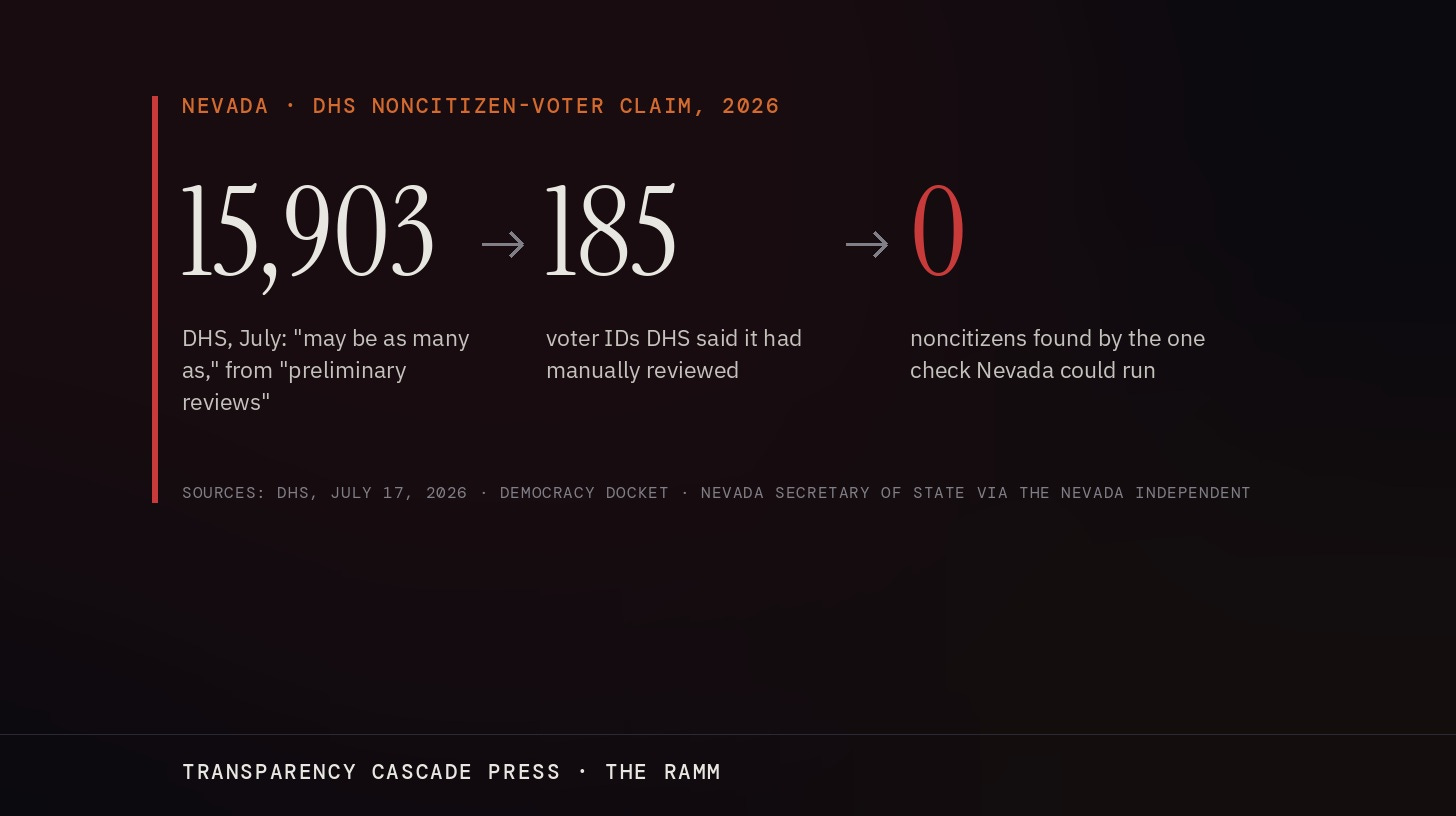
In July, DHS told Nevada there “may be as many as” 15,903 noncitizens on the state’s rolls, from “preliminary reviews.” What it sent was voter ID numbers: 185 DHS said it had manually reviewed, and 6,218 it had not. Nevada says “our records indicate” the 185 were citizens, though with only numbers it can’t be sure it is looking at the same people. DHS calls that account “false” and says it “confirmed 185 are not U.S. Citizens.” The one check Nevada could run found no noncitizens.
Two days before the press conference, the Republican county attorney in Maricopa County, Arizona, finished reviewing 60 voters the federal SAVE database had flagged as potential noncitizens. Fifty-two were citizens.
The Supreme Court’s own opinion knows her only as J. Doe 4.
She is a registered voter in Louisiana. She is a naturalized U.S. citizen. The Social Security Administration’s records — the records SAVE checks her against — do not reflect that she naturalized. That mismatch gave her organization standing. Louisiana isn’t one of the nine surge states; her case is about what SAVE gets wrong, not what happens after.
On September 25, the Supreme Court let SAVE resume checking voters nationwide. The law the Court left standing stops a state from purging its whole voter roll before an election. It does not stop a name, a flag, a referral.
What the Court did
The Court granted a stay in Department of Homeland Security v. League of Women Voters, No. 26A308 — a 6-3, unsigned per curiam order — putting the modified SAVE (Systematic Alien Verification for Entitlements) program back into effect. U.S. District Judge Sparkle Sooknanan had vacated it in June, finding it violated the Social Security Act, the Privacy Act and the Administrative Procedure Act. SAVE was built in 1986 to check immigration status for benefits eligibility; the 2025 modification linked it to the SSA’s master citizenship files and let states run bulk queries by partial Social Security number, not one at a time. The majority found the government likely to win on the merits, reading a 1996 immigration-law provision, 8 U.S.C. § 1373, as displacing the Social Security Act’s confidentiality rule.
Justice Ketanji Brown Jackson dissented, joined by Justices Sotomayor and Kagan: “the harm caused by burdening or disenfranchising even a few lawful voters outweighs the nonexistent harm that the Government experiences when it is prevented from taking an action that it likely lacks the authority to take.” She called the majority’s weighing “the judicial equivalent of expecting a seesaw with weight applied on only one side to work properly.”
The guardrail the Court left standing
The piece I wrote in June — “The SAVE Database at 97%” — has the headline number: DHS cut SAVE’s target accuracy rate from 99 percent to 97. The voters SAVE flags come back wrong far more often: at least 14 percent in Denton County, Texas, 65 of 97 in Travis County by the county’s count, and 52 of 60 in Maricopa. The target and the flag counts measure different things.
The order quotes the National Voter Registration Act, 52 U.S.C. § 20507(c)(2)(A), which requires a state to finish any program “to systematically remove the names of ineligible voters” at least 90 days before a federal election. November 3 is inside that window. The Court says so, and that this limits “the potential impact of staying the District Court’s order in this case.”
The order also says: “all agree that [the District Court’s] order prevents the Federal Government from using the modified SAVE program to conduct individualized inquiries, which are permitted under federal law during this period.” (Emphasis added.) That describes what Judge Sooknanan’s injunction had been blocking — a category of check federal law allows. It is the Court’s own language; it names no field interviews or referrals.
As Democracy Docket noted the day the order came down, that carve-out is close to what a DHS official had already told Nevada’s office, weeks before the ruling: “This is not a systematic process. This is an individualized process.” HSI’s surge is individualized by design: a list of names, worked one at a time. A footnote leaves one boundary open: whether the NVRA bars any citizenship-based removal within 90 days of an election is the question in a companion case set for argument December 8, after this election.
Three days after the order, U.S. District Judge Amir Ali vacated a FEMA rule that held back 20 percent of states’ Homeland Security Grant Program money unless they made a list of election changes, one of them to run “the citizenship of all individuals in the state voter registration database” through SAVE. The conditions, he wrote, “go beyond what Congress authorized.” In the Supreme Court case, Democracy Docket noted, the government had defended SAVE in part as a voluntary tool for states. The Justice Department, which has told courts it plans to run entire state voter lists through SAVE, is 0 for 26, by Democracy Docket’s count, in its suits for states’ unredacted rolls; Georgia’s was dismissed September 30.
The gap has a name, and it is HSI
Homeland Security Investigations is the ICE component ordinarily assigned to narcotics, human trafficking and financial crime. Since September 1, HSI offices in nine states — California, Connecticut, Georgia, Missouri, Nevada, New York, Pennsylvania, Washington and Wisconsin — have been running what CNN reported, citing an internal directive, as a “coordinated criminal voter fraud surge initiative,” through mid-October. Whether it extends, ends or hands off to ordinary casework isn’t disclosed. The guidance CNN reviewed lists field interviews; no source describes what one looks like for the voter.
DHS’s own lawyers told the Supreme Court, in a September 8 stay application citing a declaration sworn July 1, that SAVE has flagged 28,635 people as potential noncitizens since May 2025. DHS says more than 24,000 have been referred to HSI since April 2025 (one count is flags, the other referrals). An earlier, separate DHS claim — more than 250,000 “potential” noncitizens across four states, announced July 17 — was softer in DHS’s own letters to the four states, which called it a “preliminary review” and said only 118,003 of those names fully matched a noncitizen’s name, date of birth, address and Social Security number. Before the surge, ProPublica, as reported by MS NOW, counted 41 alleged noncitizen voters charged from January 2025 through May 2026.
On September 30, Blanche said the Justice Department, working with DHS, had charged more than 90 people with voter-related fraud offenses since Trump returned to office, including 50 noncitizens in the past five weeks.
On September 24, the U.S. attorney for eastern Pennsylvania, a surge state, charged four people in cases HSI investigated, over votes in 2022 and 2024 and a 2026 registration application. The ten Minnesota defendants indicted the same day came from an HSI investigation in a state that is not one of the nine; one is charged over a vote in this August’s primary, the rest over votes or registrations in 2022 and 2024.
Nevada’s slice of the 250,000 came in Mullin’s July letter to Secretary of State Cisco Aguilar. By August, DHS official Kimberley Vogt had written, in an email Democracy Docket’s fuller account reports: “we did not reduce the 15,903 to 185…. We’ve manually reviewed some of the 15,903 and confirmed 185 are not U.S. Citizens.” On September 23, a deputy attorney general in Nevada, Greg Ott, wrote back: “…our records indicate that they were citizens. You have provided nothing of substance to suggest otherwise.” Secretary of State Aguilar said there is not “100 percent certainty that both sides are looking at the same people.” The Times piece, as the Inquirer ran it, was headlined “From 16,000 to 185 to zero: Trump’s claims of illegal voting in Nevada fizzle”. In Pennsylvania, the state’s top election official, Al Schmidt, wrote to Mullin that DHS staff told him they did not have “high confidence” in that state’s 14,576, the Inquirer reported August 26. No reporting found shows California or New Jersey collapsing the same way. Citizens for Responsibility and Ethics in Washington (CREW) has sued DHS for the methodology behind the 250,000: “DHS has declined to disclose its methodology despite election officials in at least three of the four states demanding it.”
On September 8, a whistleblower alleged to Senator Alex Padilla that DHS and USCIS leadership had diverted Fraud Detection and National Security Directorate staff to an “Unlawful Voter Initiative”: hundreds of USCIS officers — a different DHS component from HSI — given lists of names and directed to falsely represent themselves as voters or authorized representatives on state election websites, Virginia among them, under a quota of 40 subjects a day, reviewing tens of thousands including known citizens. A one-page summary from Padilla’s office works the quota out to “roughly 5 per hour or 12 minutes each” and says naturalized citizens falsely flagged “are likely to be referred to Homeland Security Investigations (HSI) for potential criminal investigation.” Democracy Docket reported it on September 14, the same day Padilla and Senate Minority Leader Chuck Schumer went public. This is an allegation, not a finding, and it does not explain Nevada’s zero.
In a notice filed with Judge Sooknanan on September 14, which Democracy Docket reported, DOJ acknowledged DHS had “reactivated” a DHS-SSA data link of the kind the injunction had blocked, using it “to verify information and help determine whether illegal voting may have occurred,” but said the searches were not related to SAVE and did not violate the order. The notice does not address the whistleblower’s allegation of officers posing as voters, the quota, or citizens swept in. A DHS spokesperson called cross-referencing voter rolls against its records “not rocket science.”
Democracy Docket mapped the DHS side earlier: HSI opened a probe into Arizona’s 2020 election in March, first detailed by The Atlantic, and by April, ProPublica reported, an internal group of DHS election-denier appointees called “Team America” had turned to HSI, which, unlike SAVE, can open cases, subpoena records and refer for prosecution. This outlet has documented the same arm’s Operation Keyhole, certified in 2008, which by March 2026 had taken in HSI St. Paul’s two investigations of churches, protest groups and labor unions in Minnesota (government’s supplemental brief, United States v. Sant, No. 0:26-cr-00115, Doc. 263).
The polling place is the third front
On September 1, Mullin said of ICE at polling places: “ICE isn’t there to patrol the polling places … The only reason why we would be at polling places is if there is a threat … or we’re serving a warrant.” Nine days later, LULAC, UnidosUS, Common Cause and the City and County of Denver sued in LULAC v. DHS, No. 1:26-cv-03157 (D.D.C.), invoking 18 U.S.C. § 592 — a 1948 codification of an 1865 statute criminalizing bringing “any troops or armed men” to a federal election. Democracy Docket is tracking the case. Asked under oath whether FBI agents at polling places would be unlawful, Director Kash Patel told Senator Richard Blumenthal: “I don’t know that we can’t legally do it.”
What is not yet real
On August 25, ICE posted a request for information — not a contract, not an award — reported that afternoon by 404 Media and the next day by Democracy Docket, for a vendor to deliver “publicly available voter registration files and voter history files” nationwide on a recurring basis, for HSI’s “fraud detection and data segmentation activities.” A DHS record dated August 31 put the estimated range at $2 million to $5 million, a planning estimate.
The seesaw
The Supreme Court’s order and Justice Jackson’s dissent were arguing about a database.
J. Doe 4 is registered to vote. Her citizenship is real. Her Social Security file doesn’t yet reflect it — and to SAVE, that gap reads as noncitizen status. As of September 25, the system built to act on that reading is running again.
What to watch
The HSI surge: through mid-October. Election Day: November 3.
LULAC v. DHS: no preliminary-injunction motion among the docket entries indexed as of October 1. The government’s answer is due November 10, a week after Election Day.
The NAACP suit: filed September 18 by the NAACP and other groups against DHS, ICE, DOJ and the FBI, under Section 11(b) of the Voting Rights Act. No emergency motion among the docket entries indexed as of October 1.
DSCC v. ICE: filed September 23 by the DSCC, DCCC, DGA, Schumer and Jeffries to keep armed ICE and FBI agents away from polling places; marked related to LULAC and before the same judge; no emergency motion among the docket entries indexed as of October 1.
State law: at least four states bar armed or federal agents near polling places by statute: California (SB 851 and SB 884, which bars most arrests within 200 feet), Connecticut (Public Act 26-42, 250 feet), New Mexico (SB 264) and Rhode Island (ICE, 200 feet).
A DHS “Checklist for Law Enforcement Voter Integrity,” dated a year before this surge, surfaced in the DNC’s FOIA suit. The court ordered DHS to give the DNC any non-exempt portions by September 25. The parties filed a status report October 2; it is not on the free RECAP docket, and nothing from the checklist has been made public.
The ICE voter-file RFI: no contract award on USAspending as of October 1.
The RAMM documents the connections that beat reporting can’t see — sourced events at capturecascade.org.
Free subscribers get every investigation. Paid subscribers get draft chapters of the book and access to the research infrastructure.
Sources
Primary documents: - Department of Homeland Security v. League of Women Voters, No. 26A308, 609 U.S. ___ (2026) (per curiam, Sept. 25, 2026) - Justice Jackson, dissenting, No. 26A308 (same document) - League of Women Voters v. Department of Homeland Security, No. 1:25-cv-3501 (D.D.C.) — underlying summary-judgment ruling (June 22, 2026) - SG’s Stay Application, No. 26A308, filed Sept. 8, 2026 - LULAC v. DHS, complaint, No. 1:26-cv-03157 (D.D.C., filed Sept. 10, 2026) - Democracy Docket case tracker: Denver ICE Agents at Polls Challenge - 18 U.S.C. § 592 - State polling-place presence laws: New Mexico SB 264 (2026), enrolled text; Connecticut Public Act 26-42, § 57; Rhode Island H 7434 (enactment, Ballotpedia); California SB 884 (2026); California SB 851 (2025) - LULAC v. DHS, No. 1:26-cv-03157 (D.D.C.), docket - NAACP v. DHS, No. 1:26-cv-03263 (D.D.C., filed Sept. 18, 2026), docket - NAACP Legal Defense Fund, “Civil rights coalition files federal lawsuit challenging threatened use of ICE and federal law enforcement at polling locations,” Sept. 18, 2026 - Democracy Docket case tracker: Federal Election Interference at the Polls Challenge (NAACP) - DSCC v. U.S. Immigration and Customs Enforcement, No. 1:26-cv-03330 (D.D.C., filed Sept. 23, 2026), docket - Roll Call, “Schumer, Jeffries sue to block federal agents at polls in November,” Sept. 24, 2026 - Democracy Docket, “Democrats sue Trump admin to keep armed agents from polls during midterms” - 52 U.S.C. § 20507(c)(2)(A) (National Voter Registration Act) - Senate Homeland Security and Governmental Affairs Committee, letter to Secretary Markwayne Mullin, Sept. 25, 2026 - Senate Democrats, whistleblower letter to DHS/USCIS, Sept. 13, 2026 - ICE, “Public Voter File Acquisition and Handling,” RFI, SAM.gov, posted Aug. 25, 2026 - USAspending.gov award search, awarding agency U.S. Immigration and Customs Enforcement, keyword “voter”, Aug. 1-Oct. 1, 2026 - DHS, “DHS Secretary Markwayne Mullin Sends Letters to Secretaries of State Warning About Non-Citizens on Voter Rolls,” July 17, 2026 - Republican National Committee v. Mi Familia Vota, No. 25-1017, Supreme Court docket - NAACP v. DHS, complaint, No. 1:26-cv-03263 (D.D.C., filed Sept. 18, 2026) - Metropolitan Government of Nashville and Davidson County v. DHS, No. 1:26-cv-02886 (D.D.C.), Memorandum Opinion, Doc. 42 (Judge Amir H. Ali, Sept. 28, 2026) - DOJ, “Four Aliens Charged With Election Fraud,” Sept. 24, 2026 - DOJ, “Department of Justice Indicts Ten Aliens for Voter Fraud in Minnesota,” Sept. 30, 2026 - Sen. Alex Padilla, “New Whistleblower Uncovers Wrongdoing in DHS: ‘Unlawful Voter Initiative’,” one-page summary, Sept. 14, 2026 - DNC v. DOJ, No. 1:26-cv-00825 (D.D.C.), docket (CourtListener; Doc. 29, Status Report, filed Oct. 2, 2026, PACER only; checked Oct. 3, 2026)
Capture Cascade timeline: - SCOTUS, 6-3, Lifts Block on SAVE Database (Sept. 25, 2026) - Sooknanan Blocks SAVE Voter-Purge Database as Unlawful (June 22, 2026) - DHS Launches HSI Voter-Fraud Surge in Nine States (Sept. 1, 2026) - LULAC, UnidosUS, Common Cause and Denver Sue DHS Over Armed ICE Officers at Polling Places (Sept. 10, 2026) - Patel Refuses Under Oath to Rule Out FBI Agents at Polling Places (Sept. 15, 2026) - Judge Howell Orders ICE to Process 1,000 Pages/Month of Polling-Place FOIA Records (Aug. 22, 2026) - ICE Posts $5M Request for Information to Build Recurring Nationwide Voter-File Acquisition Pipeline (on or around Aug. 25, 2026) - DOJ Sends 29 States and DC Preservation Letters Warning of Criminal Sanctions (Sept. 10, 2026) - New Mexico SB 264 (2026) - Connecticut Public Act 26-42, §57 (2026) - Rhode Island H 7434 (2026) - California SB 884 (2026)
Reporting: - The Supreme Court revives a controversial data system for citizenship checks (NPR, Sept. 25, 2026) - Jackson blasts Supreme Court decision reviving Trump voter-purge database (Democracy Docket, Sept. 25, 2026) - In SAVE ruling, Supreme Court signals path to weaken key protection against last-minute purges (Democracy Docket, Yunior Rivas, Sept. 25, 2026) - Supreme Court revives DHS use of flawed immigration database for voter purges (Democracy Docket, Sept. 25, 2026) - DHS noncitizen voter claims unravel in Nevada as state confirms flagged voters are citizens (Democracy Docket, Yunior Rivas, Sept. 25, 2026) - Homeland Security officers are illegally accessing state voter data, new whistleblower alleges (Democracy Docket, Jacob Knutson, Sept. 14, 2026) - DOJ partially confirms DHS whistleblower allegations in new notice to federal court (Democracy Docket, Jacob Knutson, Sept. 15, 2026) - ICE’s investigative arm is now probing Arizona’s elections (Democracy Docket, Mar. 11, 2026) - Election deniers in Trump admin pushing ‘more powerful tool’ to probe voter rolls, report finds (Democracy Docket, Yunior Rivas, Apr. 13, 2026) - ICE Wants the Country’s Voter Data (404 Media, Joseph Cox, Aug. 25, 2026) — first report of the ICE voter-file RFI - Trump administration seeks private contractor to collect voter files nationwide for fraud detection (Democracy Docket, Yunior Rivas, Aug. 26, 2026) - Kash Patel suggests FBI agents may be at polls (Democracy Docket, Natalie Hausmann, Sept. 15, 2026) - DHS Applauds Supreme Court Decision Permitting Citizenship Verification for Voters (DHS, Sept. 25, 2026) - Secretary Mullin and Attorney General Blanche Hold Press Conference on Recent Voter Fraud Charges Against Non-Citizens in Minnesota (DHS, Oct. 1, 2026) - Supreme Court rules in favor of Trump’s SAVE system, but impact on 2026 election will be limited (Votebeat, Sept. 25, 2026) - Texas, federal officials announce charges against 7 related to noncitizen voting amid Trump administration push (Votebeat, Natalia Contreras, Sept. 15, 2026) - Texas officials confirm that some registered voters flagged as potential noncitizens by SAVE had already provided proof of citizenship (Votebeat, Jul. 30, 2026) - Claims of noncitizens on voter rolls leave states baffled (NPR, Jude Joffe-Block, Jul. 31, 2026) - From 16,000 to 185 to Zero: Trump’s Claims of Illegal Voting in Nevada Fizzle (syndicated from The New York Times, Sept. 24, 2026) - DHS staff lacks ‘high confidence’ in Trump’s claims of noncitizen voters in Pa., Al Schmidt claims in letter to Mullin (The Philadelphia Inquirer, Michelle Baruchman, Aug. 26, 2026) - Padilla, Schumer Announce DHS Whistleblower Report Revealing Trump Administration Directed Officers to Break State Laws in Voter Fraud Hunt (Sept. 14, 2026) - DHS voter probe may break state laws and wrongly implicate US citizens, whistleblower alleges (AP, Ali Swenson, Sept. 14, 2026) - Aggressive DHS hunt for voter fraud only finding a handful of possible noncitizen cases (MS NOW, Sept. 4, 2026) - Exclusive: DHS plans to launch voter fraud investigation surge Tuesday (CNN, Aug. 31, 2026) - DHS ramping up voter fraud investigations ahead of midterm elections: Sources (ABC News, Sept. 3, 2026) - DHS: No plans for ICE to be at polls for midterm elections (NBC News, Sept. 1, 2026) - Patel won’t rule out FBI at the polls on Election Day (Roll Call, Sept. 15, 2026) - Kash Patel clashes with Dems about possibly sending FBI agents to polling places (ABC News, Sept. 15, 2026) - DHS created a ‘law enforcement voter integrity’ checklist, new filing reveals (Democracy Docket, Sept. 21, 2026) - 185 noncitizen voters flagged by Trump admin in Nevada are likely citizens, state says (The Nevada Independent, Eric Neugeboren, Sept. 24, 2026, updated Sept. 25) - Mullin says DHS could deploy to polling sites for ‘specific’ threats, arrests (Politico, Sept. 1, 2026) - ICE tabs millions for analytics help to comb through voter data (FedScoop, Lindsey Wilkinson, Sept. 1, 2026) - Trump’s campaign against noncitizen voting shows it’s rare (AP, via MinnPost, Sept. 30, 2026) - Maricopa County investigated 60 suspected noncitizen voters. 52 are citizens, 8 are not. (Votebeat, Sasha Hupka, Sept. 28, 2026) - Judge strikes down Trump’s bid to cut states’ anti-terror funds unless they impose new voting restrictions (Democracy Docket, Sept. 28, 2026) - DOJ now 0-26 after judge rejects demand for Georgia voter rolls (Democracy Docket, Sept. 30, 2026) - Democracy Docket case tracker: DOJ National Voter Roll Database Challenge - DHS failed to provide records supporting Trump’s allegations of noncitizen voting, watchdog says (Democracy Docket, Sept. 30, 2026) - DHS relaunches voter purge database in 4 red states (Democracy Docket, Jul. 13, 2026)
Related RAMM coverage: - The SAVE Database at 97%: How a 3% Error Rate Could Become Millions of Ignored Votes (June 16, 2026) - Every Database Is an Immigration Database Now (April 1, 2026) - Certified in 2008 for Narcotics. Used in 2026 to Investigate Churches. (Sept. 15, 2026) - A Federal Agent Investigated the Collection Basket at Zion Lutheran in Ann Arbor (Aug. 21, 2026)
Selections are a farce