

On Oct. 27, a parent opened an email from Bluesky and decided it was a scam.
It was not. A federal grand jury in Washington, D.C., wanted to know who ran their account. The subpoena, dated Oct. 20, asked for their name, address, phone and device identifiers, IP addresses and payment information, and for any “History of Account Suspensions or Violations of Terms due to Threatening or Harassing Language.” It named no crime. It named an investigation number: 18.
That parent, Bluesky Poster 1, is the first plaintiff in *Bluesky Poster 1 v. Pirro*, a class action named for Jeanine Pirro, the U.S. Attorney for the District of Columbia. The ACLU filed it under seal on Nov. 16, and the court unsealed it on Nov. 25. The other three plaintiffs are Bluesky Poster 2, a retired prosecutor; the Instagram Poster, a retiree; and the X Poster, a college student whose account, the complaint says, is mostly about soccer.
All four post under pseudonyms. All four have criticized ICE.
Each learned from a platform that a grand jury wanted their name.
Thirty-three subpoenas, one prosecutor
The center of the case is a sworn declaration by Bluesky’s head of legal, filed as Exhibit 33.
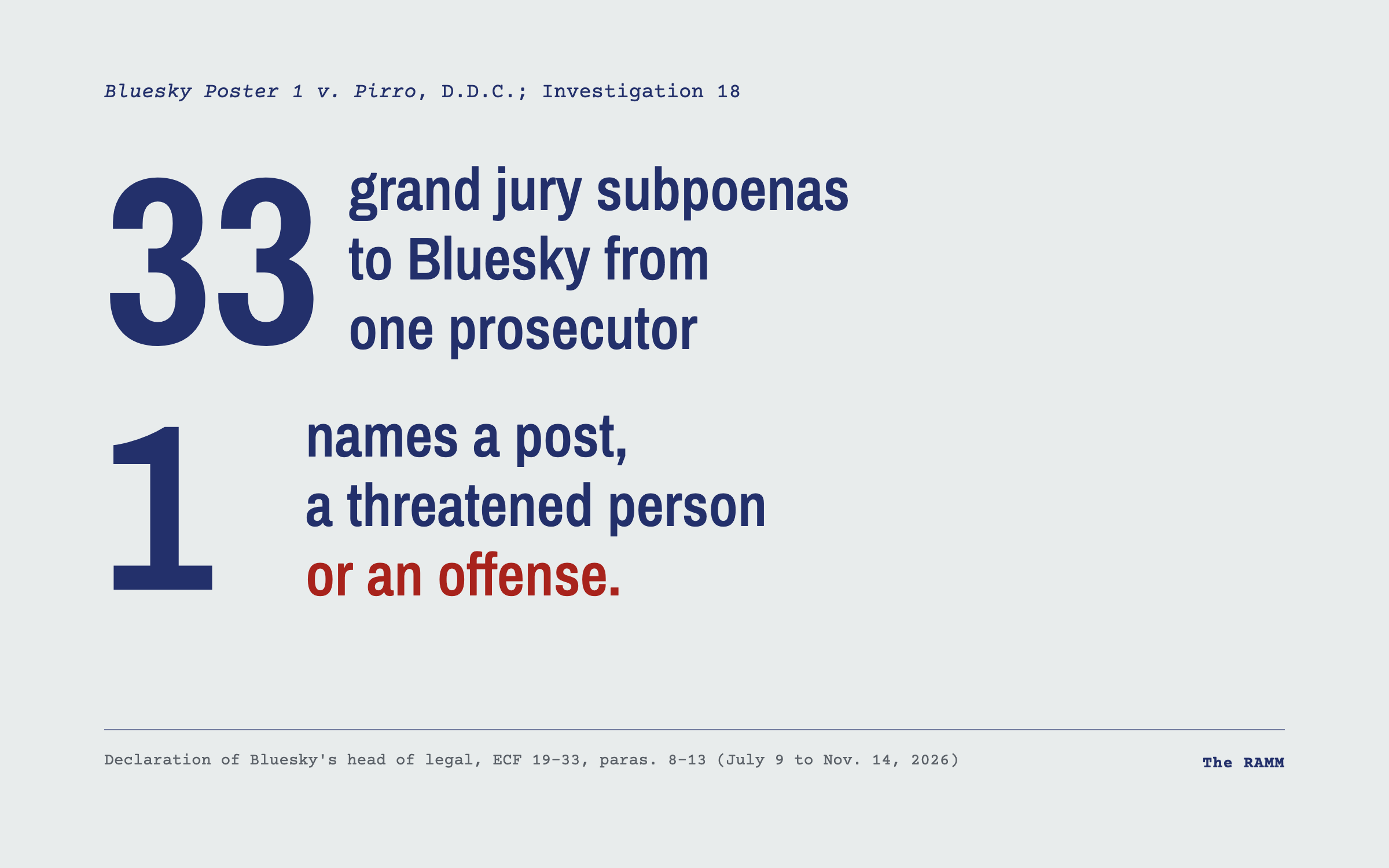
Between July 9 and Nov. 14, 2026, Bluesky received 33 grand jury subpoenas issued on behalf of Grand Jury 26-1 of the U.S. District Court for the District of Columbia. All came from one Special Assistant U.S. Attorney. All carried the same investigation number. Each sought the identity behind one pseudonymous account.
For scale: Bluesky logged 426 subpoenas issued in the United States over 21 months, about 20 a month. These 33 arrived in four months, from one prosecutor, under one investigation number. Fifteen of them arrived on a single day, Oct. 28.
“Each of the GJ 26-1 Subpoenas directs that records be delivered to an agent of the Department of Homeland Security,” the declaration says.
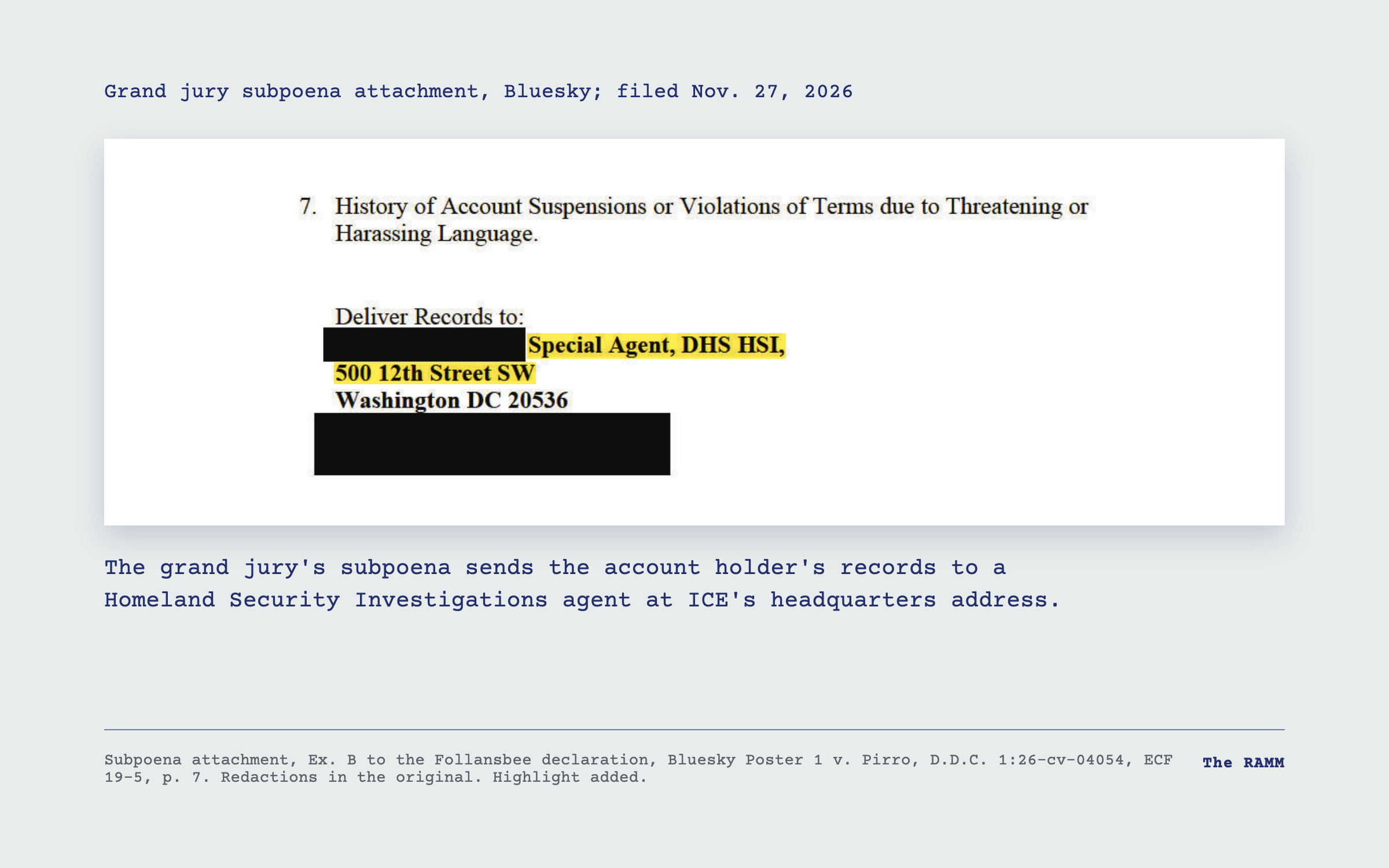
Not to the grand jury. Not to the U.S. Attorney’s Office. The subpoena paperwork for three of the plaintiffs, filed as Exhibits B, D and H, carries the Justice Department’s USA-212 form. Its “Deliver Records To” block reads “Special Agent, DHS HSI, 500 12th Street SW, Washington DC.” That street address is ICE’s headquarters. HSI is Homeland Security Investigations, ICE’s criminal investigative arm, which I have explained before. The agent’s name is redacted.
In 14 of the requests, the submitting agent told Bluesky, the information was needed to determine whether an alleged threat was “credible” or “valid.”
None of the subpoenas came with a nondisclosure order. In five cases, the agents told Bluesky to notify the user, a request Bluesky’s head of legal calls “unusual.” Notice means the account holder learns that a grand jury, and an agent of Homeland Security, want their name.
“Other than 1 subpoena Bluesky received on July 9, 2026,” the declaration continues, “none of the GJ 26-1 Subpoenas names a specific post, identifies any specific person who was threatened, or cites a criminal offense.”
Bluesky produced records on six of them. It has held the other 27. On Nov. 2, its head of legal asked the prosecutor to identify the offense under investigation and to withdraw seven of the subpoenas. As of the declaration, sworn Nov. 15, there was no answer.
A grand jury subpoena goes out under the court’s name. No judge approves it before it goes out.
Thirty-three is one platform’s count, and only the part Bluesky says it can disclose. The complaint puts the floor at “at least 35” Investigation 18 subpoenas, and counsel estimate at least 40 people in the class. The ACLU alleges that the prosecutor who requested many of them is on loan to the U.S. Attorney’s Office from the DHS Office of General Counsel. That is an allegation; the government has not yet filed a word on the merits.
Each subpoena names a date, and the complaint sets out what each plaintiff posted that day. Bluesky Poster 1 called for burning ICE and DHS to the ground. Bluesky Poster 2, the retired prosecutor, wrote of wanting to kill ICE, words the plaintiffs’ preliminary-injunction motion calls figurative. The Instagram Poster likened someone in a video of a baton attack to a rabid dog and wrote that they should be put down, followed by a water-gun emoji. The X Poster, the student, had no posts on the date the subpoena names. Whether any of this is a true threat is a question the government has not yet briefed. The subpoenas do not say.
The threat, as the government has told it
Investigation 18’s subpoenas ask for any history of suspensions for “Threatening or Harassing Language.” Its agents told Bluesky they needed to know whether a threat was “credible.” The premise is an officer under threat. The subpoenas name no threat, so what stands behind them is the government’s word that one exists. One place that word can be checked against a record is the shootings. A shooting is not a post, and an agent’s account of firing in self-defense is not a grand jury subpoena. What the two share is the government’s public claim that its officers are under threat. The shootings show how that claim has held up when it could be checked.
A register of 15 shootings by immigration agents in 2025 and 2026, built from the Capture Cascade timeline and checked against the record, sets the government’s first account beside what came after. Here are seven of the 15:
Ruben Ray Martinez, South Padre Island, Texas, March 15, 2025, killed. DHS said he “intentionally ran over” an agent. Bodycam video obtained by CBS News shows his car stationary or moving very slowly when he was shot. A Cameron County grand jury declined to indict the agent.
Silverio Villegas Gonzalez, Franklin Park, Ill., Sept. 12, 2025, killed. DHS said an agent was “seriously injured” after being “dragged a significant distance.” On police bodycam, the agent and his partner each say “Nothing major.”
Marimar Martinez, Chicago, Oct. 4, 2025, shot several times, survived. DHS called her a “domestic terrorist” who had “ambushed” agents. The charges against her were dismissed with prejudice on Nov. 20, 2025.
Renee Nicole Good, Minneapolis, Jan. 7, 2026, killed. DHS said she “weaponized her vehicle”; Secretary Kristi Noem called it “an act of domestic terrorism.” The agent has not been charged.
Julio Sosa-Celis, Minneapolis, Jan. 14, 2026, shot in the leg. DHS said he and another man attacked an officer “with a snow shovel and broom handle” and that the officer fired while “being ambushed.” Prosecutors dismissed the case against Sosa-Celis with prejudice, citing new evidence “materially inconsistent” with their complaint. The officer now faces state assault charges and a federal indictment for making false statements; he has pleaded not guilty to the federal charges.
Alex Pretti, Minneapolis, Jan. 24, 2026, killed. Secretary Noem said he “committed an act of domestic terrorism”; Stephen Miller called him a “would-be assassin.” CNN reported that video soon showed Pretti “was swarmed by law enforcement and disarmed before he was fatally shot”.
Lorenzo Salgado Araujo, Houston, July 7, 2026, killed. ICE said he “weaponized his vehicle” to run over an officer. The officers wore no body cameras. The medical examiner ruled the death a homicide.
Those are seven. Across all 15 rows, no court, medical examiner or independent investigator has confirmed the government’s first account. In two, Marimar Martinez and Sosa-Celis, the government’s own evidence or its prosecutors’ conduct contradicted it. In two more, video or witnesses contradicted it, with nothing adjudicated. Four are contested and unadjudicated. Seven have not been tested at all.
“Weaponized.” “Ran over.” “Ambushed.” “Domestic terrorist.” The same words recur across agencies and months, and in each of these first accounts the officer is the one under threat. Investigation 18 rests on that premise. By Bluesky’s sworn declaration, other than one subpoena, none of the 33 names a post, a threatened person or an offense.
The premise as policy
On Sept. 25, 2025, the president signed National Security Presidential Memorandum 7, on “countering domestic terrorism and organized political violence.” It describes campaigns that “escalate to organized doxing”, and it names the doxing of ICE agents in Los Angeles.
On Dec. 4, Attorney General Pam Bondi’s implementing memo told the FBI to investigate five years of “potential acts of domestic terrorism, including ... doxing of law enforcement, coordinated interference with federal employees in agencies such as DOJ and the Department of Homeland Security.”
Two months later, HSI’s St. Paul office opened Project Whipple Shield. Its case-opening report says: “In accordance with National Security Presidential Memorandum–7 (NSPM-7), Homeland Security Investigations (HSI) St. Paul has opened an investigation” into “intimidation of federal officers and employees, and attempts to impede federal operations.” A June incident report from the same case carries ten program codes, among them “DOX - Doxing,” “IE1 - ICE Employee Threats,” “NS7 - NSPM-7” and “CUC OP KEYHOLE,” the code for Keyhole, an undercover program HSI St. Paul first certified in 2008. A second HSI St. Paul investigation, Operation Puppet Master, was accepted under Keyhole in January. When a church synod sued over federal agents at houses of worship, the government cited NSPM-7 as HSI’s authority.
Whipple Shield’s report says its work began “in December,” before an agent shot Renee Good in Minneapolis on Jan. 7. The surveillance started before the killings.
What “doxing” has meant in practice
In January, after the Minnesota Star Tribune identified Jonathan Ross as the agent who shot Renee Good, people repeated his name.
Paigelynne Gonyea, a Syracuse poll worker, shared the newspaper’s identification on Instagram with one line: “I think today is a great day for Jonathan to be indicted.” In June, two federal agents found her at her polling place with a warning notice from ICE’s Office of Professional Responsibility, the internal-affairs office. An HSI agent’s voicemail told her she had “doxxed an ICE agent back in January,” NPR’s Jude Joffe-Block reported. I told that story in June. A second recipient, served the same day in Rochester, sued, and a judge vacated his notice while the case proceeds.
A Reddit user known as Tired_Thumb drew a DHS summons in February for posts that, according to the motion to quash, mentioned states and a city where the agent who shot Good had lived, places already reported by news outlets. An X user called podslurp, who is not a plaintiff but whom the complaint cites as background, drew one for posting what the complaint calls “address information that was circulating widely on social media at the time.”
In January, DHS condemned a website called ICE List for publishing agents’ names, data that WIRED found came mostly from agents’ own LinkedIn pages. Within days, border czar Tom Homan went on Fox News. The segment’s title: “Homan pushes to create ‘database’ to make those who impede ICE ‘famous.’” The ACLU’s complaint quotes him describing the aim as to “let their employers, in their neighborhoods, in their schools, know who these people are.” What ICE’s own filings show about its database layer is in “A Nice Little Database,” from October. On Jan. 26, DHS warned that “if you lay a hand on a law enforcement officer or dox our officers, you will be prosecuted to the fullest extent of the law.” On Oct. 1, the Justice Department sued Maryland to block state laws requiring federal agents to show their faces and identification. I have written about the mask law Washington State already has.
The machinery
Before the grand jury, DHS used its own paper.
Starting in September 2025, DHS sent administrative subpoenas and customs summonses to Meta, Google, Reddit and X for the identities of accounts critical of ICE. Some cited an immigration statute. Others cited 19 U.S.C. § 1509, a customs statute I traced in November. The New York Times reported in February that DHS had sent hundreds of administrative subpoenas to Google, Reddit, Discord and Meta.
Users challenged six of those demands in court. A subpoena to Meta, fought in three dockets, and two customs summonses to Meta were withdrawn on the court record, as was a summons to Reddit for the account Tired_Thumb. A demand to Google ended the same way, by the complaint’s account. None of the five reached a ruling on whether it was lawful. The sixth, against X, has been stayed since July.
The clearest moment came on Jan. 14, 2026, in a San Francisco courtroom. Two HSI summonses to Meta sought the identity behind a Pennsylvania account. DHS’s lawyer described the case as one that “involves threats to officers” and stated the agency’s position: it is “within their power to investigate threats to its own officers or impediments to their officers.” The magistrate judge asked whether any Supreme Court or Ninth Circuit authority supported that position. “Not that I know off the top of my head,” she said. Any authority in the district? “Not that I know.” She also called review of the account’s posts “a red herring.” Two days later, DHS emailed Meta withdrawing both summonses.
A summons from the Office of Professional Responsibility, according to the case caption, sought Tired_Thumb’s identity in February. The user moved to quash in March. An assistant U.S. attorney wrote on March 27 that DHS was rescinding it, and the user dismissed the case. On March 31, The Intercept reported, a grand jury subpoena from prosecutors in Washington reached Reddit for the same account. The user’s lawyers moved to quash it. According to the Civil Liberties Defense Center, Chief Judge James Boasberg, the judge now presiding over the class action, denied the motion in June. The appeal is pending in the D.C. Circuit. Bloomberg Law’s Jenkins and Tillman reported in May that X’s summons followed the same path to a grand jury subpoena. X’s withdrawal does not appear in the court record.
ICE’s Office of Professional Responsibility (OPR), which issued the Reddit summons, has bought online threat monitoring since 2020, from Barbaricum LLC until September 2025. Then the work moved to a new vendor, Amivero LLC, under an order whose description names OPR. Obligations on it stand at $5.78 million, of an $8.19 million value with options. The funding office on the record is an HSI division; within a month, the order’s modifications named the HSI Office of Intelligence as the customer. The Wall Street Journal’s Critchfield and Shifflett reported that OPR brought in HSI’s intelligence office because the volume was too high for OPR alone. OPR’s own count, sworn in a Massachusetts case: 131 cases of “doxxing and threats directed towards ICE employees nationwide” between January 2025 and March 2026, 85 of doxing and 46 of threats.
No public document connects Investigation 18 to Whipple Shield or Puppet Master by case number, office or program code. What they share on paper is the agency, HSI, and the premise: an officer under threat.
The model, and the record
The Minnesota records, which I have reported on since August, show what HSI built when it went looking.
Whipple Shield set its priority as “the identification of funding sources, organizational structures, and predicate actions.” A chart in the case file, headed “HOMELAND SECURITY INVESTIGATIONS / The Conspiracy,” puts one Minneapolis group at the hub and 18 organizations on the spokes, each labeled “Council Member.”
The method traveled. HSI Chicago’s report on an April 2 stop of a speaking tour called “Breaking the ICE” is titled “Antifa Roadshow.” Its plan was to send an undercover agent with “the goal of meeting people in the network, identifying people related to HSI Saint Paul Minnesota’s case” and to obtain “video and audio recordings of the event.” An agent got a duty prosecutor’s concurrence for electronic surveillance. Agents logged about 219 vehicles parked near the venue.
Leaders. Funders. Councils. A hub. That is the shape of the thing the Minnesota investigations were built to find.
The spread the reporting records looks different. Los Angeles residents began using whistles to warn neighbors when raids reached the city in June 2025, a Democratic Socialists of America organizer there told the Guardian, and Chicago organizers learned the tactic “in part” from Los Angeles groups. Indivisible Chicago mailed whistle kits, with instructions, to the New Orleans chapter after an unsolicited message on Instagram; the Guardian reported that national leadership did not orchestrate it. A New York street-vendor group hands out whistle kits “based on advice from colleagues in Chicago.” Protesters at a hotel in Medford, Mass., told TIME they were inspired by hotel protests in Chicago and Detroit. Writing from Chicago’s Little Village in November, the Los Angeles Times columnist Gustavo Arellano said of Southern California, “But we don’t have the whistles.”
The chill, and the cases
The complaint alleges that the plaintiffs changed what they say once the notices arrived. Bluesky Poster 1, Bluesky Poster 2, the Instagram Poster, the X Poster, “and other similarly situated individuals have been self-censoring on social media out of fear that any criticism of the Administration that they post will be used as reason to unmask their identities.” That is an allegation; the government has not yet responded to it.
In Minnesota, the cases are thinning. Of 17 federal dockets from the surge that I read in court records (a sample, weighted toward cases with motions to dismiss), eight have been dismissed, some with prejudice. None has ended in a conviction. Minnesota Public Radio counted more than a third of protester charges dismissed by May. The one network case, United States v. Sant, charges 15 people with conspiracy. Neither the indictment nor the superseding indictment charges anyone with leading, organizing or financing the group, and neither alleges an outside funder. The superseding indictment quotes the group calling itself “a decentralized coalition of working-class people.” Two defendants are quoted: one said “we adopt this horizontal power structure”; the other spoke of communication between independent groups “without any centralized leadership.” Beyond the conspiracy count, four defendants face individual charges. Two are charged with stalking for following officers’ vehicles from the Whipple Building into Wisconsin, and one of them also for knocking an agent’s notebook to the ground and kicking a government vehicle. A third is charged with assaulting an officer by driving into a government vehicle; a fourth, with solicitation and threats over Instagram videos posted the day Pretti was shot. The docket records not-guilty pleas at the arraignments, and none has gone to trial.
What comes next
The government’s opposition to the preliminary injunction is due Dec. 14. It will be the government’s first account, in a court, of what Investigation 18 is investigating, who supervises it, and why the records go to ICE headquarters. The ACLU’s reply is due Dec. 28. Chief Judge Boasberg will hear the motion on Jan. 6, 2027, at 11 a.m.
Bluesky’s deadline on the pending subpoenas comes first. On Nov. 2, Bluesky asked the prosecutor for more time, and the prosecutor granted it the same day, to Dec. 11, three days before the government’s opposition is due. Nothing in the public record says whether production will wait for a ruling on the injunction. One of the pending subpoenas is for the parent who thought the email was a scam.
The RAMM documents the connections that beat reporting can’t see -- sourced events at capturecascade.org.
Free subscribers get every investigation.
Before we continue, one quick ask.
A single raid is a headline. The pipeline behind it is a story nobody’s funding.
At The RAMM I connect the dots that don’t fit in one article: the federal contracts, the 287(g) deals, the quiet real-estate moves, the county-by-county buildout of detention capacity.
The receipts:
4,776+ sourced events at CaptureCascade.org
1,988 counties with signals of detention expansion at detention-pipeline
129 community fights over detention capacity, tracked
This is self-funded. Subscriptions are the only thing that keeps it alive
Sources
Court records: Investigation 18 (D.D.C. 1:26-cv-04054)
Docket, Bluesky Poster 1 v. Pirro (RECAP; Nov. 24 and Nov. 25, 2026 minute orders)
Plaintiffs’ redacted public filings went on the docket Nov. 27, 2026, as ECF 19 and its exhibits.
Subpoena paperwork, USA-212 forms: Ex. B, ECF 19-5; Ex. D, ECF 19-7; Ex. H, ECF 19-11
Court records: DHS summonses and the grand jury follow-on
Hearing transcript, Jan. 14, 2026, J. Doe v. DHS, N.D. Cal. 3:25-mc-80325, ECF 35
ACLU of D.C., In re Sealed Case (Grand Jury subpoena 26-GJ-00022)
Civil Liberties Defense Center, statement on the D.D.C. ruling (June 17, 2026)
Court records: the Minnesota HSI cases (United States v. Sant, D. Minn. 0:26-cr-00115)
Whipple Shield incident report with program codes, Doc. 231-12
Government opposition, New England Synod v. DHS, D. Mass., ECF 125
Other court records
Government documents and records
USAspending, Barbaricum LLC contract 70CMSW20C00000001 (the 2020 predecessor contract)
Primary Timeline Events
Whipple Shield incident report program codes (June 15, 2026)
DHS § 1509 summonses to journalists, unions, nonprofits (Aug. 29, 2026)
DOJ sues Maryland over agent mask and ID laws (Oct. 1, 2026)
Reporting
The DOJ wants to know who on Reddit and X is criticizing ICE’s tactics (Bloomberg Law, Jenkins and Tillman, May 28, 2026, syndicated)
Reddit grand jury subpoena (The Intercept, Apr. 10, 2026)
How ICE is weaponizing social media against its critics (Wall Street Journal, Critchfield and Shifflett, Aug. 2026, syndicated)
Gonyea and the HSI voicemail (NPR, Jude Joffe-Block, June 26, 2026)
ICE agents are doxing themselves (WIRED, Jan. 22, 2026)
Homan pushes to create ‘database’ (Fox News, Jan. 16, 2026)
Franklin Park bodycam (WBEZ, Sept. 23, 2025)
Marimar Martinez case (CNN, Nov. 21, 2025)
DHS on Renee Good (NOTUS); What is domestic terrorism? (CBS Minnesota)
Noem and Miller on Pretti (CNN, Jan. 27, 2026)
Houston shooting (Reuters via KSL, July 2026)
Ruben Ray Martinez bodycam (CBS News)
Whistles spread from city to city (The Guardian, Dec. 16, 2025)
‘No Sleep for ICE’ hotel protests (TIME, Dec. 2025, archived)
Arellano from Little Village (Los Angeles Times, Nov. 9, 2025)
Feds dismiss third of ICE protester charges (MPR News, May 6, 2026)
Earlier at The RAMM
No Warrant Required: How a Social Media Post Becomes a Federal Threat (June 27, 2026)
What is Homeland Security Investigations? (Oct. 19, 2026)
‘A Nice Little Database’: What ICE’s Own Filings Show (Oct. 30, 2026)
The Customs Statute Being Deployed Against Labor Unions and Nonprofits (Nov. 12, 2026)
A Federal Agent Investigated the Collection Basket at Zion Lutheran in Ann Arbor (Aug. 21, 2026)
The Surveillance Started Before the Killings (Aug. 26, 2026)
Certified in 2008 for Narcotics. Used in 2026 to Investigate Churches. (Sept. 15, 2026)
HSI Watched a Church Meeting in March. Its Report Was Entered in August. (Oct. 19, 2026)
The Mask Law Washington Already Has (Nov. 22, 2026)
This is incredible! Thank you for this thorough reporting!!! STAY LOUD, AMERICA!! Speak up and out.
Any "crime" of "doxxing" should not apply to law enforcement officers. They are supposed to be protecting people, citizens or not, not attacking them.