

No Warrant Required: How a Social Media Post Becomes a Federal Threat
A poll worker in Syracuse posted that the agent who killed Renée Good should be indicted. Five months later, two federal agents arrived with a dossier — and the word terrorism aimed the wrong way
On the morning of June 23, while she was checking in voters at the Central Library on South Salina Street in Syracuse, two federal agents came to find Paigelynne Gonyea. It was primary election day in New York. She was working the polls. The agents carried a file on her: her name, her address, her date of birth, her height, her weight, the color of her eyes. They handed her a form letter from Immigration and Customs Enforcement’s Office of Professional Responsibility — ICE’s internal-affairs unit, the office whose mandate is to investigate agent misconduct. In capital letters it told her she “MAY BE IN VIOLATION OF FEDERAL LAW.” If she did not take down her Instagram account, the letter warned, she could face “both federal and state prosecution.”

She had not threatened anyone. She had not done anything that morning except hand people ballots. The agents were there because of a sentence she had typed into a phone five months earlier.
She refused to sign. She did not delete the post. “For ICE to come to me over a social media post,” she told reporters afterward, “just feels very 1984 to me.”
Hold the scene in your head, because everything that follows is in it. On one side, a woman with an Instagram account. On the other, two armed agents of the federal government, a manila folder of her physical particulars, and a letter that names the prison. Three powers are in that room: the power of the badge, the power of the gun, and the power of the prison. That is not a balanced encounter.
What she actually posted
Back up to January. On the 7th, an ICE agent shot and killed Renée Nicole Good, 37, a poet and mother of three, in a residential Minneapolis street during Operation Metro Surge — the federal immigration-enforcement surge into Minneapolis that began that month. She was sitting in her Honda Pilot. Video showed her turning the wheel away from the agent in the seconds before he fired at least three times. Her last words, spoken calmly: “That’s fine, dude. I’m not mad at you.” (The RAMM covered the killing and its aftermath at length — the incident breakdown, and the pipeline that put that agent on that street.)
The next day the Minnesota Star Tribune identified the agent as Jonathan Ross. Gonyea shared that identification on Instagram and added one line: “I think today is a great day for Jonathan to be indicted.”
That is the entire predicate. Read it again. It cites a tier-one newspaper for the agent’s name. It calls for an indictment — a legal process, a grand jury, due process of law. It is the thing the Constitution was written to protect: a citizen petitioning, in public, for the government to hold one of its own to account.
Ross has not been charged. He has not been investigated. Within a day of the shooting the FBI revoked Minnesota’s state investigators’ access to the evidence and the state probe collapsed; six federal prosecutors later resigned rather than do what the Justice Department asked, which was to investigate Good’s widow instead of the man who killed her. Calling for Ross’s indictment was not a fringe demand. It was the demand a functioning justice system would have met on its own.
Five months later, that sentence was the reason two agents could assemble Gonyea’s home address and walk into her workplace.
The pretext database
Her Instagram was not evidence of a crime. It was a search term.
To see how a public post becomes a target, you have to look at the directive sitting underneath the whole apparatus. On September 25, 2025, the President signed National Security Presidential Memorandum 7, “Countering Domestic Terrorism and Organized Political Violence.” For the first time in American history, a federal directive names beliefs — not acts — as indicators of terrorism: anti-capitalism, anti-Christianity, “anti-Americanism,” “extremism on migration.” The Brennan Center found it “ungrounded in fact and law,” citing no statute and no constitutional provision. It does not mention the First Amendment at all.
On December 4, Attorney General Pam Bondi issued the memo that turned the directive into operations. It ordered the FBI to compile lists of targeted groups, to run a five-year retroactive review of its own files, to stand up a cash-reward system for citizen informants, and to instruct prosecutors to charge “the most serious, readily provable offenses” — conspiracy, RICO, material support for terrorism. The Joint Terrorism Task Forces were told to map “the full network of culpable actors.”
The directive defines the beliefs. The memo builds the machine that hunts for them. What it does not supply — what it cannot supply, because beliefs are not crimes — is evidence. So the apparatus needs something to search. It needs a place where a citizen’s opinions, movements, associations, and physical particulars already sit, indexed and retrievable.
That place is your digitized life. It is the same material a poll worker’s Instagram is made of. The post is not proof of a threat. It is the index entry that lets the machine find you and decide, after the fact, what to call you.
The notice accuses itself
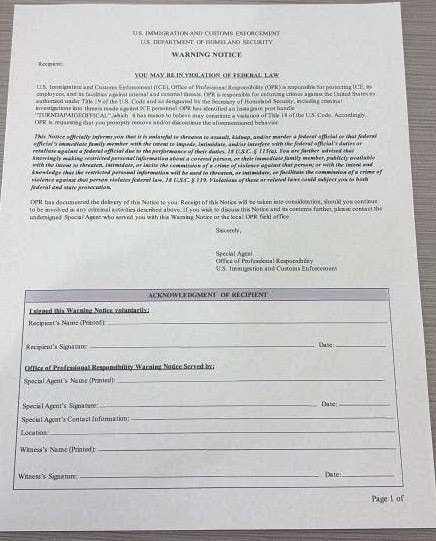
Gonyea posted the notice she was handed, so we don’t have to rely on anyone’s paraphrase. It runs on ICE letterhead, headed in bold: YOU MAY BE IN VIOLATION OF FEDERAL LAW. It says the agency’s Office of Professional Responsibility “has identified an Instagram post handle, ‘TURNDAPAIGE OFFICIAL’” — her account, the one carrying the indictment post — “which it has reason to believe may constitute a violation of Title 18.” It requires that she “promptly remove and/or discontinue the aforementioned behavior.” And it adds, in the flat language of a form, that “receipt of this Notice will be taken into consideration, should you continue.”
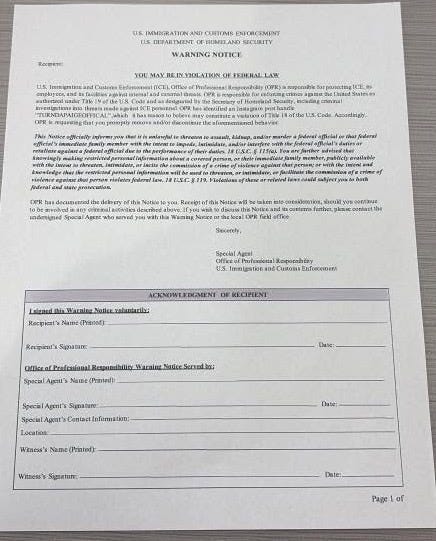
Read that last line again. The notice does not allege a completed crime. It demands she take down constitutionally protected speech, and it warns that whatever she says next will be counted against her. That is not law enforcement. It is a record that her future speech is now on file — the pre-crime logic of NSPM-7, reduced to a single page with a signature line.
Then comes the part worth holding up to the light. The notice warns her against two federal crimes. One is threatening to assault, kidnap, or murder a federal official. The other — and here the document accuses itself — is the federal anti-doxxing law: knowingly making a person’s “restricted personal information” public in order to threaten or intimidate them. ICE served that warning on a woman by handing her a folder that held her name, her home address, her date of birth, her height, her weight, and the color of her eyes. The agents who came to accuse her of exposing someone’s private particulars arrived with a dossier of hers. They cited the law against doxxing while doing the doxxing.
And neither crime is hers. To threaten under the first statute, you have to make a threat; she asked for a grand jury. To violate the doxxing law, you have to publish someone else’s private information to facilitate violence; she shared a newspaper’s identification of a public official and called for him to be indicted. The Department of Homeland Security later told NPR that she had “committed a federal crime by publishing an ICE officer’s address online.” Her post contained no address. The accusation was not a description of what she did. It was a reason, assembled after the decision to come for her had already been made. The law cited does not fit — because the law cited was never really the charge. The charge was the opinion.
The loophole that makes the database theirs
Here is the part that should change how you think about the phone in your pocket.
On March 18, 2026, FBI Director Kash Patel testified under oath before the Senate Select Committee on Intelligence. Senator Ron Wyden asked him a direct question: “Can you commit to not buying Americans’ location data?”
Patel would not. “The FBI uses all tools, Senator,” he answered, “thank you for the question, to do our mission.” Pressed on the practice itself, he confirmed it: “We do purchase commercially available information that’s consistent with the Constitution and the laws under the Electronic Communications Privacy Act.”
Set that beside what the FBI told Congress three years earlier. In 2023, then-Director Christopher Wray testified that the Bureau had bought location data in the past but, “to my knowledge, we do not currently purchase commercial database information that includes location data derived from internet advertising.” Two directors, the same question, opposite answers. In 2023 the Bureau implied it had stopped. In 2026 its Director confirmed, on the record, that it buys.
The reason this is legal is a single gap in the law. In Carpenter v. United States (2018), the Supreme Court held that the government needs a warrant to compel long stretches of your location data from your phone carrier. But Carpenter says nothing about what the government may buy. So the agencies buy. Your location, your movements, the bed-down address where your phone sleeps every night — all of it is for sale on the open commercial market to anyone with a credit card, the federal government included. Wyden has a name for it: “an outrageous end-run around the Fourth Amendment.”
This is the same market that already produced one body. As the field guide laid out, the man who assassinated Minnesota House Speaker Melissa Hortman and her husband in their home had, in his car, a notebook listing eleven commercial people-search sites annotated by cost, and beside Hortman’s name, her home address. He bought the door. The brokers did not pull the trigger; they sold him the coordinates. The FBI shops in the same aisle, without a warrant. Gonyea’s dossier — the height, the weight, the address — is the retail version of the same product.
The asymmetry, and the word for it
The terror in this story is not the post. It is the badge.
A poll worker called, in public, for a legal process — and armed agents of the state arrived at her job with her physical description and the threat of prison. The threat is the point. The domestic-terrorism designation is not being used here to describe anyone’s conduct; it is being used as a weapon, and the weapon is the implied power to make a person disappear into the federal system for the crime of having an opinion. That is what terror, precisely, is: the use of force, or the threat of it, to coerce a population into silence. By that definition, the apparatus in this story has the word exactly backwards. It has named the dissenter the threat while functioning as the thing it claims to hunt.
The third power in the room — the power of the prison — is not theoretical.
The carceral proof arrived the same day Gonyea got her letter. On June 23, a federal judge in Texas sentenced the defendants from the July 4, 2025 protest at the Prairieland ICE detention center. Benjamin Song, the only one convicted of attempted murder, got 100 years. Maricela Rueda got 70. Five others — including a woman tied to an anarchist book club — got 50 years each. And Daniel Sanchez Estrada, who was not present at the protest, got 30 years for moving a box of antifascist zines after the fact: a conviction for concealing documents, not for terrorism, not for violence. These sentences are longer than any handed down to a January 6 defendant who stormed the Capitol. The antifa-terrorism framing that produced them was applied retroactively, after the protest, to upgrade ordinary charges. (As the investigative reporter Ken Klippenstein has argued of this apparatus, the logic is pre-crime — the government acting on what people might do, defined by what they believe. The indictments are public record; the pre-crime reading is his analysis, and a sound one.)
Thirty years for a box of zines is the answer to anyone who thinks the letter handed to Gonyea was an empty gesture. The designation is not a description. It is the threshold of a prison, and the state has shown exactly how far past that threshold it is willing to go.
The data-broker market that armed Gonyea’s dossier remains unregulated. No federal action against the brokers. The Fourth Amendment Is Not for Sale Act, which would require a warrant before agencies buy your data, passed the House in 2024 and died in the Senate; Wyden’s Government Surveillance Reform Act would do the same and is sitting, unmoved, in committee. The asymmetry is not an accident of enforcement. It runs in one direction because it was built to.
Back to the field guide, harder
The field guide told you to shrink your footprint — opt out of the brokers, switch your tools, make yourself expensive to surveil. Some readers took that as privacy hygiene, a tidy habit like flossing.
It is not hygiene. The footprint is the pretext database. The beliefs that count as a threat have already been written down, signed, and distributed across ten agencies. The market that sells your coordinates already operates without a warrant. The sentences that prove the threat is real have already been handed out, in years, to people who moved a box.
Gonyea did the one thing that still works: she refused. She did not sign, she did not delete, and she said the word 1984 out loud, on the record, so the rest of us could see the shape of the thing. The tools in the field guide buy you a little of the room she stood in. Use them — not because privacy is comfortable, but because, under a government that has made a public opinion into a search term, the footprint you leave is the file they open when they decide it is your turn.
Gonyea refused to sign.
This publication refuses to stop.
Subscriptions are how that stays true.
Sources
ICE OPR “Warning Notice” (full text): published by Gonyea on her GoFundMe and Instagram; reviewed by The RAMM. Substance corroborated by the Syracuse.com / NPR / Common Dreams reporting above; the §115(a)/§119 statutory citations appear in the document she published (the doxxing/threat substance is confirmed by reporting; outlets did not print the section numbers).
Paigelynne Gonyea, Syracuse confrontation: “She posted about ICE. Five months later, DHS agents told her to take her post down” (NPR, June 26, 2026); “ICE agents confront New York poll worker during voting” (Democracy Docket); “‘Feels Very 1984’: ICE Agents Push Poll Worker to Delete Post” (Common Dreams) — letter wording, ICE OPR, Central Library, Instagram caption.
Patel testimony, Wyden question, Wray 2023 reversal, Government Surveillance Reform Act: “FBI is buying location data to track US citizens” (TechCrunch, March 18, 2026); corroborated by Gizmodo and the Washington Times (March 19, 2026); see also NPR (March 25, 2026).
Renée Good killing and the Jonathan Ross identification: ABC News and The Guardian (Jan. 9, 2026); NPR on the prosecutor resignations (Jan. 13, 2026); the Minnesota Star Tribune agent identification.
Prairieland sentencing (corrected canonical figures): “Prairieland Texas ICE protest prison sentences” (The Intercept, June 23, 2026); “Alleged antifa members in Texas get maximum sentences” (Washington Post); Al Jazeera.
NSPM-7 and the Bondi implementation memo: “Countering Domestic Terrorism and Organized Political Violence” (White House, Sept. 25, 2025); ACLU and the Brennan Center analyses; Democracy Now / Ken Klippenstein on the leaked memo (Dec. 8, 2025); Arnold & Porter, “DOJ Issues Sweeping New Domestic Terrorism Directive.”
Carpenter v. United States, 585 U.S. 296 (2018); Fourth Amendment Is Not for Sale Act (H.R. 4639), Brennan Center, “Closing the Data Broker Loophole.”
Companion piece: “Make Yourself Expensive: A Field Guide to Shrinking Your Data Footprint” (The RAMM, June 24, 2026).
A citizen says an agent should be indicted, and suddenly the federal government shows up with her height, weight, eye color, address, and a letter that smells like authoritarian cologne. That is not public safety. That is the state tapping the microphone and reminding everyone the cage has paperwork. The chilling part is not that she had an opinion. It is that the machine treated her opinion like a search warrant without needing one.
Sadly, we are very close to being an authoritarian country. Horrible.