

On December 3, 2025, an undercover Homeland Security agent logged into a virtual training on how to document ICE activity. It was publicly advertised on social media. The agent watched, took notes, and concluded in writing that there “do not appear to be violations relating to 18 USC 111” — the federal statute for assaulting or impeding a federal officer — “or threats to public safety.”
Renee Good was killed by an ICE agent on January 7. Alex Pretti was killed by Border Patrol agents on January 24. Operation Puppet Master — the investigation everyone has been reading about for the past two weeks — did not open until January 28.
The surveillance came first. Five weeks before the first death, Homeland Security Investigations — HSI, the investigative arm of Immigration and Customs Enforcement — already had an agent inside meetings in St. Paul, and the government’s own reports say so.
Last week a defense attorney in Minneapolis moved to unseal discovery in a federal conspiracy case, and thirty-one exhibits went onto the public docket. The coverage since has been about what is inside them: federal agents in church sanctuaries, warrantless summonses against national unions, an org chart of nonprofits drawn under the Homeland Security seal.


That coverage is right. But it has the scale wrong and the sequence wrong. The evidence leads to clues that this started earlier and is more widespread than previously reported.
Puppet Master is not the program. It is one investigation inside a program. The case-opening report says so, on the last page, directly above “The investigation continues”:
“This case has also been accepted under CUC Op Keyhole.”
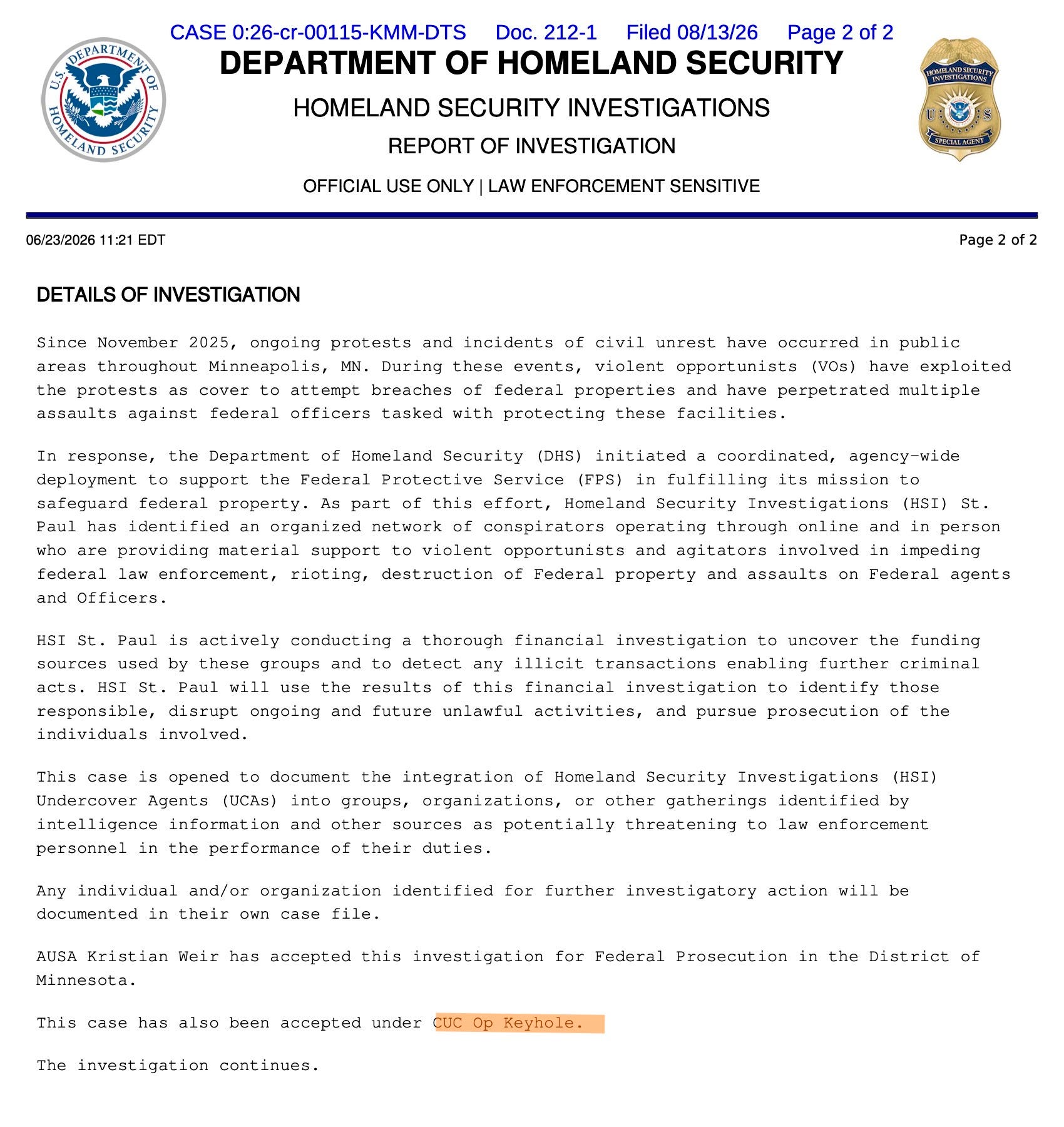
CUC stands for Certified Undercover Operation. Anthony Kimery reported that designation at Biometric Update on August 20, and Talking Points Memo followed on the exemption angle: CUC authorities are the tools built for drug cartels and money laundering — shell companies, fake bank accounts, covert identities — pointed at people who went to meetings.
So the name is out. What has not been reported is what the name is attached to, when it started, and the case number the pre-killing surveillance was actually filed under.
What “CUC” means
CUC is ICE terminology for a Certified Undercover Operation. It is not a case. It is a framework that cases are placed inside.
ICE’s own Undercover Operations Handbook, a 2008 document that has been public for years, describes what certification buys: undercover identities, covert communications, leased surveillance vehicles, recording equipment, bank accounts, business credit cards. Certification runs through an Undercover Review Committee and requires approval above the field-office level. Individual investigations are then accepted under the certified operation and draw on its authorization and its resources.
So read the sentence again with that in mind. Puppet Master was accepted under Keyhole. That is a directional word. It means Keyhole existed first, and it means Keyhole was built to hold more than one thing. That is what certification is for.
Everything else about Keyhole is undisclosed. When it was certified. By whom. What it authorized. Which other investigations were accepted under it, in which field offices, in which states.
I want to be precise about what that does and does not license anyone to say, because the temptation here is obvious and the honest version is sharper anyway.
Nothing in the unsealed record establishes that Keyhole is a national political surveillance operation. It could be a single field office’s certified undercover program. Anyone telling you otherwise is filling a gap with a guess.
What the record does establish is the mechanism by which a national program would be invisible. Operation Puppet Master and Project Whipple Shield — five churches entered, undercover agents inserted into a labor assembly, administrative summonses served on the Service Employees International Union and the Communications Workers of America, a conspiracy chart shown to a grand jury — had zero public existence before August 13, 2026. (Correction: an earlier version attributed all of this to Puppet Master. Most of the church work and the summonses were filed under Whipple Shield.) Not a leak, not a FOIA release, not a congressional disclosure.
It became knowable because one defense attorney in one criminal case moved to unseal his client’s discovery.
If an operation that size was invisible until an accident of criminal procedure, then the absence of public evidence for other operations tells you almost nothing about whether they exist.
Defense attorney Kevin Riach has asked the government to produce records on Keyhole.
That request is the most important open question in the docket.
The surveillance predates the killings
Here is the chronology that most reporting has compressed into a single sentence, and the compression is doing real work.
Operation Puppet Master opened on January 28, 2026 — four days after Border Patrol agents killed Alex Pretti, three weeks after an ICE agent killed Renee Good. Written that way, the case reads as a response: people died, the streets erupted, federal law enforcement opened a file.
Doc. 212-12 makes that reading impossible.
It is an HSI Report of Investigation titled “December 2025 UCA Activity” — UCA is the agency’s term for an undercover agent — written by Special Agent Jacob Marquis and approved by Supervisory Special Agent Hakan Catalan on February 18, 2026. Its opening line is unambiguous:
“Prior to the initiation of Operation Puppet Master, Homeland Security Investigations (HSI) St. Paul deployed an HSI undercover agent (UCA) to participate in both virtual and in-person meetings within the Twin Cities area.”
The report then lists what that agent did, by date.
December 3, 2025 — HSI UCA 9843 attended a virtual ICEWatch training. The report describes it as “a publicly advertised training on social media.” The agent’s own summary of the content: participants were urged “to observe nonviolently and obey law enforcement commands while documenting themselves doing so,” and “advised not to interfere with law enforcement activities and maintain a safe distance as required by law.”
Then the agent’s conclusion, in the report, in the government’s own words:
“Based on this information discussed during this virtual training, there do not appear to be violations relating to 18 USC 111 or threats to public safety.”
December 7, 2025 — a legal observer training in Richfield, publicly advertised. Same finding: no apparent violations. The agent joined a rapid-response notification network by scanning a QR code offered at the training, and the report notes that the notifications received “do not encourage any criminal acts.”
December 13, 2025 — a training at First Universalist Church in Minneapolis. That is the first of the five churches.
Renee Good was killed on January 7, 2026. Alex Pretti was killed on January 24.
Every one of those December operations precedes both deaths. And the Puppet Master case-opening synopsis dates its own predicate to November 2025 — before all of it.
So the January 28 opening did not start the surveillance. It gave existing surveillance a case number.
And there is a second case number in that document, which has not been reported anywhere.
Doc. 212-12 is a Puppet Master report — its header reads MS02PR26MS0003, its footer MS02PR26MS0003-002. But the December operations inside it are not filed under that number. Each one carries its own citation to a prior report under a different case entirely:
December 3, 2025 — MS05DR26MS0004-004 December 7, 2025 — MS05DR26MS0004-006
Two more, -007 and -009, appear later in the same document. The sequence implies at least nine reports under that case before Puppet Master existed.
MS05DR26MS0004 is not Puppet Master (MS02PR26MS0003) and it is not Whipple Shield (MS02PR26MS0004). Different office prefix, different program letters, different case. It is where the December surveillance actually lived, and nothing in the unsealed record says what it is.
The stated authority
The companion investigation, Project Whipple Shield, opened on February 11, 2026. Its case-opening report — Doc. 212-2, clean text layer — states its authority in the first sentence of the synopsis:
“In accordance with National Security Presidential Memorandum–7 (NSPM-7), Homeland Security Investigations (HSI) St. Paul has opened an investigation into instances where individuals and organized networks have exploited events…”
HSI cites a presidential directive as the authority for opening an investigation, in writing, in a document it produced in discovery.
NSPM-7 was signed September 25, 2025 — the domestic-terrorism directive I wrote about in June, when a poll worker in Syracuse got a federal dossier for a social media post. Its full text is in the same exhibit binder, filed as Doc. 212-26.
So read them together. NSPM-7 §2(c)(i) orders investigation of “institutional and individual funders, and officers and employees of organizations, that are responsible for, sponsor, or otherwise aid and abet the principal actors.” The Whipple Shield synopsis says the investigation “will prioritize the identification of funding sources, organizational structures, and predicate actions behind these campaigns.”
Then the operation did it. Warrantless administrative summonses — no warrant, no judge — went to FedWire and the Clearing House Interbank Payments System, targeting SEIU accounts, Communications Workers of America national and local accounts, the International Federation of Professional and Technical Engineers, and the Sunrise Movement Education Fund. A separate subpoena went to PayPal and Venmo for Voices for Racial Justice. Both bank summons cover sheets are signed by Steven Schrank, Special Agent in Charge, HSI St. Paul.
Directive, to case opening, to bank records. None of those organizations has been charged with anything.
There is a real prosecution at the center of this. In June 2026 a federal grand jury returned an eight-count indictment against fifteen people the Justice Department describes as members and associates of Direct Action Minnesota — conspiracy to impede a federal officer, interstate stalking, interstate threats, solicitation to commit a crime of violence, assault on a federal officer, destruction of government property. The government alleges they coordinated through Signal around two protests that “shut down operations at the Federal Whipple Building” on January 23 and March 1. Twelve were arrested in a coordinated HSI operation. All have pleaded not guilty, and none of it has been tested at trial.
Nothing here turns on whether those fifteen are guilty. That is what a trial is for. The story is what the government did around that case — to eighteen organizations it did not charge, to unions whose bank records it took without a warrant, to a congregation seven hundred miles outside its district. A defendant’s guilt would not make any of that lawful, and a defendant’s innocence is not required for it to be alarming.
Everything above about what Direct Action Minnesota is alleged to be comes from the Justice Department’s own charging documents, not from the defense filing that exposed the surveillance.
Before we continue, one quick ask.
A single raid is a headline. The pipeline behind it is a story nobody’s funding.
At The RAMM I connect the dots that don’t fit in one article: the federal contracts, the 287(g) deals, the quiet real-estate moves, the county-by-county buildout of detention capacity.
The receipts:
4,776+ sourced events at CaptureCascade.org
1,988 counties with signals of detention expansion at detention-pipeline
129 community fights over detention capacity, tracked
This is self-funded. Subscriptions are the only thing that keeps it alive
And NSPM-7 is cited by Whipple Shield, not by Keyhole. Puppet Master’s report names Keyhole and does not name NSPM-7. Keyhole’s certification date is unknown, and it decides the shape of the whole thing. If Keyhole was certified after September 25, the chain runs directive → certified framework → investigations. If Keyhole predates NSPM-7, the directive supplied a rationale for an apparatus already in the field.
That is a different and arguably more concerning story.
The documents do not tell us which. But the history of the agency might give us some clues.
Layer one: the agent in the pew
At approximately 5:45 p.m. on April 8, 2026, fifteen minutes before a publicly advertised talk was to begin, an HSI undercover agent walked into the sanctuary of Zion Lutheran Church on West Liberty Street in Ann Arbor, Michigan, carrying a recording device.
I wrote about that night on Friday — the couple who belong to the church, the mission trip to Uganda, the business card, the collection basket the agent received and wrote up. Michigan Advance broke the story on August 18 and published the report itself. Religion News Service established the wider pattern the next day: at least five churches entered — First Universalist in Minneapolis on December 13, Prince of Peace in Roseville on February 1, Zion Lutheran on April 8, St. John the Evangelist Episcopal on April 14, University Baptist on May 28. Lutheran, Baptist, Episcopal, Unitarian Universalist. Ann Arbor is the only one outside Minnesota.
What matters here is the machinery, and it is three facts long.
The tasking took two days. Per the report’s synopsis, HSI Detroit Metro Airport received a collateral investigation request from the “HSI Special Agent in Charge of Saint Paul, Minnesota” on April 6. The collateral case was opened April 7. The operation ran April 8.
The instruction was evidentiary, not exploratory. HSI Saint Paul requested “that UC Agent(s) attend the event equipped with recording devices to collect evidence in support of potential federal criminal charges.” Evidence, for charges, gathered inside a sanctuary — before any charge existed.
And the predicate was a public advertisement. The report concedes it: the speaking tour “was advertised via open source,” and quotes the public listing. Nothing was infiltrated in the sense of penetrating something concealed. A public talk in a church that had been asked to host it.
Note what the filing redacts and what it does not. Every attendee name is blacked out. The accountability block is not.
Special Agent Erin Herrgott wrote the report. Darryl Pugh, the Resident Agent in Charge, approved it on April 13, five days after the operation.
The requester is identified by position only — Special Agent in Charge, Saint Paul — and no document in the set names who held that chair on April 6.
Those names are public for one reason: a defense attorney moved to unseal discovery.
Layer two: the system reaching back fifteen years
On January 21, 2026 — a week before Operation Puppet Master formally opened — someone ran a Clearview AI facial recognition search. The eight-page results report is Doc. 212-29.
Biometric Update reported the story everyone should know from this exhibit: the search returned another man’s photographs, along with Facebook images of his wife and child, and those images are now linked to the defendant in Homeland Security’s internal databases. A bystander and his family, pulled into a federal file by a machine error.
What the exhibit itself shows, on its face, has not been reported.
The accepted matches reach back fifteen years.
One accepted result is captioned “OCCUPY LA, Nov. 28, 2011.” The report captures the photograph’s embedded camera data — the invisible metadata a digital camera writes into every image: shot on a Nikon D3, camera timestamp 2011:11:28.
Another accepted result links to a Defending Rights & Dissent article titled “Last Remaining Charges Dismissed Against Trump Inauguration Protesters,” photographed in April 2018.
Another links to BuzzFeed News, headline preserved in the report: “Prosecutors Just Dropped More Inauguration Day Protest Cases After They Got In Trouble Over Project Veritas Videos.”
An article about charges being dropped, retrieved as identity evidence.
And the report does not merely match faces. For each result it captures everything the camera recorded — make and model, exposure settings, timestamps, and in at least one case a Subject Location field. That is a dossier on each photograph, built out of pictures other people took and posted publicly, years before any of this.
Nothing was concealed. Nothing needed a warrant. The archive did the work.
The search was logged against a case number — Ms05fr26ms004 — that matches no case anywhere in the filing. Not Puppet Master, not Whipple Shield, not the December case. A free-text field, filled in by hand, printed as entered.**
The report’s “Report prepared by:” field is redacted. Further down the same page, “Searched by:” is not. The government blacked out the preparer and left the searching account visible — I did not find a clear reason for this asymmetry in the documents.
And then, printed on page one of the exhibit, Clearview’s own disclaimer:
“Facial recognition search results are to be treated as investigative leads and should not be solely relied upon for making an arrest. Investigators are required to conduct thorough investigations, independently verify identifications, and adhere to applicable laws and agency policies… These search results are not intended or permitted to be used as admissible evidence in a court of law or any court filing.”
It is now in a court filing — placed there by the defense, as evidence of how the government identified their client.
One chain of command
Two layers, which look like different worlds: An agent physically in a pew, writing down what was in a collection basket; and an algorithm reaching back to a photograph someone else took at a 2011 protest.
They are not two programs. Here is how the documents show it.
One desk approved both. Every Report of Investigation carries an approval block — the supervisor who signed off before the report entered the file. Across both named operations, twenty of the twenty-one standard reports carry the same signature: Supervisory Special Agent Hakan Catalan.
Those twenty reports are not one kind of work. They include the church entries, the surveillance of a union hall, an agent inside a de-arrest training in Loring Park, and the December activity that predates both cases. The point is not that one man drove this. It is that the church work and the financial work were not running in separate lanes that happened to converge later. They crossed the same desk, one at a time, before either went anywhere.
One office ran both. Steven Schrank, the Special Agent in Charge of the St. Paul field office, signed the warrantless summonses to the Federal Reserve Bank of New York against SEIU, and to CHIPS against the Communications Workers of America and the Sunrise Movement Education Fund. Same office as the collateral request that put an agent in Ann Arbor. Same season.
And one authority covers both. Puppet Master was “accepted under CUC Op Keyhole.” Whipple Shield, under which most of the church surveillance and the bank records were filed, cites NSPM-7. They were opened two weeks apart by the same field office, and their reports are approved by the same supervisor and filed in the same case file.
So the man in the pew and the machine reading fifteen-year-old photographs are not separate stories about surveillance. They are one operation with two hands.
The agent collects who was in the room; the algorithm supplies who they have been for the last fifteen years; the summonses supply where their money moves.
That is not an investigation of a crime.
It is a map of a movement.
And the container holding it is a certified undercover operation whose name reached the public because a defense lawyer asked for everything.
The sanctuary
On August 20, one week after the Minnesota discovery went public, the church plaintiffs in New England Synod, Evangelical Lutheran Church in America v. Department of Homeland Security filed a Motion for Order to Show Cause and Notice of Defendants’ Non-Compliance in federal court in Massachusetts. Attached as Exhibit 1: a Project Whipple Shield Report of Investigation, MS02PR26MS0004-193, reported by SA Katherine Wespetal, approved by SSA Hakan Catalan — the same pair, on a document that had been sealed.
It documents an undercover agent, UCA-5022, inside University Baptist Church in Minneapolis on May 28, 2026 — more than three months after Judge F. Dennis Saylor IV granted a preliminary injunction barring warrantless immigration enforcement inside plaintiff churches. The churches allege non-compliance. No court has ruled. The government’s response is due September 3.
The exhibit also confirms something the Ann Arbor report only implied. It says plainly: “All recordings will be maintained as a part of this case file.”
And it contains this, filed by the government as an investigative note: the agent’s “concealed body-worn audio recorder erroneously fell to the floor of the gymnasium near the end of the training.” She left, realized the device was gone, went back for it. The report logs the roughly three-minute gap in coverage.
That is the apparatus, described by itself. A woman in a church gymnasium, wearing a wire that fell on the floor, writing up the gap.
Back in Ann Arbor, the file contains a business card, a mission trip to build a hospital in Uganda, and a collection basket that was passed hand to hand and then written up. Zion Lutheran’s pastors say they learned that federal agents had been in their sanctuary in August, from the news. No named voice from that congregation has spoken on the record about it yet.
The report ends where all of them end.
This investigation continues.
This has happened before, and the fix is the problem
None of this is new, and the part that is not new is not the surveillance. It is what happens afterward.
In 1984, the Immigration and Naturalization Service — ICE’s institutional ancestor, before the 2003 reorganization that created DHS — ran an operation called Sojourner against the Sanctuary Movement, the network of congregations sheltering Salvadoran and Guatemalan refugees. INS put a paid informant, Jesus Cruz, inside four Arizona churches wearing a concealed recorder. He attended worship services. He attended at least fifteen Bible studies. He produced more than a hundred hours of tape, and he compiled lists of who showed up and gave them to the government. No warrant was sought for any of it.
Sixteen people were indicted, including two priests, a Presbyterian minister, and a nun. Eight were convicted in May 1986. All eight got probation.
The churches sued, and they won something real. In Presbyterian Church (U.S.A.) v. United States, the Ninth Circuit held they had standing to challenge the recordings, and on remand the District of Arizona set a constitutional limit on infiltrating groups engaged in First Amendment activity — the investigation has to be conducted in good faith, not to abridge those freedoms.
The individual INS officers were protected by qualified immunity. Nobody was disciplined. The standard went on the books in 1990 and stayed there.
Then there is the other kind of fix. In 2022, CBP Commissioner Chris Magnus disbanded the Critical Incident Teams — shadow units that had investigated Border Patrol’s own use-of-force incidents since 1987, thirty-five years, with no statutory authority to do it. Their duties went to CBP’s Office of Professional Responsibility. That is what reform looks like in a press release.
Here is what the Government Accountability Office found afterward. The Office of Professional Responsibility — the body now responsible for investigating Border Patrol — nearly doubled its investigator workforce, and more than half of those new hires came from Border Patrol itself. The Government Accountability Office — Congress’s own auditor — said this “may present risks to the independence of these critical incident investigations.” It also found that Border Patrol headquarters had never created or overseen the CITs in the first place; the sectors had simply run them.
The unit was abolished. The people moved into the office that oversees them. An unofficial version of the unit kept running. This is a mechanism that repeats.
Programs like this are not corrected out of existence. They are reorganized. The reorganization changes the names, and the faces and the policies and the culture survive.
“Nothing in that sequence broke” is a description of a system that has already routed around several rounds of reform.
I am not in a position to say what would work instead, other than to point at other countries in other times. Truth and reconciliation commissions. The Nuremberg trials. The history of resistance to authoritarian government does provide context.
An agency ran unauthorized units for thirty-five years. It used a doctrine a federal court ruled against in 1990 and practiced it in 2026. A federal magistrate said he had become “concerned with the veracity” of a single agent’s sworn affidavits — and by August, CBS Minnesota reported, nineteen prosecutions in this same operation had been dismissed, ten of them tied to that agent’s affidavits.
I do not see how you conclude that the missing ingredient is another reorganization.
Update — September 10, 2026: the government describes Keyhole on the record
This piece said that everything about CUC Op Keyhole beyond its name was undisclosed — when it was certified, by whom, what it authorized, which investigations were accepted under it. Three weeks later the government answered that list, in a supplemental brief filed in United States v. Sant. It filed after the August 27 discovery hearing, when in its own words “it became clear how important ‘Operation Keyhole’ is to the defendants’ motion for discovery” — which is to say, because of the production request this piece called the most important open question in the docket.
Keyhole was certified on December 22, 2008, and is administered by a single field office. Two things above are worth revisiting in that light.
The first is that this piece declined to call Keyhole a national political surveillance operation, said it could be one field office’s certified undercover program, and wrote that anyone saying otherwise was filling a gap with a guess. On the government’s account, that is what it is.
The second is the coin flip. I wrote that Keyhole’s certification date “decides the shape of the whole thing” — that if the operation predated NSPM-7, then the directive “supplied a rationale for an apparatus already in the field,” which would be “a different finding, and arguably a worse one.” Keyhole was certified on December 22, 2008. NSPM-7 was signed on September 25, 2025. It landed on the harder side.
What the filing says, what it leaves sealed, and why the two investigations it accepted in January and March of this year are the part that matters: Certified in 2008 for Narcotics. Used in 2026 to Investigate Churches..
Documented events and sources for this piece are indexed at capturecascade.org — including the Operation Puppet Master case opening, the Ann Arbor church operation, and Project Whipple Shield’s financial summonses.
Credit where it is owed: Anthony Kimery at Biometric Update surfaced the Keyhole nesting and the Clearview misidentification; the Minnesota Reformer published on August 13, the day the motion was filed, and the New York Times and KSTP carried it into national coverage; Michigan Advance broke Ann Arbor and published the report itself; Religion News Service established the five-church pattern. What is added here is the assembly and the primary documents.
The RAMM documents the connections that beat reporting can’t see — sourced events at capturecascade.org.
Free subscribers get every investigation. Paid subscribers get draft chapters of the book and access to the research infrastructure.
https://theramm.transparencycascade.org/p/certified-in-2008-for-narcotics-used
Mark, if you'd like to do a LIVE with me about this, I'd love to host you. You can DM me.