

Son of God vs Son of God
The Second Sermon: Caesar claimed every title first. Jesus contested every one.
“What does the LORD require of thee? Naught but to do justly, love mercy, and walk humbly with thy God.”
— Micah 6:8
“The Kingdom of God is at hand”
Start with the word.
Basileia. Kingdom. Empire. Sovereignty. Realm. It is the same word in Greek for Caesar’s empire and for what Jesus announced. The term that appeared on Roman coins, on imperial monuments, on the tax receipts that bled Galilee dry.
When Jesus opens his public ministry in Mark’s Gospel — the first words out of his mouth after the baptism, the wilderness, the arrest of John — he says:
“The basileia tou theou is at hand.”
The kingdom of God is at hand.
Nineteen centuries of theology have softened this into a statement about heaven. About the afterlife. About an interior spiritual condition. About the church.
But it cannot of those things.
It is a statement about who rules.
The Vocabulary of Empire
To hear this sentence as the people who first heard it heard it, you have to know what basileia meant in the air it was spoken into.
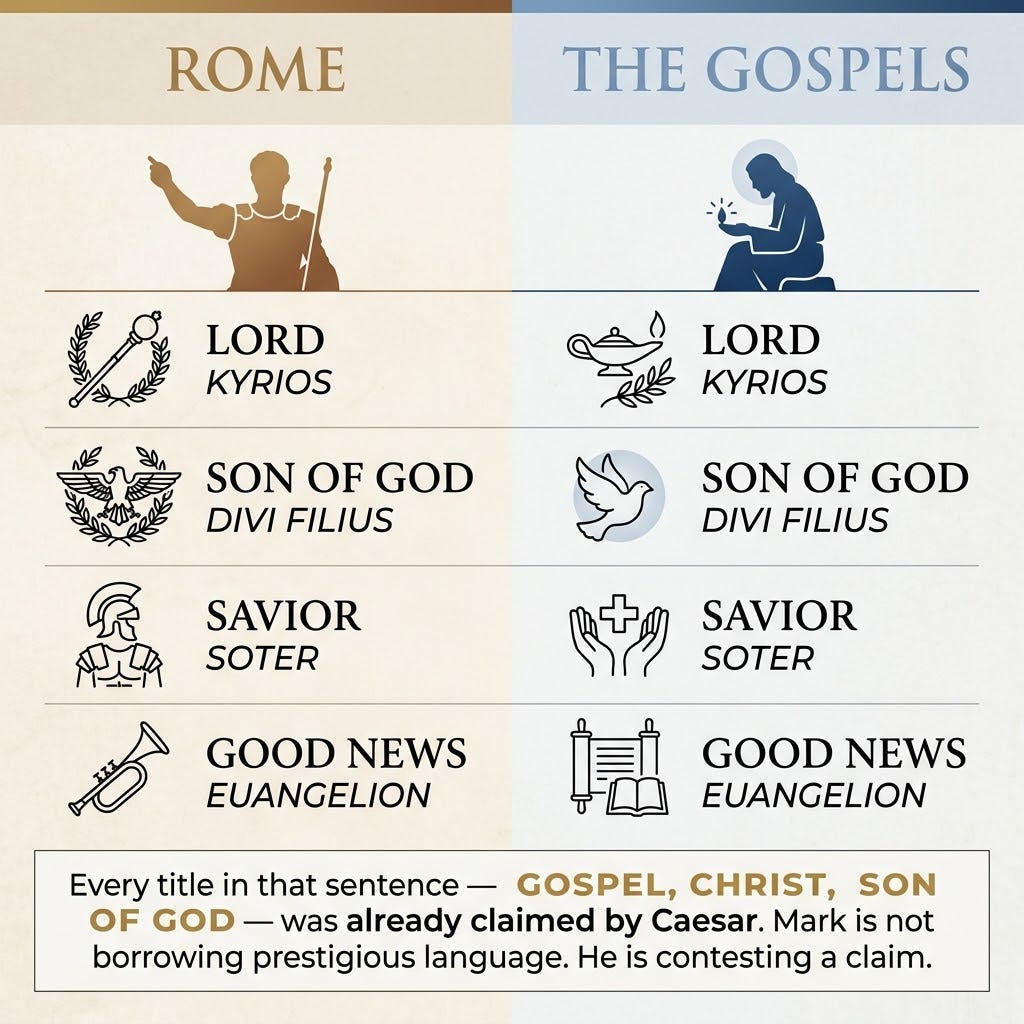
Augustus Caesar was divi filius — Son of God. He was kyrios — Lord. He was soter — Savior, the one who delivered the world from chaos. The announcement of his birth was euangelion — gospel, good news. These titles were inscribed on coins that circulated through every market in Galilee. They were carved into stone at every imperial monument.
They were the official theology of the state.
The Priene inscription, carved in 9 BCE to celebrate Augustus’s birthday, declares that the emperor’s birth was euangelion for the whole world — “good news” — and that Providence sent him as a “savior” who would bring “peace.”
Son of God. Lord. Savior. Gospel. Peace.
Now open the Gospel of Mark. First sentence:
“The beginning of the euangelion of Jesus Christ, Son of God.”
John Dominic Crossan opens God and Empire by observing that a first-century audience could not have missed what Mark is doing. Every title in that sentence — gospel, Christ, Son of God — was already claimed by Caesar. Mark is not merely borrowing prestigious language.
He is contesting a claim.
When the early church confessed Iesous kyrios — “Jesus is Lord” — it was a direct refusal to say “Caesar is Lord.” When they called Jesus soter — Savior — it was a direct counter-claim to the emperor who called himself the same. When they announced euangelion — good news — they were using the word Rome used for imperial victories and imperial births.
This is not background noise. This is the operating system of the entire New Testament.
And the word at the center of it all — the word Jesus used more than any other to describe what he was doing — was basileia. The kingdom. The empire. The sovereignty.
Except this one did not belong to Caesar.
Two Kingdoms, Two Processions
The confrontation between the two kingdoms is not subtle. The Gospels stage it.
Every Passover, the Roman governor moved troops from Caesarea Maritima to Jerusalem. The feast commemorated liberation from an empire — Egypt — and Rome was not about to let that memory ignite under occupation. Pontius Pilate entered from the west with cavalry, infantry, and the standards of Rome. War horses. Armor. Eagles. The visual vocabulary of an empire that kept the peace by reminding you, at regular intervals, what it could do to you.
On the same day, from the opposite direction, Jesus entered from the east. From the Mount of Olives. On a donkey.
Marcus Borg and Crossan call this a planned counter-demonstration — street theater performing the collision between two kingdoms. The donkey is a deliberate citation of the prophet Zechariah: “Your king comes to you, humble and mounted on a donkey.” But Zechariah doesn’t stop at the image. The full passage continues: “He will cut off the chariot from Ephraim and the war-horse from Jerusalem; and the battle bow shall be cut off, and he shall command peace to the nations.”
The king on the donkey explicitly displaces the king on the war horse.
The crowd shouts Hosanna — “save us now,” the cry to a savior. “Blessed is the coming kingdom of our father David!” — a claim about who the legitimate ruler of Israel is. This is not liturgical praise. It is a political demonstration by Galilean peasants following a man the authorities have already decided to kill.
Two processions. Two kingdoms. Two claims about who saves, who rules, who brings peace.
One enters with swords. The other enters on a donkey.
We covered this ground last week: the sword confirms empire. The cross exposes it. But there is a question I left hanging. If the kingdom is not won by the sword and not located in the afterlife — if it is, as Jesus says, “at hand,” near, beginning now — then what is it? What does it look like on the ground? What does it do?
The Counter-Economy
Start with the list. Matthew 25, the sheep and the goats. The nations are gathered. They are separated into two groups based on a single criterion:
I was hungry and you gave me food. I was thirsty and you gave me drink. I was a stranger and you welcomed me. I was naked and you clothed me. I was sick and you visited me. I was in prison and you came to me.
Read this list against what the Roman extraction economy actually produced.
The imperial system was a machine for moving wealth upward. Roman tribute flowed from Galilean peasants to Rome, skimmed at every level. Temple tithes and offerings flowed to the Jerusalem priestly elite. When peasants couldn’t pay — a bad harvest, a sick ox, a new tax — they borrowed from local creditors at ruinous rates. When they couldn’t repay, they lost their land. Then their labor. Then their liberty. Debt slavery was the endpoint of a system designed to concentrate wealth at the top while grinding the bottom to subsistence or below.
Hungry. The extraction economy — Roman tribute plus Temple tithes — left Galilean peasants at or below subsistence. Hunger was not natural scarcity. It was the product of a system that moved food upward.
Stranger. Roman occupation displaced populations. Debt foreclosure pushed families off their land. The roads between Galilee and Jerusalem were full of the dispossessed.
Naked. Debt courts could strip a person of their cloak — the last possession. This is why Jesus says, in the Sermon on the Mount, “If anyone sues you for your shirt, give them your cloak as well.” He is not teaching generosity. He is describing a debt economy that takes everything.
Sick. Without access to the Temple healing economy — which required payment and purity certification — the sick were doubly excluded. From health and from community.
Imprisoned. Rome imprisoned for debt and sedition. Visiting prisoners was a concrete act of solidarity with those the state had marked as threats.
This is not a generic list of charitable activities. It is a precise inventory of the suffering produced by the imperial system. And the sheep — the ones on the right side of the judgment — are not individually virtuous people who happen to be kind. They are participants in an alternative economy. They are the people who built and sustained the network that feeds, shelters, clothes, heals, and visits.
That network of support is the kingdom.
What the Kingdom Looks Like
The Gospels don’t just describe the kingdom as an idea. They show it in operation.
The feeding of the five thousand.
Mark places this scene directly after Herod Antipas’s birthday banquet: a feast for military officers and local elites at which John the Baptist is executed as dinner entertainment.
The display of wealth.
The violence as entertainment.
The gears of extraction.
Then the Gospels tell us Jesus withdraws to a deserted place. A crowd follows: five thousand men, plus women and children.
The disciples want to send them away to buy food. But Jesus says: “you feed them.”
Five loaves, two fish.
He takes the bread, looks up to heaven, blesses and breaks it, and gives it to the disciples to distribute. Everyone eats until full. Twelve baskets of fragments remain.
Whether you read this as miraculous multiplication or as an act of sharing that catalyzed more sharing, the structural point is identical: there is enough when extraction is removed. The scarcity of the normal economy is not natural law. It is the product of a system that concentrates wealth upward regardless of human cost. When the system is suspended — when five thousand people eat in the wilderness, outside every commercial and tribute-extraction structure — there is abundance. Twelve baskets of surplus. One for each tribe of Israel.
Herod’s table kills prophets. Jesus’s table feeds the poor. Mark has constructed the juxtaposition deliberately.
The Nazareth manifesto. Jesus stands up in the synagogue of his hometown and reads from Isaiah:
“The Spirit of the Lord is upon me, because he has anointed me to proclaim good news to the poor. He has sent me to proclaim release to the captives and recovering of sight to the blind, to set free the oppressed, to proclaim the year of the Lord’s favor.”
Then he sits down and says: “Today this scripture is fulfilled in your hearing.”
Not tomorrow. Not in the afterlife. Today.
“The year of the Lord’s favor” is the Jubilee — the Year of Jubilee from Leviticus 25, which mandated that every forty-nine years, debts would be cancelled, debt-slaves freed, and land returned to its original families. In a Galilean village being ground down by the Roman debt economy, this is not a spiritual metaphor. It is an economic announcement. Release for captives. Freedom for the oppressed. Debt cancellation. Land return.
The congregation’s reaction — initial wonder, then murderous rage — makes more sense when you hear it this way. A creditor class hearing a Jubilee proclamation has something material to lose.
The Lord’s Prayer. “Give us this day our daily bread” — a community asking for subsistence in a context where Roman taxation threatens it. “Forgive us our debts as we forgive our debtors” — the Greek word is opheilēmata. It means literal financial debts. Not trespasses. Not sins. Debts. This is a prayer for the mutual aid economy: enough food, and release from the debt that grinds families into slavery.
The laborers in the vineyard. Everyone gets the same wage regardless of hours worked. Market logic says this is unfair. Kingdom logic says the point of the economy is that everyone eats.
Soft Secession
The Jesus movement did not revolt against Rome. It seceded.
It built a parallel society inside the empire, operating on different rules. Shared meals. Mutual aid. A different Lord. Refusal to sacrifice to the emperor. A table where the last are first and the first are last.
The story the early church told about itself — the story it passed around and read over and over, the story it chose to remember — goes like this:
“All the believers were together and had everything in common.
They sold property and possessions to give to anyone who had need.”
And: “There were no needy persons among them.”
That is the story a community tells when it knows what it is supposed to be. When mutual aid is not an afterthought but the operating definition. The early church read this story to itself the way the enslaved communities preached the second sermon — as a declaration of identity against everything the empire said they were.
We are not Rome’s subjects. We are the people among whom there are no needy.
Rome eventually recognized this as dangerous — which is why the persecutions came. Not because Christians were violent. Because they were effective. They had no center to destroy. No fortress to siege. No king to assassinate.
The network was the temple.
The meal was the altar. "
The stranger welcomed at the table was Christ himself.
The kingdom of God is not a place you go when you die.
It is a competing kingdom: announced in the political vocabulary of empire, practiced as mutual aid, present wherever the hungry are fed and the stranger welcomed and the prisoner visited.
The charge nailed above the cross — King of the Jews — was a sedition conviction. Rome did not need a seminary education to understand the claim. They had a strategy for people who announced rival sovereignty: crucifixion.
The War That Never Ended
The first sermon was always the same: obey your masters.
The second sermon was always the same too: you are not slaves. You are not less than. You are God’s children. The kingdom belongs to you.
Constantine made the first sermon official. The second sermon kept coming back. It always does.
The suppression of the political reading is itself a political act. And it is the same act every time: draining the kingdom of its content so it doesn’t threaten the arrangement.
The Kingdom of God Is at Hand
Yesterday, across the United States, millions of people marched in the streets.
They did not carry weapons. They are carried signs, marching in three thousand cities and towns, in what organizers are calling the largest single-day mobilization in American history.
The administration has spent the past year telling its own first sermon. Obey. Comply. Do not inject yourself where you do not need to be. The agents of the state are God’s agents. Romans 13. Submit to the governing authorities.
And across the country — in garages turned into sanctuary shelters, in churches that have declared themselves safe spaces, in mutual aid networks feeding families whose breadwinners have been deported, in legal observer trainings and solidarity schools and bail funds — the second sermon answers.
Not with the sword. With the kingdom. The counter-economy. The network that feeds and shelters and clothes and visits without asking for papers, without checking legal status, without sorting by jurisdiction.
The community that has seceded from the empire’s moral framework while living inside its territory.
When Pete Hegseth stands at the Pentagon podium and quotes Psalm 144 — “Blessed be the Lord, my rock, who trains my hands for war” — that is the first sermon. The master’s minister has come to preach.
When a nurse in Minneapolis moves to help a wounded woman and is shot ten times for it — that is the second sermon. He injected himself where he did not need to be. He had no jurisdiction. He had no standing. He had no authorization from the empire to act.
But he had the sheep and the goats:
I was wounded and you came to me.
The kingdom of God is not a metaphor. It is not a future hope. It is not a place you go when you die.
It is a table in the wilderness where everyone eats. It is a community where there are no needy persons among them. It is a network that Rome could not destroy because it had no center — only ten thousand points of love and mutual aid, scattered across the empire, answering the extraction economy with abundance.
Even today, when we feed the hungry, when we take in the stranger, heal the sick, and forgive debts, then Jesus’ announcement is fulfilled:
“The Empire of God is at Hand.”
The Second Sermon publishes every Sunday morning at theramm.substack.com.
Context is EVERYTHING. Great article.
Thank you for this prophetic and timely article!