

Between Nov. 12 and Nov. 17, eight outages drew national coverage: Microsoft 365, the FAA’s telecommunications network, Workday, JPMorgan Chase, United Airlines, the NSA’s classified network, Apple and Marriott. The FAA ordered a nationwide ground stop. Microsoft’s disruption spread worldwide. Marriott’s guests could not sign in.
Eight in six days invites a theory, and the ones going around are sabotage or a coordinated attack. Seven of the eight operators said on the record that it was not an attack, or that they had no indication of one. The eighth, the NSA, cited scheduled maintenance.
That answer reassures, and for any single outage it may well be true. Think of each outage as weather: one event with its own local cause, such as a router change or a software bug. Climate is the set of conditions that make events like that more likely. “It was not an attack” can be true of the weather and say nothing about the climate.
I have run a lot of post-mortems, the reviews engineers write after a system fails. The first thing you learn is that the incident in front of you has a local cause, and the local cause is almost never the interesting part. A new router at a site in Arkansas, under investigation. A bug that sat in the code since July, by Microsoft’s later account. A test of the backup site meant to take over in a disaster, which connected to the live database people were actually using. Each is true, and each tells you what happened on one afternoon.
None of them tells you why afternoons like this keep arriving.
A sufficiently improbable event has two kinds of explanation. Either the conditions make it likely — the climate has changed — or someone intended it. Eight failures in six days is the kind of cluster that makes people reach for intent.
The readings here point to the climate: the system’s rules make failures like these likely. The result can be no one’s intention and still follow from choices companies and governments made about how lean to run.
I think the best indicator of why the climate explanation is most likely is the ratio of change to attention: how much work is moving through our systems against how many people are checking it. There is no single thermometer for IT. No one measures attention per change.
What exists is a set of readings — published vulnerabilities, merged code changes, staffing counts, outage surveys. Each one measured by different people in different ways for different reasons.
On load and staffing they point to a decline in available human attention. Indeed’s index of U.S. job postings for IT operations, set at 100 for February 2020, stood at 70.4 on Nov. 13.
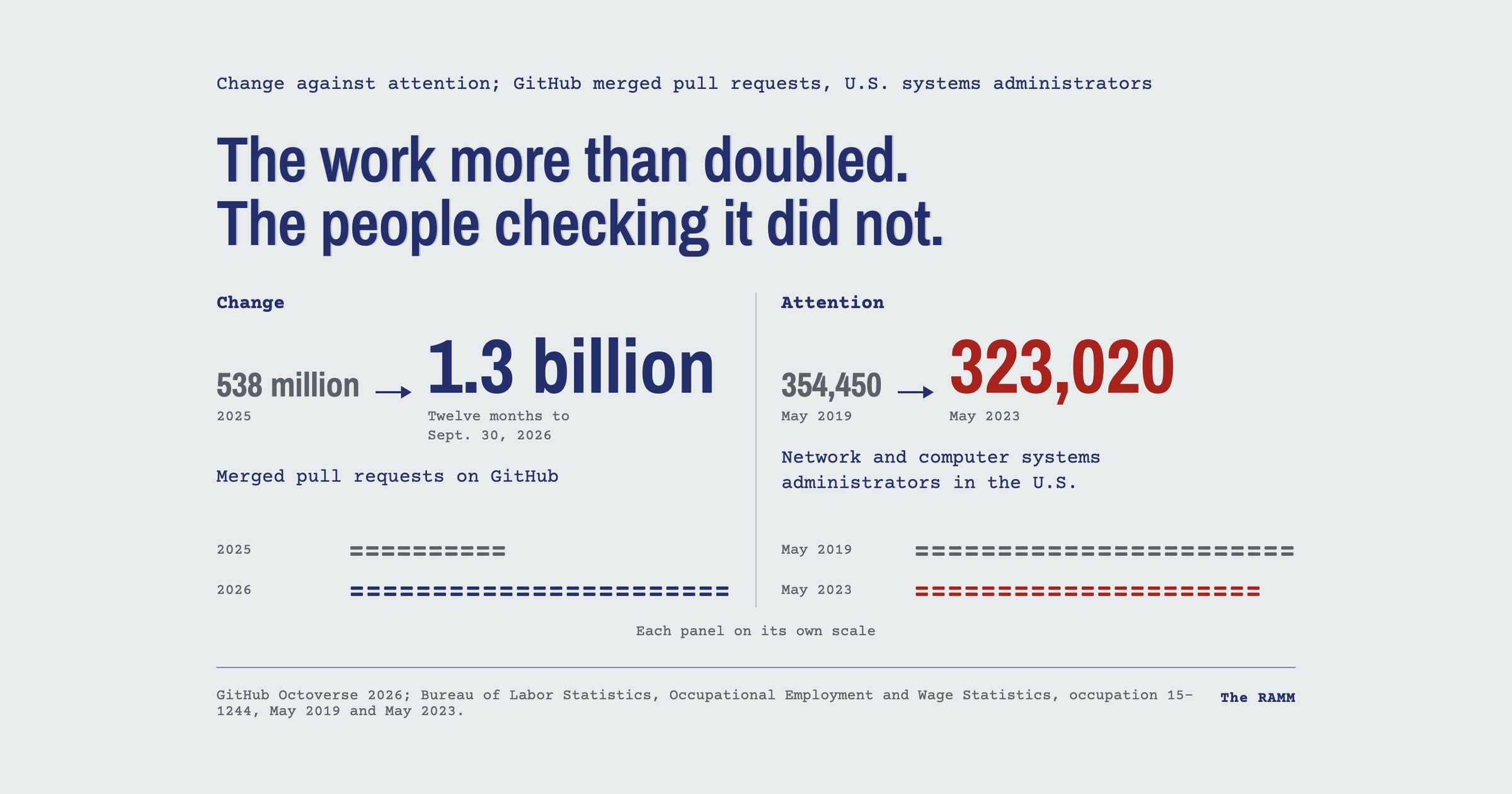
On the size and pace of change they all point towards a long upward trend, and then a massive spike in the last months. On GitHub, the number of pull requests merged (a pull request is a proposed change to a program’s code; merging it accepts the change) went from 538 million to 1.3 billion in a year.
The rules that matter are few: how much change a system takes in, how many people check that change, how much spare capacity it keeps, and how much of it runs through a few large providers. The whys below follow the first three down. For the fourth, concentration, there is an argument but no measurement; Microsoft’s Azure Front Door, below, one service sitting in front of its customers’ applications, shows its shape.
Why do they fail? Mostly not attackers
The companion piece sets out what each operator has said. Microsoft told BleepingComputer its outage was “a technical issue not related to cyber or AI / agents.” In four of the eight (Microsoft, Workday, Apple and the NSA), the operator’s own account puts the failure next to work it was doing on its own system: a software bug introduced in July, a backup site that “unexpectedly connected to Production databases,” “an internal update,” “scheduled routine maintenance.” Military & Aerospace Electronics reports that the FAA’s contractor had been installing a new router at a site in Arkansas; the FAA’s own update said excessive network traffic had overwhelmed older equipment. JPMorgan Chase blamed “a software bug in an on-premise hardware system,” equipment the bank runs itself. United and Marriott named no cause.
That is not a November quirk. In my tally of 58 attacks, breaches and outages reported in October and November, 52 of which I could verify against a source, the nine verified outages break the same way: in five, the operator said its own update, maintenance, migration or test set off the failure. The definitions are mine, and the tally is small; it is a sample, not a census.
Google’s handbook on site reliability engineering, the work of keeping its services running, puts it plainly: “roughly 70% of outages are due to changes in a live system.”
Why do changes fail? More of them, through gates built for different changes
GitHub’s own telemetry, the usage data it collects from its service, restated on one consistent basis in its 2026 Octoverse report, counts 402 million merged pull requests in its 2024 window, 538 million in 2025, and 1.3 billion in the twelve months to Sept. 30, 2026. Pushes, each an upload of code changes to GitHub, went from 5.2 billion to 6.7 billion to 17.9 billion. GitHub Actions jobs — the automated builds and tests that run on each change — went from 8.0 billion to 14.0 billion to 45.4 billion.
Some of that is agents, AI programs that write code and open pull requests with little human typing. GitHub says 17 percent of pull requests in March started with an agent’s first draft, and more than 40 percent by September, a count it calls “a floor” on agent use. It does not say agents caused the growth. By my arithmetic on its figures, even at September’s share for the whole year, the pull requests that did not begin as agent drafts still grew.
Security work stepped up too. A CVE is a publicly listed software flaw with its own tracking number, and each one usually means a patch, a fix shipped as an update. The National Vulnerability Database, the U.S. government’s catalog of them, published 25,073 CVEs in 2022, 28,816 in 2023, 39,953 in 2024 and 48,150 in 2025. In the first nine months of 2026 it published 72,793. Microsoft’s Patch Tuesday, its monthly batch of fixes, set a record of 664 vulnerabilities in July 2026, released patches for 973 in September and for 1,417 in October, according to the SANS Internet Storm Center.
Microsoft has said why. Its security response center wrote on May 12 that “Microsoft engineers and the wider security community alike are increasingly using AI to examine software more carefully and more often than was practical even a few years ago.”
These are disclosures, not attacks. CISA, the federal agency that coordinates civilian cyber defense, keeps a catalog of vulnerabilities known to be exploited, meaning someone has been seen using them in an attack. That catalog grew far more slowly: 186 additions in 2024, 245 in 2025, 298 through Nov. 17, 2026. More holes found does not mean more holes used. It does mean more patches to test, schedule and ship, every one of them a change to a live system.
Then there is the work nobody scheduled. In November 2025 a self-spreading worm, Shai-Hulud 2.0, compromised about 800 packages in npm, the public library programmers pull ready-made JavaScript code from. On Oct. 26, 2026, CISA added two PHP2Shell flaws in PHP, a programming language for websites, to its exploited catalog, with a deadline of Oct. 29 for federal civilian agencies to remediate them.
Each patch applied in a hurry is one more change through the gates: the checks a change must pass before it reaches production. When Azure Front Door, the Microsoft cloud service that sits in front of its customers’ applications, went down on Oct. 29, 2025, its protection system checked the change, and Microsoft says the checks “were all passed during the rollout.” The fault was asynchronous, meaning delayed: it surfaced only after the checks ran, then spread globally as the change went out stage by stage. Worse, it overwrote the last-known-good snapshot, the saved copy of the last working setup, which was supposed to be the way back.
Why wasn’t the extra work absorbed? The people did not grow with it
If the work multiplied, someone has to read it, review it, test it, approve it, deploy it and watch it. The readings on those people run flat or down.
The Bureau of Labor Statistics counted 354,450 network and computer systems administrators in the United States in May 2019 and 323,020 in May 2023, a drop of 8.9 percent. The occupational codes changed in between, and some adjacent roles grew: network architects by 14 percent over the same years. But the occupation most directly charged with keeping systems running shrank.
Job postings have not come back. Indeed’s index of U.S. job postings for IT operations and help desk roles, set at 100 for February 2020, peaked at 159 in June 2022. On Nov. 13, 2026, it stood at 70.4.
The administration has asked to shrink the public’s own capacity too. CISA’s budget shows 3,732 authorized positions for fiscal 2025 and 2026; the fiscal 2027 request, not yet enacted, asks for 2,865. These are authorized slots, not people on board, and no record ties any of them to any incident.
Why does load become failure, not just delay? There is no slack
A system with slack absorbs a surge as delay. Work waits, then clears. A system without slack turns a surge into failure.
Queueing theory, the mathematics of waiting lines, says that as a server gets close to busy 100 percent of the time, waiting time does not rise in a straight line. It climbs steeply, and small additions of load produce large additions of delay. Charles Perrow’s Normal Accidents adds the second half. In systems that are tightly coupled, where each part leans directly on the next, delay does not stay put. One component’s wait becomes another’s timeout, and the timeout becomes an outage. Richard Cook’s “How Complex Systems Fail” says it in one line: “Change introduces new forms of failure.”
The Microsoft 365 outage ran that way, by Microsoft’s later account as BleepingComputer relayed it. The bug, introduced in July, was “worsened on machines with more cores and newer hardware” (cores are the processing units inside a server’s chips), and the company’s load testing “tended to focus on weaker hardware with fewer cores.” The gateway is the networking front end for many Microsoft 365 services. Nearly 14 percent of its server capacity was already offline for an unrelated issue. Safeguards meant to stop problems spreading between regions also failed to contain it, and the disruption spread worldwide.
Much of modern operations was designed to run lean on attention. The same Google book describes the traditional operations model as one that “scales linearly with service size,” and its own model as one in which the headcount of its site reliability engineers “scales sublinearly”: the systems grow faster than the team. It worked, at the throughput it was built for.
Google’s DORA research program, which surveys software teams on how they deliver changes, found in its 2024 report “an estimated 7.2% reduction” in delivery stability “for every 25% increase in AI adoption.” Its 2025 report found AI adoption “currently associated with increasing instability,” and reads the mechanism as more change volume without the controls to absorb it. That is a survey of teams, not a count of outages.
Why was there no slack? It was engineered out
None of this started with AI.
In 2008 James Hamilton, then an architect at Microsoft, put the enterprise norm at about 140 servers per administrator and large-scale services at more than 2,000. In 2013 Facebook said each of its data-center operations staff looked after at least 20,000 servers. Those figures count different jobs and come from the companies themselves; they cannot be joined into one curve. But they do show the direction.
Change volume rose with them. Amazon reported 50 million deployments in the twelve months to November 2014, more than one a second.
The bank Monzo ran about 150 backend services, separate programs that each do one job behind its app, in 2016 and 2,800 in 2024.
Every one of those steps was an efficiency, and every one was a good idea. Each took human attention off the routine work and left it for the hard cases, which is exactly what Lisanne Bainbridge warned about in “Ironies of Automation” in 1983: “By taking away the easy parts of his task, automation can make the difficult parts of the human operator’s task more difficult.”
So the climate was already warming. The step in 2025 and 2026 is the steepest in any series I have read: pushes nearly tripled and Actions jobs more than tripled in a single year, alongside the rise in agent-drafted pull requests. It arrived in systems that had already spent their slack.
In the same May note, Microsoft told its customers what comes next.
Out-of-band updates are the ones that arrive outside the monthly schedule, whenever the fix is ready:
“As discovery continues to scale, customers should be prepared for more frequent cases where out-of-band updates require immediate attention.”
Before we continue, one quick ask.
A single raid is a headline. The pipeline behind it is a story nobody’s funding.
At The RAMM I connect the dots that don’t fit in one article: the federal contracts, the 287(g) deals, the quiet real-estate moves, the county-by-county buildout of detention capacity.
The receipts:
4,776+ sourced events at CaptureCascade.org
1,988 counties with signals of detention expansion at detention-pipeline
129 community fights over detention capacity, tracked
This is self-funded. Subscriptions are the only thing that keeps it alive
Sources
Companion piece:
Eight Outages in Six Days, and What Each Operator Has Said (The RAMM, Nov. 18, 2026), with the operator statements quoted above and their sources:
Microsoft statement to BleepingComputer (Nov. 13, 2026); Microsoft’s preliminary post-incident report, as relayed (BleepingComputer, Nov. 16, 2026)
FAA, Nationwide Ground Stop: Questions and Answers (Nov. 15, 2026); Military & Aerospace Electronics, FAA investigates network failure that grounded flights nationwide (Nov. 16, 2026), the account the piece uses for the contractor and the router
NSA statement, as reported by Al Jazeera (Nov. 17, 2026)
JPMorgan Chase statement, as reported by WBAL (Nov. 16, 2026)
United Airlines statement, as reported by OPB (Nov. 16, 2026)
Marriott statement, as reported by Fox News (Nov. 17, 2026)
Outages, change and gates:
Google, *Site Reliability Engineering*, Introduction (2016): “roughly 70% of outages”; linear and sublinear scaling
Uptime Institute, Annual Outage Analysis 2026 (May 11, 2026): impactful-outage share, blast zone
Microsoft Azure Networking, Azure Front Door postmortem blog (Oct. 29, 2025 incident)
Our own tally: 58 attacks, breaches and outages, Oct.-Nov. 2026, 52 verified (cascade-research dataset attacks-outages-oct-nov-2026; definitions ours)
Volume of change:
GitHub (vendor telemetry), Octoverse 2026: merged PRs, pushes, Actions jobs, agent-started share
NVD, CVE API 2.0 (quarterly published counts, excluding rejected, as of Nov. 18, 2026)
Microsoft Security Response Center, A note on Patch Tuesday (May 12, 2026)
SANS Internet Storm Center, Patch Tuesday diary (Sept. 2026): July and September 2026 counts; October 2026 diary (Oct. 13, 2026): October count
CISA, Known Exploited Vulnerabilities catalog (catalog version 2026.11.17)
Datadog Security Labs (vendor), Shai-Hulud 2.0 npm worm
The Register, PHP2Shell coverage (Oct. 2026)
People:
BLS, OEWS, Network and Computer Systems Administrators (May 2019 and May 2023 pages; see also oes151241)
Indeed Hiring Lab via FRED, IT Operations and Helpdesk postings index
Survey research:
DORA, 2024 Accelerate State of DevOps Report (p.40)
DORA, 2025 State of AI-assisted Software Development (p.41); announcement
Thirty years of efficiency:
James Hamilton, ICDE 2008 talk
Data Center Knowledge, Facebook ops: each staffer manages 20,000 servers (2013)
Werner Vogels, Apollo: Amazon’s deployment engine (2014)
Monzo, Building a modern bank backend (2016); How we run migrations across 2,800 microservices (2024)
Lisanne Bainbridge, “Ironies of Automation”, Automatica 19(6), 1983
Richard Cook, “How Complex Systems Fail”
Charles Perrow, *Normal Accidents* (Princeton University Press)
There’s that old saw, that to err is human, but to screw up at massive scale requires computing power.
Compounding the problem, making analysis difficult, is making too many changes at once, rather than incremental testing. The challenge becomes much more demanding in time and effort and requires incremental reversal. Upgrades need to be created in parallel and tested before terminating previous working deployments. And fully tested backup and recovery procedures are essential. Who is now making these policy decisions?