

At about 3:30 p.m. Eastern on Friday, Nov. 13, the FAA issued a nationwide ground stop. By the FAA’s own times, air traffic had resumed as of 8:15 p.m., so the stop lasted no more than about four hours and 45 minutes. Operators canceled “approximately 12,462 flights” that day, by the FAA’s count; the FAA says not all of those cancellations were directly caused by the stop. It was the first nationwide ground stop since January 2023. (Capture Cascade timeline entry.)
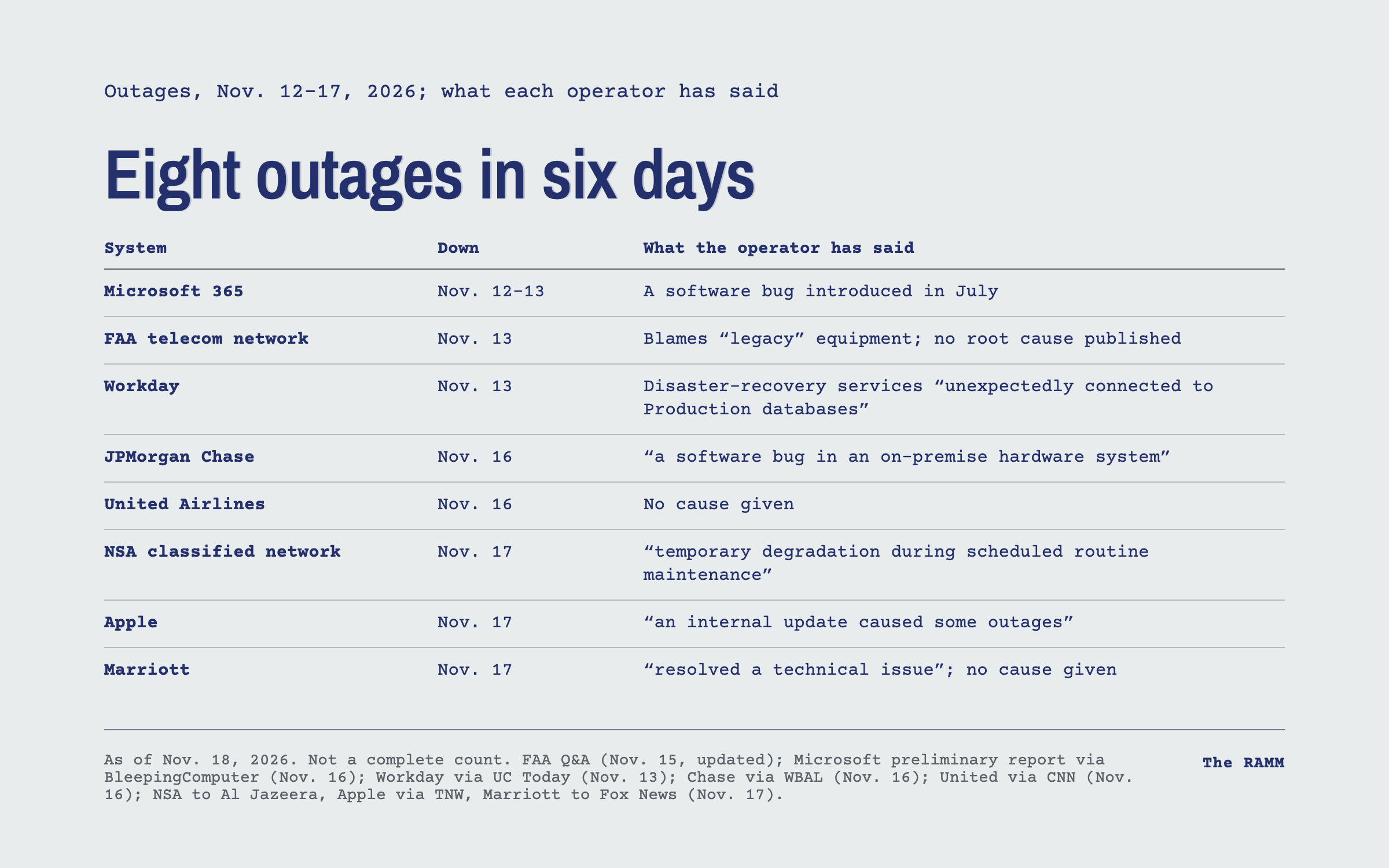
Eight outages were widely reported over the six days from Nov. 12 to Nov. 17, not a complete count of that period’s outages: Microsoft 365, the FAA’s telecommunications network, Workday, JPMorgan Chase, United Airlines, the NSA’s classified network, Apple and Marriott. Seven of the eight operators have said on the record that it was not an attack or that they have no indication of one: Microsoft (“a technical issue not related to cyber”), the FAA (“no indication that this was a cyberattack or an outside nefarious actor”, and Administrator Bryan Bedford on Nov. 14, “zero evidence of anything nefarious”), Workday (not related to a cybersecurity incident, by UC Today’s account of a spokesperson), Chase (“it is not cyber-related”), United (“no indication that this was a cybersecurity-related issue”), Apple (“not a cyberattack”, as The Next Web relayed the company’s statement) and Marriott (“Our review found no indication that the disruption was cybersecurity-related”). An NSA spokesperson later told Al Jazeera that the agency “experienced temporary degradation during scheduled routine maintenance”; the statement does not say whether this was an attack. CNN’s sources say there is no evidence of a cyberattack “at this point.” NBC News wrote in its own voice, of the Microsoft, FAA, Chase and United failures, that there is “no evidence that any of the issues are related.”.
The stated causes differ. Microsoft’s preliminary report, as BleepingComputer relayed it, names a software bug introduced in July. A Workday status notice says services in its disaster-recovery site “unexpectedly connected to Production databases.” Chase’s spokesman said “a software bug in an on-premise hardware system.” The FAA’s Q&A blames its “legacy” equipment and says its contractor had been deploying a new router at one of two candidate sites. Apple said “an internal update caused some outages this morning”. Marriott described “a technical issue” and gave no cause. United has given no cause. The NSA has said only that it “experienced temporary degradation during scheduled routine maintenance”.
The ground stop, account by account
On the night of the stop, Transportation Secretary Sean Duffy, at a press conference with Homeland Security Secretary Markwayne Mullin, said: “What happened is that our switches, actually got overloaded with data, and they went down… I shouldn’t say they went down… they started to give us inconsistency with the data from those routers, and because of that, we shut the system down.” (One Mile at a Time transcribed it; a CBS News post embedded in the same article words the first sentence as “Our switches, our routers actually got overloaded with data.”) The same day, unnamed “senior government sources” told CBS News the issue was isolated to Cisco 600 series routers manufactured between 2001 and 2006. CBS did not say how many sources.
At a news conference on Saturday, Nov. 14, Duffy named the FAA’s network contractor. As FOX Local transcribed it: “was it user error or installation error from L3Harris — or did they install a faulty router? We haven’t determined what the fault was.” An L3Harris spokesperson told The Air Current that day: “We are supporting the FAA in its investigation to understand the conditions that led to the Nov. 13 ground stop of our nation’s air travel.”
Also on Nov. 14, FAA Administrator Bryan Bedford told reporters that updating the wires was a routine maintenance issue the agency had worked on for years. The FAA technicians’ union, the Professional Aviation Safety Specialists, said the issue was “isolated to two contractor owned and maintained routers that were being updated mid-day,” and that its technicians “were not involved in the upgrades.” That is the union’s account, as One Mile at a Time reproduced it.
The FAA’s written account came Sunday, Nov. 15, in a questions-and-answers page. Its legacy equipment “became unstable when data began flooding the FAA FTI network, at a rate of 1,000 connection attempts every 4 to 5 seconds,” with instability at 17 of its 22 Air Route Traffic Control Centers. The initial investigation points to two possible origins, a radar site in Amarillo, Texas, and a radio site in El Dorado, Arkansas, where “L3 Harris, the FAA’s current network service provider, had been doing work... including deployment of a new router.” That sentence does not say what generated the traffic.
Asked whether its upgrades and modernization caused the stop, the same document answers: “No, this is due to the legacy TDM system causing instabilities.” The page does not define “TDM” or “FTI”; it calls the cause “legacy equipment,” refers to “the FAA FTI network,” and describes the wider work as a transition away from “old copper wires that are being disconnected due to their obsolescence.” The Q&A calls the router work “a routine replacement at a remote facility, which has regularly been done for decades,” says “it is important to distinguish routine equipment upgrades from the FAA’s broader modernization effort,” and adds: “based on what happened Friday, we will reevaluate when we do replacement/maintenance work.”
Hewlett Packard Enterprise, which owns the router maker Juniper, told ABC News that day: “Based on what we know today, the device functioned as it was configured to by the installer. It did not fail or act improperly.”
On Sunday television, Duffy said officials were analyzing two routers at FAA facilities in Arkansas and Texas, which AP described as “installed in recent weeks.” By AP’s account of the interviews, after the wire at El Dorado was replaced and the router turned on, a problem “cropped up” at the Amarillo facility, cascading into the ground stop. “We didn’t think that should or would happen,” Duffy said. On Face the Nation, he said the FAA “is still using this really old telecom network that has to be updated, upgraded, and I think built brand new.”
On Nov. 17, CNN wrote in its own voice that “the Federal Aviation Administration traced the problem to a single router in Arkansas.” ABC’s account of Duffy on “This Week” on Nov. 15 has him saying, “We have that router in the L3 Harris lab down in Florida,” which ABC glosses as “the specific router in Arkansas that officials believe caused instability.” The FAA’s own page names two candidate sites, Amarillo and El Dorado; CNN and ABC each describe one router.
The FBI is part of the investigation. On “This Week” on Nov. 15, Duffy said, “We’ve been partnering with the FBI and other law enforcement,” and, of the new routers: “we have 69 of these routers in the national airspace. We’ve stopped their ability to broadcast.” FedScoop reported on Nov. 16 that the router was being analyzed at an L3Harris lab in Florida with FAA staff and FBI agents, and quoted the FAA as saying it had “disabled the potentially faulty functionality on roughly 60 similar routers in the system as a precaution.” Duffy’s count is 69; the FAA’s Q&A now says “we quickly disabled the same functionality on more than 60 other Juniper routers in the system”. MS NOW wrote on Nov. 17 that “the FBI is joining” the FAA’s investigation, and that the Justice Department and the FBI did not immediately respond to its request for comment. Duffy has said there is no indication of a hack; the FBI has said nothing on the record.
The installations have stopped. The FAA’s own Q&A says that, besides disabling the routers’ functionality, “we have paused installing them”. On Nov. 17, the day AP and ABC reported the pause, Democrats on the Senate Commerce Committee led by Sen. Maria Cantwell released a letter dated Nov. 16 asking for an immediate pause, writing that the “FAA must address outstanding safety and reliability concerns before expanding installation.” By Aerospace Global News’s account of the letter, the senators, citing L3Harris, put the planned copper-to-fiber transition at 3,648 routers, with about 400 installed and 69 operating.
Four operators have stated a cause
Microsoft 365, Nov. 12-13. Microsoft’s statements, by date. On Nov. 13, to BleepingComputer: “This was a technical issue not related to cyber or AI / agents. The incident was introduced by an issue during an earlier network capacity upgrade that surfaced following a recent network change.”
On Nov. 16, BleepingComputer reported Microsoft’s preliminary post-incident report. By BleepingComputer’s account, the report names three problems: a software bug introduced in July, increased traffic after Microsoft Teams switched to the infrastructure Exchange Online uses, and reduced server capacity. The incident ran from 11:20 a.m. ET on Nov. 12 until 11:10 a.m. the next day; at its lowest, more than 80 percent of Microsoft’s networking gateway servers were unresponsive. BleepingComputer quotes the report: “The contention issue is worsened on machines with more cores and newer hardware; whereas our load testing tended to focus on weaker hardware with fewer cores.” Nearly 14 percent of the gateway’s server capacity was already offline for an unrelated reason, and the safeguards meant to stop problems spreading between regions also failed.
Workday, Nov. 13. A spokesperson told Fox News that day that “some of our customers are experiencing a service disruption.” Its cause, in a notice on Workday’s Community Status Page that UC Today relayed (Washington University’s IT office quoted it at 8:05 p.m. ET on Nov. 13): “While validating the weekly Maintenance Window for Disaster Recovery tenants, we have identified that tenanted services within the DR Site unexpectedly connected to Production databases. As a result, this has left data in an inconsistent state that can cause errors accessing tenants or jobs/integrations/tasks to fail with missing transaction error messages.” A spokesperson told ABC10, by UC Today’s account, that the disruption hit two data centers, was not related to a cybersecurity incident, and that service “was restored by 11 a.m. EST Saturday.”
JPMorgan Chase, Nov. 16. Spokesman Joe Evangelisti said the bank had experienced “a temporary issue related to a software bug in an on-premise hardware system — it is not cyber-related,” and that “this is not a systemic issue.” Fox News, in its own voice and with no speaker named, wrote that the incident was traced to a software release the bank rolled out earlier that Monday. Fox also reported that “a source familiar with the Chase outage” told it the problem was “a technical bug, not a cyber issue.”
Apple, Nov. 17. Apple’s statement, as The Next Web quoted it: “Many of our systems are back up and running after an internal update caused some outages this morning”. The Next Web wrote that the outage hit iCloud, Apple Pay, the App Store and other services, and that every service was back by early evening.
Three have not said what caused it
United Airlines, Nov. 16. Two durations are on record. CNN wrote that United spokesperson Leslie Scott told it the outage “lasted about 30 minutes, with fewer than 150 flights impacted.” AP and Reuters, in their own voice, describe an outage “that lasted more than 90 minutes.” United said there was “no indication that this was a cybersecurity-related issue.” Pilots told air traffic controllers the problem was related to the system that helps determine a plane’s final weight, AP reported; that is the pilots’ account, not United’s. CNN says the internal memo it saw “did not disclose the cause.” Duffy, on Fox News: “I don’t know what the root cause of United is.”
The NSA’s classified network, Nov. 17. CNN reported that the network the agency uses for internal communications was down, “according to six people familiar with the matter,” and that “at this point there is no evidence of a cyberattack, sources said.” Reuters, relaying the CNN report, says five people, and says it could not immediately determine the extent or the length of the outage. An NSA spokesperson later told Al Jazeera that the agency “experienced temporary degradation during scheduled routine maintenance”. The statement does not say what failed or for how long.
Marriott, Nov. 17. A Marriott spokesperson told Fox News Digital: “We have resolved a technical issue that affected sign-in capabilities on Marriott.com and the Marriott Bonvoy app”. Fox wrote in its own voice that the sign-in disruption was brief. The statement does not say what caused the technical issue.
Still owed
Microsoft’s final post-incident report, which BleepingComputer wrote on Nov. 16 is expected “later this week.”
Workday’s root-cause report.
A Chase statement saying whether the cause was a software release, a bug in a hardware system, or both.
A cause from United and from Marriott, whose spokesperson said only that there was “a technical issue”, and an account from the NSA of what failed on Nov. 17 and for how long. Its statement says only that the agency “experienced temporary degradation during scheduled routine maintenance”.
The change record for the router work at El Dorado and Amarillo: the test plan, the maintenance window, when the work was done and who approved the timing. The union says the routers were “being updated mid-day”; the FAA says it will “reevaluate when we do replacement/maintenance work.”
The router maker’s role. The FAA’s Q&A now refers to “the originating Juniper routers”; the reported pause covers “new Juniper routers,” and Juniper’s owner, HPE, has spoken for the device, while CBS’s unnamed sources said Cisco equipment made in 2001 to 2006.
What the FBI is looking for, and what it finds. It has said nothing on the record.
The FAA’s root-cause finding. Bedford said on Nov. 14 that a root cause analysis would be shared with the public when it is available, Al Jazeera reported. As of Nov. 18, the FAA had published none.
Before we continue, one quick ask.
A single raid is a headline. The pipeline behind it is a story nobody’s funding.
At The RAMM I connect the dots that don’t fit in one article: the federal contracts, the 287(g) deals, the quiet real-estate moves, the county-by-county buildout of detention capacity.
The receipts:
4,776+ sourced events at CaptureCascade.org
1,988 counties with signals of detention expansion at detention-pipeline
129 community fights over detention capacity, tracked
This is self-funded. Subscriptions are the only thing that keeps it alive
Sources
Primary:
FAA, Nationwide Ground Stop: Questions and Answers (FAA, Nov. 15, 2026)
Reporting:
Massive Microsoft 365 outage (BleepingComputer, Nov. 13)
Microsoft says months-old bug caused outage (BleepingComputer, Nov. 16)
FAA ground stop: what we know (CBS News, Nov. 15)
FAA ground stop live updates (ABC News, Nov. 15)
Who is L3Harris (FOX Local/KTVU, Nov. 15)
Al Jazeera on the FAA ground stop and the root-cause analysis (Al Jazeera, Nov. 14)
Duffy slams L3Harris for role in nationwide ground stop (The Air Current, Nov. 14)
FAA union claims nationwide ground stop totally avoidable (One Mile at a Time, Nov. 15)
Ground stop root cause (AP via Boston Globe, Nov. 15)
America hits tech wall (Fox News, Nov. 16)
Workday outage: backup test (UC Today, Nov. 14)
Bank outages (AP via WBAL, Nov. 16)
Thousands report difficulties accessing accounts (AP and Reuters via Al Jazeera, Nov. 16)
United Airlines outage (CNN, Nov. 16)
United says it has a widespread system outage (AP via OPB, Nov. 16)
United system outage (NBC News, Nov. 16)
NSA classified network goes down (CNN, Nov. 17)
Highly classified US national security network (Reuters via Yahoo, Nov. 17)
Duffy says ATC routers’ ability to broadcast data turned off, being investigated (ABC13, Nov. 15)
FAA, FBI investigating router responsible for nationwide ground stop (FedScoop, Nov. 16)
FBI investigating nationwide FAA ground stop, Duffy says (MS NOW, Nov. 17)
FAA pauses router upgrades after nationwide US ground stop (Aerospace Global News, Nov. 18)
How did these all happen at once? Seems ridiculously improbable.
Is there any precedent this Mark?