

Warehouse Detention Update: The Secret Lease and the Zoning Door
When the warehouse-purchase track stalled, the detention buildout learned to hide inside a 20-year government lease. One county learned to lock the door before the buildout knocks.
The Secret Lease and the Zoning Door
For fifteen months, the only people who knew a federal immigration detention center was coming to the eastern edge of Gilroy, California were the people who signed the lease.
The General Services Administration awarded the contract on January 8, 2025. The site — 7240 Holsclaw Road, about twenty-four acres of greenhouses and open land in unincorporated Santa Clara County, eight miles from the Monterey County line — went to an entity called ECG 6 LLC, whose Beverly Hills mailing address matches that of Elmwood Capital Group, a real-estate firm founded in 2020. Elmwood’s stated business, per its own website, is acquiring industrial parcels and procuring leases with the federal government. County records show it took ownership of the Holsclaw Road parcel weeks after the contract award.
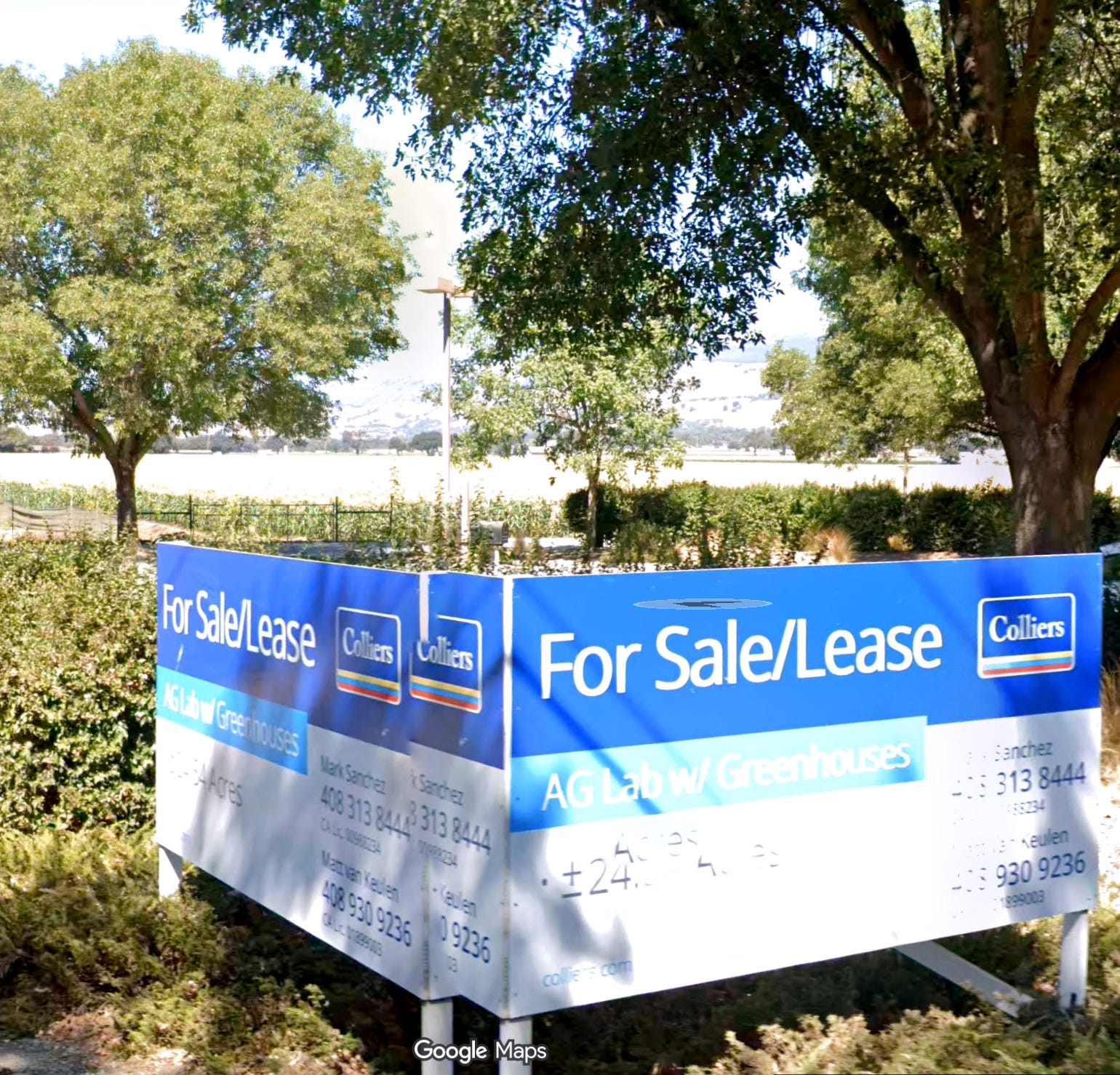
Nobody outside that transaction knew. Not the county. Not the city of Gilroy. Not the county next door. The project surfaced in April 2026 only because community members noticed activity on the land and called the county to ask. By mid-May, crews were tearing down the greenhouses and putting up privacy fencing. Asked about it, a Department of Homeland Security spokesperson said only: “We have no new detention centers to announce at this time.” ICE, the spokesperson added, “is actively working to expand detention space.”
Both of those sentences are true. That is the point. This is the deny-then-build posture working exactly as designed — and Gilroy shows where it went after the last version started getting caught.
What the Warehouse Track Was
To see why Gilroy matters, you have to know what it replaced.
Through the winter of 2025–2026, the detention buildout expanded mostly by buying warehouses — and routing the purchase through a financial owner who absorbed the public-facing transaction. DHS didn’t appear on the deed. A bank or a real-estate fund did. The detention-pipeline tracker documented the cluster building site by site: Rockefeller Group in Surprise, Arizona; Fundrise in Williamsport, Maryland; Goldman and Dalfen in Roxbury, New Jersey; Carlyle in Oakwood, Georgia; Deutsche Bank in Salt Lake City. Generic industrial real estate, bought through a cutout, repurposed to confinement.
It is a clean trick, and for a while it worked. But it had two weaknesses. It left a deed — a public record of a sale, even if the buyer’s name was a fund nobody recognized. And the scale of it drew federal review, which stalled the purchase track, and local fights, which lit up the moment the buyers were named. Once Commercial Observer could run the headline “DHS, ICE Expanding in Commercial Real Estate at Full Tilt” in February, the trick was no longer secret. It was a strategy with a name.
So the apparatus did what captured systems do when a method gets exposed. It iterated.
The Evolution: A Lease, Not a Deed
Gilroy is the iteration. And the difference is the whole story.
At Gilroy there is no purchase for a journalist to find in county property records. There is a twenty-year lease — reported at $26.5 million — held by a real-estate LLC. The federal government’s name does not appear on the parcel. ECG 6 / Elmwood owns it; ICE leases it; the deed stays private for the life of the lease.
Three things make this tighter than the warehouse purchases:
The intermediary’s whole business is the concealment. A bank that happens to own a warehouse is an accidental cutout. Elmwood Capital is a dedicated one — a firm whose stated model is procuring GSA leases on industrial land. The concealment isn’t incidental to its business. It is the business, and it is repeatable: Elmwood is tied to a second immigration-detention proposal in Pflugerville, Texas. One LLC, the same maneuver, two states.
A lease keeps the government off the public record in a way a purchase can’t. No federal sale appears anywhere. The trail belongs to a private landlord.
The GSA-lease form launders detention into routine government office-space leasing. GSA leases attorneys’ offices, field stations, ordinary federal space all the time. A detention site procured through that same channel looks, on paper, like any other government lease — until a construction crew shows up. The contract at Gilroy reportedly bears the same identification number as an ICE detention solicitation, but you would have to go looking for that. For fifteen months, nobody did.
This is what the concealment layer looks like once it learns from being caught. Not a bank absorbing one purchase, but a landlord whose recurring product is standing between the public record and the federal use. (I’ve written up the full mechanism — the move from intermediary-purchase to LLC-held lease — for the record.) DHS can say “no new detention centers to announce” and be technically correct, because on paper there is no new detention center. There is a real-estate lease.
The Counter: Locking the Door Before Anyone Knocks
Here is the part that gives the story its shape. Communities have figured out the pattern — and invented a counter that matches its secrecy.
The instinct, for years, was reactive: wait for a facility to be proposed, then fight the permit. That is how Howard County, Maryland caught a stealth facility in Elkridge — after the permit issued. But reactive fighting is always a step behind a system that can lease in secret for fifteen months.
So Maryland did something different. It started prohibiting detention as a land use — before any facility was proposed.
Baltimore County moved first, and fast. In February 2026, ICE leased about 16,000 square feet in Hunt Valley — for an attorneys’ office, the Office of the Principal Legal Advisor, not a detention site. The lease disclosure alone was enough. The County Executive called an emergency session, and on February 17 the County Council passed an emergency zoning ban 6–0, prohibiting permits for “detention centers, jails, or other facilities used for involuntary confinement,” and giving itself authority to revoke certain permits issued since the first of the year. A legal office triggered a detention ban. That is how charged this ground has become.
Then Baltimore City did it by statute. On March 10, Council President Zeke Cohen introduced a bill making “private detention center” a prohibited land use citywide — sponsored by 12 of the 15 members, cleared committee without opposition. It’s the third layer of an unusually complete municipal stack: the city had already barred ICE from city buildings on a 14–0 vote, with a pension-divestment proposal running in parallel.
Zoning is the lever that matches the concealment, because it doesn’t require catching the apparatus in the act. It does not matter when a secret lease was signed if the use was prohibited before the ink dried. A ban already on the books neutralizes the fifteen-month head start.
There’s an honest limit, and it’s the load-bearing caveat: zoning can’t reach federal property. Baltimore’s bans exempt federal buildings; the city’s federally owned hold rooms remain a separate fight. The counter works on private operators and non-federal land — which is exactly why it has to fire before a federal foothold exists. Once ICE holds the land, the leverage drops. The zoning door only locks from the inside, and only before the house is federal.
Where Both Collide: Gilroy
Which brings us back to Holsclaw Road, because Gilroy is where the secret lease and the zoning door meet in a single fight.
The site is not zoned for detention. It was leased in secret, through a real-estate LLC, on land the local code does not permit detention to occupy. And on May 19, 2026, the Monterey County Board of Supervisors — the county next door — voted unanimously to oppose it, directing the county to send opposition letters, join any litigation by Santa Clara County or the California DOJ, and review its own zoning laws. Santa Clara County, where the site actually sits, had already signaled it would fight and threatened suit.
Read the geometry: a federal facility, hidden inside a private lease, built on unzoned land in one county — opposed by the county beside it before it opens. That is the concealment layer and the zoning counter colliding in real time. The buildout’s advantage is secrecy and time. The counter’s advantage is a rule that was already there. Gilroy is the test of which one wins on a parcel where the federal foothold is still wet.
Why the Counter Exists: The Deaths, and the Counties That Couldn’t
Two more threads from this month explain why communities have moved to the hardest, earliest form of resistance. Both are about what happens when you don’t get there in time.
The deaths. Two more detainees died this month at large Texas facilities that the tracker had never documented — counties that scored high for years with no facility file at all. At the GEO-run South Texas ICE Processing Center in Pearsall, Kai Yin Wong, a 63-year-old Chinese national, died October 25, 2025, after being transported for shortness of breath and airlifted to San Antonio in heart failure. At the ICE-owned Port Isabel center near Los Fresnos, Randall Gamboa Esquivel, a 52-year-old Costa Rican who entered the country in good health in December 2024, was moved from Laredo to Port Isabel and, by mid-2025, was described in his own records as catatonic, with roughly ten conditions including sepsis. These join the homicide rulings at Adams County, Mississippi and El Paso’s Camp East Montana from last month. Mortality remains the dominant narrative of the expansion — and it is what a zoning ban is ultimately trying to prevent from arriving.
The counties that kicked ICE out and couldn’t. Williamson County, Texas is the textbook case for why a ban has to be preemptive and structural rather than contractual. In 2018, county commissioners voted 4–1 to terminate the county’s agreement at the CoreCivic-run T. Don Hutto facility. ICE simply re-contracted directly with CoreCivic to keep it open — and the commissioners learned of it from reporters. Terminating an intergovernmental agreement does nothing if ICE can contract around the county. Hutto has since shifted from a family facility to a women’s facility to, now, adult men — the same footprint repurposed to whatever demand exists. A contract you can cancel is not a door you can lock. A zoning code is closer.
What Comes Next
The detention-pipeline tracker now documents 140 fights across all fifty states, 18,002 entries, 2,016 counties scored — and the heatmap, now that it counts detention contracts directly, puts Broward County, Florida at the top (a heat score of 202) and the South Texas cluster climbing fast. The signal was always there; the engine just started counting it correctly.
But the structural finding of this month is smaller and sharper than any single score. The detention buildout has learned to hide inside real estate — first behind banks, now behind a twenty-year lease held by a firm whose business is hiding it. And the communities paying attention have learned the only counter that matches that secrecy: a rule written before the lease is signed. Gilroy is where we find out whether the rule or the lease wins.
Watch the three things that will tell you. Watch whether Santa Clara or California sues over the Gilroy zoning, and whether a lease beats a zoning code on unzoned land. Watch whether the Baltimore playbook spreads — whether more jurisdictions prohibit detention as a use before a facility is ever proposed. And watch Pflugerville, Texas, where the same LLC is reportedly running the same maneuver, to see whether the second time is as quiet as the first.

If you live in one of these places — especially near Gilroy, or in the South Texas counties where people are dying in facilities nobody had documented — and you know what is happening on the ground, the tracker wants to hear from you. Most of what is on that site started as someone in a county knowing something that needed to be written down before the fencing went up.
My wife & editor and I do this on our own. We are working hard to document the connections that beat reporting can’t see:
4,776+ sourced events at capturecascade.org.
1,988 Counties with signals of potential detention center expansion (Federal contracts, 287(g), real estate traces, etc) at detention-pipeline.transparencycascade.org my site that tracks signals of potential cooperation with ICE and Border Patrol.
129 Community fights over detention capacity built out tracked.
All of this is self-funded, and paid subscriptions are the only way I can continue to do this long term.
Sources
Primary Timeline Events:
GSA secret lease for Gilroy ICE site — ECG 6 / Elmwood Capital (Jan 8, 2025; found Apr 2026)
DHS purchases Rockefeller Group warehouse, Surprise AZ (Jan 23, 2026)
DHS purchases Fundrise warehouse, Williamsport MD (Jan 27, 2026)
Capture Cascade Context:
Reporting:
“Federal detention center planned in South County” (San José Spotlight, May 2026) — https://sanjosespotlight.com/federal-detention-center-planned-in-south-county/
“Santa Clara County Leaders Say They’ll Fight Planned ICE Facility in Gilroy” (KQED, May 2026) — https://www.kqed.org/news/12083600/santa-clara-county-leaders-say-theyll-fight-planned-ice-facility-in-gilroy
“Too close for comfort: Monterey County joins push to halt suspected ICE center near Gilroy” (Local News Matters, May 21, 2026)
“DHS, ICE Expanding in Commercial Real Estate at Full Tilt” (Commercial Observer, Feb 2026) — https://commercialobserver.com/2026/02/dhs-ice-office-industrial-expansion-trump/
“Baltimore County Council approves ban on private detention centers” (Baltimore Sun, Feb 17, 2026)
“Bill to ban private detention centers introduced in Baltimore City Council” (CBS News Baltimore, Mar 10, 2026)
Data:
The Detention Pipeline tracker — detention-pipeline.transparencycascade.org (140 fights; 2,016 counties scored)
Mark Ramm, May 27, 2026. The full detention-pipeline data and per-county fight files are at detention-pipeline.transparencycascade.org.
I noticed the leasing company on this sign is Collier Realty. I drive by their home office location every week. I think I might have to dig a little on this.