

Trump's Campaign to Decide "Who Counts?"
The Architecture of Darkness Part 1: The Supreme Court case that tests whether the 14th Amendment still means what it says.
Cecillia Wang was born in Oregon. Her parents were students from Taiwan — temporary visa holders, not permanent residents, not citizens. Under the executive order Donald Trump signed on his first day back in office, she would not be an American.
On Tuesday, Wang stood in the Supreme Court and argued against that order. The president sat twenty feet away. He left before she finished.
Wang told the justices: “Ask any American what our citizenship rule is, and they’ll tell you. Everyone born here is a citizen alike.”
The rule she described has held for 128 years. The executive order she challenged would end it — not through legislation, not through constitutional amendment, but through reinterpretation. The administration argues that the 14th Amendment’s citizenship clause has been misread since 1868. That “subject to the jurisdiction thereof” was always meant to exclude the children of people who weren’t supposed to be here.
The justices were skeptical. Chief Justice Roberts called the administration’s examples “quirky” and “idiosyncratic.” Justice Barrett asked how the theory would have applied to children of newly freed slaves whose parents were trafficked from Africa — whether they, too, would have lacked sufficient “allegiance” to qualify. The solicitor general couldn’t answer whether Native American babies born on tribal land would still be citizens under his test. “I’m not sure,” he said. “I have to think through that.”
A majority appeared ready to rule against the order. That matters. But it is not the whole story.
The fight over who counts as American is the oldest fight in the country.
In 1790, the first Congress restricted citizenship to “free white persons.” In 1857, the Supreme Court ruled in Dred Scott v. Sandford that Black people — free or enslaved — could never be citizens. The 14th Amendment, ratified in 1868, was written to make that ruling impossible to repeat. It was designed to settle the question permanently: anyone born here is one of us.
In 1882, Congress passed the Chinese Exclusion Act, barring an entire nationality from immigration. In 1898, the Supreme Court heard the case of Wong Kim Ark — a man born in San Francisco to Chinese parents who were themselves barred from ever becoming citizens. The Court ruled he was an American. His parents’ status did not determine his.
Wang cited Wong Kim Ark on Tuesday. She is, in a sense, his inheritor — born on American soil to parents the current order would use to disqualify her. The 14th Amendment was written so that no president could look at a child born in this country and say: not yours.
Even if the Court strikes down this order — and it likely will — what happened this week extends beyond one case.
On March 31, the president signed a separate executive order directing the Department of Homeland Security and the Social Security Administration to compile a national list of verified eligible voters. The order instructs the U.S. Postal Service to send mail ballots only to people on that list.
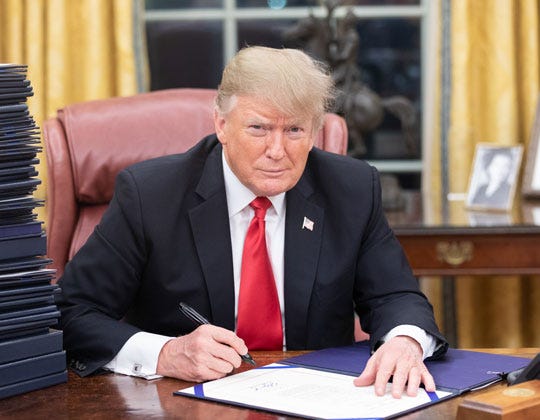
The next morning, he sat in the Supreme Court for the birthright citizenship arguments.
These are not parallel stories. They are sequential. They are an architecture.
Birthright citizenship determines who is American. The voter list determines which Americans get to participate. The mail ballot order determines how. Stack them and you get a system in which the executive branch doesn’t just enforce the law. It defines the electorate. This series documents that architecture — six layers, each enabling the others, each disguised as a separate policy story.
The infrastructure behind this is not new either. Since May 2025, the Justice Department has demanded unredacted voter rolls — including driver’s license and partial Social Security numbers — from 44 states. It has sued 24 that refused. Confidential agreements obtained by the Brennan Center reveal that the DOJ plans to conduct its own analysis and instruct states to remove specific voters within 45 days — a timeline that likely violates the National Voter Registration Act’s requirements for voter roll maintenance. A DOJ official admitted in court that the department is sharing voter data with DHS to run through its SAVE citizenship verification system — a system that has inaccurately flagged U.S. citizens.
The Georgia secretary of state purged 560,000 voters in a single day in 2017 using an “exact match” system. A conservative lawsuit forced Wisconsin to purge 200,000 before the 2020 election. Those were state actions. What is happening now is federal — the executive branch directing removals from voter rolls it has seized over the objection of the states that maintain them.
Barrett’s question on Tuesday was the one that mattered most.
She asked how the administration’s theory would have worked for children of freed slaves whose parents were brought from Africa against their will. The question was not hypothetical. It was historical. The 14th Amendment was written in the specific knowledge that some Americans’ parents had been brought here by force, denied citizenship, denied personhood — and that their children, born on this soil, had to be beyond the reach of any official who would deny them.“Subject to the jurisdiction thereof” was not a loophole. It was a lock.
The question is whether the lock holds — not just in this case, but across the infrastructure being built around it.
Coming Tomorrow: The voter rolls. The Birthright citizenship isn’t an isolated attack, it is part of a coordinated effort to control who counts, and who gets to be counted.
Previous investigations: After the Arrest | Every Database Is an Immigration Database Now | The Bones Inside the Tomb
The full Architecture timeline is searchable at capturecascade.org.
The RAMM documents the connections that beat reporting can't see — 4,776+ sourced events at capturecascade.org.
Free subscribers get every investigation. Paid subscribers get draft chapters of the book and access to the research infrastructure.