

The Washtenaw County Data Center Tryptich
Three Townships, One County. The story of the hyperscale datacenter buildout in my hometown.
I have lived in Ypsilanti, Michigan for years.
This is where I buy groceries and walk regularly along the Huron River in Riverside Park. So when I say three different corners of this county are simultaneously fighting three different hyperscale data centers, I’m not describing an abstraction. I’m describing my neighbors figuring out, independently and more or less from scratch, how to resist a category of project none of them asked for.
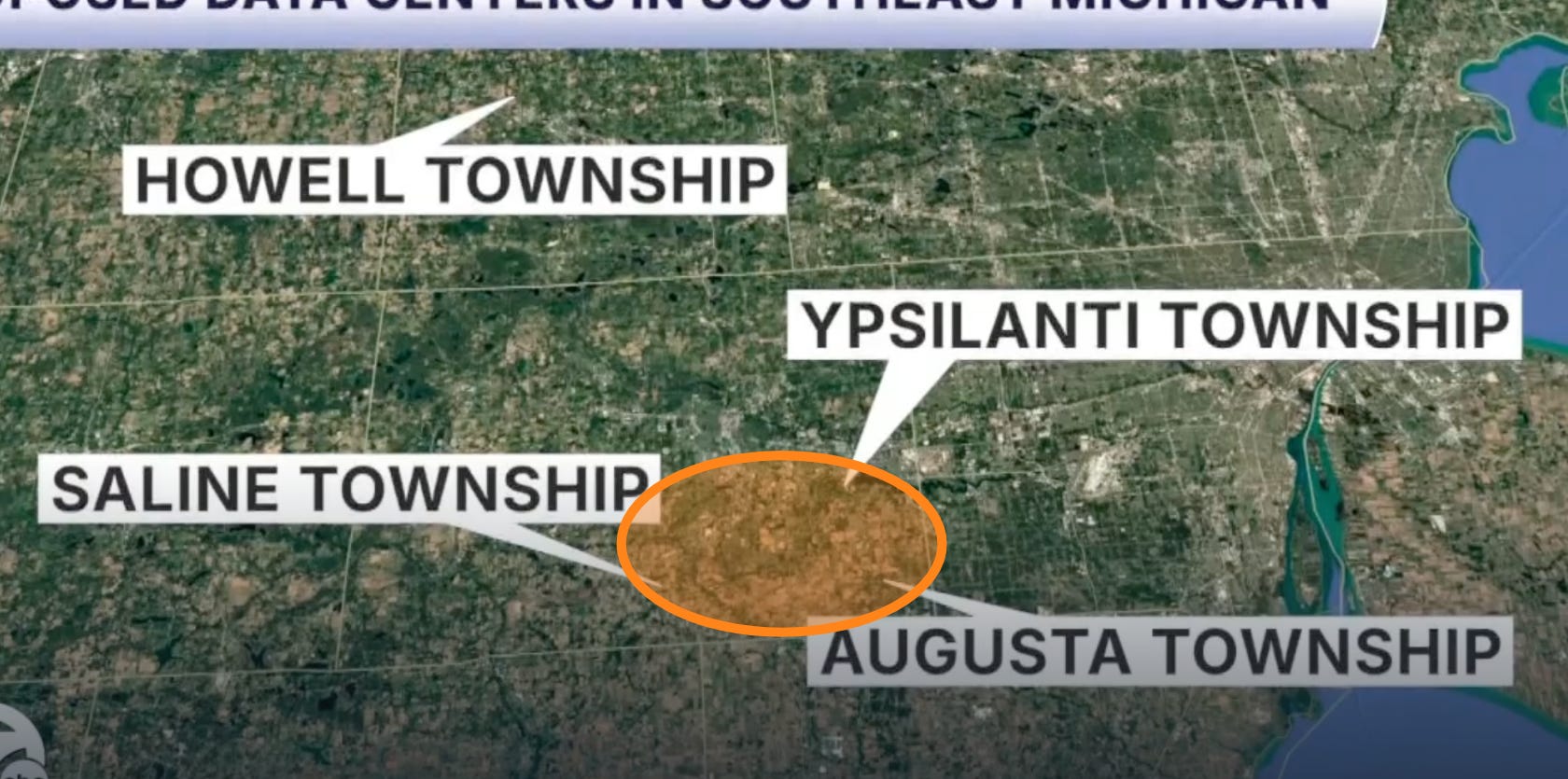
Here’s the county, as of this week. In Augusta Township, near Milan, residents vote August 4 on a referendum that could void a $1 billion, 800-acre data center rezoning the township board approved over its own Planning Commission’s recommendation.
In Saline Township, an Oracle-and-OpenAI-linked data center broke ground in June after the township board that rejected it was sued into a settlement; the same board spent this month fighting, and losing, a battle over how large a tax break to hand the developer.
And in Ypsilanti Township, the University of Michigan wants to build a $1.2 billion computing center with Los Alamos National Laboratory on land it bought without telling the township supervisor except by text message. The township’s answer wasn’t a zoning fight. It was to shut off the water.
Three townships. Three developers. Three completely different theories of how you stop one of these things. And running underneath all three, one investor-owned utility (DTE Energy) asking state regulators for permission to raise electric rates on everyone in its territory, with a filing that ties the size of the increase to whether the Saline project comes online on schedule.
Augusta: the referendum
Augusta Township’s fight is the most straightforward story of the three, and the one with a deadline attached. Thor Equities, the New York real-estate firm, wants to build a roughly $1 billion, 800-acre data center campus near Milan. The township’s Planning Commission recommended denying the rezoning needed to build it; the Township Board overrode that recommendation and approved it anyway.
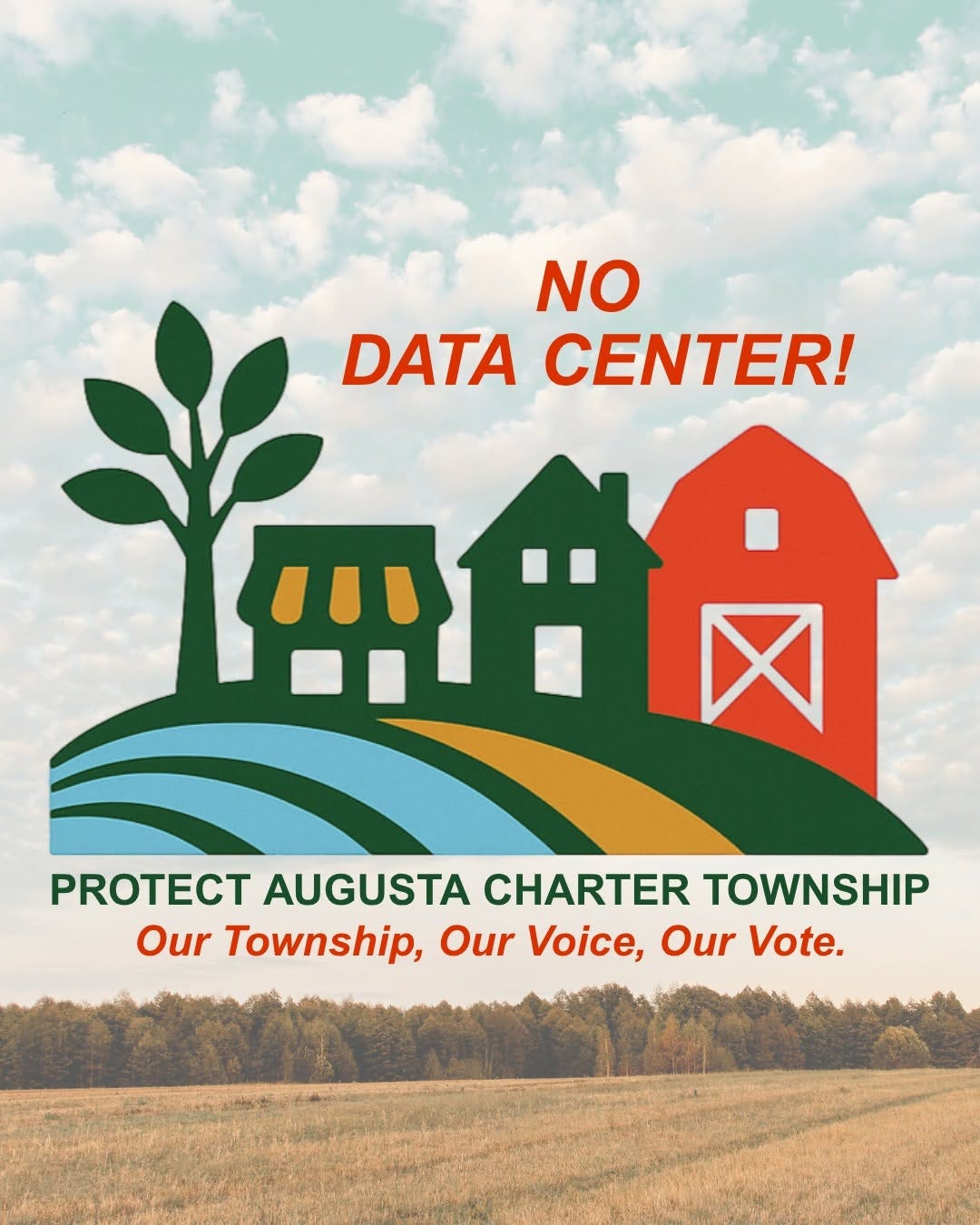
Residents organized as PACT (Protect Augusta Charter Township) and gathered enough signatures to force a referendum on the rezoning itself. That referendum is on the August 4, 2026 ballot. If it passes, the rezoning is voided outright. A separate moratorium ordinance had its second reading the same week the referendum qualified, and a campaign to recall the board is also underway.
What makes Augusta different from the standard data-center-moratorium story playing out in dozens of counties nationally this year is that a moratorium only pauses future approvals; it doesn’t undo one that’s already been granted. A referendum does. If PACT wins on August 4, the board’s approval is gone, not paused.
The referendum is an important test, and it’s on the ballot in four days.
Saline: the fight the board already lost, twice
Saline Township’s story runs in the opposite direction, and it’s the sharpest illustration of what happens when the sharper tool doesn’t get used in time, or doesn’t work.
In September 2025, Saline Township’s Planning Commission recommended denying the rezoning for what would become the Oracle-and-OpenAI-linked data center campus sometimes “The Barn.” The Barn is developed by Related Digital, a Related Companies entity. Related Companies was founded by Stephen Ross, who has donated more than two hundred million dollars to the University of Michigan, and where the business school bears his name
The Township Board followed the recommendation and voted 4-1 to deny it.
Related Digital sued.
The company argued in Washtenaw County Circuit Court that because Saline Township had no land zoned for industrial use at all, its categorical refusal amounted to unlawful “exclusionary zoning” under the Michigan Constitution: that the township had excluded a land use the state considers necessary.
Rather than litigate that claim to a verdict, the township settled.
A consent judgment filed October 15, 2025 let the project proceed, bound by conditions: no expansion beyond the agreed footprint, a noise limit, no solar farms on site, and no water-intensive evaporative cooling.
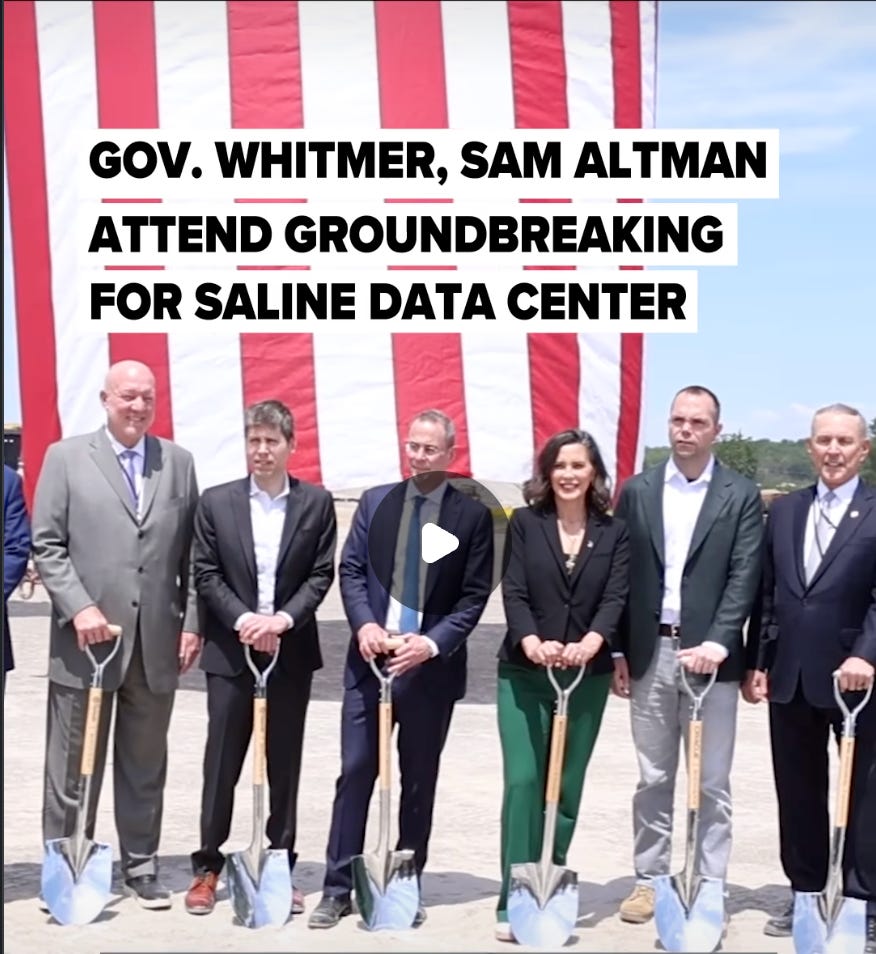
A resident living 256 yards from the site, Kathryn Haushalter, later tried to intervene and unwind the settlement, arguing it had been negotiated in secret. A judge denied her motion in February 2026, ruling that intervention wasn’t available in an already-closed case. Construction broke ground June 1, 2026, with OpenAI CEO Sam Altman, Governor Gretchen Whitmer, and Oracle executive Clay Magouyrk all present. The site is now known as “The Barn”: three single-story buildings on 250 acres, roughly 1.4 gigawatts of power capacity — Michigan’s largest data center by both size and power draw. The construction and financing figure, confirmed through an April 2026 Blackstone financing announcement, is $16 billion; some coverage cites figures as high as roughly $56 billion when Oracle’s compute-hardware procurement is added on top of the construction cost, though that combined figure is less consistently sourced than the $16 billion construction number and should be read as “construction plus hardware,” not construction alone.
This is the throughline worth sitting with: Saline Township didn’t lose this fight because its board caved to pressure at a meeting. Its board voted the project down, on the record, 4 to 1. The project got built anyway, because a lawsuit converted a democratic rejection into a legal inevitability. That’s the difference between a community that persuaded no one and a community that won the argument and lost the case anyway.
And the settlement’s terms kept costing Saline residents money for months afterward. On July 15, 2026, the Township Board, bound by the 2025 consent judgment to grant some tax abatement to the project, but with real discretion over how large, approved a 12-year, 50% abatement, but capped the taxable value it applied to at the project’s original $4.8 billion valuation rather than a newer, far larger figure the company had put forward, cutting the effective annual subsidy roughly nine times.
The cap lasted 72 hours. The board called a special meeting on July 18 and voted 5-0 to reverse itself, granting the full exemption. The reversal came after attorney David Landry told the board that the 2025 consent judgment “does not say the township may approve it, it says that it shall approve it,” and warned that if Oracle sued over the reduced figure, residents could face special assessments to cover the township’s litigation costs.
The audience booed. The board reversed anyway.
That’s the mechanism in Saline in full: a legal agreement negotiated once, outside any public vote, that keeps compelling outcomes months and years later — with the township’s only remaining choice being how much it costs residents, in legal exposure, to resist even a little.
Ypsilanti: the water, not the zoning
Ypsilanti Township took a different route entirely, and it’s the one I find most interesting, because it isn’t a zoning fight at all.
The University of Michigan, partnering with Los Alamos National Laboratory, wants to build what U-M calls a “high-performance computational research center” — supporting medicine, climate science, energy, and national-security research, according to the university.
Township officials and residents reject that framing outright, and point to Los Alamos’s actual identity: it is the federal laboratory that designed the first nuclear weapons and still does nuclear-weapons-related research today. Later reporting describes plans for a 240,000-square-foot classified building alongside a smaller unclassified one. The project’s price tag has been reported as $1.2 billion in early coverage and $1.25 billion more recently — the same project, a modestly updated figure, not a discrepancy.
In March 2026, U-M finalized the purchase of a 124-acre parcel on Textile Road, adjacent to Huron River parkland the university already owned, bringing its combined holding there to 144 acres. Township Supervisor Brenda Stumbo learned about the purchase, according to multiple outlets, when a U-M vice president informed her by text message. U-M has said it’s still weighing a second possible site, at the Willow Run complex, and has not committed to Textile Road — a genuine open question, not spin, though it does nothing to soften how the township found out about the land deal in the first place.
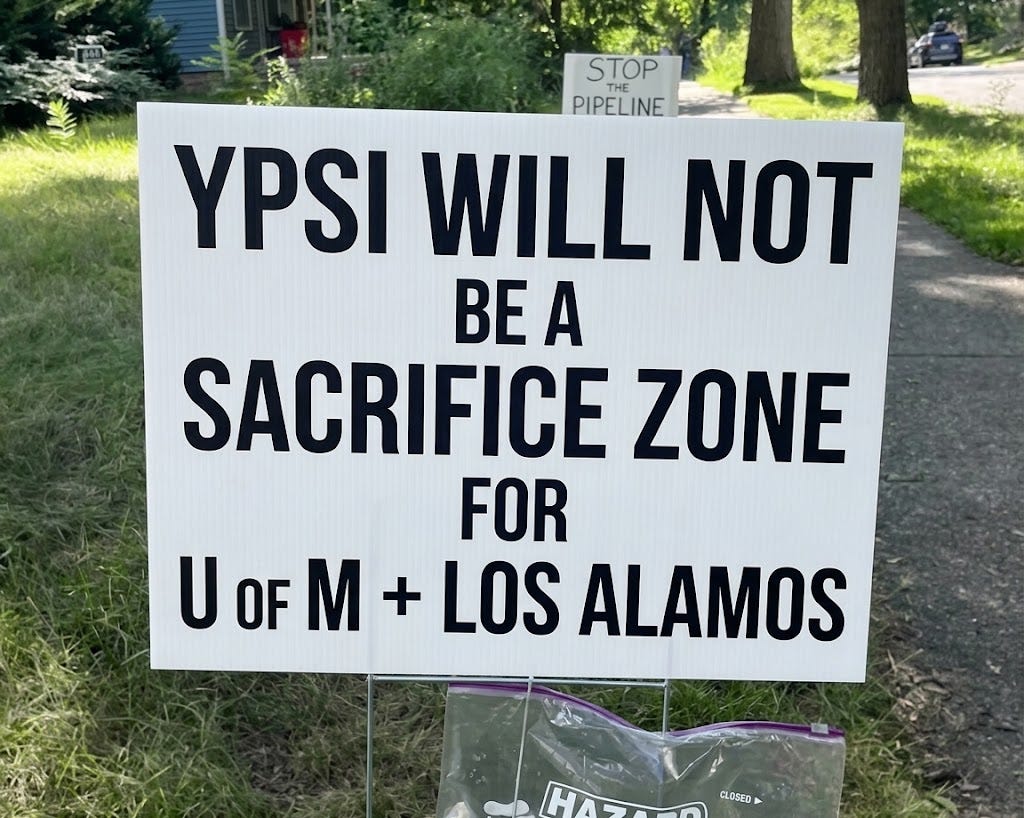
The Township Board responded on March 31, 2026, formally resolving to oppose siting the facility anywhere within township boundaries. But a board resolution isn’t binding on a university with its own eminent authority over its own land. So the township turned to something a university can’t simply route around: water.
Ypsilanti Community Utilities Authority — YCUA, the water and sewer authority that serves Ypsilanti Township and the city of Ypsilanti — voted unanimously on April 22, 2026 to pass Resolution 26-08: a twelve-month moratorium on new water and sewer connections, capacity reservations, infrastructure commitments, and preliminary approvals for hyperscale data centers, mid-sized data centers,
AI computing facilities, and high-performance computational centers as a category, not just the U-M project by name. During the moratorium, YCUA is studying its own water-supply and wastewater-treatment capacity, financial impacts, and system resilience. YCUA’s board includes Stumbo and township trustee Gloria Peterson as commissioners, so the township’s opposition and the utility’s decision run through some of the same people.
The capacity math explains why this lever exists at all: YCUA has an estimated 4 to 5 million gallons a day of excess wastewater capacity, and a single hyperscale data center can use up to 5 million gallons a day — meaning one project like this could consume the entire buffer the utility has to work with. That’s the stated rationale for pausing new commitments while the utility studies what it can actually support.
Some coverage of the YCUA vote has called it the first case of a municipal utility using infrastructure access as leverage against a data-center project nationally.
I want to be careful here, because it’s a claim worth wanting to be true and that’s exactly when it deserves the most scrutiny: the strongest version of that claim traces to a single wire-service characterization, not corroborated by a second independent source, and not checked against any national accounting of how other water utilities have responded to similar fights elsewhere.
What’s better sourced, and more modest, is that Ypsilanti is among the first — some outlets say “believed to be the first” — to use a request for more time to study wastewater and infrastructure impact, rather than a zoning vote, as the point of leverage. That’s still notable. It just isn’t a record.
The moratorium doesn’t kill the project. U-M and Los Alamos have reportedly signaled they intend to keep developing the site regardless, and multiple outlets describe that as building toward a real confrontation — a federal research initiative running up against a local utility’s control over its own pipes — though as of this writing no lawsuit over the moratorium itself has been filed.
At a packed public meeting July 15, Township Attorney Douglas Winters told residents he was tired of “months of evasive answers” from U-M and Los Alamos and said the township was “no longer interested in negotiations.” Whether a water refusal can actually stop a university-federal-lab partnership that wants to build regardless is the open question the next year of this fight will answer.
The utility that connects all three
This is where the three fights, otherwise unconnected, run through the same wire. DTE Energy, the investor-owned utility that supplies most of southeast Michigan’s electricity, including all three townships, is asking the Michigan Public Service Commission (MPSC, the state agency that regulates utility rates) for a $474.3 million rate increase, filed in April 2026, that would raise residential bills by 9.7%.
Attached to that filing, DTE floated something unusual: it said it could pause further rate-hike requests for two years, through 2028, if three things happen — a “constructive” outcome in the current rate case, the Oracle/OpenAI Saline project coming online on schedule by the end of 2027, and other unspecified regulatory approvals DTE wants.
Michigan Attorney General Dana Nessel’s response was blunt: “This isn’t a commitment, it’s a ransom note.” Her fuller point, from an April 24 statement: “DTE only offers a break in rate hikes if they win some other, unnamed data center approvals, and their Saline data center comes online with no delay.” Nessel’s office moved formally to intervene in the rate case and said separately that it hasn’t been able to review DTE’s underlying power contracts for the Saline project to check the company’s own claims about ratepayer benefit.
That $474.3 million ask isn’t the first bite. MPSC approved a $242.2 million DTE increase unanimously, effective March 5, 2026, adding roughly $4.23 a month to a typical residential bill, framed around grid-reliability upgrades. Before that, in early 2025, a separate $217.4 million increase, less than half of DTE’s original $456.4 million ask in that case, was approved, adding about $4.61 a month. Two increases, already banked, in a little over a year. The pending $474.3 million request stacks on top of both, with its pause offer explicitly tied to a data-center construction timeline the ratepayers footing the bill have no say over.
To be clear about what is and isn’t established here: DTE’s rate case does not name Augusta or Ypsilanti Township specifically, and the research underlying this piece could not confirm whether Augusta Township — home to the Thor Equities project — even sits within DTE’s or YCUA’s respective service territories at all.
The documented financial link runs specifically through Saline: DTE’s own conditional-pause filing names the Saline project’s on-time completion as a condition of the rate relief it’s dangling. What connects all three townships is less a single contract than a single arithmetic: one regulated monopoly utility, one rate base, and a growing list of hyperscale customers whose power and water demands are being priced, argued over, and in DTE’s case explicitly conditioned, in front of the same state regulator that sets what the rest of us pay.
Before we continue, one quick ask.
A single raid is a headline. The pipeline behind it is a story nobody’s funding.
At The RAMM I connect the dots that don’t fit in one article: the federal contracts, the 287(g) deals, the quiet real-estate moves, the county-by-county buildout of detention capacity.
The receipts:
4,776+ sourced events at CaptureCascade.org
1,988 counties with signals of detention expansion at detention-pipeline
129 community fights over detention capacity, tracked
This is self-funded. Subscriptions are the only thing that keeps it alive
What three separate fights add up to
I want to resist the version of this story that turns three independent local fights into evidence of some hidden plan. There isn’t one, as far as anyone has shown. Thor Equities, Related Digital/Oracle/OpenAI, and the University of Michigan are three separate developers with three separate sites, three separate deals. As far as the public record shows, no shared ownership or coordination between them. What they share is a category: enormous, water- and power-hungry computing facilities, arriving in overlapping windows, in medium-sized counties, faster than any of the county’s townships had institutional tools built to handle them.
So each township is improvising with whatever lever its own governing structure happens to hand it. Augusta has a referendum process, so Augusta is using a referendum. Saline’s board discovered, the hard way, that a rezoning denial can be converted into a legal inevitability by a company willing to sue and a court willing to treat “no industrial land at all” as unconstitutional exclusion — so Saline’s only remaining leverage sat in the abatement math, and even that didn’t hold. Ypsilanti Township doesn’t control zoning on land the university already owns, but it does sit on the water authority’s board — so Ypsilanti is fighting with water.
None of the three levers is guaranteed to hold. Augusta’s referendum could pass and still face a lawsuit resembling Saline’s. Ypsilanti’s moratorium could run its twelve months and expire with the university’s plans unchanged. And DTE’s rate case will be decided by an appointed commission in Michigan’s Capital, Lansing, not by anyone in these townships. But it’s worth naming what’s actually happening: three communities that never coordinated with each other independently arrived at three different theories of where the pressure point is, because the ordinary one — a township board saying no — kept not being enough. That’s not a conspiracy. It’s a county figuring out, one fight at a time, what leverage still works when the normal kind doesn’t.
The August 4 vote in Augusta will answer one part of that question first. The rest of the county is still finding out.
Sources
Primary Timeline Events: - Augusta Township, MI: referendum on Thor Equities $1B data center rezoning hits August 4 ballot (July 28, 2026) - Saline Township board denies, then is sued into settlement on data-center rezoning (September 1, 2025) - Saline Township caps, then reverses, Oracle/OpenAI data-center tax abatement (July 15, 2026) - University of Michigan purchases Textile Road parcel for Los Alamos data center (March 18, 2026) - YCUA passes water/sewer moratorium on data centers, Resolution 26-08 (April 22, 2026) - AG Nessel calls DTE rate-hike pause offer a “ransom note” (April 24, 2026)
Capture Cascade Context: - Pattern — Data-Center Buildout - Pattern — Ratepayer Capture