

The Regulator Who Wrote His Own Amicus Brief
Daniel Aronowitz forfeited $18.8 million in cash to run EBSA. Six months later, his office proposed a rule that maps onto his former company’s Supreme Court arguments position by position.
Daniel Aronowitz spent fourteen years building the business of predicting when ERISA (Employee Retirement Income Security Act) lawsuits would pay out. As president of Euclid Fiduciary — later Encore Fiduciary — he ran the specialty underwriting operation that prices fiduciary-liability insurance for 401(k) committees and pension trustees. He knew the litigation landscape so well that he filed an amicus brief at the Supreme Court, arguing that federal courts were letting too many ERISA cases survive to discovery. That brief was filed in January 2025, in Cunningham v. Cornell University. His position: courts need stronger filters. Meritless cases are a scam on workers.
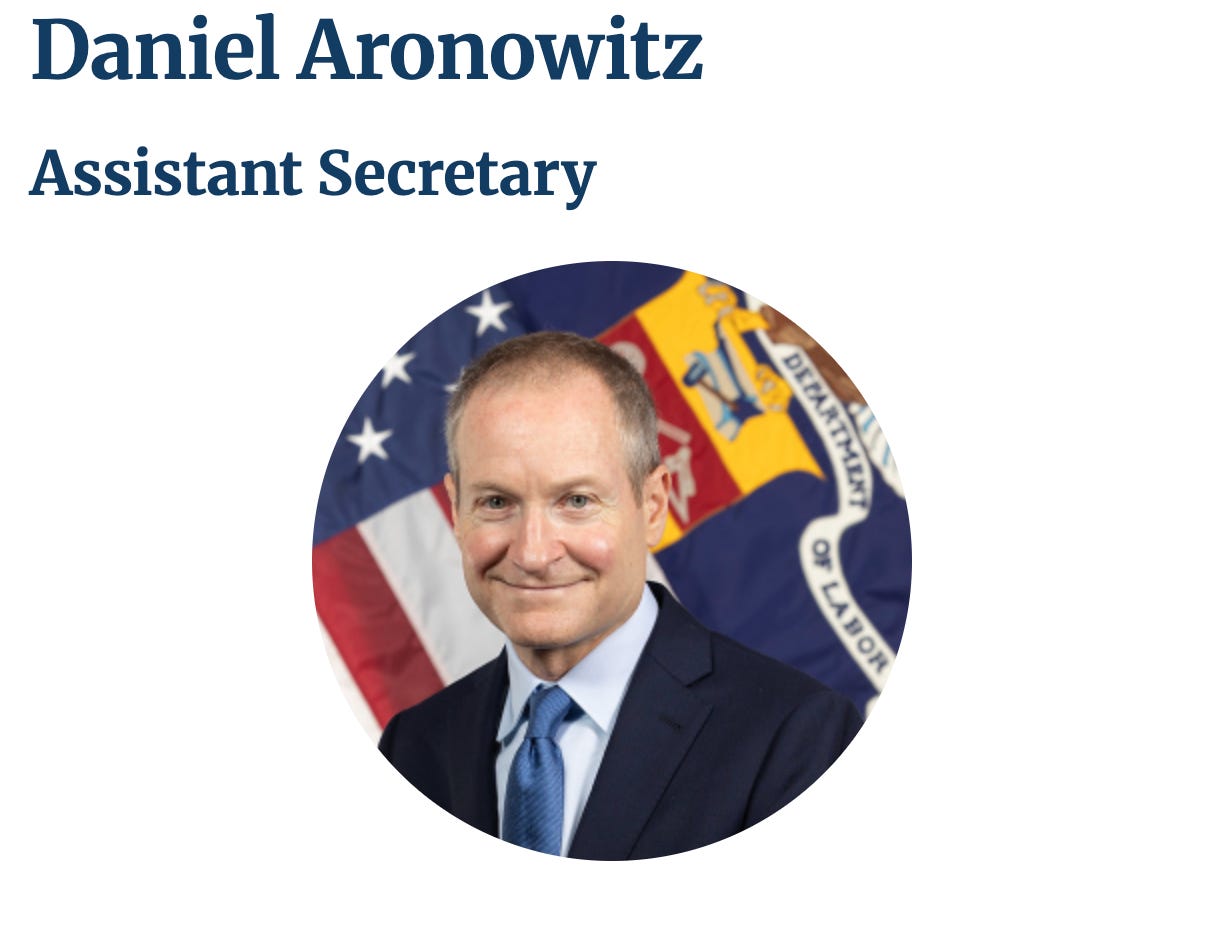
Six months later, Aronowitz was confirmed as Assistant Secretary of Labor for the Employee Benefits Security Administration — EBSA — the agency that enforces the fiduciary law his former company insured against. He forfeited $18.8 million in cash to take the seat.
Three months after that, his office proposed a rule.
The comment period on that rule closes June 1st.
The Walk-Away: What $18.8 Million Tells You
Federal financial disclosures are usually read as asset inventories — who owns what stock, what they’re divesting on the way in the door. The standard story is “Cabinet officer divests holdings worth $X.” The divestiture is the cure, and the headline follows the cure.
Aronowitz’s disclosure tells a different story, because the most significant number on it is a payment he didn’t receive.
When Aronowitz resigned from Encore Fiduciary on May 2, 2025, to accept his EBSA nomination, he was entitled to an earnout payment — his share (~44%) of the $42.7 million aggregate earnout from the 2022 sale of Euclid Fiduciary to Specialty Program Group. The payment was scheduled for approximately June 1, 2025. His OGE-278 filing states the outcome plainly: “I will forfeit my interest in that earnout when I resign from the company on May 2.”
Approximately $18.8 million. Gone.
The legal framework for ethics in government treats this as tidy. He can’t divest something he doesn’t own; he forfeited it voluntarily. The conflict is cured.
But there’s a different way to read that number: as a floor estimate of what the EBSA seat was worth to him, his network, or his cause.
Rational people do not walk away from $18.8 million in liquid cash for a Senate-confirmed regulator job that pays a government salary. They do it because the seat represents access to something more valuable — the ability to write the rules that govern the industry they came from.
Aronowitz had spent his entire career inside that industry. His $642,000 annual salary from Encore is the compensation-history number that can’t be divested. You can’t un-receive fourteen years of paychecks from an ERISA fiduciary-liability underwriter. You can recuse yourself from specific matters involving your former employer — but you can’t recuse yourself from your own professional formation, your own theory of how the law should work, your own opinion about whether ERISA litigation is a scam.
Encore Fiduciary’s Theory of the Case
Encore Fiduciary — previously Euclid Fiduciary, rebranded after Specialty Program Group’s acquisition — is in the business of pricing ERISA fiduciary-breach risk. (SPG is a subsidiary of Hub International, one of the largest insurance distribution companies in North America, owned principally by Hellman & Friedman.) Its core product: insurance that pays out when an employer loses an ERISA class action or settles one under litigation pressure.
The economics of that business are straightforward. Fewer meritorious claims, fewer payouts. Favorable pleading standards — those that let defendants knock out cases at the motion-to-dismiss stage, before discovery — reduce both frequency and severity of claims. A regulatory environment that raises the bar for plaintiffs is the most profitable possible state for a fiduciary-liability underwriter.
Encore has said so in court.
On January 15, 2025, Encore filed an amicus brief in Cunningham v. Cornell University (No. 23-1007), a case before the Supreme Court on ERISA pleading standards. The press release headline: “End ERISA Litigation Abuse By Requiring Federal Courts to Weed Out Meritless Cases Based on False and Misleading Evidence.”
Aronowitz, then still president of Encore, filed that brief in his corporate capacity. His public statement: “The claims in the Cunningham case are part of a pattern of turning voluntary employee plans into unfair liability traps. Our goal was to document the ERISA litigation abuse for the Supreme Court, and to advocate for fair fiduciary pleading standards that protect fiduciaries who diligently follow best practices.”
That is Encore’s theory of the case: litigation is abusive, fiduciaries who follow process deserve deference, courts should filter more aggressively.
He filed that brief in January. He forfeited the $18.8 million in May. He was confirmed to run EBSA in September.
The Side-by-Side
In March 2026, EBSA released the proposed rule: Fiduciary Duties in Selecting Designated Investment Alternatives — the “Investment Selection Rule.” Aronowitz personally framed and defended the rule at industry conferences across the spring: National Association of Plan Advisors NAPA’s (National Association of Plan Advisors) 401(k) Summit in Tampa (April 19–21), the Plan Sponsor Council of America, ASPPA (American Society of Pension Professionals & Actuaries).
His framing at NAPA on March 30, 2026: “ERISA is a law of process.” Fiduciaries who follow process are “entitled to deference by courts if their discretionary decisions are challenged.” The rule “gives plan fiduciaries discretion and flexibility in choosing plan investments.”
Compare that to Encore’s January 2025 amicus position: fiduciaries who “diligently follow best practices” deserve “fair fiduciary pleading standards.” Courts should “weed out meritless cases” against fiduciaries who followed process.
The structure is identical. Process compliance as a substantive shield. Judicial deference to documented process. The plaintiffs’ bar as the problem, not the fiduciary.
The Investment Selection Rule operationalizes that theory in federal regulation. Six factors — performance, fees, liquidity, valuation, benchmarking, complexity — that fiduciaries must “objectively, thoroughly, and analytically” consider. Twenty safe-harbor examples. And the rule’s explicit asset-neutrality, in Aronowitz’s framing at NAPA: “responsible fiduciaries decide what investments go into a retirement plan, not plaintiff lawyers or regulators.”
That line is verbatim Aronowitz at NAPA on March 30, 2026. It is also the animating argument of Encore’s amicus brief.
“Process, Discretion, Deference”
At NAPA in April, Aronowitz wasn’t just defending a rule. He was prosecuting an argument he’s been making for years.
“Hundreds of excessive fee and performance malpractice cases have been filed against American plan fiduciaries in the last 15 years by an enterprising and ever-growing ERISA plaintiffs bar.”
“The private retirement system has been swamped with lawsuits challenging fee and investment decisions, with over half of jumbo plans sued in the last 10 years — litigation that has almost exclusively benefited plaintiff lawyers who have secured well over $500 million in fees in these cases whereas most plan participants take home only a token $25 to $100. This is a scam.”
“Litigation risk — not investment quality — is the main barrier preventing private-sector workers from accessing certain asset classes.”
These are not the words of a neutral regulator describing a technical rulemaking. They are the words of an insurance executive describing the regulatory state his industry has long sought — and is now obtaining.
The trade press has covered the rule. NAPA-Net and PlanSponsor have both run stories on Aronowitz’s public defense of the Investment Selection Rule, characterizing his framing as “process-neutral” and noting that industry groups have responded favorably. What the trade press hasn’t done is the side-by-side: Encore’s amicus position from January 2025, next to the rule text from March 2026.
That comparison is this story.
What the Comment Period Closing Means
The Investment Selection Rule’s comment period closes June 1, 2026.
Comments are public. The named-commenter record will be available after the comment period closes. One question the comment record will answer is whether Encore Fiduciary, Specialty Program Group, or Hub International submits a comment endorsing the rule their former president proposed.
If they do, that is the circularity finding made explicit.
If they don’t, the circularity was already accomplished before the comment period opened: the rule reproduces the position they paid Aronowitz to advocate, in the industry venues, in the Supreme Court amicus briefs, for fourteen years. They don’t need to comment. The rule is already their comment.
For readers who want their voices in the record: the rule is Fiduciary Duties in Selecting Designated Investment Alternatives, DOL/EBSA. The docket is public. Consumer-side organizations — the AFL-CIO, Better Markets, the Pension Rights Center — are likely filing comments. Comments from workers and beneficiaries are accepted alongside industry submissions.
The Compensation-History Frame
This piece is one in a series tracking a pattern across the Trump administration’s implementation of the One Big Beautiful Budget Act and its regulatory corollaries: appointees whose pre-government compensation history is concentrated in the industries they now regulate, and whose early-tenure rulemaking is consistent with those industries’ stated positions.
The Aronowitz case is the sharpest single-subject specimen in that set — not because of the $18.8 million forfeiture, though that is striking, but because the rule-mirrors-amicus observation is mechanically verifiable. You don’t need to infer intent or reconstruct private conversations. You need a Federal Register notice and a Supreme Court amicus brief, both public documents.
The Ethics in Government Act framework offers two cures for financial conflicts: divestiture of assets and recusal from specific matters. Divestiture addresses what you own. Recusal addresses individual transactions. Neither addresses regulatory orientation — the professional theory of how the law should work that a fourteen-year career inside an industry instills, and that a single rulemaking can codify in federal regulation.
That is not an argument that Aronowitz did anything illegal. He was Senate-confirmed, 51-47, on a party-line vote, after a public hearing. The rule is going through notice-and-comment. The legal framework permits this.
The story is structural: when a regulator’s first major rulemaking reproduces his former employer’s litigation position argument by argument, the political economy of who got selected for the seat becomes the analytical question. Not “is this corruption.” This is how the system selects who gets to write the rules.
The RAMM documents the connections that beat reporting can’t see:
4,776+ sourced events at capturecascade.org.
1,988 Counties with signals of potential detention center expansion (Federal contracts, 287(g), real estate traces, etc) at detention-pipeline.transparencycascade.org my site that tracks signals of potential cooperation with ICE and Border Patrol.
129 Community fights over detention capacity built out tracked.
All of this is self-funded, and paid subscriptions are the only way I can continue to do this long term.
Sources
Tier 1 — Primary documents
ProPublica, Trump Team Financial Disclosures, Daniel Aronowitz entry: https://projects.propublica.org/trump-team-financial-disclosures/appointees/aronowitz-daniel/
Encore Fiduciary amicus brief press release, Cunningham v. Cornell University (No. 23-1007, January 15, 2025): https://www.prnewswire.com/news-releases/encore-fiduciary-in-amicus-brief-to-supreme-court-end-erisa-litigation-abuse-by-requiring-federal-courts-to-weed-out-meritless-cases-based-on-false-and-misleading-evidence-302351225.html
DOL/EBSA, Fiduciary Duties in Selecting Designated Investment Alternatives, 91 Fed. Reg. 16088 (March 31, 2026): https://www.federalregister.gov/documents/2026/03/31/2026-06178/fiduciary-duties-in-selecting-designated-investment-alternatives
Tier 2 — Trade press
NAPA-Net, “EBSA’s Aronowitz Outlines Fiduciary Framework for Investment Selection Rule” (March 30, 2026): https://www.napa-net.org/news/2026/3/ebsas-aronowitz-outlines-fiduciary-framework-for-investment-selection-rule/
401(k) Specialist, “Aronowitz Makes Case Against Frivolous ERISA Lawsuits at NAPA” (April 19, 2026): https://401kspecialistmag.com/aronowitz-makes-case-against-frivolous-erisa-lawsuits-at-napa/
PSCA, Aronowitz confirmation: https://www.psca.org/news/psca-news/2025/9/aronowitz-confirmed-to-lead-ebsa/
Holland & Knight, “A New Chapter at EBSA”: https://www.hklaw.com/en/insights/publications/2025/09/a-new-chapter-at-ebsa-dan-aronowitz-cleared-by-senate
Cross-reference — This piece is the first published RAMM entry in the compensation-history-as-diagnostic-layer series. Companion specimens: Kenneth Kies (Treasury/tax), Martin Makary (FDA), Abraham Sutton (CMMI), Howard Lutnick (Commerce). Architectural pattern piece forthcoming.