

The Moral Battlefield, Part 3: The Drawdown That Wasn’t
How the Administration Planted the Resistance Everywhere
Part 1 laid out the framework: Boyd’s moral warfare, Arendt’s distinction between power and violence, witness against false witness. Part 2 was the battle report from Minneapolis. Part 3 is what happened when the administration tried to escape the trap — and walked into a worse one.
The New False Witness
Thursday, January 29, 2026. The Bishop Whipple Federal Building in Minneapolis. Tom Homan — the man who designed the family separation policy that took 3,000 children from their parents — stood at a podium two days after Gregory Bovino had been sent back to California.
“My main focus now is drawdown,” Homan said. He spoke of “targeted enforcement operations.” He told reporters he didn’t come to Minnesota “for photo-ops and headlines” — a pointed dig at the commander he’d replaced.
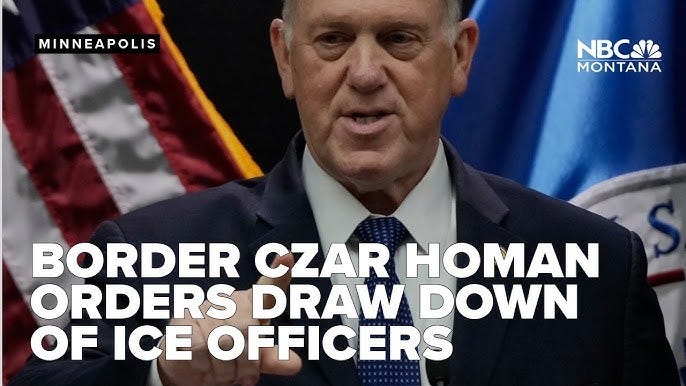
ABC News ran the chyron. NBC News did the same.
The narrative of a cooling-off period took hold.
But the operations didn’t shrink. They distributed.
In Part 1, I described the progression that runs inside a coalition maintaining false witness: uncertainty, doubt, mistrust, confusion, disorder. By January 29, the administration had traveled that progression all the way to disorder — the commander removed, the DHS Secretary under bipartisan fire, even Fox hosts pushing back on official claims. Bovino’s false witness had been crude: call the dead “domestic terrorists” and “assassins,” contradict the video, dare people to believe their own eyes. It collapsed because it was too easily falsified. Six camera angles beat one press conference every time.
Homan’s false witness was structurally different. He didn’t contradict the footage. He changed the subject.
“Drawdown” wasn’t a lie about what had happened. It was a lie about what was happening next. The tactical spectacle — the masked agents, the unmarked vehicles, the tear gas on residential streets — would wind down. The cameras would have less to film. The press would move on.
But the operations didn’t end. They relocated to places where the administration assumed the documentation infrastructure didn’t exist.
If you fought the FUD wars, you recognize this move. When Microsoft’s direct attacks on Linux failed — when the mismatch between their claims and what developers could see with their own eyes became unsustainable — they didn’t stop. They shifted to patent threats, licensing pressure, backroom deals with hardware vendors. They moved the conflict from the visible layer, where open source had overwhelming advantage, to the institutional layer, where the asymmetry favored them.
Homan did the same thing. Bovino fought on the moral level and lost — because Minneapolis had better witness infrastructure. Homan’s move was to take the conflict somewhere the witness infrastructure hadn’t reached yet.
That was the theory. Here’s what actually happened.
The Network Learns
Bureaucracies repeat. Networks adapt.
Before Bovino brought Operation Metro Surge to Minneapolis, he ran the same rigid playbook in Chicago during the fall of 2025. “Operation Midway Blitz.” The administration claimed hundreds of arrests targeting dangerous criminals. The reality, as usual, was divorced from the claims.
On September 12, ICE agents pulled over Silverio Villegas González in the suburb of Franklin Park. DHS said he’d dragged an agent “a significant distance” with his car. The agent, they said, was “seriously injured.” Bodycam footage — obtained by the Chicago Sun-Times and ABC7 through a Freedom of Information Act request to the Franklin Park Police Department — showed the agent describing his own injuries: “Nothing major.” He’d been “dragged a little bit.” A left knee injury. Some lacerations. The man he shot was killed by a bullet that entered the back of his neck at close range.
No ICE agents were wearing body cameras. A Trump executive order had ended the federal mandate.
On October 4, Border Patrol agent Charles Exum shot Marimar Martinez five times in Brighton Park. DHS called her a “domestic terrorist” who had rammed federal agents with her car. In a group Signal chat with other agents afterward, Exum wrote: “I fired 5 rounds and she had 7 holes. Put that in your book boys.” The government dropped the charges against Martinez two months later — and admitted in court that the ramming never happened.
It was during the civil use-of-force lawsuit filed by Block Club Chicago, the Chicago Headline Club, and other media organizations that U.S. District Judge Sara Ellis examined Bovino’s conduct in Chicago. Her 233-page ruling found his three days of sworn testimony “not credible.” He was “evasive,” she wrote, “either providing ‘cute’ responses to Plaintiffs’ counsel’s questions or outright lying.” Bovino admitted he’d lied about being hit by a rock before deploying tear gas. He actually deployed the gas first.
Ellis’s ruling documented what 500 hours of body camera footage showed: agents firing pepper balls at a Presbyterian minister. Agents tackling bystanders and bashing a man’s head on the street. An agent using ChatGPT to fabricate a use-of-force report. Official accounts that labeled “neighborhood moms and dads, Chicago Bears fans, people dressed in Halloween costumes, and the lawyer who lives on the block” as “professional agitators.”
None of this stopped Bovino from bringing the identical playbook to Minneapolis two months later. Traditional bureaucracies don’t learn. They can’t. Their orientation is captured — the mental model that determines what registers as information has already excluded the information that would force adaptation. That’s the mechanism I described in Part 1: a corrupted orientation layer eats the facts before they reach the place where they’d do any good.
But the network learned.
Each city’s documentation broadcast the federal failure modes to the next. The legal strategies. The body camera gaps. The pattern of false witness — “domestic terrorist,” “dragged a significant distance,” “rammed agents” — and the pattern of collapse when footage surfaced. Independent media, decentralized legal observers, and civil rights attorneys had already transmitted the antidote before the administration arrived in Minneapolis.
The 3D-printed whistles that originated as a response to the Chicago sweeps didn’t require a top-down order to reach the Twin Cities. They spread virally because they worked. That’s what open-source resistance looks like: the tactics fork, adapt to local conditions, and deploy without anyone issuing an order.
If you shipped code during the FUD wars, you recognize the architecture. The same way a patch propagates through a distributed network — not because someone at the center pushed it, but because every node that adopts it confirms that it works — the Chicago documentation infrastructure propagated to Minneapolis and then outward. No central authority. No chain of command. Just working solutions spreading through a network of people facing the same problem.
Minneapolis could receive and amplify that transmission because it had 170 years of organizational infrastructure to plug it into. The Teamsters of 1934. The anti-war movement. The American Indian Movement. George Floyd and everything built afterward. The city’s organizing culture was already legible enough to copy — and now it was exporting.
The Flying Squadrons
In 1934, Minneapolis Teamsters invented the “flying squadrons” — mobile response units and motorcycle couriers that could converge on any point where scabs or police appeared. They ran the operation out of a garage on Chicago Avenue: a dispatcher, a bank of phones, couriers radiating outward. It was the original distributed observation-and-response network, built because they needed to cover more ground than a fixed picket line could hold.
In 2026, it’s caravans following ICE vehicles. Signal chats cascading alerts — location, vehicle description, number of agents, direction of travel. Witnesses materializing within minutes. The organizational logic is identical. The infrastructure has changed.
The garage is everywhere now. The command center doesn’t need a physical location because the architecture has no center. And because it has no center, it travels.
When Homan expanded operations outward — packaging the expansion as a “drawdown” for the Sunday shows — the people who had driven into downtown Minneapolis for the Day of Truth and Freedom drove home with their moral cohesion intact. They didn’t leave the orientation at the city limits. They took the infrastructure with them.
You can see the model running today, hundreds of miles from Chicago or Minneapolis.
I can describe what it looks like because I live inside one.
A Suburb in Michigan
Heather Cox Richardson says the American people are waking up. That’s the right observation, but it’s not quite the right metaphor. Waking up implies the capacity wasn’t there — that people were inert and the crisis created something new. What I’m watching is different. The capacity was always here. What the crisis provided was the trigger.
Southeast Michigan has its own organizational lineage, and it runs as deep as Minneapolis’s — through different channels. The UAW sit-down strikes in Flint, 1936-37 — two years after the Teamsters. The civil rights movement that organized out of Detroit. Viola Liuzzo, who drove from here to Selma. And in my neighborhood, houses that were stations on the Underground Railroad — the same decade Anthony Burns was marched to the harbor in Boston. The soil isn’t blank. It’s been cultivated for 170 years by a tradition that runs parallel to Minneapolis’s, through auto plants instead of flour mills, but with the same depth.
What the Minneapolis footage did was crack the orientation. Millions of people watched the administration claim “domestic terrorist” while video showed a woman turning her steering wheel away. They watched “assassin” while footage showed a man with his palm raised. The reorientation was involuntary — the mismatch between official claims and observable reality was too large for the existing frame to absorb. That’s Boyd’s mechanism. That’s Tet.
But unlike Tet, the reoriented population had somewhere to go.
The awakening turned to activation. People started talking about what they could do. And what happened next wasn’t one thing. It was an ecosystem — multiple channels activating simultaneously, through both structured and unstructured paths.
Some people already knew Signal. They started chats within days. Others had contacts in Minnesota — through open source communities, through professional networks, through friendships built over years of collaborative work — and reached out directly for advice. Others were active in BLM, or remembered the civil rights movement, or had walked picket lines, and they remembered. The techniques were already in their bodies. The crisis reactivated what was dormant.
Major organizations began running formal trainings — operational security, de-escalation techniques, know-your-rights protocols — starting in January. The institutional support layer was there for people who needed structure. But the organic transmission was happening in parallel, faster, through the same dark networks that have always carried resistance techniques in this country: trust relationships that predate the crisis, activated for a new purpose.
And the techniques were adapted. Not just received — forked. New tactics were devised around the specifics of the local community. The terrain is different from Minneapolis. The demographics are different. The relationship between local law enforcement and federal agents is different. What works on a dense urban grid doesn’t map directly onto a suburb where the bus routes weave through residential neighborhoods and the nearest courthouse is twenty minutes away. The solutions that emerged were shaped by the local conditions, the way any good fork is shaped by its deployment environment.
Information flows between nodes in structured and unstructured ways — organized trainings and informal Signal forwards, direct advice from Minneapolis organizers and independently invented solutions, shared documents and whispered conversations at school pickup. A mesh, not a pipeline. And a mesh can’t be cut the way a pipeline can, because the same technique arrives through three channels simultaneously.
I have talked to multiple sources to documented what this looks like in a small suburban town of 20,000 people hundreds of miles away from MN.
In one neighborhood — 200 homes — sixty people are in a Signal network that has been running structured counter-surveillance operations for weeks. They don’t call them patrols. They call them “commutes” — language chosen to be defensible under scrutiny, the same instinct that made Minneapolis legal observers carry laminated cards explaining their rights. The discipline arrived with the tactics.
The system works like this: dispatchers staff a live phone line during scheduled shifts. Observers in the field — walking, driving, stationary — call in and stay connected. The dispatcher tracks plates, compiles reports, maintains situational awareness so the person on the ground can keep their eyes on what’s happening instead of fumbling with a phone. When an unmarked vehicle appears, the network responds within minutes.
That’s the garage on Chicago Avenue. A dispatcher, a bank of phones, observers radiating outward. Running on a phone bridge in suburban Michigan, ninety-two years later.
The network has already been tested. Observers witnessed an arrest in real time — they use the word “abduction” — documented it, and provided immediate support to the family. The system held. It worked under the conditions it was built for.
And here is the detail that tells you this isn’t a neighborhood watch playing vigilante. The functions are compartmentalized. Separate Signal chats for separate operations. Counter-surveillance is siloed from mutual aid. If you work commute, you don’t deliver groceries to affected families. If you do mutual aid, you don’t patrol.
The person who observes an arrest cannot be linked to the person who shows up at the family’s door afterward. The surveillance function and the support function are operationally isolated — so that compromising one doesn’t compromise the other, and so that the families receiving help can’t be identified through the people who documented their arrest.
The compartmentalization came from multiple sources — transmitted advice from Minneapolis, formal training from organizations, and the logic of the work itself. When you’re actually running both functions simultaneously, you realize immediately why the same person can’t do both.
The same model is running across the town. Multiple neighborhoods. Multiple dispatch systems. The infrastructure replicated at the neighborhood level and then networked across neighborhoods through inter-group coordination — the same topology as the Teamsters’ flying squadrons, except the replication happened in weeks rather than years.
The documentation infrastructure reached operational maturity before the enforcement operations arrived.
The tactics arrived before the agents did.
The Miscalculation
Homan assumed that Arendt’s space of appearance — the shared space where people act in concert and, in acting, constitute the reality that makes collective action possible — required density. The downtown plaza. The courthouse steps. The kind of concentrated urban terrain where cameras converge naturally and crowds form spontaneously.
He expanded outward to escape that terrain. Dilute the resistance. Operate where the documentation infrastructure doesn’t exist.
He misunderstood the nature of power. Again.
In Part 1, I described Arendt’s central insight: power is not something you possess. It’s something that exists only when people act in concert. It emerges from collective action and vanishes the instant the group disperses or fragments. It cannot be stored.
But it can be carried. And it can be activated — by a trigger event, through channels that already exist, in communities that already have the organizational depth to receive it. The suburbanites who watched the Minneapolis footage didn’t just become aware. They became reoriented. And then they plugged into networks — some inherited, some transmitted, some built from scratch — that converted that reorientation into organized action within weeks.
Homan’s expansion brought the federal menace directly to the doorsteps of the moderate, conservative-adjacent center. That’s exactly the demographic whose conversions are most devastating to the administration’s coalition.
In Part 2, I tracked the conversions: Chris Madel, the Republican attorney. Maria Bartiromo on Fox. Andrew Schulz in the manosphere. Sixty CEOs from Target, 3M, UnitedHealth Group, and Best Buy — who signed a letter on January 25 through the Minnesota Chamber of Commerce calling for “immediate de-escalation.” In 1934, the Citizens Alliance funded strikebreakers and controlled local media to crush the Teamsters. In 2026, the corporate establishment asked everyone to calm down. That reversal is moral isolation measured in institutional defections.
Homan’s suburban expansion accelerated that isolation. The administration can frame downtown Minneapolis as hostile, radicalized territory on evening cable news. They cannot frame a cul-de-sac in Michigan that way.
When sixty people in a 200-home neighborhood are running dispatch shifts to track federal agents — in a community whose organizational roots go back to the Underground Railroad, whose muscle memory includes the UAW and the civil rights movement, and whose current infrastructure was built in weeks through the same dark networks that have carried resistance techniques across this country since before it was a country — that’s not a fringe protest. That’s the American tradition operating exactly as designed.
Microsoft made the same miscalculation. They assumed open source was a phenomenon of elite developers in a few visible communities — MIT, Berkeley, a handful of European universities. They didn’t understand that the organizational logic would replicate into every environment where the problem existed and the solution worked. Enterprises. Governments. A teenager’s bedroom in Brazil. By the time Microsoft recognized the scale of adoption, the adoption was the market.
Homan is making the same discovery. The resistance infrastructure isn’t in Minneapolis. It’s everywhere the problem exists and the solution works. And a Michigan suburb running structured, compartmentalized, field-tested dispatch operations — built on 170 years of its own organizational depth, reinforced by techniques transmitted through dark networks from Portland and Chicago and Minneapolis — tells you the solution works.
The administration didn’t stretch the resistance thin. They planted it in soil that was already prepared to grow it.
The Layer Underneath
But here’s where the framework strains.
The operations didn’t just distribute geographically. The surveillance and detention infrastructure distributed with them — and that infrastructure was designed from the beginning to be invisible.
In December 2025, just as Metro Surge began, ICE awarded a two-year, $121 million contract to BI Incorporated — a subsidiary of GEO Group, the private prison company whose executives rotate through ICE leadership positions. I documented BI’s architecture in the Cascade series: the company that monitors 253,875 immigrants through ankle monitors and facial recognition now gets paid to hunt the ones who flee. The contract authorizes private investigators to track individuals using commercial databases and physical surveillance, incentivized by bounty-hunter-style bonuses for high success rates.
Meanwhile, CoreCivic has been securing contracts to reopen the 1,600-bed Prairie Correctional Facility in Appleton, Minnesota — adding detention capacity for the people the expanded operations are designed to catch.
This is the mismatch at scale. “Drawdown” means fewer agents in tactical gear on downtown streets. It means enforcement through a surveillance infrastructure that is intentionally designed to be invisible. BI’s skip tracers don’t wear CBP badges or arrive in Black Hawks. They look like your neighbors. Palantir’s ELITE system — the algorithmic targeting platform where agents draw shapes on a map and the software shows them everyone inside — doesn’t require a spectacle to function. It requires a database and an internet connection.
In Part 1, I argued that the antidote to false witness is witness — people who stand behind what happened, embodied, present, staking their credibility on testimony. The cell phones and the whistles broke the OODA loop of uniformed agents in marked vehicles because the agents were visible. The mismatch between official claims and observable reality was continuous and undeniable.
How does distributed witness work against algorithmic targeting and private bounty hunters operating in secret?
I don’t have a complete answer. That’s an honest statement, not a rhetorical device.
Boyd’s framework predicts that invisible enforcement is harder to resist on the moral level — because the mismatch between claims and reality is harder to document when the operations are designed to leave no visible trace. You can’t film what you can’t see. The FUD wars had a version of this problem: Microsoft’s patent threats operated through legal channels that were opaque to the developer community. The open-source response — patent pools, legal defense funds, institutional alliances — required a different kind of infrastructure than “just show people the code.”
The resistance infrastructure that won the moral battlefield in Minneapolis was built over 170 years. The suburban version of the specific techniques — the dispatch model, the compartmentalization, the counter-surveillance protocols — is weeks old. But the communities receiving those techniques aren’t starting from zero. They have their own organizational depth — the UAW, the civil rights movement, the Underground Railroad. What’s new is the specific application. What’s old is the capacity.
The infrastructure is holding. It’s been tested under operational conditions, it’s witnessed an arrest and supported the family, it’s running structured dispatch shifts across multiple neighborhoods. But it hasn’t been tested against the full weight of direct, sustained federal pressure backed by corporate surveillance tools and private investigators with financial incentives to find people. The question isn’t whether the capacity exists. The question is whether weeks of specific tactical experience can absorb the kind of sustained pressure that Minneapolis absorbed with generations of practice.
Moral victories don’t stop deportation flights. People are still being arrested, detained, removed from their communities. Children aren’t going to school. Families aren’t seeking medical care. The physical cost of this occupation is ongoing and catastrophic, and the shift from spectacle to surveillance may make that cost harder, not easier, to document.
What Boyd Would Recognize
But one thing is certain, and Boyd would recognize it immediately.
The administration’s own strategic decision — the geographic expansion packaged as “drawdown” — brought the federal menace to terrain where the resistance infrastructure was already taking root. The Signal chats were already running. The dispatch systems were already staffed. The administration didn’t create the opposition by expanding. It expanded into an opposition that had activated ahead of it.
Bovino fought the war with menace — the display of overwhelming physical force. He lost because Minneapolis had better witness infrastructure. The moral level defeated the physical level, exactly as Boyd predicted.
Homan is fighting the war with concealment — moving enforcement to the institutional and surveillance layers where visibility is low. That’s a smarter strategy. It targets the resistance’s actual advantage.
But concealment has its own vulnerability. It requires that the concealed operations stay concealed. Every time a skip tracer is spotted, every time an unmarked SUV idles too long near a school, every time Palantir’s targeting produces an arrest that the community can document — the concealment fails. And each failure of concealment is another mismatch, another moment when the gap between “drawdown” and reality becomes visible. Another opportunity for the progression to advance inside the administration’s coalition.
The architecture that won the moral battlefield in Minneapolis is now replicating across the country — not into blank terrain, but into communities with their own deep organizational roots. It’s already operational: dispatchers, shifts, compartmentalized functions, field-tested under real conditions. Whether it can sustain that level of organization under the full weight of an enforcement apparatus that has learned to hide remains the open question.
The administration bet that the resistance required the density of a downtown plaza. They bet wrong. The garage on Chicago Avenue was never just a building. It was an organizational logic — and that logic propagates through dark networks, lands in communities with a century of their own organizational depth, and reaches operational maturity in weeks.
The American people aren’t waking up. They’re activating. And the infrastructure they’re activating didn’t start in 2026. It started in the 1850s, in the 1930s, in the 1960s, in server rooms in the 1990s, in the streets after George Floyd in 2020. The current crisis is the trigger. The capacity was always there.
They planted the resistance in soil that was already prepared to grow it.
Why I’m Publishing This
I’m publishing the operational model — the dispatch system, the compartmentalization, the activation sequence, the dark network transmission — because the information is more valuable in the open than it is hidden.
They already know who I am. They’ve been surveilling my work and my networks for months. What they can’t surveil is the thousand people who will read this and start a dispatch system in their town next week. The growth rate is the defense. That’s the logic of open source — Linus didn’t keep the kernel secret to protect it. He published it, because adoption at scale was a stronger defense than concealment.
But the operational model isn’t the piece’s purpose. The piece’s purpose is orientation.
The distributed observation network — the cell phones, the Signal chats, the dispatch systems, the thousands of people documenting what’s happening in their neighborhoods — generates witness. Raw witness. Footage, timestamps, plate numbers, arrest reports. Without orientation, that witness is noise. The footage doesn’t explain itself. The pattern doesn’t announce itself. Someone has to connect the dispatch system in Michigan to the garage on Chicago Avenue. Someone has to show why the “drawdown” is a lie and what the lie is designed to conceal. Someone has to make the framework legible so that the next community that activates can orient faster than the last one.
That’s the sense-making layer. That’s what independent journalism does in this architecture. Not neutral observation. Orientation infrastructure.
The administration is becoming increasingly erratic — maintaining false witness across too many domains simultaneously, the cognitive cost producing the unpredictability that makes the next phase dangerous. Minneapolis. The suburbs. Congress. Iran. The Epstein files. The same people, the same captured orientation, the same lies, cracking under compound pressure across every theater at once. That’s not strength. That’s what disorder looks like from inside a collapsing orientation. It’s the late stages of Boyd’s progression, running to completion.
The resistance doesn’t need more footage. It needs orientation. It needs the pattern, the framework, the map.
That’s what I’m building. That’s why I’m here.
My mission is to help the resistance orient in the chaos.
The complete documented timeline of events is available at capturecascade.org/viewer
Series Navigation
The Moral Battlefield — Boyd, Arendt, and the war beneath the war.
Part 3: The Drawdown That Wasn’t (this article)
Part 4: The Institutional Cascade
Part 5: The Second Theater
Sources
Homan press conference (January 29, 2026): NPR, ABC News, CBS News
Bovino removal: NBC News (January 26-27), The Intercept
Silverio Villegas González shooting (September 12, 2025): Bodycam footage obtained by Chicago Sun-Times and ABC7 Chicago via FOIA to Franklin Park Police Department. NBC News
Marimar Martinez shooting (October 4, 2025): Agent Charles Exum’s text messages revealed in court proceedings before U.S. District Judge Georgia Alexakis. Charges dismissed with prejudice, November 2025. Government admitted ramming did not occur. Evidence released February 2026.
Judge Sara Ellis ruling on Operation Midway Blitz: 233-page opinion in civil use-of-force lawsuit filed by media organizations. Block Club Chicago, WTTW, CBS Chicago, FOX 9
Sixty Minnesota CEOs letter (January 25, 2026): Minnesota Chamber of Commerce, MPR News, CNN
Administration expansion strategy: CNN (February 2026): “The Trump administration plans to double down on targeted immigration enforcement, taking Tom Homan’s playbook in Minneapolis and applying it to multiple cities nationwide.”
The detail about 60 people in a 200-home neighborhood running organized dispatch shifts is wild. This isn't fringe activism. The through-line from the 1934 Teamsters to a Signal chat in 2026 sounds like a stretch... until you realize the organizational logic is literally identical.
Thank you.
I have found your work really informative, and interesting. Each new article is a great addition and I hope that you continue to do this fantastic work.