

The Moral Battlefield, Part 2: How Minneapolis Outmaneuvered the Administration in the Information War
Minneapolis: The Boyd Framework in Action
Minneapolis: The Boyd Framework in Action
The Trump Administration’s Strategy (Physical-First)
The federal government chose to fight on the physical level.
Three thousand agents deployed. Overwhelming force concentration. Early morning raids, tactical gear, unmarked vehicles. The commander with the most aggressive use-of-force record in the agency. The assumption: physical dominance produces compliance.
The administration treated Minneapolis like a problem to be hammered into submission.
Minneapolis’s Strategy (Moral-First)
Minneapolis chose to fight on the moral level — and the resistance wasn’t a mob.
Mobs are morally and mentally fragmented by definition — reactive, undisciplined, easily provoked into mistakes that justify crackdowns. The Minneapolis coalition maintained distinctions: documentation versus confrontation, legal pressure versus direct action, economic strikes versus physical presence. Eighty-plus organizations coordinating through Signal chats, dispatching observers within minutes, maintaining discipline while varying tempo.
That discipline is moral cohesion. It’s what enabled the mental advantage — the ability to adapt, coordinate, and operate inside the administration’s decision cycle without fragmenting.
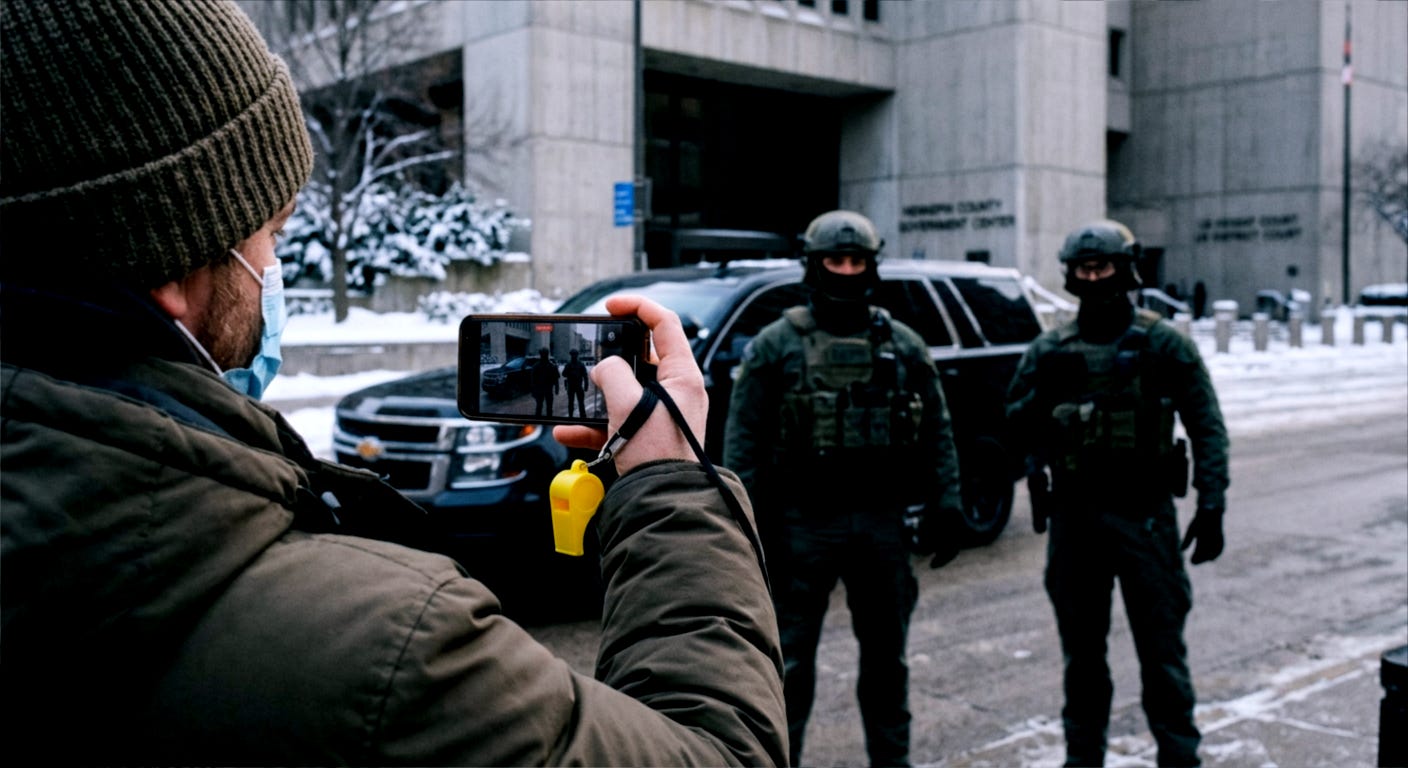
The infrastructure: Documentation networks activated immediately. Legal observer trainings at capacity, venues doubling in size. 3D-printed whistles distributed by the thousand — toy stores giving away bags of them. Caravans following ICE vehicles, jumping out to record at every stop. Counter-surveillance at the Whipple Building since August 2025. Help provided to released detainees.
They had whistles. The feds had guns. And the whistles were winning.
Inside Their Loop
The administration couldn’t keep its narrative straight because Minneapolis was documenting faster than they could spin. Here’s what tempo looks like in practice:
January 24, 2026. At approximately 9:14 AM, Border Patrol agents shot Alex Pretti outside a Minneapolis courthouse. By 9:47 AM, multiple camera angles were circulating on social media. By 10:30 AM, the claim that he “resisted attempts to disarm him” was contradicted — there was footage showing that agents had already removed Pretti’sF gun before firing. By noon, even Maria Bartiromo was pushing back on Fox: “How was he threatening Border Patrol? He was filming it.”
The administration’s afternoon press conference was outdated before it started. That’s what it means to be inside someone’s OODA loop.
The same pattern played out seventeen days earlier. January 7: Renee Good was killed. DHS immediately labeled her a “domestic terrorist” who had “weaponized her vehicle.” Within hours: Video showed her steering wheel turned to the right — away from the agent. Her last words: “That’s fine, dude. I’m not mad at you.” Mayor Frey reviewed the video and called it “bullshit.” The narrative collapsed before the press conference ended.
The administration was reacting to Minneapolis, not the other way around.
When Dana Bash asked Gregory Bovino on CNN what crime Alex Pretti had committed, he couldn’t name one. His answer: Pretti “injected himself where he did not need to be.”
That retreat — from “assassin who came to massacre” to “he was there and shouldn’t have been” — isn’t just a rhetorical failure. It’s the mental paralysis that follows moral collapse. Bovino had no frame that fit the facts. The sense-making system had failed.
Menace vs. Moral Strength
The administration deployed all of that as menace — not just force but the display of force, designed to create fear, break will, and force compliance. Two citizens were killed and called terrorists. Masked men were in unmarked vehicles. The message: resistance is futile and dangerous.
Minneapolis had moral strength. The coalition gave people the courage to keep documenting, keep marching, keep showing up in subzero temperatures. The menace didn’t break them because the moral bonds held.
The administration had menace but not moral authority. Every official claim was contradicted by video. Every label — “domestic terrorist,” “assassin” — was applied to people that the footage showed were no threat. When your own allies start doubting you, you’ve lost the ability to inspire. You can threaten, but you can’t hold a coalition together with threats alone.
Minneapolis’s Grand Ideal
Minneapolis had what the administration lacked: a grand ideal.
“We had whistles. They had guns” became the slogan — but the grand ideal underneath it was something larger: this is our city, and we will not let it be occupied. The vision wasn’t defined by the asymmetry. It was defined by what Minneapolis was defending — the right of a community to protect its own people, to refuse complicity, to insist that what happened here would be seen. The whistles were the method. The ideal was self-governance against coercion.
The administration had force but no vision that could survive contact with video.
Coalition unity through harmony: ISAIAH and faith groups. Teachers unions. Minnesota Nurses Association. SEIU announcing solidarity nationwide. Businesses closing by the hundreds on the Day of Truth and Freedom — 700 statewide, from the Guthrie Theater to a bookstore in Grand Marais near the Canadian border. The coalition didn’t need constant direction because they shared a frame.
Moral authority that provided courage: Chief O’Hara called the Pretti crime scene “contaminated” while Governor Walz railed against the “organized brutality against the people of our state.” The Timberwolves held a moment of silence. One hundred clergy accepted arrest at the airport, singing hymns as they were led away.
These voices gave people the courage to keep going. That’s moral authority — not ethical superiority, but the capacity to hold a coalition together under pressure.
The Conversions: Moral Isolation in Action
The Historical Parallel
In Boston in 1854, Anthony Burns — a fugitive slave — was marched to the harbor in chains, surrounded by federal troops, while fifty thousand people watched in protest. The enforcement of the Fugitive Slave Act was legal. It was also visible.
Amos Lawrence was a wealthy conservative Whig who had supported the Fugitive Slave Act. He believed in compromise, in obeying the law, in preserving the Union through accommodation.
After watching the spectacle of Burns being forced through the streets, he wrote:
“We went to bed one night old-fashioned, conservative, Compromise Union Whigs and waked up stark mad Abolitionists.”
The conversion wasn’t gradual. It was a breaking point — the moment when what the law required became impossible to reconcile with who he thought he was.
Minneapolis 2026
The conversions are happening in real-time.
Chris Madel was a Republican attorney running for governor of Minnesota. His profile rose in 2024 when he successfully defended a state trooper charged with murder. He was the lawyer you called when law enforcement needed defending.
When Renee Good was killed, he agreed to provide pro bono legal counsel to the ICE agent who shot her.
On January 27 — three days after Alex Pretti was killed — Madel posted a video announcing he was dropping out of the race.
“I cannot support the national Republicans’ stated retribution on the citizens of our state, nor can I count myself a member of a party that would do so.”
“Operation Metro Surge has expanded far beyond its stated focus on true public safety threats.”
He described speaking personally to law enforcement officers — “some Hispanic and some Asian” — who had been pulled over by ICE on pretextual stops. “Driving while Hispanic is not a crime. Neither is driving while Asian.”
That’s more dramatic than Amos Lawrence. Lawrence watched from the crowd. Madel was inside the apparatus — and converted while still advising the agent who killed Renee Good.
Maria Bartiromo is not a moderate. She is not a critic of the administration. She’s been one of its most reliable amplifiers for years on Fox News.
When Kash Patel tried to justify the Pretti shooting on her show, she pushed back: “How was he threatening Border Patrol? He was filming it.”
The automatic acceptance had cracked. The script wasn’t landing even with allies.
The CEOs: Sixty executives from 3M, UnitedHealth Group, General Mills, Best Buy, Target, and others signed a letter calling for “de-escalation.” In 1934, the Chamber of Commerce equivalent funded strikebreakers and controlled local media. Now corporate leaders were asking everyone to calm down.
Andrew Schulz — a manosphere podcaster, MAGA-aligned — was furious about the feds lying after the Pretti killing. Even that audience was skeptical.
What the Conversions Mean
The administration can survive criticism from the left. It was designed to provoke that criticism, to use it as fuel.
What it cannot survive is isolation from its own coalition.
Republicans questioning Republican operations. Fox hosts skeptical of administration claims. Business leaders calling for restraint. The people who were supposed to provide courage and confidence — now are providing doubt instead.
Each defection magnifies internal friction. Each public break makes the next one easier. When Maria Bartiromo hesitates, when Chris Madel defects, when CEOs distance themselves — that’s the progression from Part 1 running inside the administration’s coalition, not among its opponents.
The conversions are evidence that isolation is working.
Why Violence Would Lose
Alex Pretti was a legal gun owner with a valid permit in an open-carry state and he never drew his weapon. Agents tackled him while he was helping a woman. They removed his gun from his waistband, then they shot him more than ten times.
And they called him an assassin anyway.
That’s the lesson. A man who was legally armed, who never reached for his weapon, was killed and labeled a terrorist. Armed resistance wouldn’t change the administration’s framing. It would confirm it.
Some argue for armed resistance — use your Second Amendment rights, fight back, meet force with force. Boyd’s framework explains why this fails on every level.
Violence shifts the conflict to the physical dimension — exactly where the federal government has overwhelming advantage. On the physical level, armed resistance is suicide.
But it’s worse than that. Violence provides the moral justification the administration needs. “See, they really are domestic terrorists.” The narrative they’ve been trying to sell — protesters as violent extremists — finally becomes true. Violence fractures the resistance coalition. Moderates can’t support armed conflict. Business leaders won’t sign letters defending shootouts. Faith communities that organized airport protests won’t bless guerrilla warfare. The 80-organization coalition dissolves.
Violence hands the administration victory on all three levels. Armed resistance gives them the enemy they need. Documentation gives us the allies we need.
Political scientist Erica Chenoweth studied 323 resistance campaigns across the twentieth century. Her finding: nonviolent movements succeed twice as often as violent ones — because they’re harder to demonize, easier to join, and they fracture the regime’s support by maintaining the moral high ground that makes conversions possible.
Boyd would recognize this immediately: fight on the level where you have advantage. The federal government has overwhelming physical superiority. On the moral level, Minneapolis has cameras everywhere, infrastructure for distribution, and 170 years of organizational memory.
The Limits
The moral victory doesn’t end the occupation.
Agents remain in Minneapolis. People are still being arrested, detained, deported. The hidden cost — children not going to school, families not seeking medical care, undocumented residents afraid to leave their homes — is real and ongoing.
Bovino was removed. Tom Homan — a key architect and defender of the Trump administration’s “zero tolerance” immigration policy and the cruel family separation policies — took command. “I am staying until the problem is gone,” he said. The man who designed the policy that separated 3,000 children from their parents is now directing Minneapolis operations personally.
The walls held against the hammer. Whether they hold against the architect remains to be written.
But Boyd’s progression ran its course — inside the administration’s coalition, not Minneapolis’s.
Uncertainty (the videos don’t match our claims) became doubt (maybe we can’t control this narrative) became mistrust (allies are starting to question us) became confusion (we can’t maintain a coherent story) became disorder (the commander was removed).
The administration expected Minneapolis to follow that progression toward chaos. Instead, Minneapolis held at uncertainty — absorbing the menace without fragmenting — while the administration’s coalition traveled the path toward collapse.
That’s moral warfare. That’s what Boyd described. Not defeating the enemy through force, but isolating them until their internal friction produces paralysis.
Minneapolis didn’t break. The administration’s narrative did.
The moral battlefield is where this war will be won or lost.
Why I’m Telling You This
Citizens with cell phones are the distributed observation network. Independent journalists are the sense-making layer — we connect the dots, trace the progression, document the conversions. This is the role I’ve chosen: part of the infrastructure that turns distributed observation into coherent narrative.
The administration is running the same playbook that Fear ,Uncertainty, and Doubt has always run: overwhelming resources, menace deployed to create fear, labels designed to make allies doubt. “Domestic terrorist.” “Assassin.” “Massacre.”
It’s not working. The videos keep coming. The conversions keep happening. The progression runs inside their coalition, not ours.
Boyd gave us the framework. Minneapolis is proving it works.
For primary sources on Boyd’s theories, see “Patterns of Conflict” and “A Discourse on Winning and Losing.” For Arendt’s distinction between power and violence, see “On Violence” (1970) and “The Human Condition” (1958). For more on the Minneapolis events discussed here, see The Hammer: Gregory Bovino’s 12-Month Escalation, Minneapolis Banned Chokeholds After George Floyd, and Made of Sunshine: Renee Good’s Last Words.
"The administration can survive criticism from the left. It was designed to provoke that criticism, to use it as fuel."
It was designed to provoke that criticism, why?