

The Hammer: Gregory Bovino’s 12-month escalation across the US
How a Border Patrol commander with multiple federal court findings against him ended up overseeing the operation that killed an American citizen in Minneapolis
Gregory Bovino was there.
Minutes after Renee Nicole Good‘s burgundy Honda Pilot rolled to a stop against a light pole on Portland Avenue, a bullet in her head, the Border Patrol commander appeared at the scene. He had been commanding Operation Metro Surge—the “largest immigration enforcement operation ever”—which flooded Minneapolis with 2,000 federal agents.
A woman was dead—at least the fifth person killed in immigration operations since January. And Gregory Bovino was exactly where he had been for twelve months: at the center of the flashpoint.
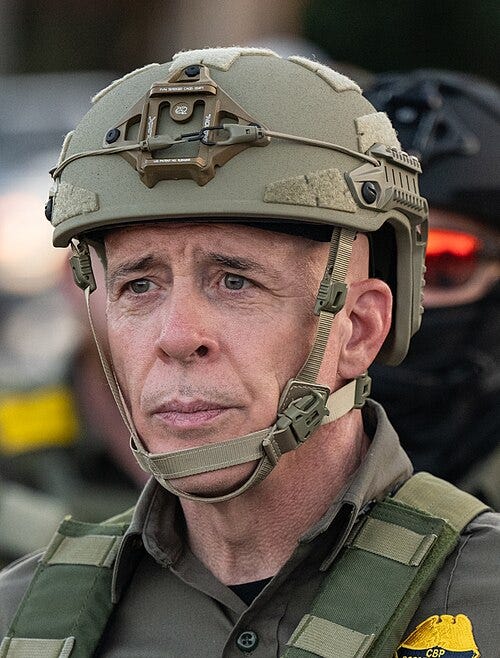

Kern County, when a federal judge ruled his agents couldn’t “walk up to people with brown skin and say, ‘Give me your papers.’”
Los Angeles, when Border Patrol agents tear-gassed a crowd that included children.
Chicago, when a federal judge found he lied under oath about his agents’ use of force.
Charlotte. New Orleans. Nashville—where he went on Fox News calling federal judges “extremists,” potentially violating a gag order in an active case.
Now Minneapolis, where an unarmed woman had just been shot through her windshield while her car moved at walking speed, and DHS was already calling her a “domestic terrorist.”
Hours later, Homeland Security Secretary Kristi Noem held a press conference at the Bishop Henry Whipple Federal Building. Gregory Bovino stood at her side—as he had at every major escalation for twelve months. The woman who had invented his title. The woman to whom he reports directly. The woman who, three months earlier, had stood beside him outside a Chicago detention facility and told his agents it was time to “go hard” and “hammer” protesters.
The question isn’t whether the administration knows who Bovino is.
It’s why they created a special position specifically for him.
II. The Warning
Hours after the shooting, Minnesota Governor Tim Walz stood before cameras and said something extraordinary. He didn’t just condemn the killing. He told Minnesotans not to react to it.
“Don’t take the bait,” he said. “Do not allow them to deploy federal troops into here. Do not allow them to invoke the Insurrection Act.”
Walz had issued a warning order preparing 13,000 National Guard troops and activated the State Emergency Operations Center—not to confront federal agents, but to maintain order so the federal government couldn’t claim disorder required intervention. He was treating the “largest immigration enforcement operation ever” not as law enforcement but as a trap.
Minneapolis Mayor Jacob Frey was less diplomatic. After reviewing video of the shooting, he addressed ICE directly: “Get the fuck out of Minneapolis. We do not want you here.”
For twelve months, one commander had been at the center of every operation designed to maximize that friction. And the administration had built a special position just for him.
III. A Commander Without Boundaries
The pattern is easy to miss if you’re following the daily news cycle. Each city gets its own coverage, its own outrage, its own few days of attention before the next crisis displaces it. But map the flashpoints and a single thread emerges.
January 2025: Kern County, California. Border Patrol sweeps through agricultural communities, arresting 78 people. A federal judge finds constitutional violations.
June 2025: Los Angeles. Border Patrol conducts raids in America’s largest sanctuary city. Protests erupt. The National Guard deploys.
July 2025: Los Angeles again. Agents deploy tear gas in a residential neighborhood. Children are present. Civil rights attorneys file for an emergency injunction.
September-October 2025: Chicago. Agents violate a temporary restraining order. A federal judge finds their actions “shock the conscience.”
November 2025: Charlotte. Border Patrol agents smash car windows, chase people through parking lots.
November-December 2025: New Orleans. “Operation Catahoula Crunch.”
December 2025: Nashville. A commander goes on cable news attacking “extremist” federal judges, potentially violating a gag order.
January 2026: Minneapolis. 2,000 agents. An American citizen dead.
Twelve months. Seven cities. One commander.
The title itself was novel—and it was Noem’s creation. Border Patrol commanders typically oversee fixed geographic sectors. “Commander-at-Large” has no statutory basis. Noem coined the term in an op-ed and made it official. Bovino became untethered from territory, a roving authority dispatched to wherever friction was highest. Under oath, Bovino testified that he reports directly to Noem—not to the Border Patrol chief, not to the CBP commissioner, but to the Secretary of Homeland Security herself. He operates outside the Border Patrol’s normal command structure entirely.
This wasn’t a bureaucratic accident. This was a position designed for one man.
His operational philosophy was evident from the start. Under Bovino’s command, the El Centro Sector had developed the most aggressive use-of-force record in the entire Border Patrol. According to the Project on Government Oversight and American University’s Investigative Reporting Workshop, El Centro logged 300 use-of-force incidents against 83 reported assaults on agents—a ratio of 3.6 to 1. The Border Patrol average was 2 to 1. “No other sector comes close to El Centro,” said Adam Isacson of the Washington Office on Latin America, who reviewed the data.
When measured by individual agents rather than incidents, the disparity was even more stark: a 4.16 to 1 ratio, more than double the agency average. El Centro was an outlier among outliers—the most violent sector in the most violent federal law enforcement agency.
That wasn’t a disqualifier. It was the qualification.
IV. The Pattern Emerges
The first federal judge to confront Bovino was Jennifer L. Thurston of the Eastern District of California.
In January 2025, just days after Congress certified Trump’s victory, Bovino led his agents on a sweep through Kern County—300 miles from the border, into California’s agricultural heartland. He told reporters his agents had “predetermined targets” with criminal records. “We did our homework,” he said.
The homework was fiction. According to sworn declarations, agents slashed tires, yanked people out of trucks, threw them to the ground, and called farmworkers “Mexican bitches”—with no criminal or immigration history on 77 of the 78 people arrested.
In April 2025, Judge Thurston issued a preliminary injunction. Her words from the bench became instantly famous: “You just can’t walk up to people with brown skin and say, ‘Give me your papers.’”
The government promised to retrain Bovino’s 900 agents on the Fourth Amendment. This was not, apparently, something they had learned in the academy.
Bovino’s response to the court order established the template for everything that followed. He didn’t retreat. He escalated. He moved to Los Angeles.
By June, his agents were conducting raids at Home Depots and car washes across America’s second-largest city. In July, he led a phalanx of military personnel into MacArthur Park while children were at summer camp, forcing families to flee as agents patrolled on horseback. When Los Angeles Mayor Karen Bass confronted him at the scene, demanding the operation cease, Bovino’s response was succinct:
No arrests were made at MacArthur Park. The operation was pure show of force—intimidation as policy.
A second federal judge entered the picture. On July 11, U.S. District Judge Maame Ewusi-Mensah Frimpong of the Central District of California issued a temporary restraining order against Bovino’s LA operations, finding his agents had likely violated Fourth Amendment protections against unreasonable searches. The order barred agents from stopping people based solely on “apparent race or ethnicity,” speaking Spanish, being present at day laborer pickup spots, or working in landscaping and construction.
The Trump administration appealed to the Supreme Court.
On September 8, the Court granted the administration’s emergency request, lifting Judge Frimpong’s restrictions. Justice Sonia Sotomayor’s dissent spoke directly to what was at stake: “We should not have to live in a country where the Government can seize anyone who looks Latino, speaks Spanish, and appears to work a low-wage job.”
Within days, Bovino’s agents hit a Hollywood Home Depot with 40 officers, deploying tear gas and pepper pellets.
Then came Chicago.
V. The Lies
Operation Midway Blitz launched on September 8, 2025. Bovino arrived with the new title—Commander-at-Large—and unprecedented authority. Within weeks, his agents had made over a thousand arrests. They had also drawn a federal lawsuit from journalists, protesters, and clergy members alleging systematic constitutional violations.
On October 9, U.S. District Judge Sara Ellis issued a temporary restraining order restricting agents from deploying tear gas and other weapons against journalists, protesters, and anyone not posing an immediate threat. The order required advance warnings and limited force to situations involving genuine danger.
Fourteen days later, on October 23, Bovino violated it.
In Chicago’s Little Village neighborhood—La Villita, the heart of the Mexican American community—video captured Bovino personally throwing at least two tear gas canisters into a crowd of protesters. No warning was given.
The Department of Homeland Security immediately constructed a justification. “The mob of rioters grew more hostile and violent, advancing toward agents and began throwing rocks and other objects at agents, including one that struck Chief Greg Bovino in the head,” Assistant Secretary Tricia McLaughlin said in a statement. “Agents properly used their training.”
There was one problem. The video showed something different.
Judge Ellis summoned Bovino to court—highly unusual for a sitting federal law enforcement commander. Under oath, in a deposition that stretched across three days, Bovino was confronted with the footage. The sequence was clear: he threw the tear gas first. Any rock that might have hit him came afterward, not before.
Bovino admitted he had been “mistaken.”
The judge used a different word.
“Defendant Bovino admitted that he lied,” Ellis said from the bench on November 6. “He admitted that he lied about whether a rock hit him before he deployed tear gas in Little Village.”
But that wasn’t all. Video also showed Bovino physically tackling a protester named Scott Blackburn to the ground outside the Broadview ICE facility. In his deposition, Bovino was shown the footage and asked directly: Did you tackle this man?
“No,” Bovino said.
“So if somebody were watching that video and thought that you tackled the older gentleman whose name is Scott Blackburn, you’d say ‘Don’t believe your lying eyes’?” the attorney asked.
“I wouldn’t say that.”
“Do you acknowledge that you’re tackling Mr. Blackburn on this video?”
“No.”
Judge Ellis was unequivocal: “In one of the videos Bovino obviously attacks and tackles the declarant Mr. Blackburn to the ground, but Mr. Bovino—despite watching this video—says that he never used force.”
Her conclusion: “I find the government’s evidence to be simply not credible.”
To underscore her assessment, Ellis quoted Carl Sandburg’s famous poem “Chicago” in full to open her order, and closed with John Adams writing to Abigail in 1775: “Liberty once lost is lost forever.”
Then she issued the strongest finding a federal judge can make short of a criminal referral: Gregory Bovino had testified falsely under oath about the use of force against American citizens.
VI. The Pivot: November 6, 2025
Consider what should have happened on November 6, 2025.
A federal judge had just issued a ruling finding that a Border Patrol commander testified falsely under oath about the use of force by agents under his command. The judge found that those agents had engaged in conduct that “shocks the conscience”—constitutional language reserved for the most extreme government abuses.
None of this happened. No removal. No suspension. No investigation announced. No public statement from DHS acknowledging the court’s findings. The department’s only response was to call Ellis “an activist judge that risks the lives and livelihoods of law enforcement officers.”
Instead, within days, Bovino was in Charlotte.
This is the moment the accountability vacuum became visible. A federal judge had done everything within her power—issued detailed findings, used the strongest available legal language, created a formal record of false testimony. The judicial system had worked exactly as designed. What failed was everything that was supposed to happen next.
If lying to a federal court about the use of force carries no penalty, then the court’s authority is merely theoretical. If a commander can be found to have “shocked the conscience” and continue commanding, then conscience is not a constraint. If perjury leads to deployment to new cities rather than removal, then perjury is policy.
Bovino’s next two months answered any remaining questions about what the administration wanted from him.
VII. The Acceleration
Charlotte, late November 2025. Three weeks after Judge Ellis found he had lied under oath, Bovino was commanding Border Patrol agents in North Carolina. Witnesses reported agents smashing car windows. Chasing people through parking lots. Conducting arrests on the side of roads in broad daylight.
The tactics weren’t new. But the deployment was. A commander with a fresh federal perjury finding wasn’t being investigated—he was being sent to new cities.
New Orleans, December 2025. “Operation Catahoula Crunch.” The name itself signaled the approach: not quiet enforcement but branded spectacle. Press releases. Photo ops. The message wasn’t just for immigrants. It was for anyone watching.
Then Nashville.
In October, U.S. District Judge Waverly Crenshaw Jr. had imposed a gag order in the criminal case against Kilmar Abrego García. The order prohibited government employees from making public statements that could prejudice the trial. Standard practice in high-profile cases. Unambiguous in its terms.
In mid-December, Bovino went on Fox News. Then NewsMax. On camera, he called Abrego García “an alien smuggler,” “wife beater,” and “MS-13 member.” He described federal judges as “extremist” and “activist.” He promised Abrego García would be “taken out of circulation” and deported.
Abrego García’s attorneys filed for sanctions. The motion remained pending as of January 6, 2026.
The pattern had crystallized. Six weeks after one federal judge found Bovino had lied under oath, he was on national television potentially violating another federal judge’s order. By then, four federal judges in four jurisdictions had confronted Bovino’s conduct or his agents’ operations:
Judge Jennifer L. Thurston (Eastern District of California): Found Kern County raids likely violated the Constitution. April 2025.
Judge Maame Ewusi-Mensah Frimpong (Central District of California): Found LA raids violated Fourth Amendment protections. July 2025. (Overturned by Supreme Court, clearing the path for expanded operations.)
Judge Sara Ellis (Northern District of Illinois): Found Bovino lied under oath, conduct “shocks the conscience.” November 2025.
Judge Waverly Crenshaw Jr. (Middle District of Tennessee): Issued gag order Bovino potentially violated. December 2025.
Four judges. Four jurisdictions. The same commander. Courts were not authorities to be obeyed. They were obstacles to be defied—publicly, contemptuously, on camera.
And then came Minneapolis.
VIII. The Content Machine
Operation Metro Surge was announced January 6, 2026, as “the largest immigration enforcement operation ever.” Two thousand federal agents. Thirty-day deployment. The target: the Twin Cities, home to the largest Somali population in the United States.
The pretext was a viral video from a conservative content creator alleging fraud among Somali residents. The scale was unprecedented. The commander was Gregory Bovino.
But there’s a dimension to Bovino’s operations that extends beyond enforcement. His raids weren’t just operations—they were content.
In August 2025, White House Digital Content Director Billy McLaughlin published an op-ed explaining the administration’s social media strategy: they had built “a fast, culturally fluent content machine,” including “an ASMR-style video of deportations.” The results: “over 16 million new followers” with growth “fastest among Americans aged 18-34.”
By October, CNN documented what DHS officials saw as an opportunity for “Call of Duty”-style recruiting videos—helmet camera footage from Bovino’s Chicago raids set to dramatic music. The tagline: “Bag it. Tag it. Take it down.” The aesthetic was indistinguishable from first-person shooter games. Bovino himself explained the strategy to CNN: the videos were “so real life they appear to be Hollywood.”
On October 27, 2025—while Bovino was vetting replacements for twelve purged ICE field directors alongside Corey Lewandowski—DHS posted an image from the video game Halo with the caption “DESTROY THE FLOOD,” comparing immigrants to the game’s parasitic alien enemy. The post linked to JOIN.ICE.GOV. Halo co-creator Marcus Lehto called the imagery “absolutely abhorrent” and said it “makes me sick.” DHS responded: “We will reach people where they are... We aren’t slowing down.”
The pipeline was complete. Bovino’s 3.6:1 use-of-force ratio wasn’t a liability. It was the product. His operations generated the compelling “gameplay footage” that recruited the next generation of agents from the demographic radicalized through a decade of online culture wars.
Illinois Governor JB Pritzker complained publicly about “camera crews” arriving with federal agents during Chicago raids. The raids were being produced, not just documented. And Bovino was the star.
The violence was escalating too. On September 12, ICE agents conducting a traffic stop in Franklin Park shot and killed Silverio Villegas González, a 38-year-old father of two with no criminal record. DHS immediately claimed the agent had been “seriously injured” after being “dragged a significant distance” by Villegas González’s car. Body camera footage told a different story: the agent described his injuries as “nothing major” and said he’d been “dragged a little bit.” The Cook County Medical Examiner ruled it homicide.
Three weeks later, in Brighton Park, a Border Patrol agent shot Marimar Martinez five times after she’d been following federal vehicles to warn neighbors of ICE activity. Agent Charles Exum’s texts to colleagues surfaced in court: “I fired 5 shots and she had 7 holes. Put that in your book boys.” Body camera footage showed Exum saying “Do something, b----” before opening fire. Martinez survived. Federal prosecutors dismissed all charges against her in November.
The template was set: shoot first, claim self-defense, let body camera footage contradict the official story weeks later.
Minneapolis Police Chief Brian O’Hara saw what was coming. The day before Renee Good was killed, he told reporters he had been “concerned for weeks” about the operation. “The greatest risk to me,” he said, “is that there would be unrest or that there would be a tragedy. That somebody could get seriously hurt or killed.”
Twenty-four hours later, Renee Nicole Good was dead.
IX. The Instrument
On October 3, 2025, Homeland Security Secretary Kristi Noem visited the Broadview immigration detention facility outside Chicago. Gregory Bovino stood beside her as she addressed dozens of his agents. The exchange was captured on video and later played during Bovino’s deposition.
“Today, when we leave here, we’re going to go hard,” Noem told them. “We’re going to hammer these guys who are advocating for violence against the American people. What they are doing is advocating to harm not just you and your colleagues, but your families and they’re doxxing your identities and victimizing people every day by the way that they are talking, speaking, who they are affiliated with, who they’re funded with and what they’re talking about as far as consequences for what we’re doing by protecting this country. So, we’re going to go out there and make sure there are consequences for the way that they are behaving.”
Go hard. Hammer them. Consequences.
Under oath, Bovino was asked if he agreed with what Noem said.
He confirmed that he did.
He was asked if he had communicated to his officers that part of their responsibilities was to “hammer guys who are advocating for violence against the American people.”
The question hung in the courtroom.
Twenty days later, Bovino was throwing tear gas into a crowd in Little Village.
This is not inference. This is not “the charitable interpretation” versus a darker one. This is documented fact, established under oath, captured on video, confirmed by the commander himself.
Noem created the title “Commander-at-Large” for Bovino—a position with no statutory basis, designed to untether him from geographic boundaries and normal chains of command. She put it in an op-ed. DHS uses it in official press releases. It exists because she willed it into being for this specific man.
Bovino reports directly to Noem. He testified to this under oath. Not to the Border Patrol chief. Not to the CBP commissioner. To her.
Together with Corey Lewandowski, Bovino compiled the list of ICE field directors to be purged for insufficient aggression—replacing career officials with those who wouldn’t push back on the tactics that had drawn four federal court interventions in twelve months.
When Judge Ellis found Bovino had committed perjury, Noem’s department called her an “activist judge.” When Bovino potentially violated Judge Crenshaw’s gag order on national television, there were no consequences. When the administration needed someone to lead the largest immigration enforcement operation in American history, in a city primed for confrontation, they sent Gregory Bovino.
And on January 7, 2026, hours after an American citizen was shot dead in Minneapolis under his command, Noem held a press conference. Gregory Bovino stood at her right side.
The administration didn’t fail to notice Bovino’s record. They promoted him because of it.
This is what an instrument looks like when it’s working as designed.
X. The Question
Hennepin County Attorney Mary Moriarty has confirmed she has jurisdiction to charge the ICE agent who killed Renee Good. The FBI and Minnesota Bureau of Criminal Apprehension are conducting a joint investigation. Eleven of thirteen Minneapolis City Council members have demanded prosecution “to the fullest extent of the law.”
Governor Walz has 13,000 National Guard troops on standby. Not to confront federal agents—but to ensure Minnesota doesn’t provide the pretext for something worse.
The agent who fired has not been identified. In Chicago, Judge Ellis’s November 6 injunction had required agents to wear activated body cameras—a requirement the same commander had been subject to just weeks earlier. In Minneapolis, the agent who killed Renee Good was not wearing one. He remains on duty.
Gregory Bovino remains in command. He stood at Noem’s side at the press conference and will presumably stand there at the next one.
The question now is what comes next. Four federal judges have confronted his conduct or his agents’ operations—one explicitly found he committed perjury, another found his agents “shocked the conscience,” and the Supreme Court overturned a third’s ruling only to clear the path for more of the same. His agents killed a woman under circumstances contradicted by video evidence, and the federal government called her a terrorist before her family had been notified.
Does accountability arrive? Or does Minneapolis become what Bovino’s twelve-month campaign has been building toward—the provocation that finally works?
Vice President JD Vance weighed in the evening of the shooting: “You can accept that this woman’s death is a tragedy while acknowledging it’s a tragedy of her own making. Don’t illegally interfere in federal law enforcement operations and try to run over our officers with your car. It’s really that simple.”
He added: “I want every ICE officer to know that their president, vice president, and the entire administration stands behind them.”
The message was clear. Not just to the agents. To Bovino. To whoever might be watching.
Keep going.
Renee Good’s mother, Donna Ganger, was asked about the federal claim that her daughter was a domestic terrorist.
“That’s so stupid,” she said. “She was probably terrified.”
She was a U.S. citizen—which meant the administration couldn’t deploy the language that had obscured earlier deaths. No “criminal alien.” No “illegal.” Just a 37-year-old mother from Colorado, a poet, a wife, a guitar strummer experiencing Minneapolis. She was watching out for her neighbors on a Wednesday morning in January.
And Gregory Bovino was there.
Series Navigation
The Gamergate Army Gets Badges and Guns — An 8-part series documenting the 22-year pipeline from 4chan to federal immigration enforcement.
Follow-Up:
Noem’s Podium: “One of Ours, All of Yours” — The 160-year doctrine behind collective punishment
“Until the Cities Lie Ruined”: The Bible Verse DHS Didn’t Finish – How a $100 Million Recruitment Campaign Became a Call to Holy War
Accountability has not yet caught up to him. But for the sake of those impacted by the hammer strategy, I hope it does soon.
Noem designed this situation when she invented a title specifically to unleash Bovino.