

The Filing Cabinet: From Wackenhut’s Dissident Files to GEO Group’s Bounty Hunters
How a 70-Year-Old Surveillance Infrastructure Became ICE’s Largest Contractor
The Earnings Call
On Thursday morning, February 12, 2026, The GEO Group, Inc. reported that its fourth-quarter results to Wall Street. Revenue came in at $707.7 million. Net income: $31.8 million. The company operates 95 facilities with approximately 75,000 detention center beds. In 2025 alone, it won $520 million in new contracts — the most successful year for new business in company history.
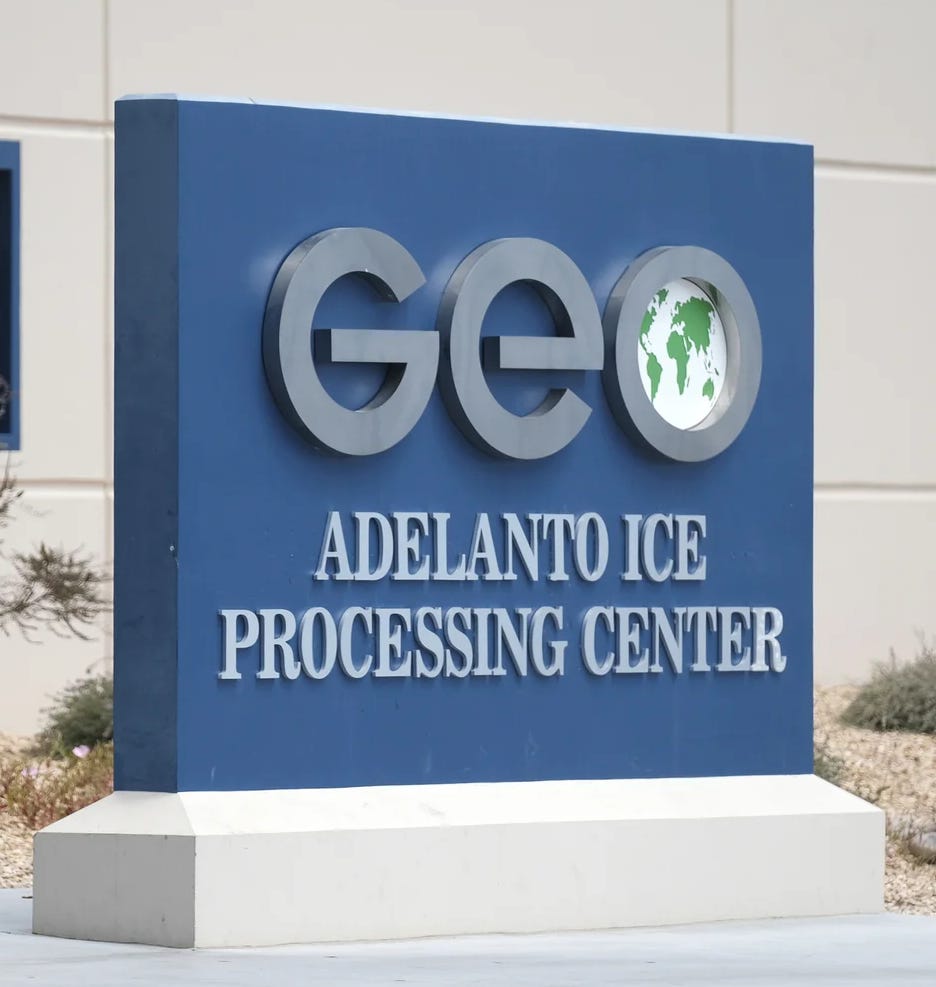
Executive Chairman George Zoley opened their quarterly call with a phrase that should be preserved for history:
“We believe our company faces an unprecedented opportunity at this time.”
CEO David Donahue, in his final earnings call before retiring at month’s end, added:
“We believe the scale of the opportunity before our company is unlike any we’ve previously experienced.”
The opportunity they were describing is human suffering. The “scale” is mass detention. The revenue projections — $800 million to $1 billion in additional annual income — are denominated in bodies.
Investors had a specific concern: whether GEO could translate the administration’s deportation agenda into sustained earnings growth. The stock sat down 50% from its 52-week high. Wall Street’s complaint was not that too many people were being detained. It was that not enough were being detained fast enough to meet projections.
In GEO Group’s third-quarter call, Executive Chairman George Zoley told investors that the “alien population” in the United States “holds strong at 16.8 million” — citing a figure from the Federation for American Immigration Reform, an organization the Southern Poverty Law Center has designated a hate group since 2007. He said GEO’s subsidiary, BI Incorporated, could “scale up its monitoring contract to serve millions of people for ICE.”
Millions.
To understand what that sentence means — a private corporation offering to surveil millions of people for the federal government — you have to understand where GEO Group came from.
You have to go back to a filing cabinet in Coral Gables, Florida, in 1954.
Part I: The Filing Cabinet (1954–1975)
In 1954, George R. Wackenhut — a former FBI special agent — founded Special Agent Investigators, Inc. with three other ex-FBI agents. By 1958, he had bought out his partners and renamed the company the Wackenhut Corporation.
Two things made Wackenhut successful. First, political connections: Florida Governor Claude Kirk, Senator George Smathers (a friend of JFK), and a revolving board of national security officials including former FBI Director Clarence Kelley, former Defense Secretary Frank Carlucci, former CIA Deputy Director Bobby Ray Inman, and former Secret Service Director James Rowley. Before becoming Reagan’s CIA Director, the late William Casey served as Wackenhut’s outside legal counsel.
Second, and more consequentially: files.
George Wackenhut was a committed right-winger who built his business on dossiers. He catalogued suspected communists, antiwar protesters, civil rights demonstrators — anyone with what he called “subversive” sympathies. By 1965, the Wackenhut Corporation boasted to potential investors that it maintained files on 2.5 million suspected dissidents — one in every 46 American adults. In 1966, after acquiring the private files of Karl Baarslag, a former staff member of the House Committee on Un-American Activities, Wackenhut claimed the largest privately held file on suspected dissidents in America: more than four million names.
As a retired FBI agent told SPY Magazine in 1992: “It is known throughout the industry that if you want a dirty job done, call Wackenhut.”
The company’s surveillance arm was eventually ordered to pay an $8 million judgment in a federal civil case in Alabama in 1999 for illegal wiretapping, theft of business documents, and corporate sabotage. Its armed guards beat protesters at nuclear sites for the Department of Energy. It provided strikebreakers at the Pittston mine in Kentucky. Among nuclear weapons lab employees, Wackenhut was known for targeting radiation whistleblowers. In Alaska, the pipeline company Alyeska publicly apologized after Wackenhut investigators were caught spying on a prominent critic — triggering congressional hearings.
In Belgium, Wackenhut left in the early 1980s after its guards were accused of luring immigrant children into basements and beating them.
The files were the business model. And when Congressional investigations in the mid-1970s threatened to expose that model, Wackenhut didn’t destroy the files.
It transferred them.
Part II: The Church League (1937–1975)
The Church League of America was founded in Chicago in 1937 to oppose “left-wing and Social Gospel influences” in Christianity — effectively a private intelligence agency for the religious right. Under Major Edgar C. Bundy — a former Air Force Intelligence officer and Baptist minister. It became an anti-communist surveillance operation based in Wheaton, Illinois, with documented ties to the John Birch Society.
In 1975, following Congressional investigation of domestic surveillance, Wackenhut transferred its files — four million names — to the Church League. The transfer avoided disclosure requirements that would have applied to a for-profit corporation. But according to the Washington Post in 1977, Wackenhut “nevertheless continues to keep files based on unverified data from the Church League of America.”
NYU’s Tamiment Library, which now holds both collections, explains why: “All of these creators had connections to the intelligence agencies of the United States government... and were part of a right-wing research and information network that monitored Communists and other perceived threats to their interpretation of the American way of life.”
The surveillance infrastructure built to track civil rights demonstrators didn’t disappear. It evolved.
Part III: The Fork (1984–2021)
In 1984, George Zoley pitched George Wackenhut on creating a prison subsidiary. In 1987, Wackenhut Corrections secured its first contract: an immigration detention center in Aurora, Colorado. That facility is still operating today — GEO Group has invested $70 million to expand it from 300 beds to 1,400.
In 2002, Wackenhut Corporation was acquired by Group 4 Falck, eventually becoming G4S, then Allied Universal in 2021. Meanwhile, Wackenhut Corrections rebranded as The GEO Group in 2003.
The Wackenhut lineage forked: Allied Universal now provides armed guards and transport to ICE field offices. GEO Group operates detention centers and surveillance infrastructure. Both descendants of the filing cabinet. Both billing the federal government.
Part IV: The Vertical Integration
In 2011, GEO Group acquired BI Incorporated for $415 million. BI had been founded in 1978 to monitor cattle. By 2011, it was tracking 60,000 people. Today, BI’s SmartLINK app monitors 182,000 immigrants through facial recognition and GPS tracking.
On December 16, 2025, ICE awarded BI a $121 million contract for “skip tracing” — bounty hunting. BI’s investigators use surveillance, commercial databases, and physical observation to track immigrants to their homes so federal agents can arrest them. The contract is incentive-based: BI gets bonuses for finding more people.
Lori Nessel, a law professor at Seton Hall and director of the Immigrants’ Rights Clinic, warned: “It’s not clear where the legal authority comes from for a government agency to contract out this type of law enforcement function without limits.”
GEO Group now profits at every stage: surveillance, location, detention, monitoring, transport. George Zoley told investors BI could serve “millions.”
Part V: The Death Toll
While GEO Group reports earnings to Wall Street, people are dying in its facilities.
2025 saw 32 deaths in ICE detention — the highest since 2004, nearly tripling the 11 deaths in 2024. At least six more have died in early 2026. In December alone, four immigrants died in four days; three were in GEO Group facilities.
At Fort Bliss — now the nation’s largest migrant detention center — an autopsy found that Geraldo Lunas Campos, a 55-year-old Cuban national, died by homicide. Guards killed him by compressing his neck and torso. ICE initially claimed “medical distress.”
In October 2025, ICE halted payments to medical contractors. Payments won’t resume until April 2026, even as the detained population breaks records above 66,000. Meanwhile, DHS Secretary Noem blocked unannounced congressional oversight visits.
Part VI: Capturing the State
When civil society tried to impose consequences, GEO Group captured the regulatory apparatus.
In 2019, seven major banks announced they would no longer finance private prisons — over 70% of GEO’s available financing. GEO’s response: spend $3.3 million lobbying Congress in 2025 for the Fair Access to Banking Act, which would legally compel banks to serve private prison companies. Trump has already signed an executive order empowering regulators to punish “politicized debanking.” In June 2025, Bank of America reinstated CoreCivic as a client.
When the market imposes accountability, you capture the legislature. When advocacy groups threaten legal challenges, you capture the executive.
On September 25, 2025, Trump signed NSPM-7, directing Joint Terrorism Task Forces to investigate “ideological extremism” regarding immigration — targeting the funding networks of nonprofits and legal aid organizations. As I documented in “ICE Agents Drew Shapes on a Map,” NSPM-7 designates opposition to “law enforcement and border control” as a terrorism indicator. The infrastructure built to surveil immigrants now has authorization to target the lawyers who might file injunctions.
The vertical integration is complete: GEO finds immigrants through BI’s bounty-hunting contracts, detains them in GEO facilities, monitors them through ankle bracelets, lobbies Congress to force banks to fund the operation, and benefits from executive orders that classify opposition as terrorism. The Four Thresholds I documented — the shift from law enforcement to paramilitary force — are not separate from the corporate profit structure. They are the corporate profit structure.
Part VII: The Personnel
Tom Homan, Border Czar: Received more than $5,000 in consulting fees from GEO Care according to his February 2025 ethics disclosure — the threshold above which disclosure is required, meaning the actual amount could be far higher. Heritage Foundation fellow. Project 2025 contributor.
Pam Bondi, Attorney General: Lobbied for GEO Group through Ballard Partners in 2019. In July 2025, she fired the Director of DOJ’s Ethics Office — the official responsible for advising on recusals from former clients.
Kristi Noem, DHS Secretary: Oversees all GEO/ICE contracts. Named by a federal judge for 96 court order violations in January 2026.
George Zoley, GEO Group Executive Chairman: From 2021 through 2025, made political contributions exceeding $1 million, including to PACs affiliated with Trump. The GEO Group PAC donated more than $280,000 to current members of Congress.
Of the 38 people who have died in ICE custody since 2025, 71% were held in for-profit facilities, according to data compiled by Andrew Free.
The Thread
1937: Church League of America founded. Surveillance files on “subversives.”
1954: Wackenhut Corporation founded. Parallel files on dissidents.
1966: Wackenhut claims 4+ million names — largest private dissident file in America.
1975: Files transferred to Church League to avoid disclosure.
1987: First immigration detention contract. Aurora, Colorado.
2003: Wackenhut Corrections becomes The GEO Group.
2011: GEO acquires BI Incorporated. The filing cabinet goes digital.
2025: GEO wins $520 million in new ICE contracts. BI monitors 182,000 immigrants. Detention deaths hit 20-year high.
December 2025: ICE awards BI $121 million for bounty hunting.
February 2026: Q4 earnings: $707.7 million. Zoley announces “unprecedented opportunity.”
What George Wackenhut Built
In 1954, a former FBI agent started a company by building files on Americans he considered subversive. When Congressional oversight threatened exposure, he transferred the files to a religious organization to avoid disclosure.
His successors pivoted from surveillance files to private prisons. Then to immigration detention. Then to electronic monitoring. Then to bounty hunting.
On the earnings call, CEO David Donahue assured investors: “We believe our company is well positioned to meet the government’s expected increased demand for safe, cost-effective detention bed capacity.”
Safe. Cost-effective. Bed capacity.
The 38 people who died in ICE custody since 2025 aren’t on the balance sheet. The “bed capacity” includes the beds where Jean Wilson Brutus died the day after arriving at GEO’s Delaney Hall. The beds where Geraldo Lunas Campos was killed by guards who compressed his neck until he stopped breathing.
GEO Group’s stock rose 7.6% in after-hours trading.
The filing cabinet in Coral Gables didn’t close. It scaled.
Related Coverage
The Four Thresholds — How ICE crossed the lines from law enforcement to paramilitary force
One of Ours, All of Yours — Collective punishment doctrine
Here Am I, Send Me — DHS recruitment and Isaiah 6:8
The Hammer: Gregory Bovino — The commander with the highest use-of-force record
Quantity Over Quality — Stephen Miller and the deportation machine
Springfield: The Next Front — Where the operations are heading
Sources
GEO Group Financial
Bloomberg: “ICE Bounty Hunting Push Aided by GEO Group’s Surveillance Work” — February 4, 2026
The Marshall Project: “Why GEO Group, CoreCivic Stock Prices Fell in 2025” — January 6, 2026
GEO Group Investor Relations: Q4 2025 Earnings Release — February 12, 2026
BI Incorporated / Skip Tracing
The Intercept: “ICE Hires Immigrant Bounty Hunters From Private Prison Company GEO Group” — Sam Biddle, December 19, 2025
The Jersey Vindicator: “ICE taps GEO Group subsidiary to track immigrants in $121 million deal” — January 14, 2026
Al Mayadeen: “ICE bounty hunters: 10 firms earn millions tracking immigrants” — December 24, 2025
Banking Legislation
The Intercept: “ICE’s Private Prison Contractors Spent Millions Lobbying to Force Banks to Give Them Loans” — February 5, 2026
Senator Kevin Cramer: Fair Access to Banking Act press release
Executive Actions
White House: NSPM-7 — Protecting the American People Against Invasion — September 25, 2025
Mark Ramm: “ICE Agents Drew Shapes on a Map” — analysis of NSPM-7 and Palantir surveillance infrastructure
Personnel Ethics
Washington Post: “Trump’s border czar consulted for immigrant detention firm GEO Group” — May 27, 2025
Congressional Donations
In These Times / The Appeal: “ICE-Cold Cash: Private Prison Companies and Executives Have Donated Millions to Members of Congress” — February 6, 2026
Detention Deaths
Axios: “ICE custody deaths reach highest peak in two decades” — January 20, 2026
Al Jazeera: “US witnessed many ICE-related deaths in 2026” — January 27, 2026
Texas Signal: “Deaths in ICE Detention Escalate” — January 2026
WOLA: “U.S.-Mexico Border Update: Detention deaths” — January 2026
World Socialist Web Site: “4 immigrants die in 4 days in ICE private prisons” — December 22, 2025
Andrew Free (data on deaths in for-profit facilities): cited in The Appeal — February 2026
Project on Government Oversight: “ICE Inspections Plummeted as Detentions Soared in 2025” — 2026
G4S / Allied Universal
Jacobin: “ICE’s Deportation Machine Runs on Private Security” — July 2025
Private Equity Stakeholder Project: “Allied Universal Acquires Attenti” — March 2023
AFSC Investigate: G4S PLC profile
AFSC Investigate: GEO Group profile
Wackenhut Corporation History
SPY Magazine: John Connolly, “Inside America’s Scariest Security Company” — September 1992
Wikipedia: “George Wackenhut”
FundingUniverse: “The Wackenhut Corporation History”
Washington Post: “Detective Firm Says It Uses Right-Wing Group’s Data” — January 27, 1977
CovertAction Magazine: “Old Documents Reveal Roots of Modern-Day American Surveillance State” — December 17, 2024
SourceWatch: Wackenhut
Church League of America
NYU Tamiment Library: “Church League of America Collection”
Wikipedia: “Church League of America”
FAIR Hate Group Designation
Southern Poverty Law Center: “Federation for American Immigration Reform”
ICE Facility Data
Exclav.es: “National data, local stories: ICE detention in 2026” — February 8, 2026
Previous Coverage
Mark Ramm: “The ICE Transformation: Four Thresholds America Has Already Crossed” — The operational side: how ICE crossed the lines from law enforcement to paramilitary force, including the shooting pattern, masked operations, private prison profit incentives, due process collapse, and loyalty-based personnel replacement
Mark Ramm is an investigative journalist and publisher of The RAMM on Substack.
The complete documented timeline of events is available at capturecascade.org/viewer
In the early 200Os Wackenhut was brought in by a union-busting law firm to work on busting the Newspaper Guild at the paper where my spouse worked.
The company fired all of the security guards, who were formerly in-house, and even all of the janitors. Security, the janitors and other support staff were replaced with Wackenhut employees or with people Wackenhut hired directly.
Janitors became spies, security guards would rifle through desks and filing cabinets at night. Phones were tapped. Union leaders were surveilled at their homes.
Employees were intimidated in various ways.
The union was decertified.
None of what you've written here surprises me, and seems like a logical progression for this evil corporation.