

The Encyclical & The Antichrist
Magnifica Humanitas signed quietly released May 25 with an Anthropic interpretability lead at the Pope's side — the magisterial response to a the new "private" and "technological" colonialism.
By Mark Ramm | The RAMM | May 29, 2026
The Choreography Is the Argument
On May 15, 2026, Pope Leo XIV signed his first encyclical. The document is dated, in the formal Vatican register, “Given in Rome, at Saint Peter’s, on 15 May, in the year 2026, the second of my Pontificate. LEO PP. XIV.” Forty-two thousand words across 245 numbered sections. Title: Magnifica Humanitas — “On Safeguarding the Human Person in the Time of Artificial Intelligence.” The title derives from the Magnificat: the encyclical’s “magnificent” is humanity-as-image-of-God, and the document closes on the same hymn’s reversal.
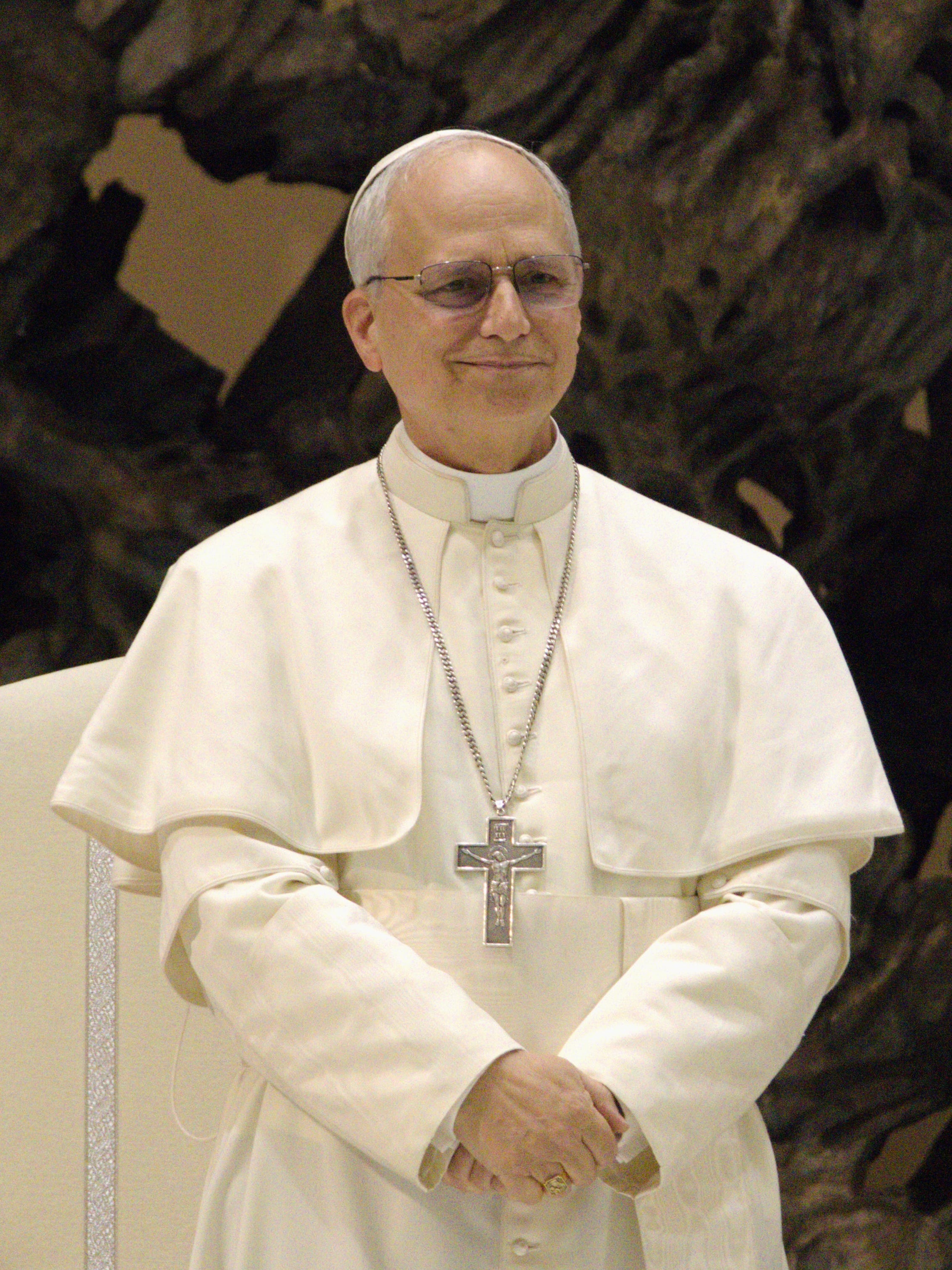
He signed it quietly. There was no press conference, no synchronized briefing, no Vatican Press Office curtain-raiser. The signing happened. The text did not.
Ten days later, on May 25, 2026, the encyclical was released to the world at the Vatican Synod Hall. At the Pope’s side, in the foreground of the photographs and at the microphones during the joint presentation, stood a thirty-three-year-old Canadian with no obvious place at a papal occasion: Chris Olah, co-founder of Anthropic and the leader of the company’s interpretability research (the technical discipline of trying to see, mechanically, what is actually happening inside a large language model). The National Catholic Reporter called the pairing “an unlikely duo.” The Washington Post led its coverage with a headline that, read carefully, is the structural fact of the week: “Anthropic aligns with Vatican over White House“.
Olah’s quoted line from the joint presentation: “We need moral voices that the incentives cannot bend.”
Twelve hours before that headline, The RAMM published “The Antichrist as Luddite” — Episode 1 of the Four-Layer Architecture series. It walked through a leaked recording of a private lecture in which Peter Thiel articulated, on tape, a christology that explicitly named two adversaries as the Antichrist he wanted the political and religious world to delay: AI-safety researchers, and “the popes who teach AI ethics.” Thiel’s framework worked by inversion. The figure conventionally identified as the katechon — the restrainer in 2 Thessalonians — was, on his account, the precise figure to be eliminated. The “Luddite” he attacked was the one urging restraint.
The juxtaposition is hard to read as an accident. One of the two named adversaries had just convened the other at the Vatican. The AI-safety research lead stood beside the Pope. The Pope released, jointly, a 42,000-word encyclical naming the regime that Thiel’s framework defends. The choreography is the argument.
This piece walks through what Leo actually wrote — section by section, in his words — and shows that the document is the structural diagnosis of the regime i have spent months documenting. Encyclicals are, by genre, forbidden from naming living political adversaries; they name structural sin.
What Encyclicals Are For (and What They Cannot Do)
A point of form, because it is load-bearing.
An encyclical is the highest register of papal teaching short of an ex cathedra dogmatic definition. It is a public letter, formally addressed to all the bishops and, since the twentieth century, to all people of good will. By convention (at least a century old, traceable in continuous practice from Leo XIII’s Rerum Novarum (1891) through Francis’s Laudato Si’ (2015) and Fratelli Tutti (2020)), an encyclical does not name living political adversaries. It does not name presidents, vice presidents, billionaires, parties. It names structural sin.
The convention operates in both directions simultaneously: it permits the Vatican to say things that would be diplomatically impossible if said as personal accusations, and it permits the targeted party to claim, with technical accuracy, “the encyclical didn’t name me.” The reasons are partly diplomatic (the Vatican maintains concordats), partly pastoral (the addressee is the universal Church, not one electorate), and partly theological (sin is a structure of disordered relations, not a biography).
The result is that any attentive reading of an encyclical has to do its own naming work. Leo wrote a 42,000-word diagnosis of the contemporary technological-political regime. He named the structures: private transnational platforms exceeding governmental capacity, the inversion of subsidiarity, the architecture of visibility, data colonialism, the slide toward “might makes right.” He did not name Peter Thiel, Larry Ellison, Sam Altman, J.D. Vance, the FedRAMP procurement architecture, the Cantor Fitzgerald disclosures, Anduril’s Lattice contract, ImmigrationOS, or NSPM-7. He cannot, by the genre.
The regime-level diagnosis is on the record. The political name for what was diagnosed — that is the unsayable thing. The encyclical’s form is itself part of the argument: a critique this thorough, this authoritative, this irrevocable, with no actor named in the indictment, demands that someone else complete the sentence.
§5 — Private Transnational Power “Surpassing” Governments
The text opens its structural argument early. Section 5, in full magisterial register, begins by acknowledging the conventional account (”In the past, it was largely up to the State to guide and direct innovation”) and then reverses it:
“Today, however, the main drivers of development are private, often transnational, parties that are endowed with resources and the capacity to intervene that surpass those of many Governments. Technological power thus takes on an unprecedented, predominantly ‘private’ aspect, which makes it even more challenging to discern, govern and direct such power toward the common good.”
He footnotes Francis’s Laudato Si’ on those who have acquired “an impressive dominance over the whole of humanity.” He pairs the observation with a regulatory call: “It is necessary to establish adequate regulatory tools capable of upholding justice and curbing the distorting effects of technological power.”
The text repays close reading. The Pope is not offering a moral exhortation to corporate good citizenship. He is making a political-theological claim about sovereignty: that the actors who shape the conditions of human life have shifted from the State to “private, often transnational” entities, that this shift is systemic rather than incidental, and that the conventional theological vocabulary for the State’s role (guidance, direction, the common good) now applies to a different set of actors who do not, by their corporate form, owe accountability to the populations they govern.
The verb is surpass. Not “complement,” not “supplement,” not “operate alongside.” Surpass. The platforms exceed the sovereign. This is a doctrinal concession that the foundational category of post-Westphalian political theology — the State as the bearer of public authority over the common good — has been factually displaced by entities the Church’s prior vocabulary did not have categories for.
This single section is also the verbatim inverse of the pillar Vice President J.D. Vance took to the Paris AI Action Summit on February 11, 2025: paraphrased from the White House transcript, I’m not here this morning to talk about AI safety — I’m here to talk about AI opportunity; excessive regulation could kill a transformative industry (presidency.ucsb.edu). Leo’s §5 reply, fifteen months later: regulation is the duty, not the threat.
The encyclical postdates Paris by 463 days. It names no Vice President. It does not need to.
§71 — Subsidiarity Inverted: The Platforms as “The Highest Level”
Subsidiarity is the organizing concept of modern Catholic Social Teaching. Coined formally in Pius XI’s Quadragesimo Anno (1931), it holds that decisions should be made at the lowest competent level: the family before the parish, the parish before the municipality, the municipality before the State, the State before the supranational body. The doctrine exists as a Catholic answer to two twentieth-century temptations simultaneously: collectivist totalitarianism on one side, atomized libertarianism on the other.
Leo’s §71 names a third temptation the doctrine never contemplated, because the situation did not exist when the doctrine was written.
“The principle of subsidiarity applies especially in the context of the digital revolution. Here, the highest level is not the State, but rather major economic and technological actors that exercise de facto power over the conditions of everyday life. This level, which monopolizes expertise, data and decision-making authority, involves companies and platforms that define conditions for access, rules of visibility, forms of interaction, and even economic opportunities. The principle of subsidiarity requires that such processes not be imposed from above in an opaque and unilateral manner, but instead be directed toward the common good with transparency, accountability and meaningful forms of participation (including independent checks, transparency regarding algorithms, equitable access to data and avenues for recourse).“
Three load-bearing observations.
First, “the highest level is not the State.” Subsidiarity in its classical form ranks the State as the upper bound. Leo declares the State displaced from the top. The doctrine still holds, but the top is now occupied by “major economic and technological actors.” The Church has, in one paragraph, conceded the operative fact of the present order and re-articulated its own foundational social doctrine around it.
Second, the verbs: monopolizes, defines, imposes, opaque, unilateral. This is not a description of a market. This is a description of a sovereign, one whose sovereignty is exercised through the architecture of access, visibility, interaction, and “even economic opportunities.” Leo is naming the platforms as the operative state for daily life.
Third, the closing parenthetical: transparency regarding algorithms, equitable access to data, avenues for recourse, independent checks. Read this paragraph as a Privacy-Act-amendment draft, because it functions as one. It is a four-point statutory checklist. It tracks, almost line-for-line, the agenda that the AI-safety wing of the technical community has been articulating for a decade and that has been, in the same decade, defunded, deregulated, or rhetorically attacked as Luddite by the actors Episode 1 of this series put on the record.
When Anthropic’s Chris Olah stood at the Vatican Synod Hall on May 25 and said there need to be people “outside those incentives… willing to say hard things,” and that decisions about AI “should not be left to people in the industry,” he was endorsing §71 in his own words.
§109 and §110 — The License to Name; The Call to “Disarm”
§109 is the section where the encyclical performs its most distinctive theological move: it licenses the work of naming as an act of social-doctrinal obedience.
“The principles of Social Doctrine offer a framework for understanding this new reality. In a world where data, computational resources and regulatory influence remain in the hands of a few, to speak of the common good means exposing this new form of epistemic, economic and political asymmetry and naming the new monopolies of AI. To speak of the universal destination of goods means finding ways of ensuring universal access to both technologies and the education needed to use them. To speak of subsidiarity calls for protecting the ability of communities to make choices and corrections, rather than confining their role to mere oversight after the standards have been set elsewhere. To speak of solidarity obliges us to recognize the hidden, often exploited workers, who sustain algorithmic systems. To speak of justice requires questioning the global distribution of power that decides who in fact can train these models and who is merely subjected to them.”
The clause is “naming the new monopolies of AI.” Leo does not name them by company. The genre forbids it. What he does — and the move is theologically substantive — is to define the work of naming as the obligation of social-doctrinal practice. To speak of the common good means exposing the asymmetry and naming the monopolies. Not evaluating. Not balancing. Naming. The verb is imperative.
In the immediately following section, §110, Leo introduces what may become the single most-quoted phrase from the encyclical:
“Finally, I would like to employ the expression ‘to disarm,’ which is close to my heart. Disarming AI means freeing it from the mentality of ‘armed’ competition, which today is not limited simply to the military context, but is also an economic and cognitive phenomenon. This entails a race for ever more powerful algorithms and larger datasets, driven by the desire to secure geopolitical or commercial dominance. To disarm means discrediting the assumption that technical power automatically confers the right to govern. To disarm does not mean rejecting technology, but preventing it from dominating humanity...”
Three vocabulary choices repay attention.
“Armed competition.” Leo is using the rhetoric of arms control on a technology that the geopolitical establishment treats as a neutral economic input. He is locating AI in the same moral universe as the nuclear arms race and the chemical-weapons regime — categories the Church developed an entire post-1945 doctrinal apparatus around. This is a category transposition. AI, on his framing, is an armed phenomenon by structure, not just by application.
“Economic and cognitive phenomenon.” Not just one or the other. The encyclical insists on the simultaneity. The arms race is economic (capital deployment, market dominance, geopolitical leverage); it is also cognitive — operating on attention, perception, the formation of belief, the conditions of public judgment. This is the doctrinal bridge to §134 (Arendt on epistemic preconditions) and §171 (the architecture of visibility). The Pope is treating the cognitive layer as a theater of armament.
“Discrediting the assumption that technical power automatically confers the right to govern.” Place this beside Larry Ellison’s quoted 2024 line that “citizens will be on their best behavior” once total surveillance is implemented. Place it beside Thiel’s lecture-room declaration that AI-safety advocates are the Antichrist’s restrainer to be eliminated, and beside the entire Silicon Valley register that maps technical capability onto political legitimacy as if the mapping were natural. Leo is performing a papal discrediting of that mapping. Technical capacity does not confer authority. The encyclical names the assumption and rejects it as an assumption.
§134 — Arendt at Magisterial Citation
§134 is the section that anchors a lineage The RAMM has been tracing for a year, and routes it through magisterial citation.
“Indifference to the truth leads, slowly but surely, to a descent into totalitarianism. As the philosopher Hannah Arendt wrote, the ideal subjects of such regimes are not so much those who are ideologically convinced, but rather ‘people for whom the distinction between fact and fiction (i.e., the reality of experience) and the distinction between true and false (i.e., the standards of thought) no longer exist.’“
The Arendt citation is from The Origins of Totalitarianism (1951), Part 3, the section on the ideal totalitarian subject. The conventional reading — Arendt herself encouraged it — is that the precondition of totalitarianism is not propagandized conviction but epistemic collapse: the loss of the public capacity to distinguish what is real from what is constructed.
The structural-AI implication is direct: algorithmic feeds calibrated to engagement maximize the very epistemic conditions Arendt named as totalitarianism’s prerequisite. This is the operational claim of the field that runs from Philip Agre’s 1994 surveillance-as-capture essay through the present generation of attention-economy literature — and Leo’s magisterial citation at footnote [143] gives it an anchor that secular technologist readings of Arendt have been unable to supply against an opposition that controls the platforms.
The architecture of visibility (which §171 will name in another five sections) is the operational form of the epistemic collapse Arendt warned about. Leo is connecting Arendt’s 1951 warning to the technical layer that, in 2026, is the substrate of public discourse. The connection is now magisterially anchored.
§§170–171 — The Digital Attention Economy and the Architecture of Visibility
§170 is the setup. It names, by phrase, the “digital attention economy” as a moral category, naming the platforms whose business models “thrive on human weakness” and asserting that “those who design or finance such systems bear a moral responsibility that cannot be ignored.” The phrase “those who design or finance such systems” is doctrinal language for the entire venture-capital and platform-engineering complex. Without naming a person, the Pope has located moral responsibility at the funding and design layers — exactly where the lecture in Episode 1 of this series defended the unrestricted right to operate.
§171 is the section that may end up being the document’s most quoted by social-systems researchers, because it names the operative mechanism in vocabulary the field has been searching for.
“A further risk, less visible but no less serious, is that of social control made possible by the massive collection of data and use of algorithmic systems. When every action — movements, purchases, relationships and preferences — leaves a trace, a new form of power emerges, namely the power to profile, predict and influence behavior, often without individuals being fully aware of it. If such kinds of data are used to make decisions affecting concrete opportunities — such as access to credit, employment or essential services — there is a risk of undermining freedom and discriminating against the most vulnerable. Furthermore, control is exercised not only through explicit prohibitions, but also through the architecture of visibility: what is amplified or rendered invisible, what is rewarded or penalized, ultimately shapes opinions and choices, fostering conformity and self-censorship.”
“The architecture of visibility.” This is the doctrinal coinage of the document. Catholic Social Teaching has, until this section, lacked a phrase for the operative mechanism that platform-recommender systems perform. The phrase that emerges in §171 is precise: control through what is amplified or rendered invisible, through what is rewarded or penalized — not through explicit prohibition but through the architecture itself.
This is the same diagnosis The RAMM‘s earlier pieces arrived at through different vocabulary. “The Violence Loads Automatically” named the load-bearing dynamic: the harm does not require a deciding actor at each step because it is architected into the substrate. §171 is the same observation in CST language. The violence loads automatically because the architecture of visibility is calibrated to load it.
The pairing of §134 (Arendt on epistemic preconditions) and §171 (architecture of visibility) is the encyclical’s full account of cognitive armament. The §110 phrase “economic and cognitive phenomenon” finds its operational specification here. AI is armed at the cognitive layer because the architecture of visibility is the weapon — calibrated, optimized, and deployed without anyone needing to fire it shot by shot.
§178 — Data Colonialism: The “New Rare Earths of Power”
If §171 names the mechanism, §178 names the extractive substrate.
“Even today, colonialism assumes new forms. It no longer dominates only bodies, but appropriates data, transforming personal lives into exploitable information. Entire regions, especially those marked by structural fragility and limited geopolitical relevance, are currently subjected to a new mindset of extraction: that of health data, epidemiological profiles, genetic maps and demographic information. These have become the new ‘rare earths’ of power: vital data which, once aggregated and analyzed, can be used to train predictive models, guide investment strategies, anticipate crises and, above all, determine who and what is deemed to matter. Those who control the health data of entire peoples — often collected under the pretext of aid, research or innovation — possess a structural leverage over the future... Otherwise, the digital age will not be post-colonial, but colonial in another form.”
The deepest claim in the passage is the final one: “determine who and what is deemed to matter.” The actors who control the aggregated data set the conditions of recognition — economic, political, biomedical, demographic. The asymmetry is not commercial; it is ontological. It determines who is counted, who is targeted, who receives medicines, who receives “investments and protections.” The colonized are the ones whose mattering is decided elsewhere.
Two moves set up that conclusion. First: data is not like colonialism, it is colonialism — in a new form. The same extractive relation that took rubber from the Congo is now taking “health data, epidemiological profiles, genetic maps and demographic information” from regions “marked by structural fragility and limited geopolitical relevance.” Second: the “rare earths” metaphor is precise. Rare earths are the strategic inputs without which semiconductor manufacture and military-grade electronics cannot proceed. Leo has located data at the same level of geopolitical primacy as the materials over which great-power competition is already being fought — framing data extraction as resource extraction, with the same global power asymmetries built in.
§178 is the operative-precondition entry that next week’s piece will turn into the political argument. The extractive surveillance substrate is not a side effect of the present order. It is the foundational economic form.
§192 — “Just War” Theory Declared “Outdated”
This is the section that closes the arc The RAMM traced in “Augustine Against Augustine” (published May 27). Five sentences before the load-bearing declaration, §192 walks the reader through the modern conditions:
“...the media and digital dimensions are adding new and decisive elements. Communication networks, fragmented information environments and algorithms that reward conflict can magnify polarization and resentment, increase propaganda and make shared discernment more difficult. Thus, war is not only fought, but also culturally conditioned through simplistic narratives, a friend-or-foe mentality, disinformation and fear. When historical memory fades and the ethical principles that protect civilians and the most vulnerable are weakened, it becomes easier to justify violence as necessary, inevitable or even ‘sanitized.’ It is in this context that humanity is slipping into a violent culture of power, where peace no longer appears as a responsibility to be taken on, but as a fragile interval between conflicts.”
Then the magisterial sentence:
“Today, more than ever, without prejudice to the right to self-defense in the strictest sense, it is important to reaffirm that the ‘just war’ theory, which has all too often been used to justify any kind of war, is now outdated. Humanity possesses far more effective and capable tools for promoting human life and resolving conflicts, such as dialogue, diplomacy and forgiveness.”
The Vatican has been moving in this direction for a decade. Fratelli Tutti §258 (Francis, 2020) said it more guardedly: that conditions for justifying war on traditional grounds are “very difficult to verify today.” Leo’s §192 closes the equivocation. The doctrinal verb is not “difficult.” It is outdated.
What makes this section the closure of the Vance-vs-Pope arc is the dated sequence. On April 14, 2026, at a TPUSA event, Vice President J.D. Vance — a Catholic convert frequently associated with the Cambridge integralist circle around James Orr — publicly told the Pope to “be careful” about theology that cited just war, hours after Leo honored the founder of the just-war tradition. Thirty-one days later, Leo signed the encyclical that retires the theory by name.
The choreography matters. The Pope did not respond by press conference; he did not respond by direct address. He responded by magisterial document, signed and dated, in the highest register the Church has short of ex cathedra dogmatic definition. The response was: the framework you instructed me to be careful about is outdated.
Vance was not named. Vance does not need to be named. The text knows what it is doing. The reader who has been paying attention knows what it is doing. And the diplomatic deniability that the genre provides is, in this case, what permits the magisterial closure to land at all.
§202 — “Might Makes Right”
If §192 closes the just-war theology, §202 names what replaces it when the closure is rejected.
“What has also re-emerged is the temptation to forge a collective identity in opposition to an enemy, fueled by narratives in which each party portrays itself as a victim entitled to retribution. The reduction of complex issues into simplistic categories — ‘me first,’ ‘friend or foe,’ ‘us or them’ — facilitates decisions that are often irresponsible and undermine mutual trust among nations. The force of international law is thus replaced by the claim that ‘might makes right.’ Consequently, tribunals that are competent for settling disputes between States or dealing with war crimes are often weakened or bypassed, with devastating ramifications for political culture and social cohesion.”
The phrase Leo identifies — “might makes right” — is, in the genealogy of political theory, the Thrasymachus position from Book I of Plato’s Republic. It is the position Socrates is brought in to refute. It is the position the entire tradition of natural-law theory exists to oppose. It is also the position the contemporary technologist register has, in some specific quoted utterances, reasserted as the de facto operative principle — most recently in the leaked Thiel material that Episode 1 of this series put on the record.
§202 names “might makes right” as the operative replacement for international law when the law is “weakened or bypassed.” It frames the slide as continuous with, and a consequence of, the “me first” friend-or-foe register that the prior fifty sections of the encyclical have been tracking through the digital and algorithmic substrate. The encyclical’s claim is that the same algorithmic-attention mechanisms that condition war (§192) condition the political culture that accepts “might makes right” as policy (§202).
This is the papal register’s account of what the four-layer architecture does if it is not restrained. Layer 1 (surveillance) extracts; Layer 2 (financial cluster) funds; Layer 3 (digital-attention engine) conditions; Layer 4 (just-war/might-makes-right operational disposition) deploys. The encyclical has named every layer without naming a single living actor or company.
The Three-Body Problem: Olah, Leo, and the White House
Before turning to the political-name question, one more documentary fact about May 25 has to land, because the most distinctive feature of the release is not in the text.
The encyclical was presented at the Vatican Synod Hall with Chris Olah at the Pope’s side as joint presenter. Olah is co-founder of Anthropic and the lead of its interpretability research — the technical sub-field within AI safety that attempts to read, mechanically, what a large language model is actually doing as it processes inputs. He is, on the technical layer, perhaps the single most respected interpretability researcher in the world. He is also, as described in press coverage, an atheist.
The Anthropic side of the joint presentation called for a Church-tech ethics partnership. Olah’s quoted line — “We need moral voices that the incentives cannot bend” — is, structurally, an articulation of why the technical-safety side of the AI industry needs a moral counterweight whose authority is not commercial. He named the Church as that counterweight. The Pope received it.
The Religion News Service and the National Catholic Reporter both reported the appearance with the joint Church-tech ethics framing. The Washington Post covered the same fact with a different framing entirely: “Anthropic aligns with Vatican over White House”. The two framings are compatible; they emphasize different facets of the same documented event. The WaPo framing is the one that matters here because it locates the May 25 choreography in the political register: an AI-safety lab and the magisterium stood together against the deregulation posture the Vice President took to Paris.
Two disciplinary notes.
The Olah-Vatican appearance is documented; the encyclical’s text is separate from the choreography. The encyclical does not name Anthropic, Olah, or Thiel. The joint presentation is a structural event surrounding the release — documented in the May 25 reporting — not a textual feature of the document itself. The piece’s analytical claim (that the choreography is the structural inversion) is The RAMM‘s reading, anchored to that documented appearance. The alignment in the WaPo headline is a political-direction alignment, not a corporate endorsement: Leo received an AI-safety researcher who came to bear witness in the same register as his own document. He did not bless a company.
On the funding question: it is widely reported that Anthropic has received investment from sources connected to Peter Thiel’s broader network, and the question of whether the “AI-safety side of the industry” has substrate-deniability problems is a real and live one. The RAMM will treat that question carefully when there is documented funding-flow detail to publish; we do not have it in tier-1 form right now, and the operative argument of this piece does not require it. The argument here is the documented fact: the Pope’s first encyclical was released with an AI-safety researcher at his side, in a register that the Washington Post described as alignment against the White House.
The structural reading — what The RAMM claims analytically, marked as such — is that the May 25 choreography executed an inversion that Thiel’s leaked private framework had not anticipated. Thiel’s framework named both the Pope and AI-safety researchers as the Antichrist’s restrainers to be discredited. Twelve hours after The RAMM put that framework on the record, the two named adversaries appeared on the same stage, on the same side, in the same release.
The choreography may be coincidence in the strict sense (it is hard to imagine the Vatican timed its release to The RAMM‘s editorial calendar). It is not coincidence in the structural sense. The encyclical was scheduled long before. The Thiel lecture had been recorded long before. The two trajectories were running on independent calendars. What the two trajectories share is the same diagnostic object: the question of whether human authority remains conferrable by something other than technical-economic power. Thiel’s framework said technical-economic power is the conferring authority and its restrainers must be cleared. The encyclical, with an AI-safety researcher at the Pope’s side, said no.
What Is Named, What Is Not Named, and the Name That Is Coming
Take stock of what Leo has put on the record.
The structural argument is complete. The political name is withheld. The withheld name is the load-bearing absence.
What is this regime? The available external term — techno-feudalism, after Yanis Varoufakis — names the economic form (cloud capital, rent extraction, vassal platforms) and stops there. It does not name the surveillance infrastructure that converts extraction into coercion, the coercion capability that turns data into political targeting, or the manufactured legitimation layer that makes the apparatus coherent to its own personnel as vocation. Leo named all of those: §5 and §71 name the privatized-sovereign extraction layer; §171 and §178 name the surveillance-and-data substrate; §202 names the slide into might-makes-right. The encyclical is a 42,000-word account of a regime that techno-feudalism is the wrong name for — because techno-feudalism names the economic face alone, and Leo described the full political-coercive structure behind it.
The political name for what Leo described — the name that names the surveillance infrastructure, the coercion capability, the cognitive-attention armament, the manufactured legitimation, and the cross-substrate operational coalition that runs them as one apparatus — is crypto-fascism. It is the term The RAMM will commit, structurally, in next week’s piece. It is the term Leo cannot say, by the genre. The encyclical leaves the name as a hole the size of its own diagnosis. The hole has a shape. The shape has a name. The naming is the next move.
This piece will not perform that move. It exists, deliberately, to leave the hole standing — so that the diagnostic register Leo committed to the magisterial record is what readers carry into the week before the political name lands. The encyclical did the diagnostic work. The political move belongs to the press that operates outside the genre.
What Comes Next
Episode 3 of the Four-Layer Architecture series — running next week — will be the crypto-fascism piece. It will walk the term through Robert Paxton’s seven mobilizing passions of fascism and through the structural distinctions that make the present variant crypto (concealed, privatized, operationally-coalitional, mass-surveillance-capable) rather than overt — and it will route the term through the same 42,000-word document that this piece walked. The encyclical will be the magisterial substrate underneath; the political term will be the load The RAMM carries that the magisterium cannot.
In the meantime, the document is available. Vatican.va has the full English text. The sections walked here are §§5, 71, 109, 110, 134, 170, 171, 178, 192, and 202 — the ten load-bearing nodes. The whole document, taken at the magisterial register it demands, is the most thorough structural diagnosis of the contemporary technological-political regime to appear from any institutional voice in any register this decade.
The Antichrist’s restrainer has spoken. The Antichrist’s restrainer’s restrainer — the katechon of the katechon, in the framework Episode 1 unpacked — was supposed to be eliminated quietly, by the very same actors the encyclical refused to name. Instead, the restrainer stood at the Vatican, with an AI-safety researcher beside him, with a 42,000-word document of structural diagnosis behind him, and pointed at a regime he could not call by its political name.
Next week, the political name. This week, the diagnosis stands on its own — magisterial, dated, signed, irrevocable.
The RAMM documents the connections that beat reporting can’t see:
4,776+ sourced events at capturecascade.org.
1,988 Counties with signals of potential detention center expansion (Federal contracts, 287(g), real estate traces, etc) at detention-pipeline.transparencycascade.org my site that tracks signals of potential cooperation with ICE and Border Patrol.
129 Community fights over detention capacity built out tracked.
All of this is self-funded, and paid subscriptions are the only way I can continue to do this long term.
Sources
Primary text:
Leo XIV, Magnifica Humanitas (15 May 2026), §§5, 7–10, 71, 109, 110, 134, 170, 171, 178, 192, 202, 243–245. Vatican.va.
Reporting on the May 25 release:
“Anthropic aligns with Vatican over White House as Pope Leo addresses AI fears.” The Washington Post, 25 May 2026.
“In his first encyclical, Pope Leo XIV says AI must serve humanity, not the powerful few.” Religion News Service, 25 May 2026.
“Pope Leo, Anthropic co-founder call for church-tech ethics partnership at Magnifica Humanitas release.” National Catholic Reporter, 25 May 2026.
“Pope Leo calls to ‘disarm’ AI in major document, warns of technologic threats to humanity.” National Catholic Reporter, 25 May 2026.
Reporting on the April 14 Vance / just-war episode:
“Vance questions the pope on just war theory hours after Leo honored its founder.” National Catholic Reporter, 15 Apr 2026.
Vance’s Paris AI Action Summit remarks (February 11, 2025):
“Remarks by the Vice President at the AI Action Summit in Paris, France.” White House transcript, The American Presidency Project.
Companion pieces in The RAMM’s Four-Layer Architecture series:
“The Antichrist as Luddite” — Episode 1. The leaked Thiel lecture that named AI-safety researchers and the Pope as the Antichrist’s restrainers.
“Augustine Against Augustine” — The Vance-vs-Pope Augustine arc closed by §192.
“The Violence Loads Automatically” (forthcoming) — §171 in RAMM vocabulary; the architecture-of-visibility mechanism.
“The Pentagon Banned Claude as a National Security Threat” — Anthropic’s prior public stand against weaponized AI deployment.
Theological / philosophical references behind the encyclical:
Hannah Arendt, The Origins of Totalitarianism (1951), Part 3 (referenced at §134, footnote [143]).
Leo XIII, Rerum Novarum (1891) — the labor-and-capital doctrinal predecessor cited throughout the encyclical.
Pius XI, Quadragesimo Anno (1931) — the formal articulation of subsidiarity that §71 transposes.
Francis, Laudato Si’ (2015) and Fratelli Tutti (2020) — quoted/referenced at §5 and §192 respectively.
Antiqua et Nova (Dicastery for the Doctrine of the Faith / Dicastery for Culture and Education, Note on AI, 14 January 2025) — the immediate doctrinal predecessor referenced in the encyclical’s footnotes throughout.
As a "Catholic atheist", I'm starting to REALLY like this Pope. Thaks for this most excellent piece, well done! 👏👏🎯
Mark, this is a remarkable and well crafted piece. As I read thorough it I noted several points that I have touched upon or discussed in length in many of my own writings. For instance in one case the concept of "Might makes right" is something I have dealt with in my personal studies for more than a decade, I took some time last year to flesh the concept out and cerate a modern term to describe it:
*
Kratorism is a neologism constructed to name the belief that “might constitutes right.” It merges the Greek root “kratos” (κράτος), meaning strength or power, with the structure of ideological “-ism,” signaling a formal doctrine or worldview. This term was coined as part of an ongoing project exploring language not as a static archive, but as a living system—a ring that encircles reality and evolves with it.
As a writer and thinker, I work within a framework I call Language as a Ring Around Reality—the idea that language does not merely describe the world, but coils around it, shaping how we see, think, and act. Words are not inert. They are recursive forces—changing us even as we use them. New words like Kratorism emerge when older languages fail to name the structures we now live within. I believe that language is never finished. It is an unfinished bridge between mind and world—always under revision, always becoming.
*
This is found in my work titled "A Political Savant with Fatal Flaws, How instinctive genius, untempered by reflection, devours the systems it commands." located at--robertjrei.substack.com/p/a-political-savant-with-fatal-flaws
A second concept that I have recently been developing and have yet to explicitly put in public writings is "Digital Borders" this as a concept is currently under development within my AES series of writings, and will likely surface within upcoming writings and is currently found in nascent form within the framework of three examples of the AES series, "“ICE as Problem” Versus “Cities as Problem”" | "Massachusetts Is Not a Router" ? "Project 2025 America Fails Where the States Brake the Route" as well as it is actively contained within current policy development writing I have been crafting for use by the Massachusetts Congress, more on that when it is genuinely appropriate to discuss such matters publicly and openly.
A third one is found in the concept discussed by you and addressed in the encyclical is well described by my phrase, "Private technological-sovereignty problem" as found in my essay, "The 2026 Midterms and American Election Systems" the development of the concept, private technological sovereignty, has yielded several other directly adjacent forms that help to clarify this moment in human political history, money-sovereignty layer, private-sovereignty node, concentrated private communications and technological sovereignty layer.
I actually have quite a few things to say about or could be discussed with regard to the Encyclical, especially given my own personal positioning as a true, pure None.
It has been some time since I have engaged with elements of organized religion, but in the case your marvelous piece you have provided me with an excellent opportunity for reflection and engagement. Thank you.