

The Electric Bill: How Texas Consumers Pay for Industrial Capacity
A Texas data center can make itself invisible to the grid for one hour a year and erase millions in transmission costs. The bill doesn't disappear. It moves to your electric statement.
If you live in Texas, find your last electric bill. Not the total at the top — the itemized page. Somewhere on it is a line called “transmission and distribution charges” or “TDU delivery charge.” That line is not your electricity. It’s a separate fee, set by your state’s regulators, for the wires and substations that carry power to your house.
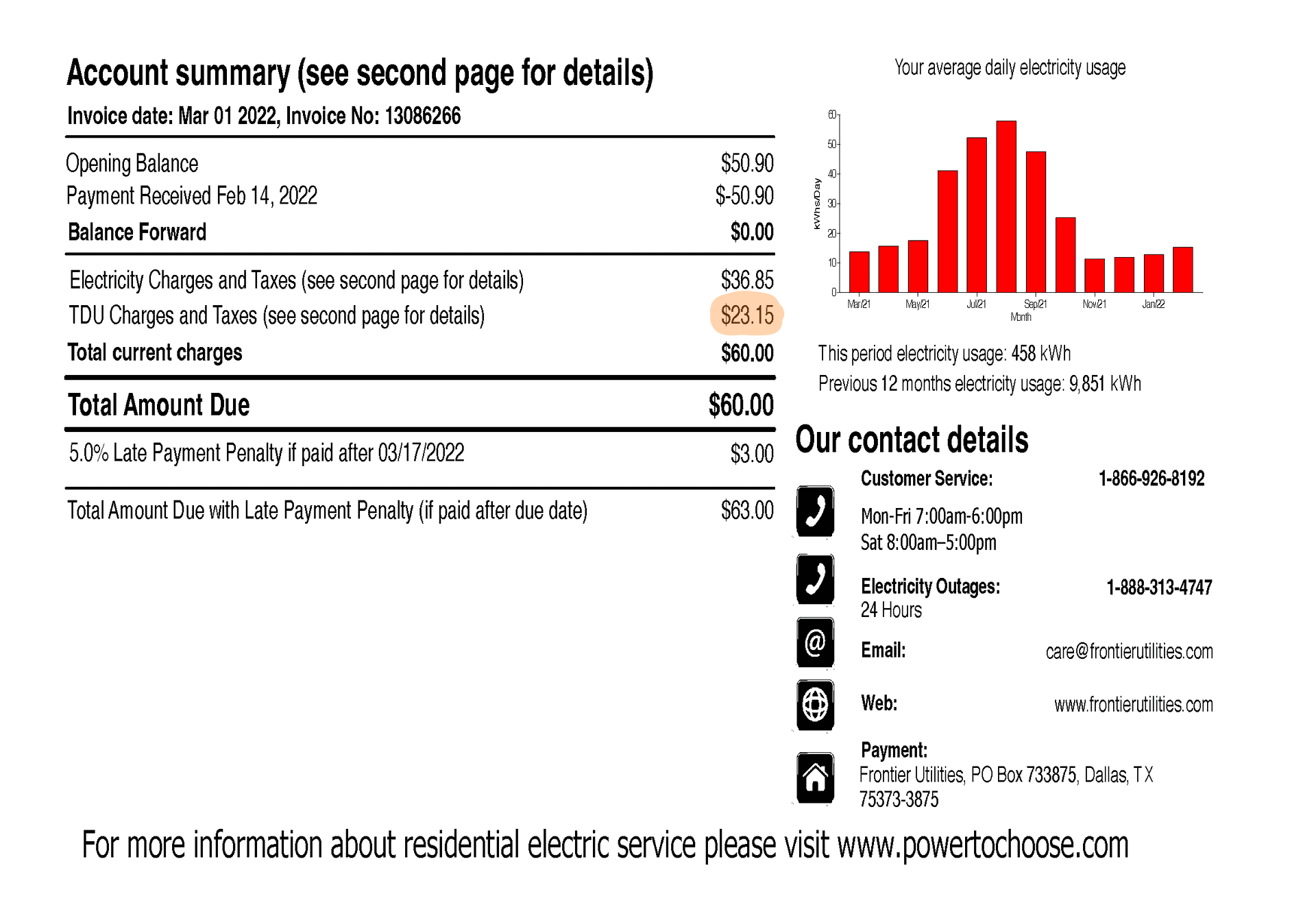
Every ratepayer in America has that line. In most states you cannot tell what’s inside it.
Texas is the exception — not because Texas is worse, but because its grid allocates that cost through a formula anyone can check. And when you check it, this is what you find, according to figures utilities themselves have put on the record with regulators: in 2023, residential customers of CenterPoint Energy in the Houston area used about a third of the electricity that moved through the system. They were allocated about half the transmission bill.
Not a third. Half.
The gap is not a mistake, and it is not inflation. It is the output of a legal, well-documented mechanism — and the reason it is worth understanding in Texas is that the same trade is being made in your state, through machinery you cannot see.
The Four Afternoons a Year That Set the Rate
Texas’s power grid, run by ERCOT, pays for its transmission lines through a method called 4CP — four coincident peak. Once a year, ERCOT identifies the single highest-demand 15-minute window in each of June, July, August, and September — four afternoons total, usually brutally hot ones, when every air conditioner in the state is running at once. Whatever share of the grid’s total load a customer class used during those four windows determines its share of the year’s transmission bill.
The idea, when it was designed decades ago, made sense. The grid’s most expensive stress moments are the summer-peak afternoons. Charge the customers who cause that stress, in proportion to how much they cause it.
Here’s the part that broke it: those four 15-minute windows are predictable. Grid analysts forecast them. And if a customer can simply switch off during those specific fifteen minutes, four times a year, its share of the bill drops toward zero — while its power use for the other 35,000-odd minutes of the year continues exactly as before.
Steel mills and refineries have played this game for years. Bitcoin miners perfected it — a mining rig has no minimum operating load, so a mine can go from full power to zero in seconds, with no product lost, no customer inconvenienced, nothing but a pause in computation nobody outside the building even notices. Data centers are learning the same trick: pre-cool the building before the predicted peak, shift computational workloads to other facilities, ride out the fifteen minutes on stored thermal capacity, then resume.
One industry estimate puts the savings for a single large data center avoiding its 4CP charge on a 500-megawatt load at roughly $33.4 million a year in transmission charges it would otherwise owe.
The Bill Doesn’t Vanish. It Moves.
Here is the mechanism’s second half, the one that turns a clever accounting trick into an extraction: ERCOT’s total transmission cost for the year is fixed. Someone has to pay for the wires that got built. If a data center’s four-window curtailment erases its share, that share does not disappear from the ledger. It is reallocated — mechanically, automatically, by the same formula — across everyone who couldn’t curtail.
Who couldn’t curtail? Air conditioners. Refrigerators. Families cooking dinner on the exact same hot August evenings the grid peaks, because that is when people are home and it is 101 degrees outside. Residential demand is highest precisely when the four coincident peaks occur, and a household cannot “pre-cool and shift workload” its way out of needing power during a heat wave. So residential customers absorb, dollar for dollar, whatever the curtailing loads avoided.
That’s the CenterPoint gap: 33% of the electricity, 49% of the transmission bill, in 2023 — up from a 12.6-point gap in 2018. The figures come from CenterPoint’s own cost-allocation schedules, filed with Texas regulators in its base rate case (PUCT Docket 56211) and the prior rate case that preceded it (Docket 49421); they are not a formally adopted cost-shift finding, but they are the utility’s own numbers, on the record. The number of organized 4CP-avoidance participants in ERCOT’s territory grew from 418 to 1,080 between 2022 and 2024, tracking almost exactly with the growth of the gap. This is not one company gaming the system. It is a growing population of large, flexible, price-insensitive loads — increasingly data centers — all running the same play, all landing on the same residential line item.
Texas lawmakers know it. Senate Bill 6, signed June 20, 2025, ordered state regulators to review whether 4CP still “appropriately assigns costs” and to fix it by the end of 2026 if not. The Public Utility Commission opened a review, took public comment, and in March 2026 published six draft fixes — lengthen the peak-measurement windows, count more than four peaks, make large loads pay toward system upgrades, impose minimum demand charges regardless of actual use. None of it is final. In June 2026, Governor Greg Abbott directed the commission to move faster, ordering it to act by the end of July to reduce residential transmission costs and to make data centers pay the full cost of the infrastructure built to serve them.
The rule hasn’t changed yet. As of this writing, residential ERCOT customers are still absorbing whatever the curtailing loads avoid — and CenterPoint alone expects to bring 8 gigawatts of new data-center load onto its system by 2029. Whatever the gap is doing to residential bills now, it is doing it at a scale about to multiply.
One Mechanism, Five Doors, No Single Culprit
Texas’s 4CP fight is the clearest version of a pattern that runs through every major grid in the country, just wearing different local paperwork.
Readers who’ve followed the datacenter buildout through my reporting have already seen pieces of this same pivot. In the mid-Atlantic grid operator PJM’s territory — Virginia, Ohio, Maryland, Pennsylvania, Illinois — a single capacity-market auction price is paid by every customer in the zone, with no mechanism to isolate who drove the price up. That price went from $28.92 per megawatt-day in the 2024/25 auction to a record $269.92 in 2025/26, then to a newly imposed price cap in each of the next two consecutive auctions — $329.17, then $333.44. By December 2025 data centers accounted for roughly 40% of the $16.4 billion total.
Customers in seven PJM states paid roughly $4.3 billion for data-center-driven transmission buildout in 2024 alone. In Indiana, a utility’s unregulated-affiliate arm is seeking an alternative regulatory plan from state regulators to build power plants for a large-load customer under a confidential contract — a structure that claims to protect ratepayers but cannot be independently checked, because the contract terms are secret and the customer named in the filing itself is redacted.
The financial-vehicle version of this opacity shows up wherever data-center capital needs a wall between the money and the public record. Federal energy regulators have invoked emergency powers more than forty times since May 2025 — a running log counts 43 orders and extensions across roughly six plants — to keep aging coal plants running past their retirement dates, citing data-center-driven demand growth as the emergency, with the above-market cost of running old plants recovered through regulated rates, paid by ratepayers, not by the data centers whose growth supplied the justification.
Each of these is approved by a different regulator, on a different record, and each looks reasonable in isolation — a state utility commission here, a market operator there, a federal agency somewhere else. That is the mechanism’s real signature: nobody ever votes on “the cost-shift.”
It emerges from five separately defensible decisions made in five separate rooms, and the same class of customer benefits from all five.
Be cautious of the claim that a residential bill went up 267% because of a data center down the street — that specific figure describes wholesale prices at grid nodes, not what shows up on a residential statement, and a widely circulated claim using it that way was rated “Mostly False” by fact-checkers. The real number is smaller and still real: a documented, growing, multi-billion-dollar shift of infrastructure cost off the customers who caused it and onto the ones who didn’t.
The Colony Pays Twice
Texas also gives away roughly $1.3 billion a year in local tax exemptions to attract data centers — forgone revenue for schools, roads, and public services, on top of the transmission cost-shift. That is the same trade playing out on two separate ledgers: general-fund forgone revenue and the utility-bill cost-shift this piece has walked through. Georgia’s legislature tried to unwind both in a single 2026 session — killing a tax-exemption repeal and three separate ratepayer-protection bills in the same sitting. Both survived the same attack in the same room.
Pope Leo XIV named something adjacent to this in his May 2026 encyclical, Magnifica Humanitas — a “new form of colonialism” that, in his words, “no longer dominates only bodies, but appropriates data,” turning regions of what he calls “structural fragility” into the raw material of digital power (RAMM broke down that language when the encyclical published, and followed it to the guest list of who actually holds that power). The paragraph is about health records, genetic maps, demographic data — what he calls the new “rare earths” of power. It is not about electricity. He never mentions transmission lines, grid capacity, or Texas.
But the extension holds, and it’s worth making explicitly rather than implying it: a data center cannot appropriate data without land, water, and grid capacity — and the grid capacity comes from a captive population of ratepayers who supply the electricity that makes the appropriation physically possible. If data is the new rare earth, the mine that extracts it has a service address, a transmission line, and a residential customer base absorbing the infrastructure cost. The Pope was describing the resource. This is the extraction of the plant that processes it.
The Building Next Door Has Two Faces
Somewhere in a data-center county, the same week a transmission line-item creeps up, a county commission may also be voting on a tax abatement for a warehouse-sized building that will hold not servers but people.
The economics rhyme — this piece walked the same public-cost, private-profit shape through the detention system. A facility goes up outside town; the company that runs it takes the profit; the public absorbs the cost the company doesn’t pay. In Adelanto, California, under the city’s older pass-through contract, GEO Group paid the city $1 per contracted bed per day, plus a flat $50,000 administration fee, while ICE money flowing through the arrangement ran to tens of millions of dollars a year.
Adelanto kept the sliver; GEO kept the rest.
GEO has since taken the facility direct — under the ICE contract it has held since December 2019, worth roughly $85 million a year, with no city cut at all. The extraction didn’t need the city as an intermediary; it just needed somewhere to put the building. Ismael Ayala-Uribe died in that facility in September 2025, one of four deaths there in seven months — the same care-collapse pattern this piece’s own mechanism produces when a fixed budget gets stretched across more load than it was sized for, except the budget here is medical staffing and the load is human beings.
It is not the same building as a data center. It is the same shape: a facility that consumes public infrastructure and offloads the cost onto the public that hosts it. And the the extracted value — computing power, or a per-bed federal contract — flows to shareholders somewhere else.
The building consumes the grid.
The public funds the grid.
What This Is and Isn’t
This is not a claim that data centers curtailing their load during 4CP windows are doing anything illegal. They are following the rules exactly as written — playing the game the regulation created, rationally. The rules are the story, not the players’ intent.
This is not a national claim. The 4CP mechanism is specific to Texas’s ERCOT grid, which operates outside the rest of the country’s interconnected power system by design. Other regions produce the same result — customers subsidizing data-center infrastructure — through their own mechanisms: PJM’s capacity auction, special utility contracts, federal emergency orders keeping old plants running. Find your own state’s version before assuming this one applies to you.
This is not a claim that the aggregate dollar cost to Texas residential ratepayers has been officially calculated. It hasn’t. No Public Utility Commission study, no consumer-advocate filing, and no PUCT order has yet published a system-wide estimate of how many dollars a year Texas households are overpaying because of 4CP avoidance. The CenterPoint 33%/49% ratio and the $33.4 million-per-project avoidance figure are real and sourced. The statewide total residential households are effectively paying is, as of this writing, not a number that exists in any public document — which is itself worth sitting with.
Before we continue, one quick ask.
At The RAMM I connect the dots that don’t fit in one article: the federal contracts, the 287(g) deals, the quiet real-estate moves, the county-by-county buildout of detention capacity.
The receipts:
4,776+ sourced events at CaptureCascade.org
1,988 counties with signals of detention expansion at detention-pipeline
129 community fights over detention capacity, tracked
This is self-funded. Subscriptions are the only thing that keeps it alive
The Go-Look Beat
Pull your own utility bill and find the delivery or transmission line. If a data center has been proposed near you, its tax-abatement agreement is very likely a public record — most cities and counties are required to post economic-development agreements, and if yours hasn’t, you can request it. If you live in ERCOT territory, PUCT’s Project 58484 docket is open for public comment until the commission issues its final rule. If you live somewhere else, find your own grid operator’s cost-allocation proceeding — PJM, MISO, SPP, WECC all have one. It’s rarely covered by name. It is almost always public.
The Pope named the class. Your utility commission’s docket names the instance. Now go find yours.
Sources
Texas / ERCOT
NRG Energy remarks to the ERCOT Market Summit, Feb 25, 2025 — source of the 33%/49% figures, the 2018 comparison, the 418→1,080 participant growth, and the $66.76/kW-year transmission rate
PUCT Docket 56211, Commission order, March 13, 2025 — CenterPoint base rate case; cost-allocation schedules behind the figures
PUCT Substantive Rule §25.192, Transmission Service Rates — the legal definition of 4CP
Texas SB 6, 89th Legislature — signed June 20, 2025; 75 MW threshold
PUCT Project 58484, Staff Memo and Draft Report, March 16, 2026 — the six recommendations
CenterPoint Q1 2026 earnings presentation (SEC) — 8 GW by 2029
Texas Comptroller, Tax Exemptions & Tax Incidence, January 2025 — §151.359 data-center exemption: $1.31B in FY2026, rising to $1.75B by FY2030
PJM and national
Monitoring Analytics, Analysis of the 2027/2028 RPM Base Residual Auction, Jan 5, 2026 — $16,411,578,225 total; $6,497,653,512 attributable to data-center demand (39.6%)
PJM 2027/2028 Base Residual Auction Report, Dec 17, 2025 — Table 2, full clearing-price history
Union of Concerned Scientists, PJM data center issue brief, September 2025 — $4,356.3M across 130 projects in 7 states
IURC Cause No. 46322 — NIPSCO/GenCo joint petition — special contract and PPA, confidential exhibits
POWER Magazine’s running log of DOE §202(c) orders, April 2, 2026 — 43 orders and extensions
Congressional Research Service R48568 — DOE’s FPA emergency authority
PolitiFact, June 12, 2026 — “Mostly False” — the 267% figure is wholesale nodal prices, not residential bills
Georgia
SB 410 — Georgia General Assembly — passed Senate March 6, died in House March 10, 2026
HB 1063 — passed the House Feb 17, stalled in Senate committee
HB 1012 — died in committee
Other
California State Auditor, Report 2018-117, City and County Contracts With ICE — Adelanto retained $1 per contracted bed per day, under the city’s earlier pass-through contract
ICE, Detainee Death Report — Ayala Uribe, Ismael — official ICE record, death September 22, 2025