

The Dog Finally Barked: Epstein Emails + 218th Signature
Documentary evidence dropped today. A congress woman is finally seated, and signs the Discharge petition triggering a mandatory vote. You have one week to pressure your representatives.
Two major developments converged today:
This morning: The House Oversight Committee released emails from Jeffrey Epstein’s estate proving Trump spent hours with a trafficking victim and knew about the operation.
This afternoon at 4 PM: Representative-elect Adelita Grijalva (D-AZ) was sworn in, becoming the 218th signature on a discharge petition that forces a House vote on releasing all Epstein investigation files.
The timing isn’t coincidental.
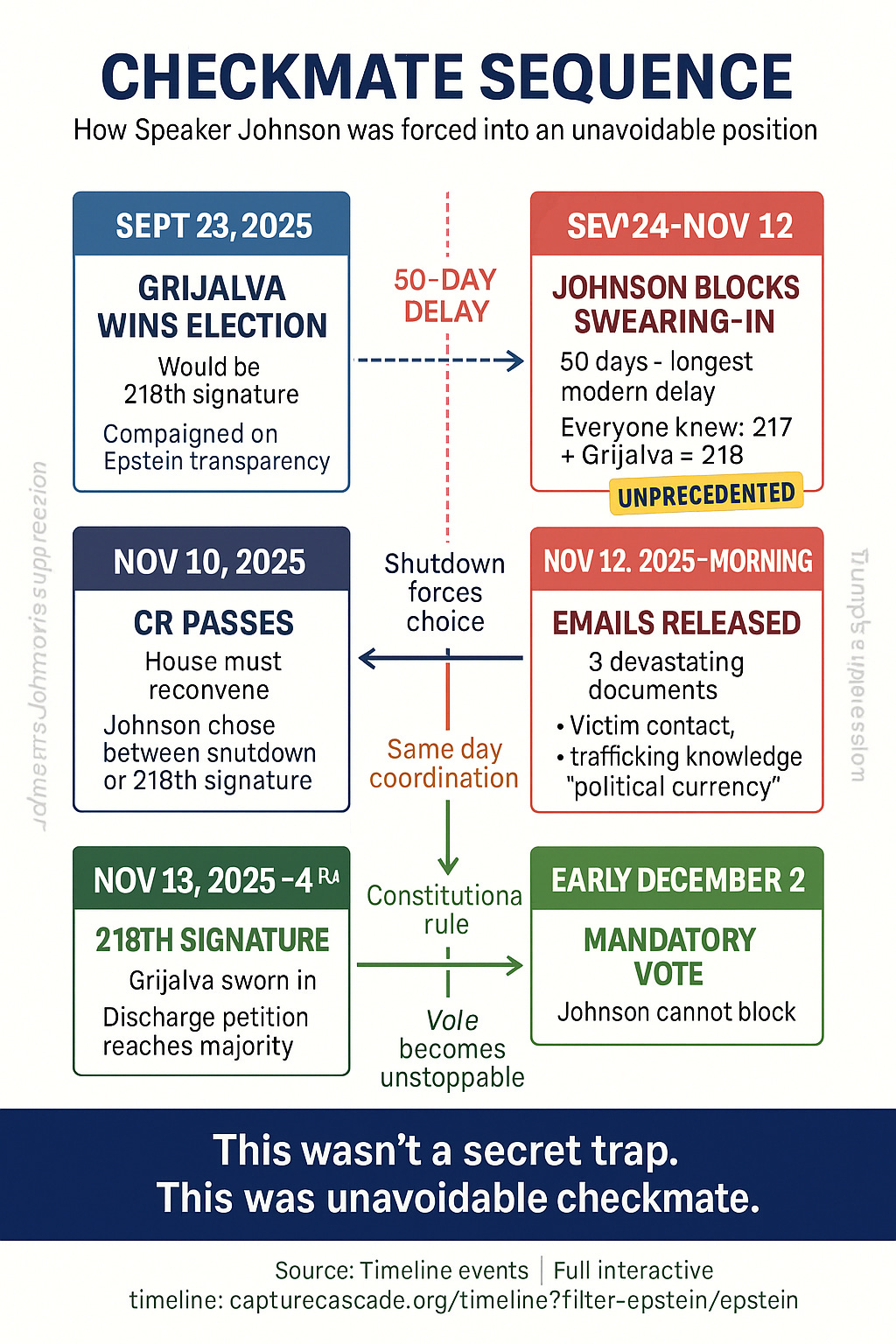
For seven weeks, everyone knew the math: 217 signatures existed. Grijalva would be the 218th. Her swearing-in would trigger a mandatory vote on releasing all 100,000 Epstein files—every document the Justice Department has been hiding for six years.
Speaker Mike Johnson knew this. So he simply refused to swear her in. Fifty days. The longest special election delay in modern history. All to prevent a single signature on a single petition.
Then the government shut down. Johnson faced an impossible choice: Keep it closed forever, or pass a continuing resolution and reconvene the House.
On Sunday, he chose the CR. This morning, House Democrats released the emails. This afternoon, Grijalva was sworn in as the 218th signature.
This wasn’t a secret trap. This was watching someone walk into checkmate in full view, step by step, knowing exactly what was happening, and being unable to stop it.
And now we know what they’re trying to hide.
The emails prove what Trump has spent 10 months suppressing. The signature triggers what Johnson spent 50 days blocking. And now every representative will vote on the record.
This is the exposure window. Here’s how to use it.
Note: If you’re following from Monday’s shutdown analysis, this is the activation of the “possibly significant” tactical terrain. If you’re new here: welcome. Everything you need is in this post.
What Dropped Today
The House Oversight Committee released three emails from the 23,000-document archive obtained from Epstein’s estate. Each email is documented and sourced. Here’s what they say:
Email 1: “The dog that hasn’t barked” (April 2011)
From: Jeffrey Epstein To: Ghislaine Maxwell
“I want you to realize that that dog that hasn’t barked is trump.. [VICTIM NAME] spent hours at my house with him, he has never once been mentioned.”
Source: Washington Post, NPR, ABC News
What this documents: A named trafficking victim spent extended time with Trump at Epstein’s property. Epstein is noting to Maxwell—his chief recruiter and convicted sex trafficker—that this victim “hasn’t been mentioned” in connection to Trump.
Republicans on the committee identified the victim as Virginia Giuffre, one of Epstein’s most prominent accusers.
Email 2: “Political currency” (December 2015)
From: Michael Wolff (author) To: Jeffrey Epstein Context: CNN planning to ask Trump about Epstein during Republican primary
Wolff tells Epstein that if Trump denies being on the plane or at the house, “that gives you a valuable PR and political currency.”
What this documents: Epstein and associates discussed Trump’s potential public denials as leverage—”political currency.” Classic kompromat architecture: let the target lie publicly, possess the evidence proving it false.
Email 3: “He knew about the girls” (January 2019)
From: Jeffrey Epstein To: Michael Wolff Context: Six months before Epstein’s arrest
“Of course he knew about the girls as he asked ghislaine to stop.”
What this documents: Trump knew about Epstein’s trafficking operation and asked Ghislaine Maxwell to “stop.” Written six months before Epstein’s arrest. Direct statement about Trump’s knowledge of ongoing federal crimes.
Why This Matters Now
Johnson’s 50-day delay blocking Grijalva wasn’t procedural—it was desperation. Today we see what he was desperate to prevent.
This afternoon (Wednesday, November 13) at 4 PM, Grijalva was sworn in. She has said her first act will be to sign the Epstein Files Transparency Act discharge petition as the 218th signature.
How Discharge Petitions Work
A discharge petition is a constitutional mechanism: when 218 House members (a simple majority) sign, they can force a vote that leadership cannot block. House rules require seven legislative days to pass, then any signer can demand a vote within two days.
Once Grijalva’s signature is obtained:
Seven legislative days pass (Nov 14-26)
Early December: House vote becomes mandatory
Speaker Johnson cannot prevent it
Every representative votes on the record
What Gets Released
The Epstein Files Transparency Act (H.R. 581, sponsored by Rep. Thomas Massie R-KY and Rep. Ro Khanna D-CA) would compel DOJ to release all unclassified documents:
FBI investigation files (1996-2019)
Palm Beach Police evidence
Federal prosecutors’ files from the 2008 Acosta plea deal
SDNY 2019 sex trafficking investigation materials
Flight logs, financial records, phone records
Victim statements and depositions
Maxwell trial evidence
DOJ estimates ~100,000 documents.
If three emails are this damaging, what’s in the other 99,997?
The Suppression Timeline (Documented)
Trump’s administration has spent 10 months blocking transparency. Here’s the timeline with sources:
February 2025: Epstein Files Phase 1 released (heavily redacted, minimal Trump references)
May 2025: AG Pam Bondi briefs Trump on “names in files”—no public release follows
July 12: Trump attacks transparency supporters as “weaklings”
July 16: Trump calls Epstein connection “hoax” on Truth Social
August 1: FBI redacted Trump’s name from files before release
September 2: White House warns transparency is “hostile act”
September 10: Senate Republicans block disclosure vote
September 11: Bloomberg publishes 18,000-email archive
September 23: Grijalva wins special election
September 24-November 12: Johnson blocks swearing-in for 50 days (longest modern delay)
November 13: House Democrats release victim contact and trafficking knowledge emails
November 13: Grijalva sworn in, 218th signature obtained
Early December: Mandatory vote
The Tactical Read
I can’t read minds. I don’t know if Democrats coordinated Monday’s shutdown vote with today’s email release. But I can observe the tactical terrain:
What’s Documented
217 signatures existed since late September
Everyone knew Grijalva = 218th (she campaigned on it)
Democrats publicly accused Johnson of blocking specifically to prevent Epstein vote
Sunday’s CR vote forced House to reconvene
Tuesday’s emails drop
Wednesday’s swearing-in triggers seven-day countdown
Possible Interpretations
Scenario A: Coordinated strategy. Democrats accepted “bad CR” optics to force House reconvening, held emails for maximum impact, timed release for day before 218th signature.
Scenario B: Opportunistic timing. House Oversight had emails for months (from 23,000-document subpoena), released when political moment aligned with pending swearing-in.
Scenario C: Independent coincidence. Different Democratic factions pursuing separate tactics that happened to converge.
What I think: The timing is too precise to be random.
But whether coordinated from top or it emerged organically from distributed Democratic actors, the tactical effect is the same: emails + signature + mandatory vote = forced transparency in a way Johnson spent 50 days trying to prevent.
But more importantly: It doesn’t matter which interpretation is correct. What matters is the opportunity now exists. The discharge petition will hit 218. The vote will happen. Every representative will be on record.
Why Pressure Works
Johnson didn’t block Grijalva’s swearing-in for 50 days as theater. He did it because constituent pressure on the Epstein vote terrifies Republicans.
The math proves it:
Public polling: 70%+ support release (including 68% of Republicans)
Political vulnerability: Today’s emails mean voting NO isn’t “blocking partisan documents”—it’s suppressing evidence a named victim spent hours with Trump while he knew about trafficking
2026 exposure: Every NO vote becomes a campaign ad: “[Representative] voted to hide evidence of sex trafficking”
Why Johnson delayed: If constituent calls/emails surge, vulnerable Republicans flip. If 5+ flip, the House passes. If 13+ Senate Republicans feel pressure, it passes Senate. If 20+ Senate Republicans face constituent fury, it’s veto-proof.
Your call matters. That’s why they fought so hard to prevent this vote from happening.
What You Can Do (Next 7 Days Critical)
The seven legislative days start tomorrow. Early December vote is coming. Maximum pressure window is RIGHT NOW.
1. Call Your Representative (TODAY)
Find your House rep: https://www.house.gov/representatives/find-your-representative
Call script (30 seconds):
“I’m calling about the Epstein Files Transparency Act. House Democrats released emails today showing Trump spent hours with a trafficking victim and knew about the operation. The discharge petition hits 218 tomorrow and will force a vote. I expect [Representative Name] to vote YES on full transparency. This is not partisan—it’s about accountability. I’m watching how they vote.”
2. Call Your Senators
Find your Senators: https://www.senate.gov/senators/senators-contact.htm
Call script:
“I’m calling about the Epstein Files Transparency Act. If the House passes it, I expect [Senator Name] to vote YES on releasing all files. The emails released today prove we need full transparency. Seventy percent of Americans support this. I’m watching how they vote.”
3. Share Today’s News
The emails are breaking news. The strategic timing is the hidden story. Share both:
4. Prepare for Next Week
Rep. Ro Khanna promised a press conference with Epstein survivors next week. When victims speak publicly, pressure intensifies.
Watch for timing—likely scheduled before the December vote for maximum impact.
5. Track the Vote
Bookmark these for December:
GovTrack Epstein Files bill page (will update when vote scheduled)
Massie’s office (lead Republican sponsor)
Khanna’s office (lead Democratic sponsor)
Every representative’s vote will be public record. Make sure your district knows.
The Vote Math (Realistic Assessment)
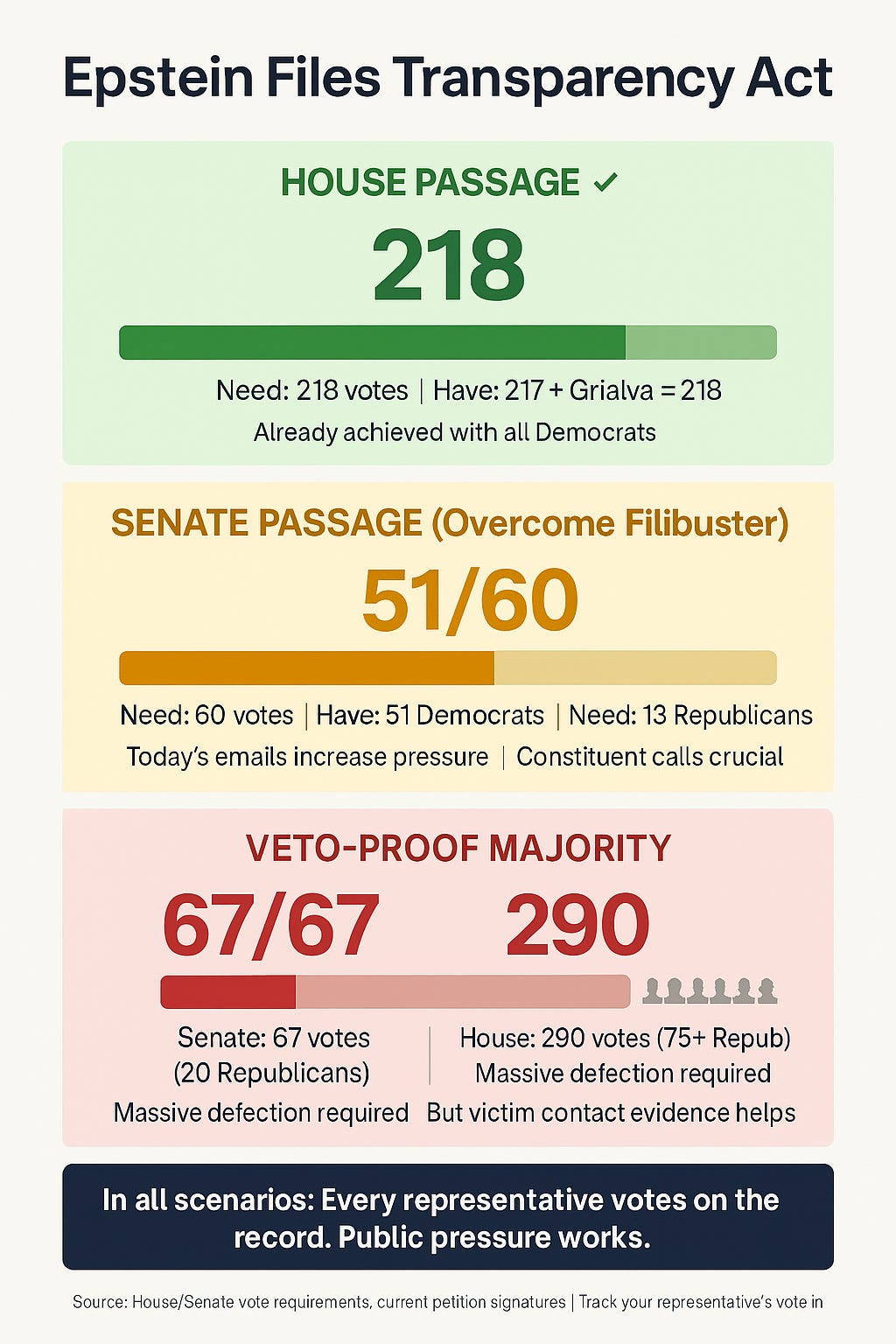
House (needs 218 to pass)
This Morning: 217 signatures (all Democrats + 3 Republicans: Boebert, Greene, Mace)
After this afternoon: 218 with Grijalva
To pass: Needs majority (218) - will definitely get that with all Dems + 3 GOP
Likely additional support: Several more Republicans under constituent pressure (bipartisan bill, 70% public support, today’s emails shift politics)
Probability of passage: Very high (85%+)
Senate (needs 60 to overcome filibuster)
Democratic votes: 47 (plus 4 independents who caucus with Dems = 51 total)
Republican votes needed: 13 to reach 60
Challenge: Senate Republicans more insulated from immediate constituent pressure than House
Catalyst: House passage + continued revelations + survivor press conference + constituent campaigns
Probability of passage: Medium (45-55%)—today’s emails help significantly
Veto-Proof (needs 67 Senate, 290 House)
Senate Republicans needed: 20 (to reach 67)
House Republicans needed: ~75 (to reach 290)
Challenge: Requires massive Republican defection despite Trump opposition
Catalyst: Overwhelming constituent pressure + additional damaging revelations + corporate donor pressure (they don’t want prolonged Epstein scandal)
Probability: Low-Medium (25-35%)—higher than it was yesterday
Three Scenarios From Here
Scenario 1: Passes House, Dies in Senate
Outcome: House passes with bipartisan support. Senate Republicans filibuster. Bill dies without needing Trump veto.
Political effect: Every House vote is public record. Senate Republicans who block take full blame. Becomes 2026 midterm issue in competitive Senate races.
Tactical lesson: Constitutional tool (discharge petition) works in House but Senate rules protect minority obstruction.
Scenario 2: Passes Both Chambers, Trump Vetoes
Outcome: House and Senate pass with simple majority but not veto-proof. Trump forced to publicly veto victims’ evidence. Veto override fails.
Political effect: Trump on record choosing self-protection over transparency. Every NO vote on override becomes campaign ad. Suppression becomes defining issue for 2026 midterms.
Tactical lesson: Forced the vote, forced the veto, exposed the priorities. Even “losing” creates political vulnerability.
Scenario 3: Veto-Proof Passage
Outcome: Overwhelming bipartisan support. Files released regardless of Trump position.
Political effect: Full documentary record becomes public. Multiple powerful figures likely exposed. Justice Department can’t ignore victims’ evidence. Criminal referrals possible.
Tactical lesson: Constitutional accountability tools still function when public pressure exceeds elite protection instincts.
Why This Is a Test
For 54 years since the Powell Memo, we’ve watched systematic institutional capture. Financial crimes unprosecuted. Regulatory capture unchallenged. Elite impunity normalized.
The Epstein case is different because the architecture of blackmail is documented. Today’s emails let us read Epstein’s own words describing strategic leverage, victim contact, knowledge of crimes.
The discharge petition is a constitutional tool designed for exactly this: when leadership blocks legislation with overwhelming public support, a majority can force accountability.
The question: In 2025, with a compromised president wielding power, do these tools still work?
The answer: We’re about to find out.
Not through speculation. Through actual votes on actual evidence affecting actual victims.
My Tactical Read
What I’m watching for:
This Week (Nov 13-20)
Grijalva sworn in today (confirmation that 218th signature obtained)
White House response evolution (defensive → aggressive → what?)
Republican wavering (which members signal openness under pressure?)
Additional leaks (the 23,000-document archive has more)
Next Week (Nov 21-27)
Survivors’ press conference (Khanna promised this—when/where?)
Seven legislative days complete
Vote can be called
Corporate donor pressure (do they want prolonged scandal during holiday season?)
Early December
The vote itself
Every representative on record
Senate response if House passes
Trump’s decision if Senate passes
January
Next CR deadline (Jan 30)
Democrats return to shutdown leverage
Now with Epstein votes documented
Pattern established: Republicans fold under pressure
Pattern I’m tracking: Does the 10-week CR timeline create sustained pressure points? Epstein vote → ACA vote → January leverage? Or do Republicans successfully suppress each crisis separately?
What would change my read: Ifthe discharge petition signatures somehow drop below 218 (White House has been pressuring Boebert/Greene/Mace to withdraw). These would indicate capture is deeper than constitutional tools can overcome.
What would strengthen my read: More Republicans signaling openness, additional damaging revelations from the 23,000 documents, corporate donors pushing for resolution, survivors’ press conference shifting public pressure.
The Discipline Question
There’s a choice for everyone watching this unfold:
Energy spent arguing about partisan blame = energy not spent forcing transparency votes and building coalitions for winnable fights. There will be time for this later. And trust me we will remember how these senators voted next time elections roll around.
But we have more important work to do now: Our energy ths week must be spent calling representatives and tracking votes = material progress toward accountability.
One fragments movements, one builds power.
If we focus on the winnable fight—forcing every representative to vote on documented victim contact—we build real accountability.
This is a weird coalition moment: Progressive Democrats + MAGA Republicans (Massie, Boebert, Greene) + Epstein survivors + 70% of the public demanding transparency. Republican leadership trapped between constituent fury and Trump’s protection instinct.
Discipline means: Channel justified anger into effective pressure. Call representatives. Share emails. Track votes. Win material victories over moral ones.
What I’m Documenting
I’m tracking this for the Cascade Timeline—see the full Epstein timeline view here:
Who votes YES (transparency over protection)
Who votes NO (protection over victims)
How pressure affects votes
Whether constitutional tools work
How January leverage plays out
Pattern: Can weird coalitions overcome capture?
We’ll know in two weeks whether Epstein transparency pressure works.
But right now—today—we know:
✅ Emails prove victim contact and Trump’s knowledge ✅ The final singature triggers mandatory vote ✅ Every representative will be on record ✅ Public pressure works (that’s why Johnson fought so hard) ✅ The opportunity exists
Your move.
TAKE ACTION NOW
The next 7 days are critical. Seven legislative days pass, then the vote comes. Maximum pressure window is RIGHT NOW.
Call your House Representative: https://www.house.gov/representatives/find-your-representative
Call your Senators: https://www.senate.gov/senators/senators-contact.htm
Use the call scripts above (30 seconds, be polite but firm)
Share today’s emails: House Oversight press release
Track the vote: Watch for survivors’ press conference and December vote
Why your call matters: Johnson blocked Grijalva for 50 days because constituent pressure terrifies Republicans. One call is a data point. A hundred calls is a problem. A thousand calls changes votes.
The timeline is urgent:
Next 7 days: Maximum pressure window
Next week: Survivors speak
Early December: The vote
One More Thing
Today’s emails came from a 23,000-document archive. We’ve seen three. The Bloomberg leak was 18,000 emails (fragments published). The Ehud Barak leak was 100,000 emails (fragments published).
We’re seeing <1% of what exists.
This is why they fought so hard. This is why the vote matters. This is why your call matters.
The dog finally barked. Now we see if Congress listens—or if you make them listen.
Call today. Track tomorrow. Watch December.
Update Log:
Nov 12: Emails released, analysis posted
Nov 13: [Will update after Grijalva swearing-in]
Week of Nov 18: [Will update after survivors’ press conference]
Early Dec: [Will update with vote results]
Sources linked throughout | Subscribe for updates | Share widely
#EpsteinFiles #ReleaseTheFiles #CallYourReps #AccountabilityWorks
This is part of the Cascade Timeline Project documenting 54 years of institutional capture from the Powell Memo to present. Support independent investigative journalism.
This a great analysis of the Epstein situation. Stunning drop of docs today!