

The Darkness is Infrastructure: The system didn't fail at oversight. It was engineered to eliminate it entirely.
What we know, and what we don't know about what is happening inside ICE detention facilities.
The Darkness
Last Wednesday, Trump removed DHS Secretary Kristi Noem — the official who blocked congressional access to detention facilities, presided over 96+ court order violations in a single month, spent $300 million on luxury jets and $220 million on self-promoting ads, and called two U.S. citizens shot dead by federal agents “domestic terrorists.” Her replacement inherits the system she built. This is the story of that system’s relationship to light.
On July 20, 2025, Representative Jason Crow arrived at the ICE facility in Aurora, Colorado.
He carried a printout of Section 527 of the federal appropriations law — the statute that guarantees members of Congress the right to conduct unannounced inspections of any DHS facility. The law is explicit. The access is mandatory. The executive branch cannot use federal funds to prevent it.
ICE guards turned him away.
Eight days later, six Maryland Democrats — including Senators Chris Van Hollen and Angela Alsobrooks, and Representatives Kweisi Mfume and Glenn Ivey — were denied access to the Baltimore field office. The field office director told them the denial came from “headquarters.”
On October 7, 2025, ICE furloughed its entire Office of Detention Oversight — the internal unit responsible for monitoring conditions in facilities. The furlough came during the government shutdown, but the timing was precise: it coincided with a record 60,000+ people in custody and plans to double capacity past 100,000 beds.
On July 11, 2025, Attorney General Pam Bondi fired Joseph Tirrell, the DOJ’s top ethics official — the person responsible for advising her on recusals from former clients, including GEO Group, one of the largest private prison and immigration detention companies in the US. GEO makes billions from incarceration and deportation.
In January 2026, the chief federal judge in Minnesota documented 96 court order violations by DHS in a single month. This is not a system that fails at oversight. This is a system designed to exist in the darkness.
The Congressional Lockout
Federal law guarantees members of Congress access to detention facilities. Section 527 of the DHS Appropriations Act states that the department cannot use any funds “to prevent or hinder a Member of Congress, or a designee of such a Member, from visiting any detainee.”
The law was passed in 2019 specifically to prevent the executive branch from hiding detention conditions from legislative oversight.
In June 2025, DHS issued new directives requiring seven days’ advance notice for congressional visits — and blocking access to field offices entirely.
Representative Crow showed guards the law. They turned him away anyway.
On July 30, twelve Democratic members of Congress filed suit in federal court:
Rep. Joe Neguse (CO)
Rep. Jason Crow (CO)
Rep. Jamie Raskin (MD)
Rep. Veronica Escobar (TX)
Rep. Adriano Espaillat (NY)
Rep. Dan Goldman (NY)
Rep. Bennie Thompson (MS)
And five others
The lawsuit documented systematic denial of access in California, Colorado, Texas, Maryland, and New York. Rep. Neguse stated: “Blocking Members of Congress from oversight visits to ICE facilities that house or otherwise detain immigrants clearly violates federal law — and the Trump administration knows it.”
The administration’s response: we’ll see you in court.
On March 2, 2026, Judge Jia Cobb of the D.C. District Court blocked Noem’s policy, ruling it likely violates the appropriations law that guarantees unannounced congressional visits. The court sided with Congress. It took eight months and a federal lawsuit to restore a right that was already written into law.
Three days later, Noem was gone — removed by Trump after bipartisan fury over the killings of two U.S. citizens, 187 impeachment co-sponsors, and congressional hearings where she refused to retract calling the dead “domestic terrorists.” Her replacement, Sen. Markwayne Mullin, takes over March 31.
But the policy Noem imposed didn’t require Noem to exist. It required a system that treats oversight as the enemy. Court orders, as we’ve seen, are only as strong as the executive’s willingness to obey them — and the next Secretary inherits the same incentives.
The Internal Watchdogs
Every federal agency has internal accountability mechanisms: inspectors general, ethics offices, compliance units. These aren’t just bureaucracy. They’re the structures that prevent abuse when external oversight fails.
In 2025, the administration dismantled them.
Office of Detention Oversight
ICE’s Office of Detention Oversight was responsible for inspecting facilities and documenting conditions. In the first 50 days of Camp East Montana’s operation, this office found more than 60 federal standards violated. Camp Montana is the largest internment facility in the United States with planned capacity for 5,000 detainees.
On October 7, 2025, the entire office was furloughed.
The furlough technically resulted from the government shutdown. But the timing was precise: as the detained population hit a record 60,000+ and capacity was racing toward a planned 100,000+ beds — the largest expansion in history — the office responsible for monitoring conditions stopped existing.
When the shutdown ended, the office wasn’t restored at full capacity. Inspections remain infrequent. Facilities that held three people who died in 44 days operate without independent monitoring.
The DOJ Ethics Office
Joseph Tirrell served as the Department of Justice’s top ethics official — he joined the office in 2018 and became its director in 2023, after more than two decades in federal service including over ten years at the FBI. His office advised senior leadership on federal employee ethics — including when prosecutors and political appointees should recuse themselves from matters involving former clients.
Attorney General Pam Bondi lobbied for GEO Group in 2019. GEO Group operates facilities that hold ICE detainees. The ethics office would have advised whether Bondi should recuse from matters affecting her former client.
On July 11, 2025, Tirrell was fired “effective immediately.” The termination memo cited “Article II of the United States Constitution” — the president’s authority to remove executive branch officials.
No ethics director. No recusal guidance. No accountability for conflicts of interest.
DHS Inspector General
The DHS Inspector General is supposed to investigate waste, fraud, and abuse within the department. In 2025, investigative capacity was cut. Whistleblower protection weakened. A backlog of unresolved complaints grew.
As detention expansion accelerated and congressional oversight was blocked, internal investigation capacity declined.
The Judicial Resistance
Federal judges continued issuing orders. The administration continued ignoring them.
In January 2026, Chief Judge Patrick J. Schiltz of the U.S. District Court in Minnesota wrote:
“ICE has likely violated more court orders in January 2026 than some federal agencies have violated in their entire existence.”
He documented at least 96 court order violations in a single month including:
Deporting people with active stay orders
Transferring detainees to different facilities without notification
Denying access to attorneys
Refusing to comply with habeas corpus writs
Ignoring injunctions against specific removals
By late February, the violations hadn’t stopped — they’d escalated. On February 27, Judge Schiltz warned the federal judiciary was prepared to hold Trump administration officials in criminal contempt, which could include jail time. Judge Jeffrey Bryan ordered U.S. Attorney Daniel Rosen and ICE officials to appear and explain why they shouldn’t face contempt for “numerous unlawful violations” — specifically, the government’s repeated failure to return personal property seized during unlawful arrests: bank cards, identification documents, cell phones, work permits.
By March 4, Judge John Tunheim ordered Rosen back to court for a second contempt hearing. Bryan stated he “has not ruled out imprisonment.”
Federal judges are now threatening to imprison a U.S. Attorney for the government’s refusal to obey court orders in immigration cases. In a functioning system, that threat alone would force compliance. In this system, it is an open question whether the executive branch will comply even with the threat of incarceration.
In a separate case, Judge James Boasberg found probable cause to hold the administration in criminal contempt for ignoring an order to return Venezuelan deportees — before an appeals court intervened to halt the proceedings. DHS refused to comply.
By February 2026, more than 400 federal judges, including 44 appointed by Trump, had ruled literally thousands of times that ICE was holding people illegally. In New Jersey alone, the DOJ admitted to 56 court order violations in a single two-month period.
The judicial branch can rule. It cannot enforce. When the executive branch decides to ignore courts, the constitutional structure has no mechanism beyond words — and even the mechanism of jailing a federal prosecutor may not be enough.
The Autopsy Switch
The cover-up infrastructure extends to the dead.
On January 3, 2026, Geraldo Lunas Campos died at Camp East Montana. Witnesses said guards compressed his neck and torso. ICE claimed he had “attempted suicide.”
The El Paso County Medical Examiner performed an autopsy. The ruling: homicide — asphyxia due to neck and torso compression.
Eleven days later, Victor Manuel Diaz died at the same facility.
This time, ICE sent the body to William Beaumont Army Medical Center — a Department of Defense facility on Fort Bliss.
The Army hospital doesn’t release autopsy reports to the public.
After a civilian medical examiner ruled a death homicide, the agency found a new examiner — one that wouldn’t release its findings.
The Diaz family’s attorney asked: “Why did they go against their previous practice?”
The answer is visible in the switch itself. When civilian oversight produces unwanted results, route around civilian oversight.
Witness Deportation
After Campos’s death was ruled homicide, ICE moved to deport the witnesses.
Rep. Veronica Escobar demanded: “DHS must preserve all evidence — including halting their effort to deport the witnesses.”
A federal judge is hearing the matter.
The pattern is consistent: identify people who saw what happened, then remove them from the country before they can testify.
This isn’t evidence tampering in the traditional sense — destroying documents or hiding recordings. It’s evidence removal. The witnesses don’t disappear. They’re deported.
The Visitor Lockdown
Starting January 15, 2026 — the day after Diaz’s death — Minnesota detainees were specifically denied visitors.
Guards told families: “They’re not allowing the people from Minnesota to have visitors. They’re out in Echo.”
Diaz came from Minnesota. He was arrested there on January 6 and transferred to Fort Bliss the same day. He died eight days later.
Minnesota visitors could testify about his condition when he arrived — whether he was healthy, whether the “presumed suicide” story made sense for a man in custody only eight days.
The visitor ban wasn’t random. It was geographic targeting of potential witnesses.
The FOIA Void
The Freedom of Information Act is supposed to ensure government transparency. Citizens can request documents. Agencies must respond.
In 2025-2026, the system collapsed.
Response times extended from the statutory 20 business days to months or years. Redactions expanded to cover entire documents. Fees increased. Exemptions multiplied.
For immigration enforcement specifically:
Contracts with private detention companies: heavily redacted
Death investigations: sealed as “law enforcement sensitive”
Facility inspection reports: delayed indefinitely
Training materials: classified as “proprietary”
Use-of-force statistics: no longer published
The administration didn’t formally suspend FOIA. It simply stopped complying. Requesters can sue — and wait years for courts to order compliance, which agencies then delay further.
The Military Jurisdiction
Camp East Montana sits on Fort Bliss Army base for a reason.
On military property, state and local oversight is limited. The county medical examiner’s jurisdiction is questionable. Military police control access. Military hospitals receive bodies. Congressional visits require military permission.
Defense Secretary Pete Hegseth authorized the use of Fort Bliss for immigration detention.
When the El Paso County Medical Examiner ruled a death homicide, the next body went to William Beaumont Army Medical Center — the military hospital on the same base.
The military jurisdiction wasn’t incidental. It was designed. Put detention facilities on military bases, and civilian oversight mechanisms don’t apply.
The Database Darkness
Palantir’s ImmigrationOS integrates IRS records, Social Security data, passport files, and immigration databases into a unified targeting system.
What it doesn’t include is transparency.
ICE’s detainee locator — the public database where families can search for detained relatives — has degraded. Updates are delayed. Records disappear. People show status “no longer in the system” while still in custody.
Hannah Silveira checked the locator for her husband. Status: “No longer in the system.” She called the facility. Response: “We don’t know where he is.”
He was still in custody. He’d been granted voluntary departure by a judge. Instead, ICE held him at Otay Mesa Detention Center, unreachable.
The surveillance system tracks everyone. The transparency system tracks no one.
The Legal Aid Targeting
On September 25, 2025, Trump signed NSPM-7 — a national security presidential memorandum directing Joint Terrorism Task Forces to investigate “ideological extremism” regarding immigration.
The memo designates opposition to “law enforcement and border control” as a terrorism indicator. It specifically targets the “funding networks” of organizations engaged in such opposition.
Legal aid organizations — the groups that file habeas petitions, represent detainees, and challenge unlawful transfers — are funded by philanthropy and government grants. NSPM-7 authorizes investigation of their funding.
The infrastructure built to surveil immigrants now has authorization to surveil the lawyers who might challenge that surveillance.
The darkness isn’t just about hiding what happens inside facilities. It’s about preventing legal challenge to what happens inside facilities.
The Agitator Chat
On March 5, 2026, The Intercept reported that federal agents in the Twin Cities have been systematically intimidating legal observers — people engaged in the constitutionally protected act of watching what happens during ICE operations.
The tactics documented:
Matt Little, a former Minnesota state senator, was followed home by agents who blocked his driveway with SUVs. Beth Jackson, a St. Paul grandmother and Meals on Wheels volunteer, found federal vehicles parked outside her home. Emily Beltz of Edina was approached by an agent who leaned from an SUV window: “Emily, Emily, we’re going to take you home” — while repeating her address. Ed Higgins, a Marine Corps veteran from Columbia Heights, experienced agents attempting to force his vehicle off the road; he called 911 fearing for his life.
How did agents identify these people? Through a stack of surveillance tools: Mobile Fortify, a smartphone app enabling field facial recognition and fingerprint capture. Automated license plate readers. Face recognition systems accessing state driver’s license databases. Commercial data brokers.
And a tool called the “Agitator chat” — an internal Microsoft Teams channel with an estimated 500 participants, tracking identified individuals.
The system that surveils immigrants now surveils the people who watch the system. The infrastructure documented in Part 5 — Palantir’s databases, GEO’s monitoring technology, the commercial data layer — is being turned on American citizens engaged in lawful observation.
NSPM-7 provided the legal authorization. The surveillance tools provided the capability. The “Agitator chat” provides the institutional memory. The darkness isn’t just the absence of oversight. It’s the active targeting of anyone who tries to provide it.
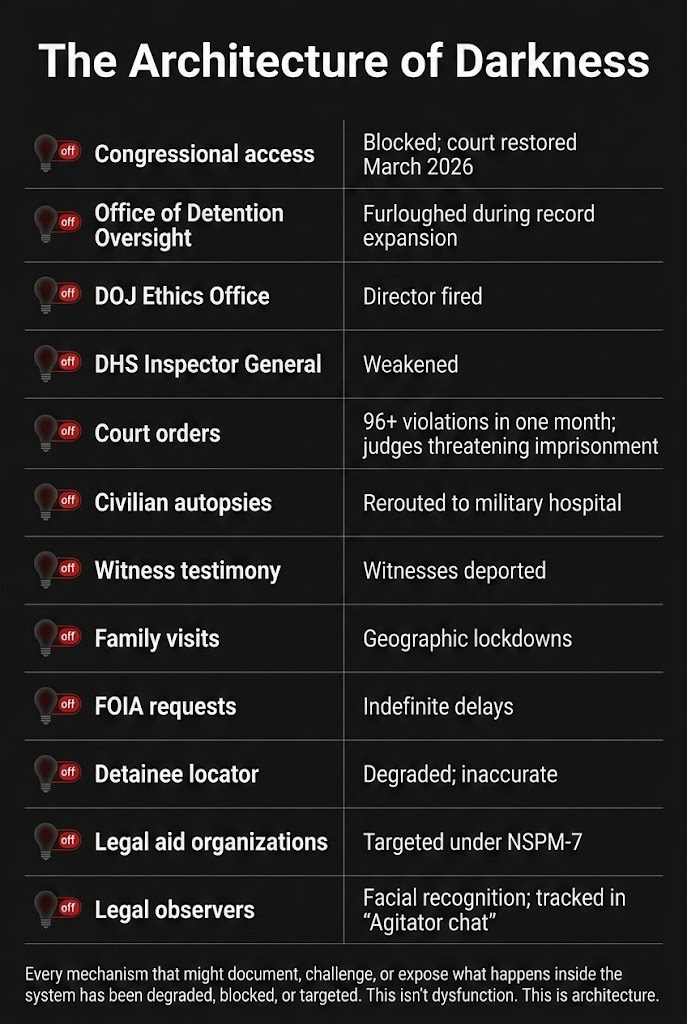
The Pattern
Every mechanism that might document, challenge, or expose what happens inside the system has been degraded, blocked, or targeted.
Congressional access — Blocked; court restored access March 2026
Office of Detention Oversight — Furloughed; reduced capacity
DOJ Ethics Office — Director fired
DHS Inspector General — Weakened
Court orders — 96+ violations in one month; judges threatening imprisonment
Civilian autopsies — Rerouted to military hospital
Witness testimony — Deportation of witnesses
Family visits — Geographic lockdowns
FOIA requests — Indefinite delays
Detainee locator — Degraded; inaccurate
Legal aid organizations — NSPM-7 targeting
Legal observers — Identified via facial recognition; tracked in “Agitator chat”
This isn’t dysfunction. This is a pattern. This is designed. This is architecture.
Why Darkness Matters
In a functioning system, oversight serves multiple purposes.
Documentation — records create evidence.
Deterrence — knowledge of monitoring prevents abuse.
Accountability — violations trigger consequences.
Public knowledge — citizens understand what’s done in their name.
Remove oversight, and abuse becomes invisible. Deterrence disappears. Accountability becomes impossible. The public knows nothing.
The darkness isn’t a side effect of expansion. It’s the essential prerequisite.
You can’t detain 135,000 people — many with no criminal record — in facilities with documented deaths, inadequate medical care, and use-of-force violations if congressional investigators can walk in unannounced.
You can’t operate at scale if every death requires an independent autopsy, every transfer a court notification, every condition complaint a public report.
The darkness is infrastructure. It’s as essential to the system as the beds and the guards.
What We Know Despite the Darkness
The remarkable thing is how much we know despite the architecture of concealment.
We know about the homicide ruling because the El Paso County Medical Examiner still had jurisdiction over one body before ICE rerouted the next.
We know about the 96 court order violations because a federal judge documented them.
We know about the congressional lockout because members of Congress filed a public lawsuit.
We know about the death toll because journalists track it, advocates count it, and families grieve publicly.
Every piece of information in this series was obtained against the architecture’s design — through whistleblowers, court filings, FOIA litigation, investigative journalism, or the families of the dead demanding answers.
The system was designed to be dark. The light that exists comes from people who refuse to accept the darkness.
The Question
Andrea Pitzer, in One Long Night: A Global History of Concentration Camps, identifies their defining feature: civilian populations held without trial, selected based on political, religious, or ethnic identity rather than individual criminal conduct.
That darkness is what distinguishes camps from prisons.
Prisons have oversight. Visitor logs. Inspector general reports. Public accountability.
Camps operate in shadow. Witnesses are deported. Medical examiners are replaced. Courts are ignored. Families are blocked.
The question isn’t what we call the facilities.
The question is: when oversight is systematically dismantled, when transparency mechanisms are blocked, when the public knows only what survivors and whistleblowers risk everything to reveal — how is that different from the historical patterns we were supposed to never repeat?
The darkness is the answer to the question no one wants to ask.
The darkness documented above isn’t inevitable—it’s a choice that requires the systematic dismantling of oversight, the targeting of observers, and the silencing of witnesses. But darkness requires effort to maintain.
I build open-source tools to make that effort visible, proving that what we’re experiencing is not a sudden rupture, but a cascade failure of accountability across financial regulation, national security, and immigration enforcement.
Our Ecosystem:
Capture Cascade: A public, living timeline of 4,300+ events documenting institutional capture and accountability failures.
Pyrite: Research infrastructure and a knowledge-as-code platform designed for journalists, researchers, and AI agents to document patterns the official record obscures.
Transparency Cascade Press / The Ramm: The investigative journalism that synthesizes the data into narrative action.
Series: After the Arrest
This is Part 6 of a 7-part series tracing what happens after ICE operations disappear from the cameras.
Autopsy Shopping — One came back homicide. The next body went somewhere else.
1,500 Miles in 24 Hours — The transfer system that turns an arrest into a disappearance
The Tent City and the Warehouse — Inside the facilities America is building to hold 135,000 people
The $165 Billion Machine — How Congress cut student loans to fund detention
The Closed Loop — One company monitors, hunts, and detains
The Darkness — The system wasn’t designed to fail oversight ← You are here
Making It Visible — The journalists, whistleblowers, and communities forcing the system into the light
Sources
Congressional Access
Roll Call: “House Democrats sue after being denied entry to ICE facilities” (July 30, 2025)
Colorado Public Radio: “Following lawsuit, Rep. Jason Crow says members of Congress have ‘constitutional obligation’ to inspect ICE facilities” (July 31, 2025)
Democracy Forward: “Members of Congress Sue Trump-Vance Administration for Blocking Lawful Oversight” (July 30, 2025)
Denver Post: “ICE denies U.S. Rep. Jason Crow entry to Aurora detention facility” (July 21, 2025)
Denver7: “Judge blocks DHS policy requiring notice for congressional ICE facility visits”
Internal Watchdogs
Washington Post: “ICE closes detention oversight group in shutdown despite surge in detainees” (October 7, 2025)
Law & Crime: “Hereby Terminated: AG Pam Bondi Just Sent Top DOJ Ethics Lawyer Packing” (July 11, 2025)
ABC News: “Attorney General Pam Bondi fires top Justice Department ethics official” (July 11, 2025)
Bloomberg Law: “Bondi Fires Her Personal Ethics Chief as DOJ Purge Continues”
Democracy Docket: “DOJ Purge Ramps Up As Bondi Fires Her Ethics Chief”
Court Order Violations and Contempt
U.S. District Court, Minnesota: Chief Judge Patrick J. Schiltz ruling (January 2026)
Minnesota Reformer: “Chief Judge Schiltz: ‘One way or another, ICE will comply with this court’s orders’” (February 27, 2026)
Minnesota Reformer: “Federal judge in Minnesota threatens Trump officials with contempt over violated orders” (February 26, 2026)
Minnesota Reformer: “Judge weighs contempt against top Department of Justice official in Minnesota over ICE orders” (March 3, 2026)
FOX 9: “ICE in Minnesota: U.S. Attorney heading back to court over violations” (March 5, 2026)
NPR: [Reporting on Judge Boasberg contempt ruling]
Democracy Forward class action lawsuit (February 2026)
Congressional Access Ruling
Minnesota Reformer: “Judge blocks Noem policy limiting congressional visits to immigrant detention facilities” (March 2, 2026)
Observer Intimidation
The Intercept: “Federal Agents Are Intimidating Legal Observers at Their Homes” (March 5, 2026)
404 Media: “Lawmakers Demand DHS Define ‘Domestic Terrorist’ As It Uses Vast Array of Surveillance Tools” (February 27, 2026)
Fort Bliss / Camp East Montana
El Paso Matters: “ICE sent body to Army hospital after El Paso medical examiner ruled detention death homicide” (February 3, 2026)
Texas Tribune: “ICE bypasses El Paso medical examiner for autopsy of migrant who died at Fort Bliss” (February 3, 2026)
Rep. Veronica Escobar: Statement on witness deportations (January 2026)
NSPM-7
White House: NSPM-7 — Countering Domestic Terrorism and Organized Political Violence (September 25, 2025)
The RAMM: “ICE Agents Drew Shapes on a Map” — Analysis of NSPM-7 implications
Historical Context
Andrea Pitzer: Concentration camp scholarship
Timothy Snyder: On Tyranny (2017)
Holocaust Memorial Museum: “Americans and the Holocaust” exhibit
For the series documenting how this enforcement apparatus was built, see The Gamergate Army Gets Badges and Guns.
Must always have vigilance for the vulnerable - can’t say more cuz I rage about this all the time - 🙏