

The Bypass: $364 Million Dollars in Documented Overpayment for ICE Warehouse Detention Centers
How a Military Contract for Afghanistan Became a Blank Check for ICE Warehouses
When the federal government buys a building, a set of rules applies. The Uniform Relocation Act requires an independent appraisal. The Federal Acquisition Regulation requires competitive bidding. Congressional notification is required above certain thresholds and the transaction is posted publicly. Competing vendors can file protests with the Government Accountability Office. An environmental review under the National Environmental Policy Act is conducted. Local officials are consulted.
These rules exist because the government learned — through decades of procurement scandals — that buying things without independent price checks produces exactly one outcome: vastly inflated prices paid to connected sellers.
The agency that enforces these rules is the General Services Administration. The GSA manages the federal government’s real estate portfolio. When a federal agency needs to acquire property, the GSA’s process is designed to ensure the taxpayer doesn’t get fleeced.
Between January 23 and March 11, 2026, the Department of Homeland Security spent $1.074 billion purchasing eleven warehouses for ICE detention facilities. Not one of those purchases went through the GSA.
Instead, DHS routed them through a military contracting vehicle called WEXMAC-TITUS — a Navy procurement system originally designed for building forward operating bases in Afghanistan. Under WEXMAC-TITUS, there are no independent appraisals. No competitive bidding. No congressional notification. No public posting. No U.S. Government Accountability Office protest rights. No environmental review. No local government consultation.
The documented markups range from 33% to 483%. The documented overpayment across seven of the eleven is approximately $364 million.
The man who runs the GSA — the agency whose process was bypassed — is Edward Forst, a former Goldman Sachs partner. Goldman Sachs sold warehouses through the bypass.
The Administrator
Edward Forst knows what a real estate acquisition is supposed to look like.
He joined Goldman Sachs in 1994 and made partner in 1998. By 2007, he was co-head of Goldman Sachs Asset Management, overseeing more than $1 trillion in assets. He sat on Goldman’s Management Committee. After Goldman, he became President and CEO of Cushman & Wakefield — one of the world’s largest commercial real estate brokerage firms, operating across more than 60 countries.
In 2008, the Treasury Department asked him to advise on the creation of TARP, the Troubled Asset Relief Program, which was created to implement programs to stabilize the financial system during the financial crisis of 2008.
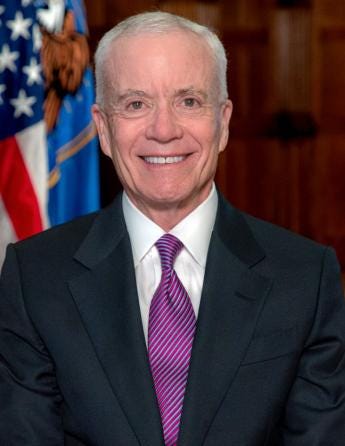
On December 18, 2025, the Senate confirmed him as GSA Administrator, 53-43. He was sworn in on Christmas Eve.
Thirty days later, the warehouse purchases began.
His financial disclosures, filed with the Office of Government Ethics and published by ProPublica, show that Forst maintains extensive financial ties to the firms profiting from the purchases his agency didn’t oversee:
Goldman Sachs. Forst holds between $1.8 million and $6.1 million in Goldman Sachs stock and private equity funds — including GS Vintage Fund VII ($1 million to $5 million), West Street Capital Partners VII ($250,000 to $500,000 in two positions), and GS Capital Partners VI ($250,000 to $500,000). Goldman Sachs still provides healthcare benefits to Forst and his spouse under a December 2011 employment agreement.
Goldman Sachs, through its asset management arm and a joint venture with Dalfen Industrial, sold a 470,000-square-foot vacant warehouse in Roxbury, New Jersey to ICE for $129.3 million — 137 percent above its estimated market value. Goldman Sachs also refinanced the Williamsport, Maryland warehouse five months before DHS bought it for $102.4 million — 33 percent above the June 2025 appraisal of $76.8 million.
CBRE Group. Forst holds $15,000 to $50,000 in CBRE stock. CBRE brokered the Williamsport sale.
CoStar Group. Forst holds $50,000 to $100,000 or more in CoStar stock. CoStar is the commercial real estate data firm whose reporting documented the overpayment pattern across the ICE warehouse program.
Palantir Technologies. Forst holds $15,000 to $50,000 in Palantir stock. Palantir runs ImmigrationOS — the targeting and case management software that serves as the backbone of the ICE enforcement system the warehouses support.
Forst also holds a Deutsche Bank defined benefit pension, a legacy of his years at Bankers Trust, whose pension obligations Deutsche Bank assumed when it acquired the firm in 1999. Deutsche Bank, through its DWS Group subsidiary, sold the Salt Lake City warehouse to DHS for $145.4 million — 49 percent above its tax-assessed value.
His senior advisor at GSA, Frank Schuler ($81 million in reported assets), holds Cushman & Wakefield stock. Cushman & Wakefield is the commercial real estate firm Forst ran as CEO — and a direct competitor of CBRE and Newmark, both of which are involved in ICE warehouse transactions.
None of this is hidden. It is disclosed, on government forms, in a public database. It is the architecture operating in plain sight.
The Contract
WEXMAC stands for Worldwide Expeditionary Multiple Award Contract. It was designed for what the name implies: building things in expeditionary environments. Forward operating bases. Military logistics facilities in combat zones. The kind of construction that needs to happen fast, in hostile territory, where normal procurement timelines would cost lives.
It is administered by the Naval Supply Systems Command — NAVSUP — under the Department of the Navy.
In October 2025, the Trump administration repurposed WEXMAC for domestic immigration detention. The addition was called TITUS: Territorial Integrity of the United States. A military logistics vehicle for Afghanistan was now being used to buy vacant warehouses in Pennsylvania.
The transformation was dramatic:
The contract ceiling was raised from $10 billion to $65 billion — a 550 percent increase. The vendor pool expanded from 96 to more than 140 companies, with 24 new vendors added specifically for detention work. The new vendors include GEO Group, the largest private prison operator in America, and Cart.com, a Houston-based e-commerce fulfillment company with no detention experience.
Senators Elizabeth Warren and Jeanne Shaheen, in a March 22 letter to Defense Secretary Hegseth, documented that the Pentagon diverted more than $2 billion from military barracks repairs, training programs, and schools for military children to fund the detention expansion. The Pentagon has acknowledged that the military will not be reimbursed by DHS.
The Secretary of the Navy, whose department administers WEXMAC-TITUS, is John Phelan. His reported assets exceed $791 million. His financial disclosures show multiple Blue Owl Capital investments, including Blue Owl Healthcare Opportunities III LP — an illiquid alternative fund requiring active subscription. Blue Owl Capital sold the Tremont, Pennsylvania warehouse to DHS for $119.5 million, approximately double its estimated market value.
The Assistant Secretary of the Navy for Energy, Installations, and Environment — the official who directly oversees the physical infrastructure side of the command that runs WEXMAC-TITUS — is Brendan Rogers. Rogers holds Blue Owl Capital stock.
He also has loan receivables from CBRE U.S. Logistics Partners and JLL Partners Fund IX. CBRE brokered the Williamsport sale. JLL Capital Markets arranged Goldman Sachs’s $352.7 million refinancing of the Fundrise portfolio that included the Williamsport warehouse. The two largest commercial real estate brokerages involved in ICE warehouse transactions literally owe money to the Navy official whose command administers the contract vehicle those transactions flow through.
The Purchases
Between January 23 and March 11, 2026, DHS purchased eleven warehouses across seven states for a combined $1.074 billion. Every purchase closed after Forst was sworn in as GSA Administrator. Every purchase went through WEXMAC-TITUS instead of his agency.
The sellers are institutional investors. The markups are documented.
Surprise, Arizona — $70 million. The property cost approximately $12 million in 2023. Markup: 483 percent. Seller: Rockefeller Group, a subsidiary of Japan’s Mitsubishi Estate. The city was not notified before the purchase.
Williamsport, Maryland — $102.4 million. Appraised at $76.8 million in June 2025. Markup: 33 percent. Owner: Fundrise, which had listed the vacant warehouse as a liability on SEC filings for three years. Goldman Sachs refinanced the property five months before the sale.
Social Circle, Georgia — $128.6 million. Assessed at $29.8 million. Markup: 333 percent. Seller: PNK Group, a Russia-founded industrial developer. PNK bought the property for $29.4 million in 2023 and sold it less than three years later for a profit of approximately $99 million. The sale closed in four days.
Tremont, Pennsylvania — $119.5 million. Approximately double estimated market value. Seller: Blue Owl Capital. The warehouse was a former Big Lots distribution center that sat empty after Big Lots went bankrupt in September 2024. Blue Owl was simultaneously facing a 68 percent stock price collapse, $5.4 billion in fund redemption requests, and a securities fraud class action. The Tremont sale closed at roughly double market value while Blue Owl was facing those pressures. President Trump holds more than $5 million in Blue Owl Capital stock.
Socorro, Texas — $122.8 million. Development cost: $79.3 million. Markup: 55 percent. Seller: Flint Development. The mayor of Socorro was not informed before the deal closed.
Upper Bern, Pennsylvania — $87.4 million. The property sold for $57.5 million in September 2024. Markup: 52 percent in under five months. Seller: PCCP, a commercial real estate equity firm.
Roxbury, New Jersey — $129.3 million. 137 percent above estimated market value. Seller: Goldman Sachs Asset Management and Dalfen Industrial. The GSA Administrator’s former employer.
Salt Lake City, Utah — $145.4 million. Tax-assessed at $97.4 million. Markup: 49 percent. Seller: a subsidiary of DWS Group, which is 79.49 percent owned by Deutsche Bank. A comparable Walmart warehouse nearby sold for $112 million — below its assessed value.
Oakwood, Georgia — $68.2 million. Prior valuation unknown. Seller: Carlyle Group and Alliance Industrial.
Romulus, Michigan — Approximately $104 million. Prior valuation unknown. Seller: Crestlight Capital.
San Antonio, Texas — $66.1 million. Prior valuation unknown. Seller: Oakmont Industrial Group.
No independent appraisals have been made public for any of these purchases. NDAs were signed with local officials. In several cases, city councils and police departments were not notified before the transactions closed.
The data that documents these overpayments was compiled by Project Salt Box, a seven-person volunteer research organization founded by a U.S. Army veteran in Baltimore, using public property records, financing documents, and lien filings. The research has been cited by More Perfect Union, the Salt Lake Tribune, congressional investigators, and the DHS Inspector General’s office.
The Investigations
The system is not unnoticed.
On March 22, Senators Warren and Shaheen wrote to Defense Secretary Hegseth, demanding that the Pentagon end the WEXMAC-TITUS arrangement with DHS. They documented that the contract was repurposed without congressional authorization and that more than $2 billion was diverted from military families.
On March 26, the DHS Inspector General launched a formal investigation into contracts “awarded by any means other than full and open competition during fiscal year 2025.” The investigation covers the role of Corey Lewandowski — former DHS Secretary Kristi Noem’s de facto chief of staff — in the contracting process. NBC News reported that at least four companies complained to senior White House officials that Lewandowski solicited payments in exchange for contracts. One official raised the issue with the president directly. The conversation was cut short.
Noem’s handling of DHS contracts was one of the main catalysts for her firing. Her replacement, DHS Secretary Markwayne Mullin, paused warehouse conversions for eleven facilities on March 24 and imposed a $25 million approval threshold for new contracts. He is reviewing all Noem-era procurement. No purchases have been reversed. No money has been returned.
On March 29, Representative Jamie Raskin and Senator Elizabeth Warren, with 52 members of Congress, sent letters to six companies — GEO Group, CoreCivic, GardaWorld, Newmark, KVG LLC, and PNK Group — demanding disclosure of their expected profits, lobbying efforts, and connections to Trump administration officials. The response deadline is April 13.
Howard Lutnick, the Secretary of Commerce, is a former officer and director of Newmark Group — one of the six companies under investigation. His financial disclosures show millions in Newmark stock and a change-in-control agreement with the company. His Chief of Staff also holds Newmark stock.
What the Bypass Replaced
The GSA exists because the government learned something.
It learned that when you buy property without an independent appraisal, you pay whatever the seller asks. It learned that when you skip competitive bidding, connected vendors get the work. It learned that when you don’t notify Congress, no one asks questions. It learned that when you sign NDAs with local officials, communities can’t organize resistance. It learned that when you don’t post transactions publicly, the price never gets checked.
Every rule the GSA applies to federal real estate acquisition exists because someone, at some point, exploited its absence.
WEXMAC-TITUS eliminated all of them at once. Not by accident. Not through oversight. Through design — a structural decision to route $1 billion in real estate purchases through a military contract vehicle that treats the purchase of a vacant Pennsylvania warehouse the same way it treats the construction of a forward operating base in Kandahar.
The man who runs the agency that would have applied those rules holds millions in Goldman Sachs investments. Goldman Sachs sold buildings through the bypass. The Navy official whose command administers the bypass has loan receivables from the brokerages that handled the deals. The Secretary of the Navy holds investments in one of the sellers. The president holds investments in two.
The contractor response deadline is April 13. The DHS Inspector General investigation is active. The Mullin pause covers eleven facilities. But the pause is temporary, and they are already moving money through other channels. The purchases are final. And $364 million in documented overpayments has already moved from taxpayers to institutional investors — through a door that was specifically designed to have no lock.
The RAMM documents the connections that beat reporting can't see — 4,776+ sourced events at capturecascade.org.
Free subscribers get every investigation.
Paid subscribers get to support the mission, and will get draft chapters of the Capture Cascade (tentative title) book.
This is the latest installment in a continuing investigation into ICE’s warehouse detention expansion. The last, “The Blueprint for America’s Detention Camps,” documented the operational model; how former ICE officials help sheriffs build detention facilities designed to hide in plain sight. This installment documents the financial mechanism; the procurement bypass that made the overpayments structurally possible.
Reporting credits: Project Salt Box (Michael Wriston), More Perfect Union (Lucy Dean Stockton), Salt Lake Tribune, the Warren/Shaheen/Raskin congressional investigation, and the ProPublica financial disclosures database. A documented timeline is available at capturecascade.org.
Thank you for this!
You may or may not know I am a part of a clergy group who successfully helped to stop the purchase of one of these places in Dallas County. We are very proud of how local activist, organizers, and ordinary citizens rose up against this injustice.
One of the things we encountered early on was: why can’t we find more information about these purchases?
We were ably assisted in great reporting from our own Beth Erickson @D Magazine and also from Sophie at Bloomberg News… Who to my knowledge was the first legacy media reporter to break the story on this workaround way of purchasing buildings.
I think it is still very hard for the public to understand that all this is happening, and just how completely devoid of any ordinary process this is.
Americans have a great trust that there are guard rails to prevent things exactly like this. The purchase of those 10 buildings shows us that those guard rails can be worked around at any moment.
Excellent reporting. Just shared with my subscribers.