

The Blueprint for America’s Detention Camps
A leaked proposal reveals how former ICE officials are helping sheriffs build a 3,000-bed “detention campus” — designed to hide in plain sight
The document is dated December 16, 2025. It’s titled “Bradford County ICE Detention Campus: Commissioners’ Briefing Package.” The cover bears the logo of a company called Sabot Consulting.
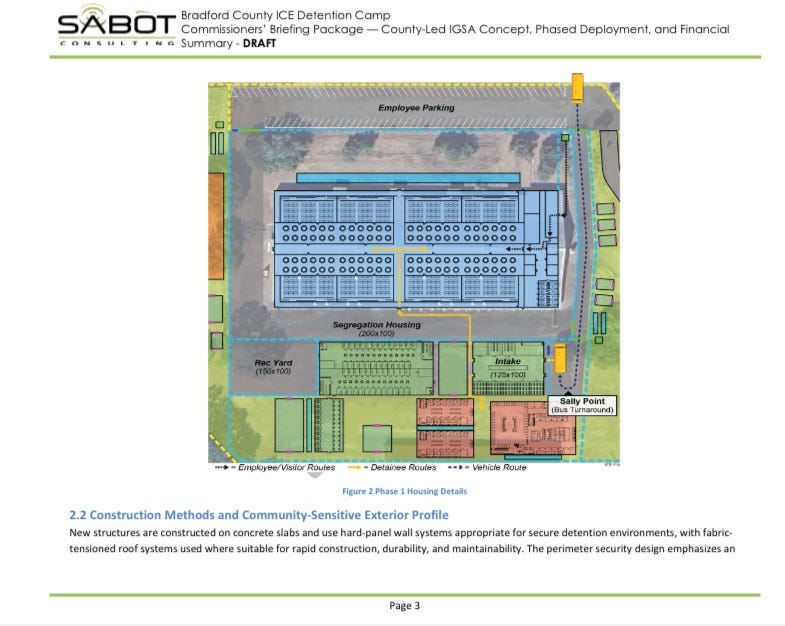
Inside: architectural plans for a phased detention facility that would grow from 1,000 to 3,000 beds over 38 weeks. Site diagrams showing housing pods, segregation units, intake processing, a “sally port” for bus arrivals. Staffing tables projecting 1,250 employees at full capacity. Financial projections totaling $239 million per year.
The facility would use an “opaque fencing approach and muted external signage, reducing visual prominence and avoiding an outward presentation that ‘advertises’ the campus as a detention facility.”
They’re designing it to hide.
The proposal was prepared for the Bradford County, Florida Board of Commissioners. It lays out what Sabot calls a “county-led IGSA concept” — a structure in which the county retains ownership of the land and existing warehouse, while a prime contractor builds and operates the detention facility. ICE pays for beds.
This is how the warehouse detention camps are being built: not by the federal government directly, but through county sheriffs who hold the leases and advised by consultants who used to run ICE.
The Proposal
Bradford County is a rural county in north-central Florida, population roughly 28,000. The proposal targets a 30-acre site with an existing 100,000 square-foot warehouse — the kind of industrial building that’s been at the center of reporting on ICE’s warehouse expansion.
The phased buildout works like this:
Phase 0 (Weeks 1–6): Site preparation. Demolition, grading, utilities, temporary security fencing, CCTV.
Phase 1 (Weeks 7–18): The existing warehouse is converted into a 1,000-bed facility with intake processing, medical and isolation units, segregation housing, administration, kitchen, laundry, and staff support. Initial operations begin. The proposal notes this phase uses “hard-panel wall systems appropriate for secure detention environments, with fabric-tensioned roof systems used where suitable for rapid construction.”
Phase 2 (Weeks 19–28): Four modular housing pods are added, bringing capacity to 2,000 beds. Dining and recreation facilities expand.
Phase 3 (Weeks 29–38): Four more housing pods bring total capacity to 3,000 beds. Full Operating Capability achieved.
From groundbreaking to a 3,000-bed detention camp: nine months.
The Money
The financial projections are detailed. At each phase:
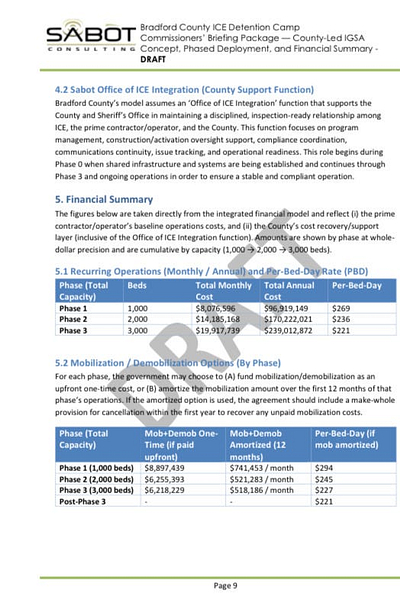
Phase 1 (1,000 beds): $8.08 million per month / $96.9 million per year / $269 per bed-day
Phase 2 (2,000 beds): $14.2 million per month / $170.2 million per year / $236 per bed-day
Phase 3 (3,000 beds): $19.9 million per month / $239 million per year / $221 per bed-day
The per-bed-day rate decreases with scale — a selling point for the county.
The proposal also details mobilization costs if the federal government wants to fund construction upfront: $8.9 million for Phase 1, $6.3 million for Phase 2, $6.2 million for Phase 3. Or the costs can be amortized into the monthly rate.
Bradford County’s cut comes through what the proposal calls “cost recovery” — compensation for providing the land, the existing warehouse, administrative burden, infrastructure impacts, and coordination with local services. The county retains property ownership throughout. When the facility eventually closes, the proposal promises the site will be “left in an improved condition to the maximum extent practicable, with clear closeout documentation, environmental compliance, and an agreed restoration/end-state plan.”
The pitch to commissioners: you keep the land, you get paid for the use, and when it’s over you have a better property than you started with.
The Company Behind the Proposal
Sabot Technologies, Inc., doing business as Sabot Consulting, is based in Folsom, California. Founded in 2000 by Christopher Eaves and Darren Chiappinelli, it started as an IT consulting firm serving state government clients.
At some point, Sabot pivoted. It now markets what it calls the “Office of ICE Integration” — a service it describes as “the only dedicated Criminal Justice Compliance and ICE Integration practice in the country.”
From Sabot’s website:
“Our flagship innovative offering, the Office of ICE Integration, equips your agency with ongoing, expert guidance to: Optimize Intergovernmental Service Agreements (IGSAs)—ensuring alignment with your public safety mission, budget goals, and local priorities. Maintain full compliance across ICE detention standards, medical care, intake procedures, detainee processing, and operational protocols. Respond effectively to federal inspections, lawsuits, NGO scrutiny, and press inquiries—with Sabot as your interface and advocate, managing the noise so your agency can focus on the mission.”
The phrase “managing the noise” appears repeatedly in Sabot’s materials. So does “NGO scrutiny” — meaning immigrant rights organizations — and “press inquiries.”
The Bradford County proposal explicitly lists Sabot’s ongoing role: “Office of ICE Integration support (Sabot): program management support, compliance coordination, communications discipline, issue tracking, and facilitation of County–ICE–operator alignment (supporting, not substituting for County authority).”
They’re not just designing the facility. They’re offering to manage the relationship between the county, ICE, and the private operator — and to handle the political fallout.
The Revolving Door
What makes Sabot different from other consulting firms is who’s doing the consulting.
Tae D. Johnson served 31 years at U.S. Immigration and Customs Enforcement and its predecessor agency, the Immigration and Naturalization Service. He rose to become Deputy Executive Associate Director for Enforcement and Removal Operations — the division responsible for immigration arrests, detention, and deportation — managing a budget of approximately $4.4 billion and more than 7,900 employees.
Before that, Johnson served as Assistant Director for ERO’s Custody Management Division. In that role, according to his official biography, he “provided policy and oversight for the administrative custody of about 40,000 detainees daily and roughly 500,000 detainees annually, at approximately 250 facilities nationwide.”
In January 2021, Johnson became Acting Director of ICE, a position he held until July 3, 2023. He oversaw approximately 20,000 employees and an annual budget exceeding $8 billion.
Johnson is now listed on Sabot Consulting’s Criminal Justice team page.
The person who ran ICE’s detention system now advises counties on how to build detention facilities.
But Johnson is not alone. Sabot’s Criminal Justice team includes:
Daniel P. Marquith, identified in business databases as a former Deputy Chief of Staff at the Department of Homeland Security, with more than 20 years of experience in law enforcement.
Lisa McDermott, who spent 23 years with the Federal Bureau of Prisons and retired in 2019 as Health Service Administrator at the Federal Detention Center in SeaTac, Washington. She subsequently served as “an Operations Director in the private sector,” providing oversight for facilities including ICE/DHS detention centers.
Juan C. (JC) Garcia, described as having “over 30 years of service across federal law enforcement, detention management, investigation, and training.”
Daniel L. Godinez, who spent 32 years with the California Department of Corrections and Rehabilitation.
Mr. Carvo, who spent 30 years with CDCR and “was instrumental in the Board of Parole Hearings class action suit (Armstrong, Valdivia, Rutherford) litigation responses and compliance efforts.”
This is a team of former federal and state detention officials — the people who ran the system — now advising local governments on how to join it.
The Pivot to Sheriffs
The Bradford County proposal illuminates a shift in strategy that former Border Patrol agent and whistleblower Jenn Budd flagged today: the federal government isn’t abandoning the warehouse detention plan. It’s routing it through county sheriffs.
“Seeing lots of articles about how DHS/ICE is pausing the warehouse plan,” Budd wrote. “This is not true. They are transitioning to having local sheriff departments hold the warehouse leases. So, technically they are pausing ‘buying’ warehouses but they are still creating warehouse camps.”
The Bradford County proposal confirms this. The structure it describes — county ownership of the land and warehouse, with a private operator running the facility under contract to ICE — insulates the federal government from direct responsibility while still creating detention capacity.
This is the third model in an expansion I’ve been documenting since January. The first model places detainees on military bases — Camp East Montana, Guantanamo — where military jurisdiction limits civilian oversight and the county medical examiner’s authority is questionable. The second model has the federal government purchasing warehouses outright — $100 million in Hagerstown, $70 million in Surprise, $123 million near El Paso — bypassing local zoning and permitting through federal preemption.
Both models provoked backlash. Surprise, Arizona passed a five-year ban. Maryland passed the Dignity Not Detention Act. Members of Congress were denied entry to facilities despite presenting valid court orders.
The county-led IGSA model solves these problems. The county wants it — economic development for a place facing a $5.5 million tax shortfall. The sheriff controls it — local authority, local credibility. And Sabot manages the noise — handling NGO scrutiny, press inquiries, and political fallout so the sheriff can “focus on the mission.”
Sabot’s materials make the pitch explicit. From a July 2025 blog post titled “Bridging Federal and Local Priorities: Smart ICE Collaboration for Sheriffs”:
“Sheriffs maintain operational control and community credibility—Sabot manages the federal interface.”
And:
“Our strategies reflect your politics, culture, and long-term goals.”
The company attended the National Sheriffs’ Association Annual Conference in Fort Lauderdale in July 2025, where it reported “several counties have already enlisted Sabot Consulting to support their ICE detention programs.”
The Bradford proposal is not an outlier. It is one node in a $38.3 billion expansion that ICE projects will approach 135,000 beds by 2029 — nearly matching the entire federal prison system.
Not Just Consulting
Sabot isn’t only advising on existing facilities. It’s proposing to build new ones.
In September 2024, the American Civil Liberties Union filed a Freedom of Information Act lawsuit seeking records related to ICE’s contract solicitations for detention expansion. The documents that emerged revealed Sabot among the entities submitting proposals — alongside private prison giants GEO Group, CoreCivic, and MTC.
From the ACLU’s April 2025 press release:
“Sabot Consulting also submitted a proposal to construct new facilities in Utah and Wyoming. Although a large portion of the document is redacted, the proposal cites to ‘potentially problematic statutory requirements’ in Utah state law that would pose challenges to the construction of a new facility absent a contract with the state department of corrections. The proposal also includes a map of the geographic boundaries of the U.S. Circuit Courts of Appeal.”
That detail — the Circuit Court map — suggests strategic thinking about legal jurisdiction when siting facilities.
The Bradford County proposal now shows what these submissions look like in detail: not vague expressions of interest, but fully developed architectural plans, timelines, staffing models, and financial projections.
Sabot isn’t positioned as a consulting firm that advises on detention. It’s positioned as the integrator — the company that brings together the county, the land, the operator, and ICE, and then manages the ongoing relationship.
The Legal Questions
Under 18 U.S.C. § 207, former senior federal employees face restrictions on post-government employment activities.
For someone at Tae Johnson’s level, these include a one-year “cooling-off” period during which the former employee may not communicate with or appear before their former agency “with the intent to influence” on any matter. There’s also a lifetime ban on matters in which the former employee “participated personally and substantially.”
Johnson retired July 3, 2023. The one-year cooling-off period ended July 3, 2024. But the lifetime ban on specific matters he worked on — particular policies, procurements, or decisions — would still apply.
The question is how Sabot’s business model interacts with these restrictions. If Johnson advises counties rather than communicating directly with ICE, the arrangement might comply with the letter of the law. But when the company’s materials describe serving as the county’s “ICE-facing arm” and facilitating “County–ICE–operator alignment,” the line becomes harder to draw.
In February 2023, the Government Accountability Office found that Johnson’s service as Acting ICE Director after November 16, 2021 violated the Federal Vacancies Reform Act’s time limits. The GAO concluded that actions he took after that date should be “nullified.” DHS disagreed.
I reached out to the Office of Government Ethics, to Sabot Consulting, and to Tae Johnson for comment on post-employment restriction compliance. None had responded as of publication.
The Contamination
There is one more detail the proposal doesn’t mention.
The Douglas Building site — the 100,000-square-foot warehouse that would become the core of a 3,000-bed detention facility — sits on land that the Florida Department of Environmental Protection has been monitoring for nearly 15 years for volatile organic compound contamination in groundwater.
FDEP records show the contamination has spread to nearly 30 surrounding properties. A September 2025 monitoring report by Arcadis found the contamination is still present and has migrated further. The Sabot proposal itself lists “vapor intrusion” among the environmental issues requiring evaluation — an acknowledgment that toxic vapors from contaminated groundwater could rise into the buildings where people would be housed.
At the March 3 county commission meeting, Sheriff Gordon Smith assured commissioners: “No person would ever be housed in such a facility without proper environmental evaluations.”
Tomorrow morning at 9:30 AM, the Bradford County Commission has two items on its agenda: a Site Access Agreement with DEP for environmental monitoring of the Douglas Building property — and a lease with the Bradford County Sheriff’s Office for installation of a “temporary ICE detainment facility.”
The lease is on the agenda before the environmental studies are complete.
Designed to Hide
Return to page 4 of the Bradford County proposal. After describing the hard-panel walls and fabric-tensioned roofs, it continues:
“The perimeter security design emphasizes an opaque fencing approach and muted external signage, reducing visual prominence and avoiding an outward presentation that ‘advertises’ the campus as a detention facility, while still maintaining clear governmental wayfinding and safety markings.”
Below this text is a photograph labeled “Figure 3 Example Structure.” It shows a cluster of large white tent-like buildings in a parking lot — the kind of rapid-deployment structures used for emergency shelters or temporary facilities.
The message is clear: these facilities can be built quickly, at massive scale, and designed so that passersby don’t immediately recognize what they’re looking at.
Three thousand beds. Hidden in plain sight. In a rural Florida county. Proposed by a company staffed with former ICE officials who know exactly how the system works.
This is the infrastructure of mass detention, and it’s being built county by county.
What Happens Next
The Bradford County proposal is dated December 16, 2025 — less than four months ago. It’s marked “DRAFT” and titled as a “Commissioners’ Briefing Package.”
Jenn Budd reports that the Bradford County sheriff “is desperate to control the lease for ICE” and that residents have been trying to get national attention.
The proposal Sabot prepared shows them exactly what they’re up against: a detailed plan, backed by experienced operators, with clear financial incentives for the county, designed to move fast and minimize visible opposition.
Other counties are likely seeing similar proposals. The ACLU’s FOIA litigation has revealed that ICE’s solicitations covered 17 states. Sabot’s website claims it has already signed “several counties.”
The warehouse camps are coming. The question is whether anyone is watching.
This story is based on documents provided by Jenn Budd, former senior Border Patrol agent. The Bradford County proposal images were shared directly with the author. Tip via The Resistance Sentinel.
This investigation connects to The RAMM’s ongoing documentation of the detention infrastructure: the After the Arrest series on what happens inside the system, and The Architecture series on how the system is designed. The detention expansion is tracked in the Capture Cascade Timeline.
If you have information about Sabot Consulting, ICE detention partnerships, or warehouse detention facilities in your community, contact me securely.
Sources
Primary Documents:
Sabot Consulting, “Bradford County ICE Detention Campus: Commissioners’ Briefing Package — County-Led IGSA Concept, Phased Deployment, and Financial Summary,” DRAFT, December 16, 2025 (provided by Jenn Budd)
Bradford County Commission Meeting transcript, March 3, 2026, Sheriff’s Report (corrected against video)
Reporting:
WUFT: Proposed Bradford County ICE detention facility shows levels of contamination (Feb 28, 2026)
News4Jax: Bradford County plans warehouse conversion to ICE detention center (Jan 16, 2026)
WCJB: Bradford County commissioners give go-ahead on proposed ICE detention facility (Jan 15, 2026)
WUFT: Protest planned following Bradford County vote (Jan 30, 2026)
PBS NewsHour: ICE spending billions to turn warehouses into detention facilities (Mar 9, 2026)
WWALS: Site contamination investigation before lease discussion (Apr 6, 2026)
Legal and Government:
GAO: Violation of Federal Vacancies Reform Act — ICE Acting Director (Feb 2023)
ACLU FOIA litigation re: ICE detention expansion (Sept 2024–Apr 2025)
Sabot Consulting:
“Bridging Federal and Local Priorities: Smart ICE Collaboration for Sheriffs” (July 2025 blog post)
Related RAMM Coverage:
This story came together in hours — the afternoon before the hearing.
Earlier today, Jenn Budd — a former senior Border Patrol agent who has spent years documenting abuses in immigration enforcement — posted a note on Substack flagging the shift from federal warehouse purchases to sheriff-held leases. She mentioned Bradford County. She had documents.
The Resistance Sentinel, who tracks these networks, tagged me.
I reached out to Jenn. She sent the proposal images and the commission meeting transcript. We agreed in a brief exchange that I would write it up and credit her research. She wrote: "Feel free to write on it. I don't have the time."
A few hours later, this piece exists — published the evening before Bradford County commissioners meet again.
This is what distributed investigative journalism looks like. A whistleblower with knowledge and documents but limited bandwidth. An amplifier who connects researchers. A publication with the tools and time to synthesize it. No institutional gatekeepers. No six-month editorial process. Just people who trust each other enough to share what they know.
The documents did the work. All I had to do was read them and write down what they said.
That's the model. If you have documents, reach out. If you have time, write. If you have an audience, amplify. The infrastructure of accountability is a network, not an institution.
Thank you and Jenn Budd for bringing this to light. Sharing with my subscribers.