

The Architecture of Visibility: How Meta Made Political Speech Disappear Without Banning It
If you joined Instagram after February 9, 2024, you have never seen a political post from an account you don’t follow surface in your discovery feeds. This is the history of that setting.
On February 9, 2024, Instagram and Threads quietly became different platforms. Mark Zuckerberg announced that political content from accounts you don’t already follow would no longer be recommended to you by default — no more surfacing in Explore, no more Reels suggestions, no more popping up in suggested accounts.
The announcement landed in a blog post and a round of press coverage. Then it faded.
That setting is still running.
It has been running for over two years.
If you joined Instagram after February 9, 2024, you have never seen a political post from an account you don’t follow surface in your discovery feeds.
You were not told. You were not given a choice. The choice was made for you, set to OFF, and the platform moved on.
The 2026 midterms are six months away.
What Was Actually Announced
Zuckerberg’s announcement used the phrase “won’t recommend.” The framing was deliberate. Meta said the platform would no longer proactively surface political content from accounts users don’t follow. Washington Post reported it as Meta stepping back; TechCrunch called it Instagram and Threads declining to “proactively” recommend political content; Variety ran the same language. The Instagram official blog post described the move as respecting user preferences.
“Won’t recommend” sounds like restraint. Like the platform stepping back, giving you space.
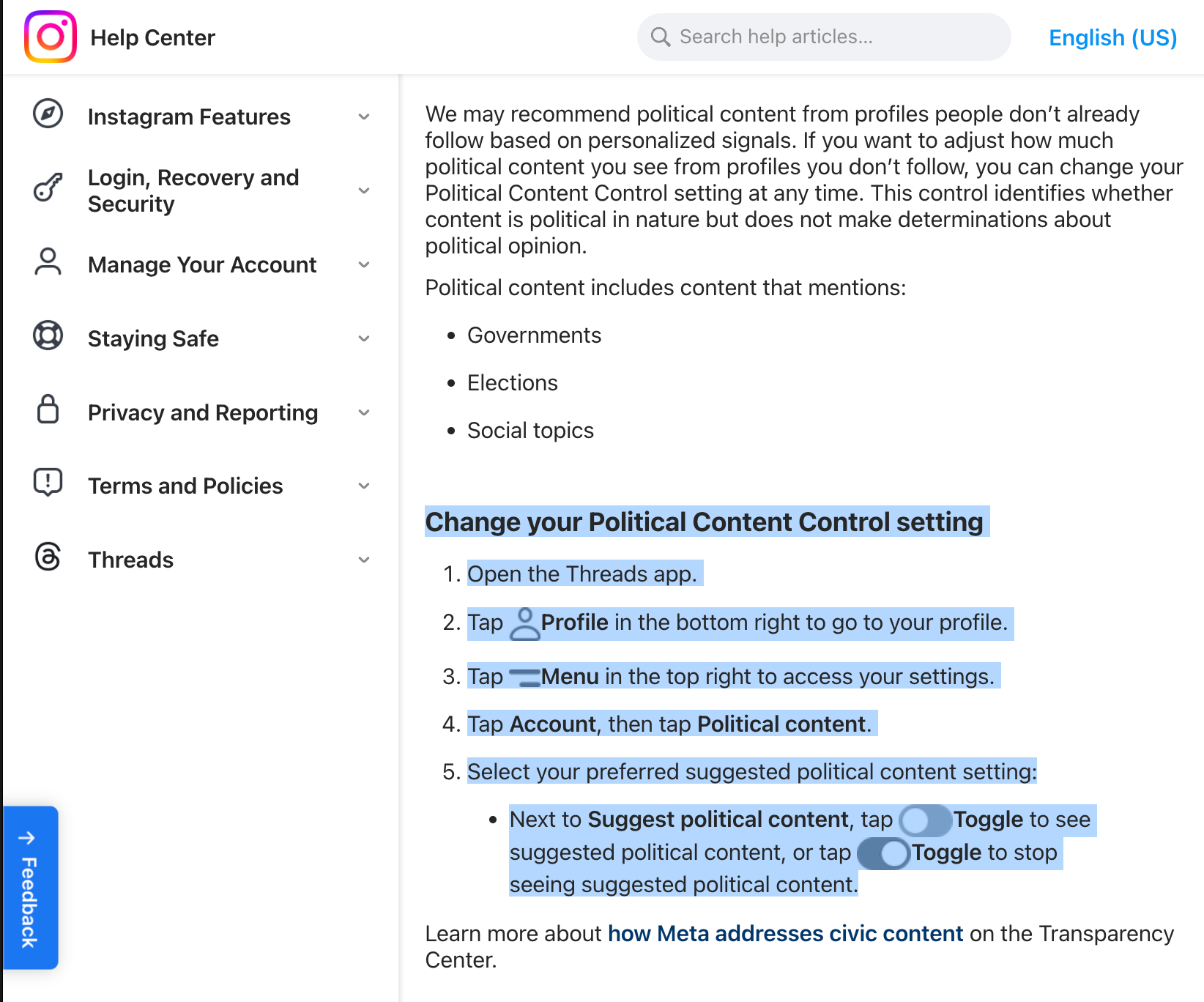
What it describes is a default-state change. Political content from accounts you don’t follow — the entire discovery layer through which new political voices reach new audiences — was switched to suppressed by default. Users who want to see that content must navigate to settings, find the toggle, and turn it on. No prompt appeared when the change happened. No in-app notification told existing users the settings had changed. New users who joined after February 9 inherited the suppressed default without being told it existed.
“Users can turn it on” is true. “Users were told it was turned off” is false.
The surfaces affected were exactly the ones that matter for political discovery: Explore, Reels recommendations, and suggested accounts. Content from accounts you already follow continues to appear in your feed. The suppression falls specifically on the discovery layer — the surfaces where political voices without large existing followings build reach, where grassroots organizations find new audiences, where candidates who aren’t already famous get found.
Political content didn’t disappear.
It became invisible in the spaces where new audiences form.
How the Toggle Suppresses
The February 9, 2024 announcement works through three components that, combined, work differently from ordinary content moderation.
First: binary opt-in, not opt-out. The default is not “reduced” political content. It is no recommended political content from non-followed accounts. The toggle is binary. A user who doesn’t know to look for it doesn’t get a softened experience — they get none of the discovery-layer political content that the platform would otherwise surface.
Second: no user notification. Existing users were not told. Meta published a corporate blog post. There is no record of Meta sending users an in-app prompt, an email, or a settings-screen disclosure explaining that their political content visibility had been reduced as of that date. For the hundreds of millions of users who don’t follow platform-policy news, the change happened and they never learned it had.
Third: continuous new-user inheritance. Every user who created an Instagram or Threads account after February 9, 2024 has never experienced the platform with the political discovery layer enabled. They have no pre-change baseline to compare against. To them, this is just how Instagram works.
The persistence dimension is the part that doesn’t make headlines. The setting has been running since February 2024.
A candidate running for Congress in a competitive district in 2026 whose campaign account was built for Instagram’s discovery features has been operating in a suppressed-reach environment since before the 2024 cycle, and will be in the same environment for the 2026 midterms.
When Political Content Became a Liability
Meta didn’t frame the change as a business decision. They framed it as a user-experience improvement, a response to feedback that political content was generating negative experiences. That framing isn’t false. Political content on social platforms does generate negative user experiences. That is partly why it is engaging. Engagement is what pays.
By early 2024, political content recommendation had become a liability for Meta’s business model. Congressional scrutiny over the 2020 election cycle and the January 6 period. Advertiser pressure. Regulatory exposure in the EU under the Digital Services Act. The engagement calculus had flipped — political content was generating regulatory attention and advertiser anxiety faster than it was generating revenue. When political content became a net negative for the business model, removing it from recommendation defaults was the choice that protected revenue.
This is not a claim about intent. It is a claim about function. The political de-recommendation was not a principled editorial intervention. It was what happens when political content becomes a liability rather than an asset and the business follows the money.
The June 2024 “political filter bug” — in which Meta’s political content filter accidentally suppressed content outside the policy’s intended scope — makes the mechanism visible. The bug was not an editorial misjudgment. No human editor had made a call that was too broad. The algorithm was running the suppression, and when it continued filtering political content for users who had opted in to see it, Meta logged it as a bug and fixed it. The code was driving the result, not anyone’s judgment about a story. (Timing note: the bug surfaced just before the first 2024 presidential debate.)
The Asymmetry
The political content default change did not affect all political accounts equally.
A politician with two million followers who posts political content: her followers already see it. The recommendation suppression has limited marginal impact. When your audience is already there, you don’t need discovery.
A grassroots organization with twelve thousand followers that built half its audience through Explore and Reels recommendations: the suppression is material. The discovery layer was how they grew. It’s gone by default now, accessible only to users who know to find the toggle.
The mechanism lands hardest on political voices without large existing followings — smaller candidates, advocacy organizations, new political movements, independent journalists, organizers whose reach depended on the platform surfacing their content to people who weren’t already looking for them. The already-established faced less impact. The less-established faced more.
The default produces that gap whether or not anyone intended it.
Pope Leo XIV Names the Mechanism
On May 25, 2026, Pope Leo XIV published Magnifica Humanitas. The encyclical addresses technology, labor, human dignity, and the social consequences of algorithmic systems at length. (The RAMM covered the encyclical’s broader argument and its pairing with Arendt in The Encyclical & The Antichrist.) Paragraph 171 is the load-bearing passage for the Meta mechanism:
“A further risk, less visible but no less serious, is that of social control made possible by the massive collection of data and use of algorithmic systems. When every action—movements, purchases, relationships and preferences—leaves a trace, a new form of power emerges, namely the power to profile, predict and influence behavior, often without individuals being fully aware of it. If such kinds of data are used to make decisions affecting concrete opportunities — such as access to credit, employment or essential services — there is a risk of undermining freedom and discriminating against the most vulnerable. Furthermore, control is exercised not only through explicit prohibitions, but also through the architecture of visibility: what is amplified or rendered invisible, what is rewarded or penalized, ultimately shapes opinions and choices, fostering conformity and self-censorship.”
Magnifica Humanitas does not contain the words Meta, Facebook, Instagram, Threads, or Zuckerberg. Leo XIV deliberately names the mechanism without naming the platform. This is methodological precision, not evasion — a doctrinal document that names a current executive is tied to that executive’s news cycle and loses its authority when the executive changes. A document that names the mechanism survives every corporate realignment, every political cycle, every succession announcement.
Section 171 of the encyclical’s language maps to the Meta mechanism point by point:
“Less visible but no less serious” — the political-toggle generated a brief news cycle in February 2024 and then largely faded. The setting kept running. The silent toggle is less visible than the January 2025 fact-checking rollback, which was announced, controversial, and publicly debated. The silent default is the less-visible instance Leo is describing.
“Often without individuals being fully aware of it” — users are not aware the toggle exists. New users have never learned it was ever otherwise.
“Control is exercised not only through explicit prohibitions” – Meta banned nothing. No content was removed. No account was suspended.
“Through the architecture of visibility” – the recommendation infrastructure was changed. What discovery surfaces was restructured.
“What is amplified or rendered invisible” – political content from non-followed accounts was rendered non-recommended. Not invisible in absolute terms. Invisible in the discovery space where audiences form.
“Fostering conformity and self-censorship” – when political creators and campaigns learn that political content does not reach new audiences on Instagram by default, they adjust. They optimize toward content that performs better in the new environment. The architecture shapes behavior without requiring a prohibition.
Leo names the class. This piece names the instance. Together they are stronger than either alone.
What the Pelley Firing Has in Common With a Toggle
On June 3, 2026, Scott Pelley was fired from 60 Minutes. The Pelley firing operates at a different layer — editorial rather than algorithmic — and through a different mechanism: an anchor removed from a broadcast news program rather than a recommendation toggle set to OFF on a social platform.
Neither event involves an explicit prohibition. Meta did not ban political content. CBS News did not prohibit political journalism. In both cases, reach is reduced through mechanisms that don’t register as censorship in the conventional sense — no government action, no court order, no formal rule prohibiting content. One is a default-state change in an algorithm. The other is an editorial personnel decision. Both reduce the reach of a category of political speech without issuing a prohibition on it.
The distinction that matters: the Pelley firing is public. It generated press coverage, institutional commentary, discussion about editorial independence at CBS News. The Meta political-toggle is silent. It generated a news cycle in February 2024 and then continued running without further controversy while millions of new users joined and inherited the suppressed default without knowing.
Visible suppression generates accountability. Silent suppression compounds.
This is the property Leo XIV is naming in §171 — the risk that is “less visible but no less serious.” The visibility of the intervention determines whether it generates scrutiny. The Meta mechanism was designed, intentionally or not, to generate none.
The Calendar
The February 9, 2024 political-toggle has now been running for over two years. Here is what has not happened in that time:
Meta has not sent users a retroactive notification explaining that political content from non-followed accounts was suppressed in their discovery feeds since that date.
Meta has not published a transparency report showing the cumulative reach impact on political content — how many impressions were not delivered, to how many accounts, across what categories of political content.
Meta has not changed the toggle’s default from OFF to ON.
New users who join today still inherit the suppressed default without being told.
The 2024 presidential election cycle ran under this default. The 2026 midterms will run under it too. A competitive House race in which a challenger’s campaign depends on Instagram discovery to reach voters who aren’t already following them is running in an environment where that discovery is suppressed by default for every potential new follower who hasn’t found the settings toggle.
The mechanism is not time-limited. It was not a temporary election-safety measure. It is the default state of Meta’s recommendation infrastructure for political content, and it will be the default state when voters in November 2026 are making up their minds.
What This Is and Isn’t
This is not a claim that the political-content default suppression determined 2024 election outcomes. The mechanism is documented; the specific causal pathway from mechanism to electoral result is not.
This is not a claim that Meta designed the toggle to benefit one party over another. The mechanism that lands hardest on smaller political voices with fewer existing followers produces partisan asymmetries, but the mechanism’s logic is engagement-economics, not partisanship. The documented finding is what the mechanism does, not what was intended.
This is not a claim that silent defaults are inherently illegitimate. Platforms make default decisions constantly. This is a claim about a specific kind of silent default — one that restructures political-speech discovery without user notification, during an election cycle, with persistent effects on new-user cohorts who join without ever learning the configuration they’ve inherited.
The precise claim is the one that is hardest to refute and most important to name: Meta made a choice on behalf of its users about what political content they would encounter in discovery feeds, did not tell them, and has continued not telling the users who have joined since.
Leo XIV names what that is: control exercised through the architecture of visibility.
What Comes Next
The silent default is a documented mechanism with two years of operational history. What would accountability for it look like?
The Digital Services Act, which applies to Meta’s platforms in the European Union, requires risk assessment reports under Articles 34 and 35 for designated Very Large Online Platforms. Those reports are supposed to disclose systemic risks including to civic discourse and democratic processes. Whether the February 2024 political-toggle and its silent-default-without-notification mechanism appear in Meta’s DSA disclosures, and how they are characterized if they do, is a live regulatory and journalistic question.
In the United States, there is no equivalent disclosure regime. No platform is legally required to notify users when recommendation defaults change. No federal transparency requirement covers the cumulative reach impact of default-state changes on political content.
The 2026 midterms will be the second federal election cycle that runs under this default. The outcome of those elections will be shaped in part by which political voices reach new audiences through discovery feeds — and which don’t, because the platform that, as of 2025, serves three billion monthly users decided, in February 2024, that political content would be suppressed by default in the spaces where new audiences form.
Most users still don’t know.
The mechanism has a name now: the architecture of visibility. A pope named it in May 2026. The journalism is naming the instance. The reader gets to reckon with what that means between now and November.
The RAMM documents the connections that beat reporting can’t see:
4,776+ sourced events at capturecascade.org.
1,988 Counties with signals of potential detention center expansion (Federal contracts, 287(g), real estate traces, etc) at detention-pipeline.transparencycascade.org my site that tracks signals of potential cooperation with ICE and Border Patrol.
129 Community fights over detention capacity built out tracked.
All of this is self-funded, and paid subscriptions are the only way I can continue to do this long term.
Sources
Primary Timeline Events: - Meta silent-default political-content suppression (February 9, 2024) - Meta Fixes Bug in Political Content Filter (June 26, 2024) - 60 Minutes Phase 5: Pelley Fired; CBS Capture Complete (June 3, 2026)
Reporting: - Meta won’t recommend political posts on Instagram and Threads (Washington Post, February 10, 2024) - Instagram and Threads will no longer ‘proactively’ recommend political content (TechCrunch, February 9, 2024) - Meta’s Instagram, Threads Will Stop Recommending Political Content (Variety, February 9, 2024)
Primary Source — Doctrinal: - Pope Leo XIV. Magnifica Humanitas, §171. Holy See / vatican.va. May 25, 2026.
Cascade-Research Context: - Pattern — algorithmic suppression - Pattern — media capture
Thank you for this!
My life has been sans Meta for a month now. Substack, on my tablet, is my only online social interaction. Whew! Highly recommended.