

Christopher Poole's Three Choices: How a 15-year-old's anime forum became federal recruitment infrastructure
Part 3 of 8: The Gamergate Army Gets Badges and Guns
Previously: Part 1 documented Gregory Bovino—the Border Patrol commander with the highest use-of-force ratio in the agency, now recruiting 10,000 new ICE agents. Part 2 established the four thresholds that mark the transformation from law enforcement to something else: masked operations, punitive detention, systematic due process violations, and loyalty to leader over law.
This part goes back to the beginning. Not the beginning of immigration enforcement—the beginning of the recruitment pipeline.
In 2003, a fifteen-year-old named Christopher Poole launched a website from his bedroom in New York City.
In 2025, the Department of Homeland Security recruits federal agents using aesthetics cultivated on that website’s white nationalist boards.
Twenty-two years. One platform architecture. A pipeline from anime forum to armed enforcement.
This is not a story about technology gone wrong. It’s a story about choices—specific decisions made by specific people at specific moments, each one opening possibilities that didn’t have to exist.
October 1, 2003: The Bedroom
Christopher Poole was fifteen. Online handle: “moot.” He’d been browsing Japanese imageboards, particularly Futaba Channel—called 2chan—and wanted an English version for discussing anime and manga.
The technical implementation was straightforward. He could have built it many ways.
He made three choices.
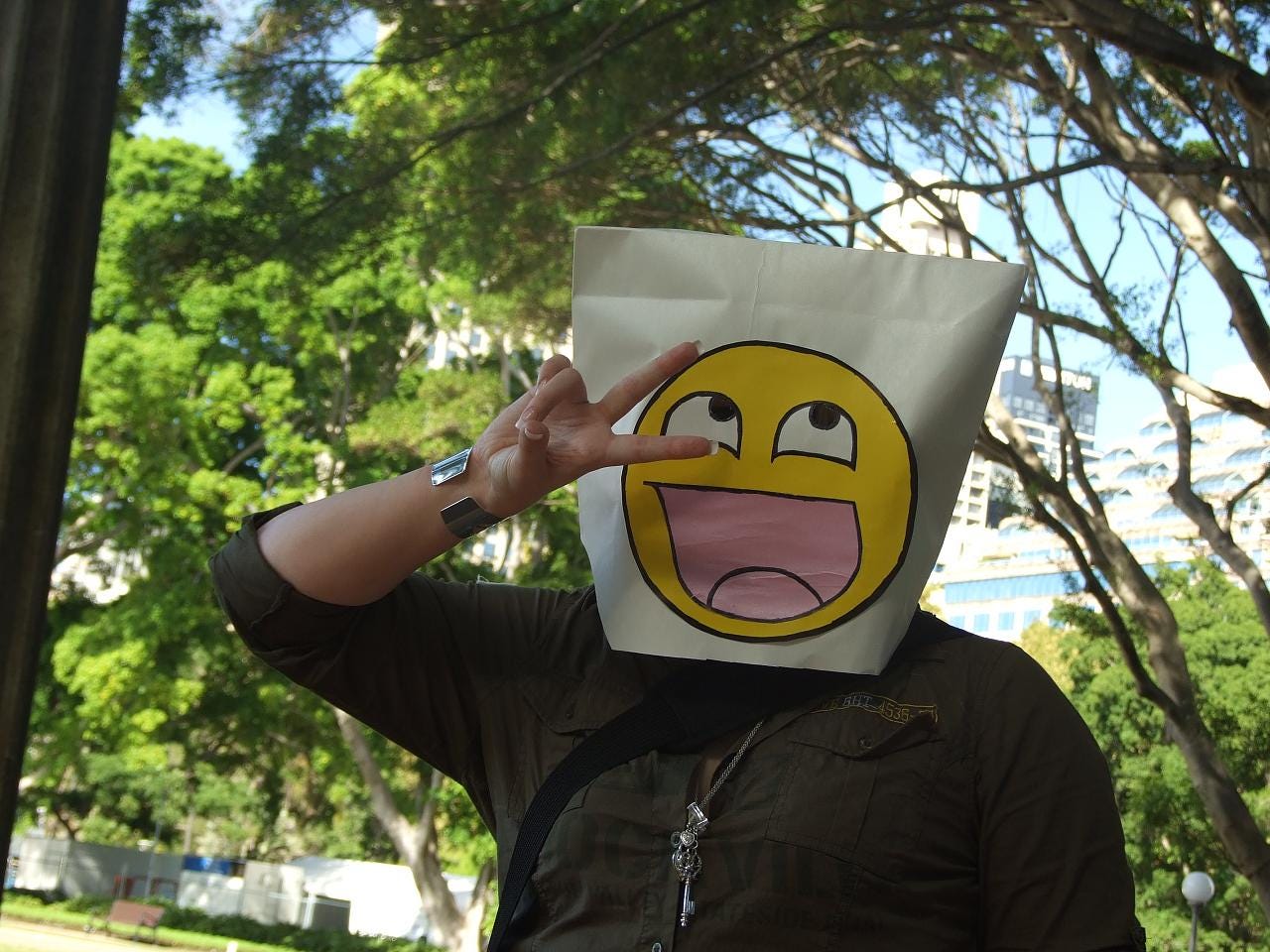
Choice one: radical anonymity.
No user accounts. No passwords. No persistent identity. Everyone posts as “Anonymous.” IP addresses hidden from other users.
Japanese imageboard culture valued this. It freed people from reputation management, from performing for followers, from consequences that followed you across conversations.
It also meant no one could be held accountable for anything they said.
Choice two: ephemerality.
Threads disappear when newer content pushes them off the front page. No permanent archive. Posts exist, then vanish. “Screencap or it’s gone” became the culture.
This created urgency. It also meant evidence evaporated by design.
Choice three: minimal moderation.
One rule: no illegal content. Everything else permitted. Transgression celebrated. When new users asked what rules applied, veterans responded with exaggerated proclamations that there were none—rules were for other platforms.
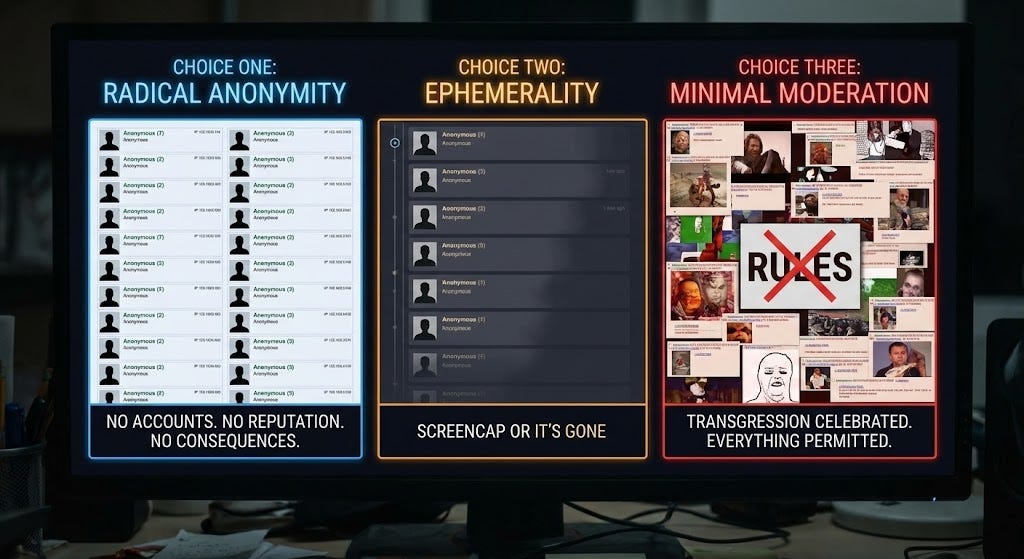
Poole wasn’t inventing these features. He was importing the Japanese imageboard model. But the combination—anonymity plus ephemerality plus minimal moderation—would prove to have consequences no fifteen-year-old could foresee.
4chan launched October 1, 2003. Twenty-two years and three months before Gregory Bovino would be recruiting agents using gaming culture aesthetics from its descendant boards.
2003-2010: The Early Architecture
For seven years, 4chan was known for:
Absurdist humor. Video game discussions. Anime fandom. Coordinated pranks on other websites. The emergence of “Anonymous” as a collective identity—faceless, chaotic, unpredictable.
The most significant early event was Project Chanology in 2008. Thousands of 4chan users showed up to real-world protests against the Church of Scientology wearing Guy Fawkes masks, representing the faceless collective.
This established a template: anonymous online coordination producing real-world action.
The content was mostly apolitical. The cruelty was juvenile rather than ideological. Poole genuinely believed he’d created a space for authentic expression freed from social performance.
He wasn’t wrong about the authenticity. He was wrong about what would be expressed.
2011: The Containment Theory
By 2011, 4chan’s /new/ board—for news discussion—had become indistinguishable from Stormfront. Poole’s own description. Stormfront was the internet’s most prominent white supremacist forum.
He deleted /new/ in January. Then created /pol/—”Politically Incorrect”—in November as a containment board. A designated space for controversial political discussion, isolated from the rest of the site.
The theory: concentrate toxic content in one place, prevent it from spreading elsewhere.
The reality: containment boards don’t contain. They concentrate and amplify.
Within months, /pol/ became a hub for white nationalist organizing. A laboratory for “ironic” Nazi aesthetics. A recruitment pipeline moving users from gaming culture to explicit racism.
Multiple academic studies have quantified /pol/’s hate content. Hine et al. (2017) found 12% of posts contained explicit hate speech—roughly double the rate of 4chan’s sports board. Rieger et al. (2021) found that 24% of analyzed /pol/ comments contained explicit or implicit hate speech.
But statistics miss the mechanism.
Cathrine Thorleifsson’s 2022 qualitative analysis of /pol/ culture documented how “fascist fantasies of white supremacy” spread through what she called “transgressive play frames”—the ironic posture that makes radicalization feel like rebellion.
/pol/ worked because of how it exploited Poole’s original architecture.
Anonymity removed social accountability. You could post Nazi imagery without your name attached. Test transgressive ideas without consequences. Watch yourself become comfortable with content that would have shocked you months earlier.
Ephemerality meant the most extreme content disappeared quickly. Hard to document. Hard to prove. Easy to deny. “I saw it but can’t show you” became the default experience.
Minimal moderation allowed steady escalation. Each shocking post reset the baseline for what was acceptable. What seemed outrageous in January became normal by March.
The architecture was neutral. The outcomes were not.
The Mechanism: Irony Poisoning
Researchers call it irony poisoning.
It works like this: Post something racist. When challenged, claim you’re joking. Mock anyone who takes it seriously. They’re the ones with the problem—they can’t take a joke.
Repeat this cycle. Daily. For months.
At some point, the distinction between your ironic persona and your actual beliefs dissolves. Not because you decided to become a white nationalist. Because you practiced white nationalist speech acts so consistently that they became default.
The “irony” was always the point. It provided cover for sincere radicalization while making that radicalization feel like rebellion against humorless authority.
By 2013, /pol/ had cultivated thousands of young men who’d traveled this pathway. Gaming culture to anti-feminism to “ironic” racism to something that wasn’t ironic at all.
They were about to prove that online harassment could become political mobilization.
September 2014: Poole Sees What He Built
When Gamergate erupted in August 2014—coordinated harassment of women in gaming, disguised as “ethics in journalism” concerns—Christopher Poole made a rare intervention.
He banned Gamergate discussion sitewide.
He called the culture “toxic.”
His users called him “SJW” and “cuck.” Some threatened his life. They migrated to 8chan—an even less moderated imageboard created specifically for content too extreme for 4chan.
Poole had built the architecture. Now he was watching what grew inside it. And he couldn’t stop it without dismantling the platform entirely.
January 2015: Departure
Christopher Poole left 4chan. He sold it to Hiroyuki Nishimura, founder of the original 2chan. He joined Google as a product manager. He largely disappeared from public life.
In interviews around his departure, he described it as “the end of a long journey” and acknowledged he needed time away. He was twenty-six years old. He’d spent eleven years—from age fifteen to twenty-six—running a platform that had evolved from anime discussion forum to white nationalist recruitment infrastructure.
The choices he made at fifteen created conditions he couldn’t undo at twenty-six.
What Poole Never Addressed
As of January 2026, Christopher Poole has never publicly spoken about:
Gamergate’s role in the 2016 election.
The Christchurch shooter, who announced his attack on 8chan—4chan’s direct descendant—and murdered 51 people at prayer while livestreaming like a video game.
The El Paso shooter, who posted his manifesto to 8chan before killing 23 Latinos at a Walmart, explicitly targeting them as “invaders.”
The 75 people killed in five months of 2019 by shooters radicalized through the platform architecture he created.
The DHS recruitment campaign in 2025, using the aesthetics his platform cultivated, speaking the visual language his boards invented.
Poole’s silence isn’t the point. The point is that the architecture outlasted him. The choices made in 2003 continued producing effects in 2025, long after their creator walked away.
The Scholar’s Assessment
Tarleton Gillespie studies platform governance. In 2018, he wrote:
“Platforms are not neutral. The technical decisions about what to allow, what to remove, what to recommend—these are political decisions with real-world consequences.”
Christopher Poole’s case proves it.
Anonymity plus ephemerality plus minimal moderation equals radicalization infrastructure. Not because anyone intended it. Because the architecture created conditions where radicalization could flourish without friction.
The 4chan model has been replicated—8chan, 8kun—and evolved—Telegram channels, Discord servers, Cozy.tv streams. But the fundamental pattern remains: spaces where anonymity enables transgression, ephemerality erases accountability, and minimal moderation allows escalation.
These weren’t the only possible design choices. Other forums required real identity. Other platforms archived content permanently. Other communities moderated aggressively.
Poole chose differently. His choices became infrastructure. His infrastructure became a pipeline.
2025: The Architecture’s Return
The Department of Homeland Security doesn’t recruit on 4chan. It doesn’t need to.
It recruits using 4chan’s aesthetic. Gaming culture. Dehumanizing memes. Ironic cruelty. Video game references that signal shared fluency in the language /pol/ spent a decade cultivating.
When DHS posts Halo screenshots with “DESTROY THE FLOOD” next to an ICE hiring link, they’re speaking to people who understand the reference. The Flood—parasitic aliens that consume all sentient life, requiring extermination to save humanity. Immigrants as the Flood. Enforcement as saving humanity.
When the White House says “the arrests will continue, the memes will continue,” they’re not embarrassed by the comparison to chan culture. They’re claiming it.
When Gregory Bovino—the official with the highest use-of-force ratio in Border Patrol, who admitted lying under oath about deploying tear gas, who remains in command and is now vetting candidates for ICE leadership—recruits 10,000 new agents using video game aesthetics, he’s recruiting from the demographic that /pol/ spent a decade radicalizing.
The fifteen-year-old who created 4chan for anime discussion didn’t intend to create recruitment infrastructure for federal law enforcement.
But platform design has consequences. And sometimes those consequences take twenty-two years to fully materialize.
The Pattern Ahead
The Pattern Ahead
This is Part 3 of an eight-part series documenting the pipeline from 4chan to federal enforcement.
Parts 1 and 2 documented the current crisis: Gregory Bovino’s operations, the four thresholds that mark transformation from law enforcement to something else, the communities experiencing what radicalized enforcement looks like in practice.
This part went backward—to the platform architecture that made the pipeline possible.
The next parts trace what happened when that architecture met:
- Part 4: Political mobilization—Gamergate, the manosphere, and Steve Bannon’s recognition: “You can activate that army”
- Part 5: Mass violence—Christchurch, El Paso, 75 killed in five months of 2019
- Part 6: The machinery—Stephen Miller’s “quantity over quality” doctrine
- Part 7: Institutional infiltration—Groypers and the GOP, “no longer pariahs”
- Part 8: What the pipeline kills—Renee Nicole Good, made of sunshine
By August 16, 2014, /pol/ had cultivated thousands of radicalized young men. They were about to prove that coordinated harassment could become political mobilization.
The test case would be women in gaming.
The proof of concept would be called Gamergate.
And Steve Bannon would be watching.
Series Navigation
The Gamergate Army Gets Badges and Guns
Part 1: The Hammer: Gregory Bovino’s 12-month escalation across the US
Part 2: The ICE Transformation: Four Thresholds America Has Already Crossed
Part 4: Steve Bannon Saw an Army in Gamergate — And built the bridge to federal power
Part 5: Christchurch to El Paso: 75 Dead in Five Months — When 8chan became terrorism infrastructure
Part 6: Stephen Miller Screamed ‘Quantity Over Quality’ — And built the deportation machine
Part 7: Nick Fuentes Dined at Mar-a-Lago — How Groypers completed the pipeline from chan culture to federal policy
Part 8: Renee Good’s Last Words: ‘I’m Not Mad at You’ — What twenty-two years of radicalization infrastructure killed
Sources and Further Reading
Timeline Events
All events documented in the Capture Cascade Timeline with primary source verification:
January 21, 2015: Christopher Poole announces departure from 4chan
March 27, 2025: “The arrests will continue, the memes will continue” doctrine
Academic Research
Hine, Gabriel et al. (2017). “Kek, Cucks, and God Emperor Trump: A Measurement Study of 4chan’s Politically Incorrect Forum and Its Effects on the Web.” ICWSM 2017.
Rieger, Diana et al. (2021). “Assessing the Extent and Types of Hate Speech in Fringe Communities.” Social Media + Society.
Thorleifsson, Cathrine (2022). “From cyberfascism to terrorism: On 4chan/pol/ culture and the transnational production of memetic violence.” Nations and Nationalism.
Gillespie, Tarleton (2018). Custodians of the Internet: Platforms, Content Moderation, and the Hidden Decisions That Shape Social Media. Yale University Press.
Primary Sources
Rolling Stone (2015). “4chan’s Overlord Christopher Poole Reveals Why He Walked Away”
VentureBeat (2015). “The creator of 4chan tells us why he’s leaving the site for good”
The Guardian (2015). “Moot: the 4chan founder who sparked Anonymous”
This is Part 3 of “The Gamergate Army Gets Badges and Guns,” a free 8-part series documenting the 22-year pipeline from 4chan to federal immigration enforcement.
The complete timeline—3,000+ documented events from 1971-2025—is available at capturecascade.org/viewer.
For deep research, book chapters, and the full Capture Cascade analysis, consider a paid subscription ($7/month).