

The Antichrist as Luddite
On a leaked tape, Peter Thiel articulated a christology that has to stay coded. Now it’s on the record.
“In the 21st century, the Antichrist is a Luddite who wants to stop all science. It’s someone like Greta or Eliezer.”
The man speaking was Peter Thiel — chairman of Palantir Technologies, founding partner of the Founders Fund, the largest political patron of the sitting Vice President of the United States. The room was the Commonwealth Club in San Francisco. The date was September 15, 2025. Reporting was prohibited. Attendance was by invitation. The microphones were not supposed to be on.
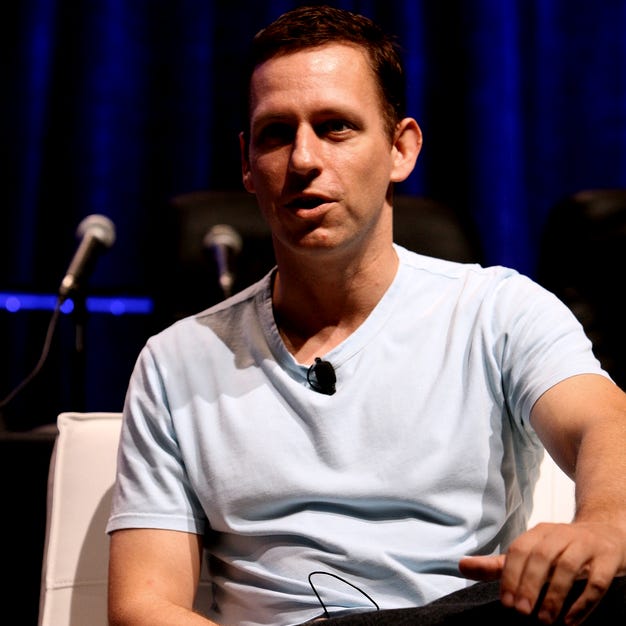
The lectures were billed as “The Antichrist: A Four-Part Lecture Series.” They ran on four consecutive Mondays — September 15, September 22, September 29, and October 6, 2025 — organized by a Christian tech nonprofit called ACTS 17 Collective, the acronym standing for Acknowledging Christ in Technology and Society. “Greta” is Greta Thunberg, the climate activist. “Eliezer” is Eliezer Yudkowsky, the AI safety researcher. The people who sound the alarm about catastrophic risk. “The Antichrist,” Thiel said, “comes to power by talking constantly about Armageddon, about rumors of wars, and scaring you into giving him control over science and technology.”
Recordings of the four lectures were obtained by Reason — which published a seven-hour listening review by Jack Nicastro on October 14, 2025 — and by The Guardian. Audio authenticity was verified by Hany Farid, the UC Berkeley digital forensics expert. The lectures and their content have been reported on across major outlets including The New York Times, Fortune, the Washington Post, Unherd, the religion press, and the Catholic Herald. The Catholic writer Christopher Hale, in his Substack newsletter Letters from Leo, drew out what most of the broader coverage had skipped past: that Thiel had brought Pope Leo XIV by name into the lectures.
Thiel called Leo XIV “the woke American pope.” He warned his audience of a “Caesaro-Papist fusion” — the union of temporal and spiritual power that, in his framework, is the structural shape an Antichrist regime would take — between “a woke American pope” and “a woke American president like AOC.” Alexandria Ocasio-Cortez (D-NY). Her initials, Thiel observed, were “worrisome.” He spoke of his protégé Vice President Vance: “I don’t like his popeism. We have all these reports of fights between him and the Pope; I hope there are a lot more.” And, per Hale’s reporting on the same recordings, Thiel told his audience he had advised the Vice President to ignore the pope on moral matters and simply pray for him.
Thiel did not, in the recordings, name Pope Leo XIV as the Antichrist. The figure he named for that role across the lectures was the unspecified luddite — the existential-risk preacher, the AI safety researcher, the climate activist, the regulator. The pope, in Thiel’s framework, plays a different role: the spiritual-power half of the feared Caesaro-Papist union, the moral authority whose teaching ministry would lend the broader anti-technology project the institutional reach to bind.
The distinction matters. It is also the structure of the operation. The Antichrist framework provides the eschatological category, the end of the world framing, that makes any constraint on technological development the work of the lawless one. The pope is then placed inside the framework. He is not himself accused of being the eschatological enemy. He is identified as the figure whose moral authority — if not neutralized — would lend that enemy the institutional reach to win.
After Hale’s piece circulated in religion-press silos and largely failed to break into the wider conversation, the recordings resurfaced when Hale appeared on Jon Favreau’s podcast Offline and posted a viral thread on X.
The lectures themselves were not improvised. Thiel has been delivering versions of the Antichrist material across at least eighteen months. In a June 2025 interview with Ross Douthat at The New York Times, Thiel articulated the same framework: “If the Antichrist were to come to power, it would be by talking about Armageddon all the time.” After the September–October San Francisco series, he took the lectures to Rome.
The Rome dates were March 8–11, 2026, per an invitation reviewed by the Associated Press. The lectures were originally rumored to be hosted at the Pontifical University of St. Thomas Aquinas — the Angelicum, the Dominican institution where the future Pope Leo XIV studied in the 1980s. The Angelicum issued a public statement: “We would like to clarify that this event is not organized by the University, will not take place at the Angelicum, and is not part of any of our institutional initiatives.”
The lectures proceeded under the auspices of the Vincenzo Gioberti Cultural Association — an Italian organization with documented ties to Italy’s far right, dedicated to “the restoration of Catholicism as the cornerstone of national identity” — and the Cluny Institute, “incubated at” the Catholic University of America in Washington. CUA also issued a public denial of any institutional sponsorship. The press was excluded. The venue was not disclosed. The closed-door format was preserved.
This is not a man airing private speculation in unguarded moments. It is a man building out a venue infrastructure for a specific theological argument, choosing his audiences, declining the institutions that would scrutinize it, and traveling internationally to deliver it. The fact that recordings nonetheless escaped is what is unusual, not the existence of the project.
What Thiel said on those tapes is the framework caught in the open mic. It is not a fringe utterance. It is not the eccentric fixation of a billionaire crank. It is the load-bearing theological claim of an entire wing of American power, articulated in private to vetted audiences because it cannot survive being articulated in public.
Call it crypto-christology. The smuggled gospel.
The church that has to stay underground because its own scriptures will not bear it.
What the prefix means
The “crypto-” prefix carries two registers, and both belong here.
The first is older: hidden, encoded, secret. A crypto-Catholic in Elizabethan England outwardly conformed to the Anglican liturgy while privately maintaining the old faith. A crypto-Jew in the Iberian peninsula passed as Christian in public while keeping kosher in the cellar. The encoding was protective; the public face concealed the actual creed.
The second is contemporary. Cryptocurrency presents itself as a technology of liberation and operates as a technology of capture. The marketing — financial freedom, individual sovereignty, escape from state control — is decoupled from the structural function: a parallel financial system that escapes anti-money-laundering frameworks, capital controls, sanctions enforcement, and democratic oversight.
The two layers are not contradictory. They are how the project works. The marketing is the rails on which the function travels. The Bitcoin-maximalist canon — Saylor’s “divine math,” the 21-million-coin cap as sacralized constraint, the recurring vocabulary of sovereign, immutable, trustless applied to monetary form — is structurally theological even when its proponents are secular; a later piece in this series will work the sound-money register on its own terms.
Crypto-christology operates the same way. The surface presents a traditional Christian faith — common-good language, natural-law reasoning, defense of Western civilization, masculine headship, ordered hierarchy, restraint of chaos. The structural function is something else: the legitimation of a small elite against any moral authority that would constrain it.
What gets concealed is the actual content of Christian scripture.
The gospels are not subtle on this point. The Christ they portray is a Galilean peasant prophet executed by the imperial occupation of his people. He proclaimed the Kingdom of God at hand, and the proclamation was a sovereignty claim: Rome did not crucify peasants for offering gentle ethical teaching; Rome crucified peasants for claiming alternative sovereignty against Caesar’s. The vocabulary the Jesus movement used to make that claim was Caesar’s own — Lord, Savior, Son of God, good news — every title stripped from the deified emperor and conferred on the man Rome had crucified. (Son of God vs Son of God, in The Second Sermon, works the full philological argument and its political stakes.)
His program announced the cancellation of debts, the release of captives, the lifting up of the lowly, the scattering of the proud, the filling of the hungry, and the sending away of the rich empty. He was killed for the sovereignty claim. The early Jesus movement spread because people recognized in him the unmasking of imperial logic — the revelation that the executed peasant, not the deified emperor, was the bearer of God’s vindication.
A christology that takes this content seriously is structurally incompatible with elite legitimation. It cannot bless concentrated power, technological domination, or the dehumanization of the poor and the foreign. The texts will not stretch that far.
What crypto-christology does is the reversal. It takes the titles back. It returns Lord to the apparatus of the imperial state. It returns Savior to the engineer who promises to save us through unconstrained technological development. It returns good news to the marketing departments of the surveillance vendors. The Christ of crypto-christology is not the Galilean prophet who proclaimed the Empire of God against Rome. It is the Christ enlisted by Rome.
Which is why the project requires concealment. Common-good language is the public face. Pope-as-impediment-to-Antichrist-resistance is what gets said when the door is closed.
It is not, in this sense, a failure of nerve that the recordings happened in private. It is a structural requirement.
The Girardian inversion
To understand what Thiel did to christology, you have to understand who he was reading.
In the early 1990s, as a graduate student at Stanford, Thiel attended the seminars of René Girard, the French literary theorist whose work on mimetic desire and the scapegoat mechanism became the central interpretive framework of his life. Thiel funded Girard’s institute, Imitatio. He installed Girard at the heart of his self-presentation as a serious thinker rather than a mere venture capitalist. He introduced J.D. Vance to Girard’s work in the 2010s, and Vance has cited Girard as a formative intellectual influence.
Girard’s own analysis was, in its first movement, devastating to power.
Human communities, Girard argued, generate violence through mimetic rivalry — we want what others want because they want it, and the resulting tensions accumulate until the community discharges them by collectively turning on a victim. The scapegoat absorbs the violence. The community experiences relief, mistakes that relief for divine sanction, and the cycle resumes. Religion, in Girard’s reading, is the elaborate cultural machinery for managing this — the ritualization of the scapegoat mechanism, with myth as the cover story that makes the violence look like justice.
The gospel, in Girard’s late work, is what unmasks the machinery. The crucifixion narratives, told from the victim’s perspective, expose the lie at the center of every previous scapegoating. The crowd believes it is doing God’s work; God turns out to be on the side of the victim; the mechanism is named, and once named, can no longer operate as it did. Christianity, in this reading, is anti-sacrificial. It dismantles the structures by which power has historically purchased its own legitimacy.
That is not the christology Thiel deploys.
The Girard he hands to his patrons and protégés has been quietly inverted. The scapegoat mechanism still appears. The mob still produces sacrificial victims. But the mob, in Thiel’s rendering, is no longer Pilate’s crowd or the religious authorities or the imperial machinery — it is the regulators, the ethicists, the climate scientists, the journalists, the critics of monopoly power, the popes who teach that artificial intelligence raises questions of human dignity. The victims, in Thiel’s rendering, are the technological elite. The Christ-figure is the misunderstood founder, the visionary entrepreneur, the seer mocked by the small. Girard’s anthropology, which exposed the scapegoat mechanism that elites have always used to legitimate their position, is repurposed to make those same elites the scapegoated.
The form of the analysis is preserved; the content is reversed.
Thiel’s stated sources in the lectures make the framework legible. He drew on John Henry Newman’s nineteenth-century apocalyptic writings and on Vladimir Soloviev’s 1900 novella A Short Story of the Antichrist, in which the Antichrist arrives as an engineer offering rational solutions to human chaos. He cited Hobbes’s Leviathan as the political form the Antichrist would inhabit. He described himself in the lectures as a “small-o orthodox Christian” and a “humble classical liberal,” and said his concern about the Antichrist was his “only deviation from classical liberal orthodoxy.” In one of the recordings, he formulated the political-theological dilemma directly: America, he said, is “the natural candidate for Katechon” — the restrainer, the figure or force in 2 Thessalonians that holds back the lawless one until the appointed time — “and Antichrist; ground zero of the one-world state, ground zero of the resistance to the one-world state.”
The katechon is the load-bearing concept. It is also the concept that Catholic integralists, particularly Adrian Vermeule at Harvard Law, have spent the last decade rehabilitating as a justification for authoritarian governance. In the integralist reading, legitimate political authority is the katechon, charged with restraining civilizational collapse. The construction of a surveillance-enforcement state ceases to be a moral compromise for strategic gain and becomes a theological obligation. The restrainer must restrain.
What Thiel said on the tape — that the Antichrist will come as a luddite who weaponizes existential risk to seize global control over technology — is the katechontic frame applied to AI policy. Anyone who would constrain technological development on moral or precautionary grounds is, by definitional fiat, doing the lawless one’s work. The katechon, in this rendering, is the unrestrained technologist. Anything that restrains him — regulation, ethics, religious moral teaching — is the Antichrist’s instrument.
This is what is meant by smuggling. The form is recognizable Christian theology. The content is its photographic negative.
Why the pope, why AI, why now
The framework is not aimed at the abstract figure of any future pope. It is aimed at a particular pope, doing particular work, at a particular moment.
Pope Leo XIV is the first American pope in the Catholic Church’s two-thousand-year history. Cardinal Robert Francis Prevost was elected to the papacy on May 8, 2025. He chose his name, by his own account, to invoke Leo XIII — the pope whose 1891 encyclical Rerum Novarum responded to the dehumanizing forces of industrial capitalism by articulating Catholic social teaching as a tradition of moral resistance to economic systems that grind human dignity into capital.
In his first formal address to the College of Cardinals on May 10, 2025, Leo XIV named the project explicitly: the Church, he said, “offers to all her treasure of social teaching in response to another industrial revolution and the developments of artificial intelligence.” The pontificate would do for the AI revolution what Leo XIII’s had done for the industrial revolution. To insist that the human person is not raw material for technological systems. To name the moral obligations of those who build and deploy these systems. To establish, with the institutional weight of the world’s largest religious body, that there are theological grounds for constraint.
For a year that was a stated intention. Now it is on the page. On May 25, 2026, Leo XIV released his first encyclical, Magnifica Humanitas — forty-two thousand words “on safeguarding the human person in the time of artificial intelligence” — calling for AI to be “disarmed” from “logics of domination, exclusion and death,” holding that “it is necessary to establish adequate regulatory tools capable of upholding justice and curbing the distorting effects of technological power,” and naming the danger by its structure: technological power concentrated in “private, often transnational, parties” beyond the reach of states. The intention became the magisterial document. And the luddite the lectures warned about turned out to be exactly the figure the lectures said he was: a pope, teaching that there are limits.
This project is not optional for the church. It is a faithful extension of a teaching tradition that has been continuous since 1891. It is also the single most dangerous moral authority on earth from the perspective of a project whose entire architecture depends on AI surveillance, AI enforcement, AI weapons, and the steady displacement of human moral judgment by algorithmic decision.
The Catholic Church speaks to roughly a billion and a half people across every continent and every political coalition. Its teaching authority is recognized, with varying degrees of fidelity, by Catholic integralists, mainline Protestants, evangelicals who absorb its social teaching even while rejecting its ecclesiology, secular ethicists who treat its tradition as a serious moral interlocutor, and the broader cultural ecosystem in which “what does the pope say about this” still functions as a question with weight. No other moral authority on earth has that reach.
With the encyclical, the moral case for AI restraint is now a global teaching with institutional backing across denominational lines — no longer a forecast. The Palantir contract architecture — explicitly designed to rebuild Total Information Awareness in the private sector after Congress banned it — the Anduril defense integration, the surveillance-state buildout, the algorithmic enforcement systems now all have to operate inside a moral environment the church has made hostile. Not by political mobilization, though that may follow. By teaching. By the slow accumulation of moral authority that names what is happening and refuses to bless it.
The framework’s mechanism is already visible, and I have documented it at length elsewhere: when Anthropic refused Pentagon demands to relax its AI product Claude’s safety guardrails, the administration designated the company a “supply chain risk” — the language ordinarily reserved for hostile foreign governments — then used the model anyway for Iran strike modeling while signing a parallel deal with a competitor that asked fewer questions. The message was never “remove your guardrails.” It was: don’t say no in public. The “luddite” framing in the Antichrist lectures is the theological legitimation of that message. Whoever names a moral limit is named the enemy.
So watch what happened next. When Leo presented the encyclical at the Vatican on May 25, he did not present it alone: beside him stood Chris Olah, a co-founder of Anthropic, calling with the Pope for moral limits on AI — “we need moral voices that the incentives cannot bend.” The Washington Post headlined it “Anthropic aligns with Vatican over White House.”
Read this in the context of Thiel’s framework, he names two archetypal luddites — the AI-safety researcher and the now the pope who teaches AI ethics — and on that one stage, on that one day, both of them stood together. The legitimation layer’s two designated villains, shoulder to shoulder. It is the precise photographic negative of the story the framework needs to be true: the company the administration tried to brand a security threat for holding a line on safety, standing next to the moral authority the lectures cast as the Antichrist’s instrument, both of them saying the same thing. (I traced that collision through the Vance-versus-Pope arc in the companion piece, “Augustine Against Augustine.”)
The structural threat is precise. The response is precise.
In the lectures: tell the Vice President to ignore the pope on moral matters. Frame the pope as the spiritual half of a feared Caesaro-Papist fusion. Travel to Rome in March 2026 to deliver Antichrist lectures at the doorstep of the Vatican — refused a venue by the pope’s own doctoral institution, ultimately hosted by integralist-friendly cultural associations operating outside official Catholic ecclesiastical structures. Build out the alternative theological infrastructure that allows Catholic-identified political figures to override their church’s teaching while continuing to perform Catholic identity for their political base.
This is not religious conflict in the conventional sense. It is the systematic neutralization of countervailing moral authority on the precise policy axis where the four-layer technological-political project is most exposed.
The pattern in The RAMM‘s capture-cascade work has been institutional: Powell Memo, Federalist Society, Project 2025, bureaucratic embedding. This piece opens a different layer underneath that one — the theological legitimation that makes the institutional capture coherent to the people running it. The smuggled christology is the load-bearing ideology underneath the surveillance contracts, the detention infrastructure, the interlocking-conflicts cabinet, the AI weapons procurement, and the captured Christianity that prays for “overwhelming violence” at the Pentagon.
The November 2024 ACTS 17 Abu Dhabi event — Trae Stephens of Anduril paired with Faisal Al Bannai of EDGE Group, the UAE state-backed defense-AI conglomerate, under the program title “Theology of AI and Defense” — names what the legitimation layer also is: a transnational surveillance-defense relational vehicle. The same theological vocabulary that delegitimates AI restraint in San Francisco is the vocabulary inside which US-Gulf defense-tech procurement gets framed as Christian vocation in Abu Dhabi. The crypto-fascism layer this series will document is already operational; the Antichrist lectures are the doctrinal framing.
The conflict is not new
Pope Leo XIV is the second pope this Vance administration has crossed in public.
In late January 2025, less than two weeks into the second Trump administration, Vance gave a Fox News interview in which he invoked an “old school” Christian concept he later identified as the ordo amoris — the order of loves, articulated by Augustine and developed by Aquinas — to defend the administration’s deportation program. “You love your family,” he said, “and then you love your neighbor, and then you love your community, and then you love your fellow citizens in your own country, and then after that you can focus and prioritize the rest of the world.” When the citation was challenged, Vance posted on X: “just google ‘ordo amoris.’”
Pope Francis responded on February 10, 2025, in a public letter to the bishops of the United States. Without naming Vance, the letter took apart the construction. “Christian love is not a concentric expansion of interests that little by little extend to other persons and groups,” Francis wrote. “The true ordo amoris that must be promoted is that which we discover by meditating constantly on the parable of the Good Samaritan — that is, by meditating on the love that builds a fraternity open to all, without exception.”
It was the most direct public confrontation between a pope and a sitting American Vice President on Catholic moral teaching in modern memory.
Vance addressed the conflict on February 28, 2025, at the National Catholic Prayer Breakfast in Washington. He said he was “surprised” that Francis had criticized the administration’s immigration policy. The argument continued through March and April. On Easter Sunday, April 20, 2025, Vance met Francis briefly at the Domus Sanctae Marthae — what would be Francis’s last meeting with a major political figure. Francis died the following morning, April 21, at age 88, after a long convalescence from bilateral pneumonia.
The conclave elected Cardinal Prevost on May 8. Leo XIV picked up the project in continuity with his predecessor. He has condemned the administration’s military posturing toward Iran and Venezuela. He called publicly on November 4, 2025 for ICE to allow clergy access to detained migrants. And on April 14, 2026 — the same day Vance stood at a Turning Point USA event and told that pope to “be careful” about “matters of theology,” citing just-war theory against him — Leo was in Annaba, Algeria, saying Mass in the Basilica of St. Augustine, the first Augustinian pope on the ground where Augustine wrote the just-war tradition Vance had just invoked against him. Six weeks later came the encyclical. (The full arc of those confrontations — ordo amoris, just war, the encyclical, the same saint cited on both sides — is the subject of the companion piece, “Augustine Against Augustine.”) He has not stopped speaking. He has institutionalized the speaking.
Four months after Leo’s election, on September 15, 2025, Thiel began delivering the Antichrist lectures.
Where Vance stands
The surrounding political-economic project requires a bridging figure. Tech-right capital can build infrastructure and win contracts but cannot generate the bureaucratic depth, the enforcement legitimation, or the mass democratic cover needed to govern through that infrastructure. Christian nationalist movements have spent forty years building exactly those capacities — personnel pipelines through ADF, Liberty, Patrick Henry, the CREC, Catholic integralist institutions — but lack the technological and capital infrastructure that would let them rule at scale.
The two projects ran parallel through the late 2010s. They required a coupling figure to fuse into a single governance model. J.D. Vance is that figure.
His position is documentable, not speculative. He met Peter Thiel at Yale Law School in 2011. He joined Thiel’s Mithril Capital in 2016. He converted to Catholicism in August 2019, confirmation saint Augustine. Thiel seeded Vance’s own venture firm, Narya, founded in 2019 — the fund raised $93 million, announced in January 2020. In the 2022 cycle, Thiel contributed more than $15 million to Protect Ohio Values, the super PAC supporting Vance’s Senate campaign — approximately 75 percent of the PAC’s total fundraising. Trump’s endorsement followed Thiel’s investment. Vance has been Vice President since January 20, 2025.
The intellectual orientation tracks the Catholic-integralist current that became publicly visible in the late 2010s: First Things under Rusty Reno, Adrian Vermeule’s “common-good constitutionalism” at Harvard Law, Patrick Deneen’s Why Liberalism Failed, Sohrab Ahmari’s case for state enforcement of moral order. Vance’s “British sherpa,” in his own description, is James Orr, the Cambridge philosophy of religion scholar who helped found the UK National Conservative Movement.
The denominational ambiguity is a feature, not an accident. Vance integrates three doctrinally incompatible Christian-nationalist streams without resolving the contradictions between them.
He is personally inside the Catholic-integralist stream — baptism, confirmation, Hallow app, the First Things circuit, Steubenville. He is operationally adjacent to the Reformed-postliberal stream. He shares the National Conservatism platform and American Moment infrastructure with Stephen Wolfe and Doug Wilson’s circle, even though Wilson’s March 2026 statement that a “stout Protestant republic” could not permit a Virgin Mary parade because it would be “public idolatry.”
This was made, pointedly, by the pastor who mentors Defense Secretary Hegseth — puts him in explicit doctrinal opposition to Catholic Vance. He is ratified by the Pentecostal/NAR stream through the Anti-Christian Bias Task Force frame, which collapses denominational distinctions into a single “anti-Christianity is the threat” paradigm that lets dominionist Pentecostals operate under the same coalition cover. The denominational ambiguity works because the underlying christology — small elite as scapegoated, regulator as Antichrist’s instrument, restraint of disruption as civilizational sin — is shared across the three streams even when the ecclesiology isn’t.
What the recordings reveal is the substrate beneath the public performance. The same christology, named openly, with the actual living head of the actual largest church Vance claims as his own identified as the spiritual-power half of a feared Caesaro-Papist fusion that the Vice President is being instructed to help prevent.
What this is, and what it is not
It is not religious persecution in the brutalist sense. The Catholic Church will not be banned. Crypto-christology is not the religious authoritarianism of 1930s Spain or contemporary Iran.
Instead, is internal christological conflict — a fight over what the word “Christian” structurally authorizes, conducted through the apparatus of the state, with the resources of a vast technological and financial empire deployed to ensure that the answer comes out one particular way.
It is also not a marginal phenomenon. The largest political donor in the Vance succession architecture said it. The Vice President of the United States is the recipient of the instruction it contains. The intellectual infrastructure — Vermeule at Harvard Law, Deneen at Notre Dame, First Things in publishing, the Claremont Institute in policy, the network of integralist cultural associations and Catholic-identified think tanks — has been built out, funded, and staffed across the past decade by Thiel-network capital and Federalist Society judicial pipelines. The bureaucratic embedding — Russell Vought at OMB, Jim O’Neill at HHS, the integralist-aligned judicial appointments, the Christian nationalist cabinet faction operating across DHS, DOJ, HHS, and Defense — provides the executive-branch reach.
The capital and personnel base is documentable. Palantir alone is valued at over $270 billion, part of a vertically integrated surveillance-to-weapons infrastructure across more than twenty-one companies, with more than a dozen Thiel-network alumni placed in Trump administration agencies. Palantir alone carries 144 documented Trump-administration financial ties in the ProPublica disclosures. Palantir’s ImmigrationOS — the $30 million ICE sole-source contract that became a $1 billion DHS no-bid expansion — is the operational instrument. The theological layer this piece names is the legitimating cover for an apparatus of that scale.
This is not a fringe. It is at the apex.
Crypto-christologies are also intrinsically fragile. They depend on the gap between surface performance, and structural function holding. When the gap is exposed — when the tape leaks, when the patron’s actual instructions surface, when the smuggled content is articulated openly — the public legitimation suffers immediate strain. The political base that has been performing Catholic identity around Vance has to make a decision. The integralist intellectuals who have been treating Thiel as a serious philosophical interlocutor have to either reckon with what their philosophical interlocutor actually thinks of the head of their church, or perform the further intellectual contortion required to absorb it.
The smuggling works until it is named. Once named, the audience that had been operating on the surface performance has to choose. Some will reject the smuggled content and walk away. Some will embrace the smuggled content and carry the project forward with the gap closed. Some will continue to operate in bad faith, but with diminished cover. None of those outcomes leaves the equilibrium where it was.
What the tapes name
Return to the actual recordings.
A Vice President of the United States is in receipt of an instruction from his largest political patron to disregard the moral authority of his church on the specific policy axis — the development of ethical AI — where his administration’s most consequential project sits. The patron has, on tape, framed the head of that church as the spiritual-power half of a feared Caesaro-Papist union and identified resistance to technological development as the work of the Antichrist.
The Vice President has, in his public conduct, performed Catholic identity while overriding Catholic teaching on the questions where these projects intersect most directly — first under Pope Francis, who challenged him on the ordo amoris and died the day after their final meeting at the Vatican, and now under Pope Leo XIV, who answered Vance’s “be careful” on just-war theory from Augustine’s own basilica and then, on May 25, placed the moral status of artificial intelligence at the center of the church’s teaching with an encyclical that names exactly what the lectures said must never be named: a limit.
The keystone phrase — Antichrist as luddite — is so theologically aggressive that it forces every reader who knows the Christian tradition into the same recognition. The Antichrist in scripture and in patristic tradition is not the figure who would restrain the seer or constrain the technocrat. The Antichrist is the figure of false sovereignty, the one who claims worship through power, the one who deceives by appearing as an angel of light. Catholic readers, Protestant readers, even secular readers with no theological investment recognize what is happening: the deepest moral category in the inherited tradition is being inverted on tape, in service of the precise project the inverted category was constructed to oppose.
What Pope Leo XIV is actually doing is teaching that human beings are not raw material for AI systems. What Pope Leo XIV is actually doing is naming the moral obligations of the actors who build and deploy those systems. What Pope Leo XIV is actually doing is the work of a teaching church responding to a technological revolution exactly as Catholic social teaching has responded to every previous one. What Pope Leo XIV is actually doing is what the inherited tradition asks the office to do.
The patron of the Vice President of the United States said, on tape, that the resistance to that work is the work of the Antichrist. He said the Vice President should ignore the church’s living head on the moral questions raised by that work. He said the tradition of moral teaching that constrains technology is the lawless one’s instrument. He said it across four lectures in San Francisco, in a June 2025 interview with The New York Times, and again across four days in Rome in March 2026.
This is one piece of a larger architecture — the financial apparatus that funds it, the cryptocurrency rails that move its capital, the surveillance infrastructure that gives it operational reach, each with its own ledger. But this piece is here first, because the recordings are here, and because the smuggled christology is the legitimating layer that makes everything else thinkable. Name the theology, and the rest stops looking like a series of separate scandals and starts looking like what it is.
A patron told the principal to ignore the moral authority. On tape. About AI ethics. The recordings exist. They were obtained by Reason and The Guardian and have been reported on across the political and religious press. The principal is the Vice President of the United States. The moral authority is the head of the largest church on earth.
The microphone was on.
This is the legitimation layer — the theology that makes the rest coherent to the people running it. Underneath it sits the apparatus the theology blesses, and that apparatus has its own ledger: the surveillance infrastructure built to rebuild Total Information Awareness in the private sector; the defense-AI stack that runs from Palantir through Anduril and out to the Gulf; the ACTS 17 network where the same vocabulary that delegitimates AI restraint in San Francisco frames US–Gulf defense-tech procurement as Christian vocation in Abu Dhabi. Those are the pieces this series is building toward — and the surveillance layer is the one coming into focus next. The companion to this piece, “Augustine Against Augustine,” follows the same christology into the open, through the Vance-versus-Pope confrontations. The Second Sermon companion — “Son of God vs Son of God“ — works the philological argument underneath all of it: what kyrios, soter, euangelion, and divi filius meant in their imperial context, and why the early Christian confession was a sovereignty claim before it was a creed. There is much more here than one piece can hold. It is coming.
The RAMM documents the connections that beat reporting can’t see:
4,776+ sourced events at capturecascade.org.
1,988 Counties with signals of potential detention center expansion (Federal contracts, 287(g), real estate traces, etc) at detention-pipeline.transparencycascade.org my site that tracks signals of potential cooperation with ICE and Border Patrol.
129 Community fights over detention capacity built out tracked.
All of this is self-funded, and paid subscriptions are the only way I can continue to do this long term.
Sources
Primary recordings and verified reporting:
Jack Nicastro, “I Listened to Over 7 Hours of Peter Thiel’s Leaked Antichrist Lectures. They’re Surprisingly Libertarian” (Reason, October 14, 2025)
“What billionaire Peter Thiel said in his private ‘Antichrist lectures’” (Washington Post, October 10, 2025)
“Inside tech billionaire Peter Thiel’s off-the-record lectures about the Antichrist” (The Guardian, October 10, 2025)
“Hany Farid Verifies Billionaire Lectures Warning of ‘The Antichrist’” (UC Berkeley School of Information)
“Peter Thiel is delivering 4 private sold-out lectures at a club in San Francisco — about the Antichrist” (Fortune, September 2, 2025)
ACTS 17 Collective, “The Antichrist: A Four-Part Lecture Series” (event listing)
Christopher Hale’s reporting and the resurfacing:
Christopher Hale, “JD Vance’s Top Donor Suggests Pope Leo XIV is Antichrist” (Letters from Leo)
Christopher Hale, “JD Vance’s Top Donor Brings His War on the Pope to Rome” (Letters from Leo)
Jon Favreau, “How Peter Thiel Became the Right’s Tech-Authoritarian Kingmaker” (Offline with Jon Favreau, fall 2025 — link pending correct episode URL)
Rome 2026 lectures:
“Peter Thiel brings his Antichrist lectures to the Vatican’s doorstep, and Catholic institutions back away” (America Magazine, March 13, 2026)
“Thiel brings Antichrist lectures to Vatican’s doorstep” (Religion News Service, March 13, 2026)
“Peter Thiel’s secret lectures on Antichrist in Rome spark debate” (CNN, March 16, 2026)
“Peter Thiel brings his Antichrist lectures to Rome” (Fortune, March 16, 2026)
Papal documents and Vatican coverage:
“Pope Leo XIV to Cardinals: Church must respond to digital revolution” (Vatican News, May 10, 2025)
“Pope signals he will closely follow Francis and says AI represents challenge for humanity” (CNN, May 10, 2025)
“Pope Francis takes aim at Vance’s definition of ‘ordo amoris’ in letter to US Bishops” (Religion News Service, February 11, 2025)
“Pope’s death due to stroke and irreversible cardiocirculatory collapse” (Vatican News, April 21, 2025)
“JD Vance meets Pope Francis on Easter Sunday” (Washington Post, April 20, 2025)
Vance documentation:
“13 things to know about J.D. Vance’s Catholic journey” (Catholic News Agency / EWTN News — original URL defunct; fact verified via America Magazine and Religion News Service)
Protect Ohio Values PAC summary (OpenSecrets, 2022 cycle)
Ross Douthat interview with Peter Thiel, The New York Times (June 2025)
Earlier Thiel framework articulations:
“Antichrist or Armageddon? Peter Thiel rethinks apocalypse from Silicon Valley” (Religion News Service, September 9, 2025)
“Peter Thiel’s Antichrist lectures” (Catholic Herald)
Or the current regime.