

The $95 Million Question: A Russian Oligarch, a Mansion, and the Offshore Entity Created Twenty-Three Days Later
Today we are going to dig into a critical transaction mentioned in the e-mails. The results connect to specific information in the Muller Report. This is part one of a two part series. I am working on part 2 right now, and will try to release that later this afternoon.
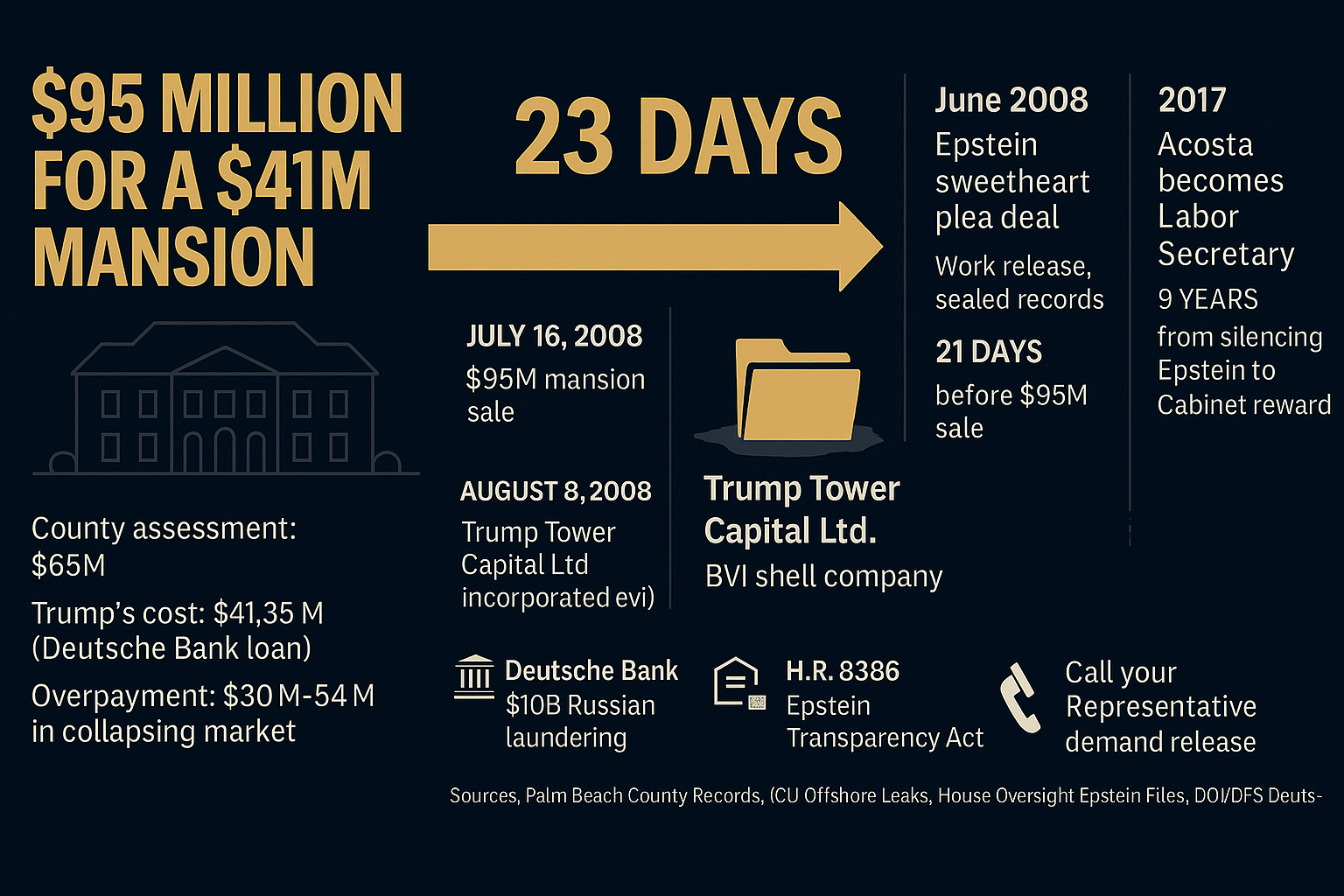
Palm Beach County, Florida - July 16, 2008
The property deed recorded that Wednesday afternoon showed a transaction that made no sense: $95 million for a mansion purchased four years earlier for $41.35 million. No significant improvements. No inspection by the buyer. And the market was collapsing—Lehman Brothers would file for bankruptcy in fifty-eight days.
The seller: Trump Properties LLC. The buyer: County Road Property LLC, a front for Russian oligarch Dmitry Rybolovlev.
Twenty-three days later—August 8, 2008—an entity appeared in the British Virgin Islands: Trump Tower Capital Ltd. Incorporated through Mossack Fonseca, the Panama Papers law firm. Professional nominees concealing the real owner. Maximum secrecy jurisdiction.
You are looking at money laundering infrastructure in operation.
The question: Do the sealed Epstein files contain proof of what the public record suggests?
According to House Oversight Committee documents, Jeffrey Epstein believed Trump was “fronting for the mansion’s real owners” and threatened to expose the deal. Then Epstein’s investigation began. Alex Acosta gave him a sweetheart plea deal. Three weeks later, the mansion sold. Three weeks after that, the offshore entity appeared. Nine years later, Trump appointed Acosta as Labor Secretary.
Every date is documented. Every entity is real. The timing reveals the mechanism.
Scene One: The Economics of Absurdity
July 16, 2008. The financial crisis was accelerating. Bear Stearns had collapsed in March, sold to JP Morgan for $10 per share after trading at $172 six months earlier. Lehman Brothers stock was plummeting. It would file for bankruptcy September 15, just sixty days away. Florida’s housing market had peaked in 2006 and was in freefall. Foreclosures were surging. Palm Beach luxury properties were selling at steep discounts as credit froze and buyers disappeared.
On this Wednesday, in this market, Russian oligarch Dmitry Rybolovlev paid Donald Trump $95 million for the Palm Beach mansion.
The numbers document the absurdity:
Trump’s purchase (2004): $41.35 million from Abe Gosman’s bankruptcy estate Trump’s financing: 100% through Deutsche Bank (Trump invested $0 personal capital) Trump’s improvements: Modest, cosmetic—“$3 worth of paint and a good cleaning” per Trump’s own 2013 description County assessment (2008): $65 million. Sale price (July 2008): $95 million Trump’s profit: $53.65 million on zero invested capital Market conditions: Collapsing
The overpayment: $30 million above county assessment. $54 million above Trump’s cost basis. In the worst real estate market in decades.
What Rybolovlev did next reveals this wasn’t investment:
Subdivided into three lots
Sold lots over eleven years for $108.2 million total (2016-2019)
Paid approximately $15.4 million in property taxes ($1.4M/year × 11 years)
Net outcome after demolition, carrying costs, and taxes: minimal profit on $95 million tied up for over a decade
This is not how real estate investment works. This is how money laundering works—the property is vehicle for transaction, not the asset itself.
Scene Two: What Epstein Knew—And When He Threatened to Use It
November 2004. Two men competed for the same foreclosed Palm Beach mansion at bankruptcy auction: Donald Trump and Jeffrey Epstein. They had been friends, neighbors, party companions for fifteen years. Now they lobbed insults through intermediaries to the bankruptcy trustee.
“Donald saying, ‘You don’t want to do a deal with him, he doesn’t have the money,’” the trustee later recalled. “While Epstein was saying: ‘Donald is all talk. He doesn’t have the money.’”
Epstein was right to question Trump’s financing. But Trump won anyway, purchasing the property for $41.35 million—entirely financed by Deutsche Bank through an entity called Trump Properties LLC.
According to Michael Wolff’s book “Siege” (2019), documented in House Oversight Committee Epstein Files (HOUSE_OVERSIGHT_030989), Epstein didn’t just lose an auction. He suspected something more systematic:
“The billionaire financier knew Trump had been loaning out his name in real estate deals for a fee, and he suspected the freshly minted reality TV star was fronting for the mansion’s real owners.“
Epstein showed Trump the property initially, planning to bid $36 million. Trump went behind his back and bid $40 million. But Epstein knew Trump couldn’t raise that capital himself. Deutsche Bank financing suggested to Epstein what he’d seen before: Trump as paid front man and the actual ownership concealed.
And Epstein threatened to expose it.
The threat created leverage. Trump knew Epstein’s secrets—the underage girls, the trafficking, the high-profile clients. Epstein knew Trump’s secrets—the fronting schemes, the financing arrangements, the shadow ownership structures.
Then Epstein’s leverage evaporated.
The timeline documents the mechanism:
2004: Trump purchases mansion, beating Epstein at auction
2005: Palm Beach police begin investigating Epstein (tips about underage girls)
2006: Federal investigation expands 2007: Federal prosecutors prepare serious charges June 2008: Alex Acosta, U.S. Attorney for Southern District of Florida, offers Epstein extraordinary plea deal—thirteen months in county jail, work release, sealed records protecting co-conspirators
July 16, 2008: Twenty-one days after Epstein plea deal finalized, mansion sells to Rybolovlev for $95 million
August 8, 2008: Twenty-three days after mansion sale, Trump Tower Capital Ltd. incorporates in BVI
2008: Jerffery Epstein pled guilty for
2017: Trump elected president, appoints Acosta as Labor Secretary
Notice the sequence. Epstein threatens exposure. Investigation begins. Sweetheart plea deal silences him. Mansion sale closes three weeks later. Offshore entity appears three weeks after that. Acosta gets Cabinet position nine years later.
This is leverage converted into silence, silence enabling transaction, transaction creating offshore infrastructure.
The Entity That Appeared Twenty-Three Days Later
August 8, 2008. British Virgin Islands registry records show incorporation of Trump Tower Capital Ltd. The timing—twenty-three days after the $95 million mansion transaction—documents rapid movement from real estate deal to offshore infrastructure.
The ICIJ Offshore Leaks Database preserves the evidence (Node ID: 10135758):
TRUMP TOWER CAPITAL LTD. Jurisdiction: British Virgin Islands Incorporated: August 8, 2008 Intermediary: Mossack Fonseca & Co. (Singapore) Pte Ltd. Officers: MF Corporate Services (Niue) Pte. Ltd., Alliance Corporate Services Limited Network: 3,887 client entities
The structure reveals systematic concealment. The BVI offers zero taxes, no beneficial ownership disclosure, bearer shares for anonymous ownership, and professional nominees concealing real owners. Mossack Fonseca—exposed in the 2016 Panama Papers for creating 214,488 offshore shells—specialized in making concealment appear legitimate. They shut down in 2018 after the scandal.
The two listed officers aren’t people. They’re corporate nominee services that appear on documents while protecting beneficial owners’ identities through client confidentiality. This is why we cannot prove who owns Trump Tower Capital Ltd. The nominees exist specifically to prevent such proof.
And the timing: $95 million transaction closes July 16. BVI entity incorporates August 8. Twenty-three days.
The Two Money Laundering Mechanisms
Michael Wolff, who conducted one hundred hours of recorded interviews with Epstein, offered two explanations for the mansion transaction. Both describe money laundering.
Mechanism One: Trump fronts for shadow owners. Deutsche Bank finances the purchase knowing Trump is nominee, not owner. Rybolovlev’s $95 million payment includes the overpayment ($30M-$54M) as transfer to shadow owners for reasons unrelated to Florida real estate. Trump collects his fee for providing his name and entity structure. Twenty-three days later, Trump Tower Capital Ltd. appears in the BVI.
Mechanism Two: Rybolovlev controls both sides through offshore structures, using Trump as intermediary to create distance between dirty money entering and clean money exiting. Trump keeps $54 million for providing the service. The property is incidental and demolishing it proves this.
What both mechanisms share: Trump as facilitator, inflated price unrelated to property value, Deutsche Bank enabling, legitimate-appearing paper trail, rapid offshore movement (twenty-three days), nominee concealment, property demolished. Different mechanisms, same crime.
Wolff’s conclusion: “This was Donald Trump’s world of real estate.” Not occasional suspicious deal. Systematic business model.
The Russian Oligarch Who Overpaid
Dmitry Rybolovlev made his billions in potassium fertilizer—Uralkali, once the world’s largest producer. Forbes estimated his wealth at $6.8 billion in 2024. He purchased Monaco’s AS Monaco football club in 2011. He faced criminal charges in Russia in the 1990s that were later dismissed. Various media sources reported Kremlin connections, though the nature and extent remained opaque.
This is relevant context. But the behavior pattern matters more than biography:
July 2008, financial crisis deepening, Rybolovlev paid $95 million for property assessed at $65 million. He never moved in. During contentious divorce proceedings (2009-2015), he testified under oath that he neither owned nor controlled the Florida property—despite Palm Beach County records showing his County Road Property LLC as purchaser. He demolished the mansion in 2016. He subdivided and sold lots over eleven years for $108.2 million total (2016-2019), paying approximately $15.4 million in property taxes over that period.
This is not real estate investment. Real estate investors don’t:
Overpay by $30M-$54M in collapsing markets
Never occupy properties they purchase
Deny ownership under oath during divorce
Demolish structures then hold empty lots for a decade
Accept minimal returns after carrying costs
This is money movement dressed as real estate transaction. The property provides the vehicle. The inflated price provides the transfer mechanism. The demolition eliminates evidence. The long hold and eventual subdivision provide narrative cover.
And twenty-three days after this transaction closed, Trump Tower Capital Ltd. appeared in the BVI.
The Bank That Financed It All
Trump’s 2004 purchase—the $41.35 million acquisition that preceded the $95 million flip—was “entirely financed by Deutsche Bank” according to House Oversight Committee documents (HOUSE_OVERSIGHT_030989). Trump invested zero personal capital.
This matters because Deutsche Bank wasn’t just any lender. By 2008, it was becoming what prosecutors would later term a “criminal enterprise” for Russian money laundering.
The timeline documents the pattern:
1998-2011: Deutsche Bank’s Moscow operations moved approximately $10 billion in suspicious trades through mirror trading scheme—Russian rubles in, U.S. dollars out, proceeds appearing clean.
2004: Deutsche Bank finances Trump’s $41.35 million mansion purchase when other major U.S. banks had stopped lending to Trump after multiple bankruptcies.
2004-2017: Deutsche Bank loans Trump over $2 billion across various projects—Trump Tower Chicago, Trump National Doral Miami, Trump International Hotel Washington D.C.—while other banks declined due to default history.
July 2008: Mansion sells to Rybolovlev for $95 million, Trump profits $54 million on Deutsche Bank-financed purchase.
2017: Deutsche Bank settles with DOJ for $630 million, admitting to laundering $10 billion in Russian money.
2019-2020: Congressional investigations seek Trump loan documents. Bank fights subpoenas.
Deutsche Bank appears in the ICIJ Offshore Leaks Database with 622+ offshore entities using similar concealment structures.
The pattern:
Russian money → Deutsche Bank → Trump financing → $95M overpayment
↓ ↓ ↓
$10B laundered Mansion transaction $54M profit
↓
23 days → BVI entity
One institution at every node: the bank that loaned Trump $2 billion, financed the purchase, laundered $10 billion in Russian money, and services 622+ offshore entities. Documented pattern showing systematic infrastructure.
Closing: The Documents That Could Prove It
The public record establishes the pattern. Palm Beach County property records document the $95 million transaction on July 16, 2008. The ICIJ Offshore Leaks Database confirms Trump Tower Capital Ltd. incorporated August 8, 2008—twenty-three days later. Mossack Fonseca’s professional nominees conceal beneficial ownership by design.
But pattern isn’t proof. That proof exists in sealed documents: wire transfer records showing money movement, Trump-Epstein communications about the deal and shadow ownership structure, Deutsche Bank financing details, Acosta plea deal negotiations, and beneficial ownership records for all entities involved. The Treasury has access through anti-money laundering agreements. Congress controls release.
The Epstein Transparency Act (H.R. 4405) would release these documents.
Trump appointed Acosta—who gave Epstein the sweetheart deal—as Labor Secretary nine years later. Not for policy expertise. For enabling the silence that made the transaction possible.
The infrastructure exists at scale. Trump Tower Capital Ltd. is one entity in Mossack Fonseca’s 3,887-entity network. Deutsche Bank services 622+ offshore entities. The same infrastructure enabled the 2008 transaction, the 2016 campaign, the 2017 offshore-friendly tax cuts, the 2025 autocratic consolidation.
You are looking at how oligarchy works. Not conspiracy theory. Documented mechanism.
The institutional capture cascade that began with Powell’s memo in 1971 culminates here—offshore entities obscuring ownership, prosecutors silencing witnesses, presidents rewarding enablers, financial institutions moving money while pretending ignorance.
This is what sent seven million people into the streets.
What You Can Do Now
The House could vote on H.R. 8886, the Epstein Transparency Act, any day.
Contact your Representative: 📞 https://markramm.github.io/Epstein-Transparency/
Script:
“I’m calling about H.R. 8886, the Epstein Transparency Act.
Investigative reporting documents a $95 million real estate transaction on July 16, 2008, between Trump and Russian oligarch Rybolovlev. Just 23 days later, Trump Tower Capital Ltd. was incorporated in the BVI through Mossack Fonseca—the Panama Papers law firm.
According to House Oversight document HOUSE_OVERSIGHT_030989, Epstein believed Trump was ‘fronting for the mansion’s real owners’ and threatened to expose it. Alex Acosta—Trump’s future Labor Secretary—gave Epstein a sweetheart plea deal three weeks before the sale.
The sealed files likely contain wire transfers, communications, and beneficial ownership records proving the connection.
Will the Representative vote YES on transparency?”
The timing: 23 days from transaction to offshore entity. 9 yeas from silencing Epstein to rewarding Acosta.
The documents exist. The only question is whether Congress releases them.
How to Verify Every Claim
This investigation is fully reproducible. Every date, every entity, every document can be verified independently.
The Rybolovlev Transaction:
Palm Beach County Clerk’s Office: Property records for 515 North County Road
Purchase date: November 2004, price $41.35 million
Sale date: July 16, 2008, price $95 million
Wikipedia: “Maison de L’Amitie” (comprehensive timeline with multiple source verification)
The BVI Entity:
Search: Node ID 10135758
Entity: Trump Tower Capital Ltd.
Incorporation: August 8, 2008
Intermediary: Mossack Fonseca & Co. (Singapore) Pte Ltd.
Officers: MF Corporate Services (Niue) Pte. Ltd., Alliance Corporate Services Limited
The Epstein Files:
Repository: https://github.com/markramm/EpsteinFiles
Search: “Trump” (2,039 documents)
Search: “Rybolovlev” (7 documents)
Key document: HOUSE_OVERSIGHT_030989 (Wolff “fronting” allegation)
Deutsche Bank:
Settlement: $630M fine for $10B Russian money laundering
ICIJ Database: Search “Deutsche Bank” (622+ linked offshore entities)
The Timeline:
November 2004: Trump purchases mansion ($41.35M, Deutsche Bank financing)
2005: Epstein investigation begins (Palm Beach police)
June 2008: Acosta plea deal (13 months, work release, sealed records)
July 16, 2008: Mansion sold to Rybolovlev ($95M)
August 8, 2008: Trump Tower Capital Ltd. incorporated (BVI)
2016: Trump elected
2017: Acosta appointed Labor Secretary
2017: Tax Cuts and Jobs Act (offshore-friendly provisions)
21 days: Acosta plea deal to mansion sale 23 days: Mansion sale to BVI entity 9 years: Epstein silenced to Acosta rewarded
Sources
Primary Documentation:
ICIJ Offshore Leaks Database, Panama Papers (Node ID: 10135758)
Palm Beach County property records (2004, 2008)
House Oversight Committee Epstein Files (HOUSE_OVERSIGHT_030989)
Verified Reporting:
Michael Wolff, “Siege” (2019)—Epstein fronting allegations
Washington Post (July 31, 2019)—Comprehensive mansion auction coverage
Senator Ron Wyden investigation (February 2018)—Money laundering concerns
Wikipedia: “Maison de L’Amitie” (comprehensive verified timeline)
The Miami Herald—Epstein plea deal investigation
New York Times—Deutsche Bank Trump loans
Legal Record:
Tax Cuts and Jobs Act, Public Law 115-97 (December 22, 2017)
Sections: 14101 (territorial tax), 11011 (pass-through), 14103 (repatriation)
Database Searches (November 18, 2025):
Epstein Files: “Trump” (2,039 mentions), “Rybolovlev” (7 mentions)
ICIJ: “Deutsche Bank” (622+ offshore entities)
Every claim verified. Every date documented. Every entity confirmed.
The pattern is in the public record. The proof is in the sealed documents.
Verify it yourself. Then demand Congress release the rest.
Author: Mark Ramm Research Infrastructure: https://github.com/markramm/EpsteinFiles Advocacy Tool: https://markramm.github.io/Epstein-Transparency/ Offshore Database:
https://offshoreleaks.icij.org/
🔍 Verify everything. 📞 Call your Representative. 📢 Share this investigation.
A detailed analysis of something else in the Epstein files: Trump's shady business dealings