

A Dollar a Day
Congress cut $887 billion from Medicaid to fund mass detention. Inside the facilities, private prisons put asylum seekers to work for less than the cost of a vending machine snack.
The $165 Billion Machine
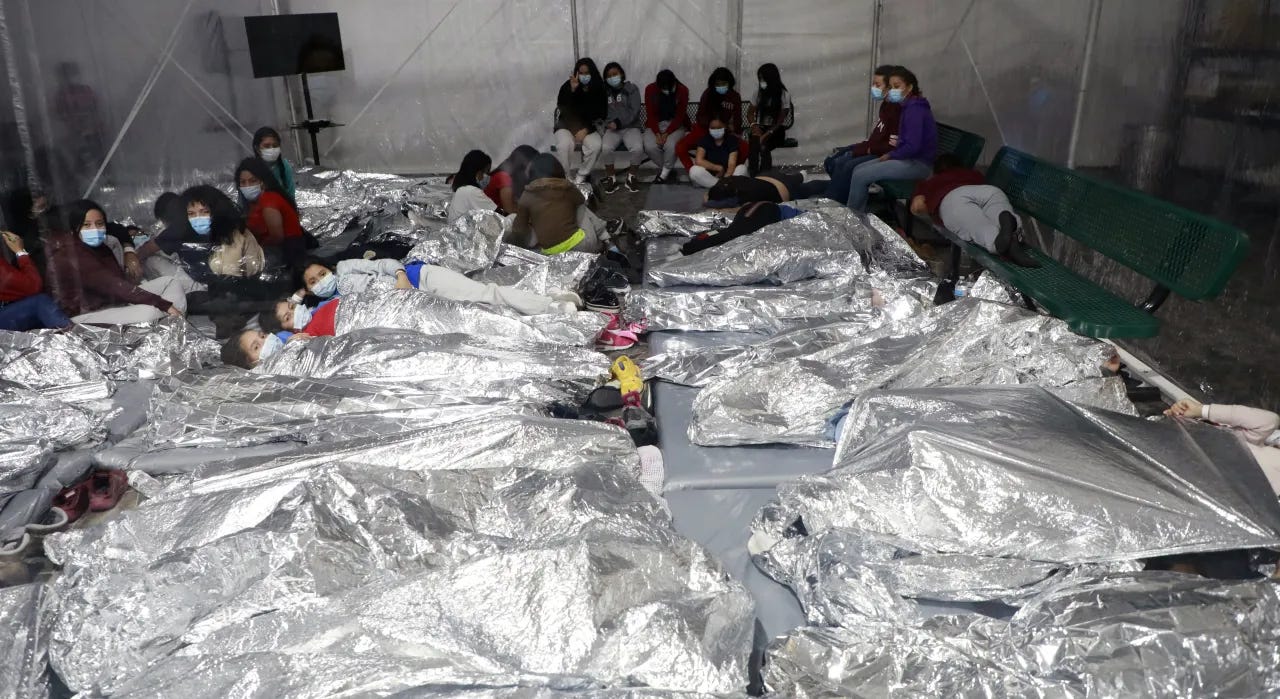
In a sworn declaration filed with the ACLU in December 2025, a woman identified as Josefina described what it’s like to be diabetic inside Camp East Montana, the largest immigration detention facility in America, built on Fort Bliss Army base with $1.24 billion in federal funding.
Josefina receives insulin at erratic intervals. Her blood sugar spikes and crashes. Staff do not respond to medical requests for days. People must faint or bleed before receiving attention.
Two hundred to three hundred people at Camp East Montana require daily insulin, according to Rep. Veronica Escobar, who visited in January 2026. The facility logged 140 emergency 911 calls in its first six months. Three people died in 44 days.
The bill that funded Camp East Montana — the One Big Beautiful Bill Act (OBBO), signed July 4, 2025 — also cut $887 billion from Medicaid over ten years. The Congressional Budget Office (CBO) projects 7.5 million people will lose Medicaid coverage, with 10 million total newly uninsured. Among them: lawful permanent residents, working immigrants who paid into the system for decades, and people whose insulin was covered last year and won’t be next year.
The same law that will make their insulin unaffordable built the facility that denies it to them.
This is the fiscal architecture of mass detention.
The One Big Beautiful Bill
On July 4, 2025, President Trump signed H.R. 1 — the “One Big Beautiful Bill Act” — into law. The bill passed through budget reconciliation, requiring only 51 Senate votes and bypassing the normal appropriations process.
What the bill contained — $165 billion in total DHS enforcement funding:
ICE: Detention capacity expansion: $45 billion ICE: Removal operations and hiring: $30 billion US Customs and Border Patrol (CBP): Border wall and infrastructure: $47 billion CBP: Hiring, facilities, technology: $18 billion Border technology and surveillance: $25 billion
ICE’s new annual budget: $27.7 billion (previous baseline: $10 billion — a 177% increase).
ICE became the highest-funded federal law enforcement agency in the United States — larger than the FBI ($10.1 billion), the Drug Enforcement Agency (DEA) ($3.3 billion), and the Bureau of Prisons ($8.5 billion) combined.
The funding runs through September 30, 2029. Four years. No annual reauthorization required. The machinery is shutdown-proof.
Where the Money Came From
The $165 billion didn’t appear from nowhere. Budget reconciliation requires offsets, and spending increases must be balanced by spending cuts elsewhere.
The One Big Beautiful Bill implements $2.5 trillion in offsets over a decade — the Committee for a Responsible Federal Budget’s breakdown. Here’s where the money came from:
Medicaid and Health Coverage: $1.1 Trillion Cut
The Congressional Budget Office estimates the final enacted law will cut federal Medicaid spending by $887 billion over ten years, including the Children’s Health Insurance Plan (CHIP) and Affordable Care Act (ACA) eligibility changes. Total health coverage cuts exceed $1.1 trillion.
The CBO projects that 7.5 million people will lose Medicaid coverage by 2034, with 10 million total newly uninsured from all health coverage changes. Seventy percent of those losing coverage lose it for procedural reasons — paperwork burdens, verification failures — not because they’re actually ineligible.
The mechanisms: prohibiting federal financial participation for anyone without a Social Security number, imposing new work requirements on adults without dependents, and cutting federal administrative cost-sharing. States must implement continuous eligibility verification. Federal contribution to state administrative costs drops from 50% to 25%
For the 1.4 million lawfully present immigrants projected by the Kaiser Family Foundation to lose health coverage under the bill’s provisions — refugees, asylum seekers, and humanitarian parolees — the cuts begin October 2026. For the millions more affected by new work requirements and verification burdens, coverage lapses are already happening. At Camp East Montana, 200-300 people who need daily insulin are held in a facility where, according to the ACLU, “staff do not respond to medical requests for days.”
SNAP: $206 Billion Cut
The Supplemental Nutrition Assistance Program — food stamps — was cut by $206 billion over the budget window through expanded work requirements, new state contribution requirements, and benefit increase restrictions.
Work requirements extended to ages 18-64 (up from 18-49)
Parents with children over 14 no longer exempt
Veterans, homeless individuals, and former foster youth lose exemptions
CBO projects 2.4-3 million Americans will lose benefits
The cuts took effect October 1, 2025. By November, food bank leaders were in what CNBC reported as “disaster response mode” — compounded by a government shutdown that froze SNAP payments. In Texas alone, 125,000 people per day ran out of EBT funds after November 1. Many of those losing benefits were working — just not enough hours to satisfy the new requirements.
Student Loans: $295 Billion Cut
The bill eliminates federal subsidized student loans entirely. For students from families earning under $60,000, this means interest begins accruing while they’re still in college — adding thousands to their long term debt burden. Graduate loan borrowing limits were imposed for the first time. The Secretary of Education’s authority to discharge loans was repealed.
Federal Work-Study programs were also eliminated. The program had employed 700,000 students annually in campus jobs.
The $295 billion reflects not just the elimination of subsidized loans but also the new graduate borrowing limits and repeal of the Secretary’s discharge authority — provisions that affect student debt across the income spectrum.
Tax Credits: Social Security Number Requirements
The Earned Income Tax Credit and Child Tax Credit — programs that lifted millions of working families above the poverty line — now require Social Security numbers for all household members.
Mixed-status families, where citizen children have undocumented parents, lose eligibility.
An estimated 4.5 million children in citizen-and-immigrant families affected.
The Direct Trade-Off
Let’s be precise about the mathematics.
Budget reconciliation required offsets for the bill’s entire spending side. Those offsets totaled $2.5 trillion over a decade:
Health coverage cuts (Medicaid/CHIP/ACA): $1.1 trillion
Clean energy tax credit repeals: $540 billion
Student loan program cuts: $295 billion
SNAP cuts: $206 billion
Other revenue and offsetting receipts: $346 billion.
Those offsets funded both the enforcement expansion and $4.5 trillion in tax cuts — which is why the CBO scored the bill as adding $3.4 trillion to the deficit despite the “savings.” The social safety net was dismantled to fund a detention system and a tax cut, and the deficit exploded anyway.
Here is where the enforcement money went:
DHS enforcement allocation: $165 billion
Private prison contracts (CoreCivic + GEO): ~$4 billion/year × 4 years = $16 billion
Warehouse conversion program: $38.3 billion planned
Military base detention construction: $10 billion (via Navy)
Deportation fleet expansion: $4.5 billion in contracts.
The healthcare, food, and education cuts alone — $1.6 trillion — dwarf the enforcement allocation ten to one. The detention system didn’t even require all the money taken from the safety net. Most of it went to tax cuts for the wealthy.
The subsidized student loan that would have helped a first-generation college student. The Medicaid coverage that would have paid for a diabetic’s insulin. The SNAP benefits that would have fed a veteran’s family. All cut in the same bill that funded Camp East Montana and Acquisition Logistics LLC.
These aren’t metaphors. They are people reduced to line items.
Who Benefits
The money flows through specific channels to specific recipients.
The Private Prison Industry
Billions go to processing and detention facilities operators.
CoreCivic:
ICE revenue doubled: $120M (Q4 2024) → $245M (Q4 2025)
Contract value expected to reach $680+ million
Stock price increase: 47% since January 2025
GEO Group:
2025 revenue: $2.63 billion (+6%)
Net income: $254 million (vs. $32 million in 2024)
That’s an eightfold profit increase
Acquisition Logistics LLC:
$1.24 billion contract for Camp East Montana
39 employees, registered at a residential address
No prior detention experience
Previous largest contract: $16 million
The Deportation Flight Industry
Nearly 4 billion goes to the companies that operate the deportation flights:
CSI Aviation: Up to $3.6 billion (5-year contract)
Salus Worldwide Solutions: $915 million (no prior federal experience)
Daedalus Aviation: $140 million for 6 Boeing 737s (company established February 2024)
Both Salus and Daedalus share the same principals: William Allen Walters III and Taundria Cappel. Neither company existed as a federal contractor before 2024.
The Surveillance Contractors
Nearly 6 billion goes to the companies that operate the surveillance infrastructure:
Palantir: $5.9 billion in DHS surveillance technology allocation
BI Incorporated (GEO subsidiary): $121 million skip-tracing contract
Various biometric/facial recognition vendors: Contracts under GSA schedules
The fiscal architecture creates a closed loop: cut social programs, fund enforcement, award contracts to companies, those companies profit, they lobby for more funding → repeat.
The 308% Increase
The $45 billion detention capacity earmark represents a 308% increase over ICE’s FY2024 detention budget.
What $45 billion builds:
23 warehouse mega-centers (planned capacity: ~100,000)
3 “giga-jails” in Texas, Georgia, Mississippi (8,500 beds each)
6+ military base detention facilities
Reopening of 16 shuttered state prisons
Expansion of existing private prison capacity
The goal: 135,000 detention beds by 2029.
The entire federal prison system currently holds 155,000 people. By 2029, ICE detention capacity will approach the scale of the entire Bureau of Prisons — built in four years with money taken from healthcare, food assistance, and education.
Budget Reconciliation: The Bypass
Why use budget reconciliation?
Normal appropriations require 60 Senate votes to overcome a filibuster. Reconciliation requires only 51 — a simple majority.
The trade-off: reconciliation bills must be deficit-neutral over the budget window. Spending increases require spending cuts.
This created the direct linkage: the bill’s spending — enforcement, tax cuts, and more — required $2.5 trillion in offsets. Medicaid, SNAP, student loans, and clean energy credits were the targets.
The Committee for a Responsible Federal Budget called the accounting gimmicks in OBBA maneuvers that “would make Enron executives blush.” The CBO scored the bill as adding $3.4 trillion to the deficit over 10 years despite the “mandatory savings” — the cuts to social programs offset enforcement spending, but tax cuts elsewhere blew up the deficit.
The reconciliation process also limited oversight. Normal appropriations involve committee hearings, amendments, and debate. OBBA passed in 72 hours — from House passage (July 3) to presidential signature (July 4).
Seventy-two hours to transfer $165 billion from healthcare and education to enforcement and detention.
The Territory Impact
U.S. territories faced the sharpest structural blow.
Unlike states, the territories operate under Medicaid funding caps — fixed annual allotments that don’t adjust for population or need. Puerto Rico receives $3.5 billion per year at a temporarily elevated 76% federal match rate. The other territories — United States Virgin Islands ($142 million), Guam ($148 million), American Samoa ($86 million), the Northern Mariana Islands ($68 million) — operate under caps so low they routinely exhaust federal funds before the fourth quarter.
OBBA didn’t directly cut territory funding — it did something worse. It failed to address the funding cliff approaching in FY 2028, when Puerto Rico’s federal match rate drops from 76% to 55% and its allotment is recalculated from a much lower base. The projected shortfall: $1.5-2 billion per year for Puerto Rico alone. If treated like a state, Puerto Rico’s match rate would be 83%.
Delegate Stacey Plaskett (D-USVI) warned that the Virgin Islands government must “act creatively to remedy impacts of federal cuts locally.” The Northern Mariana Islands declared a “very dire fiscal crisis.”
The territories have no voting representation in Congress — they had no say in the bill that preserved their discriminatory funding structure while allocating $165 billion to enforcement. American citizens who cannot vote for president subsidized the detention system that holds people awaiting deportation to countries they fled.
The Self-Funding Mechanism
OBBA doesn’t just cut programs to fund enforcement. It creates a self-perpetuating revenue stream.
Immigration fees:
Apprehension fee (charged to arrestees): $5,000
Asylum application fee: $100
Temporary Protected Status registration: $500
Visa fee increases across all categories
These fees flow directly to ICE operations. The people being detained fund their own detention.
Detained labor:
Goodluck Nwauzor was a Nigerian asylum seeker held at GEO Group’s Northwest Detention Center in Tacoma, Washington for eight months. He scrubbed showers for $1 a day. “I need the money desperately,” he testified. “I have no choice.”
That wasn’t a figure of speech. GEO’s facilities ran on detained labor. At Tacoma, detained people performed virtually all non-security work: cooking meals, washing laundry, cleaning toilets, buffing floors, collecting garbage, maintaining the building. GEO estimated the work replaced 85 full-time employees. Washington’s minimum wage is $16.66 an hour. GEO paid $1 a day.
At CoreCivic’s Stewart Detention Center in Georgia, Wilhen Hill Barrientos — another asylum seeker — prepared meals for 2,000 people daily, working eight- to nine-hour shifts, seven days a week, for $4 to $5 a day. When he filed a grievance about working while sick, CoreCivic placed him in medical segregation for over a month. He was told that if he refused to work, he’d be put in solitary.
The coercion was structural. Plaintiffs in the Tacoma case alleged that GEO deliberately kept food and hygiene supplies inadequate so detainees would have to work to buy basics at the commissary — a closed economic loop where the company created the desperation it then exploited. At GEO’s Aurora facility in Colorado, a federal judge found that GEO threatened detainees with solitary confinement for refusing unpaid “Housing Unit Sanitation” duties and called the company “deceptive” in its attempts to avoid trial. That case — with a class of over 60,000 detained workers — alleges violations of the federal Trafficking Victims Protection Act. The human trafficking statute.
In January 2025, the 9th Circuit affirmed a $23 million judgment against GEO in the Tacoma case — $17.3 million in back wages for 10,000 detained workers and $5.9 million to Washington State. GEO’s response: it could “pay the Judgments twenty times over.” The penalty was less than 1% of its annual revenue. The DOJ filed in GEO’s defense, arguing that federal immigration policy should preempt state wage law. The 9th Circuit rejected that argument.
Here is the constitutional paradox: immigration detention is civil, not criminal. These people have not been convicted of crimes. The 13th Amendment prohibits involuntary servitude “except as punishment for crime” — an exception that, by its own terms, should not apply to civil detainees. They should have stronger protections against forced labor than convicted prisoners. Instead, their ambiguous legal status and limited access to counsel leave them with weaker ones.
As detention capacity expands from 41,500 beds to 135,000, so does the labor pool. GEO halted the Tacoma work program after the verdict rather than pay minimum wage — then hired outside contractors, proving the labor had genuine market value. At the new mega-facilities, with 7,000 to 10,000 people per site, the math is straightforward: replace hundreds of employees with detained workers at a dollar a day.
The system is designed to pay for itself with the people it captures.
What $165 Billion Buys
Here is what $165 billion in enforcement funding purchases:
Personnel:
ICE workforce: 10,000 → 22,000+ (120% increase)
287(g) agreements: 135 → 1,001 (641% increase)
Military lawyers as immigration judges: 600
DOD civilian detailees: 500+
National Guard deployment: up to 20,000 troops
Physical infrastructure:
Warehouse mega-centers: 23 planned
Military base detention sites: 6+ operational
Private prison expansions: dozens of facilities
Giga-jails: 3 under construction
Detention beds: 41,500 → 135,000 authorized
Transportation:
Deportation flights: 450/month → 1,464/month peak
Boeing 737 fleet: 6 aircraft
Military deportation flights: 68+
ICE Air domestic transfers: 5,322 (Jan-Sep 2025)
Technology:
Palantir surveillance systems: $5.9 billion
Biometric collection expansion
Facial recognition deployment
License plate reader networks
Social media monitoring
This is the largest law enforcement expansion in American history — a detention system approaching the scale of the federal prison system, built in four years, funded by the dismantling of the social safety net.
The Comparison
ICE’s new annual budget of $27.7 billion exceeds the FBI ($10.1 billion), the DEA ($3.3 billion), and the Bureau of Prisons ($8.5 billion) combined. It is now the highest-funded law enforcement agency in the country by a factor of nearly three.
Put the four-year enforcement allocation in annual terms: Roughly $41 billion per year on DHS enforcement, compared to $74 billion on federal K-12 education and $30 billion on federal student aid administration. The government will spend more per year on immigration enforcement than on student aid. The detention capacity allocation alone ($45 billion over four years) exceeds total federal student aid spending over the same period.
America is building more detention beds than college classrooms.
The Pattern Across History
This isn’t unprecedented.
The 1994 crime bill cut education and social spending to fund prison construction. The result: mass incarceration that imprisoned 2 million people, disproportionately people of color.
Reagan’s 1980s war on drugs shifted money from addiction treatment to law enforcement. The result was prison populations that quadrupled.
Every mass incarceration system in American history has been funded by cutting programs that help people and redirecting money to programs that cage them.
OBBA is the same pattern at new scale: $165 billion, four-year runway, shutdown-proof, reconciliation-passed, oversight-bypassed.
The question isn’t whether America can afford healthcare, education, and food assistance. The question is what America chooses to buy instead.
Inside the Machine
Fernando Gomez Ruiz is a father of two who lived in Los Angeles for 22 years before ICE detained him. At the California City Detention Facility, he was repeatedly denied insulin. His blood sugar climbed. A foot ulcer went untreated. A federal judge eventually ordered ICE to provide constitutionally adequate medical care and appointed an independent monitor.
At Camp East Montana, Josefina still waits for insulin at erratic intervals. Francisco Gaspar-Andrés, 48, didn’t wait long enough — he died of liver failure on December 3, 2025, after weeks of inadequate medical care. Geraldo Lunas Campos, 55, died January 3, 2026. The county medical examiner ruled it a homicide.
The facility that holds them cost $1.24 billion. Each deportation flight costs $200,000. The system that processes them requires the labor of 22,000 ICE employees.
Camp East Montana sits on land that held Japanese immigrants during World War II under the Alien Enemies Act. The same legal authority the current administration has invoked.
The fiscal architecture is complete. The money flows from programs that keep people healthy to programs that cage them. From the social safety net to the detention net. The Medicaid cut and the detention bed are line items in the same bill, passed on the same day, signed by the same hand.
This is what $165 billion buys.
Series: After the Arrest
This is Part 4 of a 7-part series tracing what happens after ICE operations disappear from the cameras.
Autopsy Shopping — One came back homicide. The next body went somewhere else.
1,500 Miles in 24 Hours — The transfer system that turns an arrest into a disappearance
The Tent City and the Warehouse — Inside the facilities America is building to hold 135,000 people
The $165 Billion Machine — How Congress cut student loans to fund detention ← You are here
The Closed Loop — One company monitors, hunts, and detains. Its executives run ICE.
The Darkness — The system wasn’t designed to fail oversight. It was designed to exist without it.
Making It Visible — The journalists, whistleblowers, and communities forcing the system into the light
Sources
OBBA Legislative Analysis
CBO: Estimated Budgetary Effects of Public Law 119-21 (Publication 61570)
CBO: Public Law 119-21, Medicaid Supplemental Estimate (Publication 61837)
CBO: Distributional Effects of Public Law 119-21 (Publication 61367)
CRFB: What’s In the One Big Beautiful Bill Act? (July 22, 2025)
Social Program Cuts
KFF: Allocating CBO’s Estimates of Federal Medicaid Spending Reductions
Center for Budget and Policy Priorities: By the Numbers — SNAP Cuts
Brookings: SNAP cuts will significantly impair recession response
CNBC: Food banks in ‘disaster response mode’ (November 7, 2025)
NPR: Food banks brace for impact as SNAP cliff looms (October 29, 2025)
Enforcement Spending
American Immigration Council: Detention Expansion Report (January 2026)
Brennan Center: Big Budget Act Creates a ‘Deportation-Industrial Complex’ (August 13, 2025)
Brennan Center: Budget Bill Massively Increases Funding for Immigration Detention
Private Prison Financials
Contractor Analysis
Detention Conditions and Medical Neglect
El Paso Matters: TB and COVID at Camp East Montana (February 9, 2026)
KTEP: Dozens of 911 Calls at Detention Camp (February 23, 2026)
Sen. Ossoff: Medical Neglect in Immigration Detention (October 2025)
ACLU: Gomez Ruiz v. ICE — Insulin Denial at California City Detention
KFF: 1.4 Million Lawfully Present Immigrants Expected to Lose Health Coverage
Historical Context
For the series documenting how this enforcement apparatus was built, see The Gamergate Army Gets Badges and Guns.
Awesome. They cut things that help people in favor of things that hurt them. I fail to understand this situation. Why do we want to pay to cram these folks into concentration camps for an indefinite amount of time? And now they're being forced into slave labor. Disgusting.