

Part 7 of 8: The Gamergate Army Gets Badges and Guns
Previously: Part 6 documented Stephen Miller—the man who built the deportation machinery, who screamed at ICE directors demanding “quantity over quality,” who vetted officials like Gregory Bovino for their willingness to use force. Steve Bannon built the cultural pipeline. Miller built the operational one.
This part documents what happened next: the pipeline entered mainstream politics.
The Intercept, July 2024:
“Nick Fuentes’s Groypers No Longer Pariahs Among Mainstream Republicans.”
Born 1998. Came of age during Gamergate. Radicalized through /pol/. Openly denies the Holocaust. Advocates white nationalism. Uses “ironic” Nazi references.
And by 2024, members of Congress were speaking at his conferences.
This is how the pipeline completed. Not through stealth. Through force.
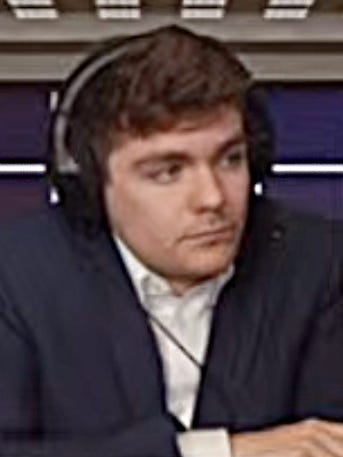
August 18, 1998: Born Digital
Nick Fuentes was born in Chicago six weeks before Google incorporated.
He’s never known a world without the internet. No analog childhood. No pre-social media adolescence.
The timeline:
2003: 4chan founded. Fuentes is five years old.
2011: /pol/ board created. Fuentes is thirteen.
2014: Gamergate. Fuentes is sixteen.
2016: Trump campaign. Fuentes is seventeen, eighteen.
By the time Fuentes started livestreaming at nineteen, he’d spent his entire adolescence immersed in the culture this series has documented. Platform architecture became radicalization infrastructure became political mobilization became mass violence—and he’d been present for all of it.
He understood something the older alt-right missed: you don’t march in Charlottesville. You infiltrate CPAC.
2017-2019: Building the Army
At nineteen, Fuentes launched “America First with Nicholas J. Fuentes” on YouTube.
The format was pure streaming culture. Three to four hour livestreams. Rapid-fire jokes, memes, audience interaction. Gaming stream aesthetics applied to politics.
But the content was explicitly white nationalist. Demographics as destiny. Christian nationalism. Anti-immigration. Holocaust denial disguised as “just asking questions.”
Unlike older white nationalists who tried to sound academic, Fuentes sounded like a gamer. He used Twitch culture, YouTube algorithms, and chan board tactics. His audience was young men—teenagers into their twenties—who’d grown up in the same pipeline.
The ADL described him as attempting to “sanitize extremism by wrapping it in the conservative flag.”
That undersells the strategy. Fuentes wasn’t sanitizing anything. He was forcing conservatives to choose: embrace explicit racism or be called weak.
October 2019: The Groyper Wars
The Groyper Army emerged with a coordinated campaign to hijack mainstream conservative events.
The strategy was pure Gamergate.
Identify targets: Charlie Kirk’s Turning Point USA, Ben Shapiro, Dan Crenshaw, Don Trump Jr.
Coordinate via Telegram and /pol/: which event, what questions, who asks.
Infiltrate Q&A sessions: line up during question time.
Ask “provocative questions” designed to embarrass: “Why do you support non-white immigration?” “Are you okay with America becoming minority white?” “Why do you support Israel over America?”
Force the choice: either embrace white nationalism or reject questions and look weak.
This is exactly how Gamergate worked. Coordinated harassment disguised as “just asking questions.” Forcing targets to respond to framing they didn’t choose. Making reasonable responses look like evasion.
At a Don Trump Jr. book event in Los Angeles, November 2019, Groypers disrupted so aggressively that Trump Jr. ended the event early.
Mainstream conservative response was telling. Charlie Kirk called them “bad faith actors.” Ben Shapiro condemned them. Turning Point USA banned Groypers from events.
But many hesitated. Because the Groyper questions—about immigration, demographics, Israel—touched on tensions within conservatism that mainstream figures couldn’t resolve without alienating part of their base.
The Groyper Wars forced conversation rightward. Topics that were previously fringe became debatable within conservatism.
And Fuentes’s profile grew. Media coverage. Thousands recruited to the Groyper Army. The harassment campaign worked.
February 2020: AFPAC
Fuentes launched the America First Political Action Conference—AFPAC—deliberately scheduled the same weekend as CPAC, in the same city.
The positioning was strategic. AFPAC as “real conservatism” versus CPAC as “Conservatism Inc.” Explicitly white nationalist versus multiracial conservatism. Younger, edgier, more “based” versus establishment.
The speakers included white nationalists, Holocaust deniers, and far-right livestreamers. The crowd was young men, chan culture fluent, radicalized online.
CPAC tried to ignore them. But AFPAC’s existence created a problem: any conservative speaker who appeared at CPAC but not AFPAC could be accused of rejecting “real” America First conservatism.
The Groyper strategy was working. Pull the Overton window rightward through embarrassment and pressure.
February 2022: The Congresswoman
On February 25, 2022, Representative Marjorie Taylor Greene of Georgia spoke at AFPAC III in Orlando.
A sitting member of Congress. Speaking at a conference organized by a Holocaust denier. With white nationalists in the audience chanting “Putin! Putin!”—Russia had invaded Ukraine the day before.
Greene’s response when criticized:
“I do not know Nick Fuentes. I’ve never heard him speak. I went and spoke at his event, and I spoke to a group of young Republicans.”
The claim was absurd. She spoke at his conference but didn’t know who he was. But the response revealed the strategy: plausible deniability while mainstreaming white nationalist infrastructure.
Republican response was mixed. Mitch McConnell condemned it. Kevin McCarthy criticized it. But no formal consequences. Greene kept committee assignments. No expulsion efforts.
The pattern was established. You could speak at a Holocaust denier’s conference and remain a Republican in good standing.
November 22, 2022: Mar-a-Lago
Nine months after MTG spoke at AFPAC III, the infiltration reached its apex.
The architect was Milo Yiannopoulos.
The same man who’d served as Breitbart’s bridge to Gamergate in 2014-2017—the “Dangerous Faggot” who’d pioneered harassment-as-politics on college campuses before his fall over pedophilia comments—had reinvented himself as a manager for problematic celebrities. His client list included Kanye West.
When Kanye—in the midst of a public spiral that had included wearing a “White Lives Matter” shirt and telling Tucker Carlson he was “going death con 3 on JEWISH PEOPLE”—requested a meeting with Donald Trump at Mar-a-Lago, Milo saw an opportunity.
He told NBC News he was “the architect” of what happened next.
Milo arranged for Karen Giorno, a former Trump 2016 campaign adviser, to pick up Kanye in Miami. He told her Kanye would be with two people, including someone named “Nick.” He didn’t give a last name.
Nick Fuentes.
Milo later admitted to NBC News that he’d orchestrated it “just to make Trump’s life miserable,” knowing the story would leak. “The master troll got trolled,” a longtime Trump adviser told NBC.
But that framing obscures what actually happened: the man who’d built the first bridge from chan culture to conservative politics in 2014 had just built another one—from white nationalist media figure to former president’s dinner table.
At 8 p.m. on November 22, Trump made his entrance. According to Fuentes, the former president sat down with West, Fuentes, and Yiannopoulos at a reserved patio table. The dinner lasted approximately three hours.
Trump, who had announced his 2024 campaign one week earlier, sat with a rapper in an antisemitic breakdown, a 24-year-old Holocaust denier, and the disgraced provocateur who’d engineered the meeting.
The next day, the story broke. Trump’s defense was immediate: he didn’t know who Fuentes was. Kanye brought him. He was just being polite to a guest.
The defense was implausible. Trump’s own social media team had been tracking Fuentes for years. The Secret Service would have flagged anyone entering Mar-a-Lago. And Fuentes wasn’t exactly obscure—he’d been banned from every major platform, designated an extremist by the ADL and SPLC, and covered extensively in media Trump consumed.
But the implausibility was the point. Trump didn’t need to convince anyone he hadn’t known. He needed to provide a script for supporters who wanted permission to not care.
The Republican response was telling. Some condemned it—Mitch McConnell, Mitt Romney. Others criticized without naming Trump. Most said nothing.
No one expelled Fuentes from Mar-a-Lago mid-dinner. No one refused to seat him. No one treated his presence as disqualifying.
Fuentes livestreamed that night, ecstatic. “We had a very productive meeting,” he said. He’d proved what the Groyper strategy was designed to prove: push hard enough, long enough, and the door opens.
The ADL’s response: “White supremacist Nick Fuentes met with former President Trump at Mar-a-Lago. This is exactly why it’s so important for political figures to unequivocally reject extremists.”
Unequivocal rejection never came. Trump distanced himself slightly but never condemned Fuentes directly. Never said the ideology was wrong. Never said the movement should be shunned.
The white nationalist movement took that as permission.
2024-2025: The Bridge Builder Returns
Milo Yiannopoulos didn’t disappear after Mar-a-Lago. He adapted.
In 2024, he founded Tarantula, a talent management company for “scandal-prone celebrities.” The client list read like a who’s who of problematic figures: Kanye West, Marjorie Taylor Greene, Martin Shkreli.
But the real business, according to a Hollywood Reporter investigation, was something else.
Yiannopoulos told reporters that Tarantula had two financial backers—one from the music industry, one “a Trump adviser from inside the Beltway.” The company, he said, was helping place candidates in the second Trump administration.
The targets: the Departments of Homeland Security and Health and Human Services.
On his X account, Tarantula announced it “welcomes enquiries from professionals seeking appointments in the upcoming administration” and offered “advisory services and introductions.”
On election night 2024, according to the Hollywood Reporter, Yiannopoulos received a phone call from “a member of Donald Trump’s family” thanking him for helping the campaign “smear once ‘useful idiots’—Trump allies no longer wanted in his orbit.”
The man who built the Gamergate-to-politics bridge in 2014, who engineered the Fuentes dinner in 2022, was now placing personnel in the department that would run deportation operations.
The same department that, months later, would recruit with Halo memes. “DESTROY THE FLOOD.” Gaming aesthetics targeting the exact demographic Milo first activated a decade earlier.
He wasn’t just a historical figure in the pipeline. He was actively connecting the endpoints—helping place the people who would recruit the army he’d helped politicize.
The Gamergate army doesn’t just get badges and guns. Milo is helping hand them out.
November 6, 2024: Victory
Two years after the Mar-a-Lago dinner, the man who dined with Nick Fuentes—with Milo’s help—won the presidency.
The morning after Trump’s 2024 victory, Fuentes posted to X:
“Your body, my choice. Forever.”
The phrase exploded. Fewer than 20 mentions per day before the election. Over 2,000 per day after. Facebook recorded 52,000 posts within 24 hours.
Gen Z boys chanting it at girls in schools. Women receiving rape threats for criticizing it on social media.
This was the manosphere ideology documented in Part 4—the same sexual entitlement that motivated Elliot Rodger and Alek Minassian—now a viral celebration of political victory.
The demographic spreading it: young men, 18-34, online culture fluent, anti-feminist, “anti-woke.”
The same demographic cultivated through the pipeline this series has documented.
The same demographic DHS would recruit from months later.
2025: The Pipeline Completes
When the Department of Homeland Security launched its recruitment campaign in 2025, they spoke the language the Groyper Army spoke.
Gaming aesthetics. Meme warfare. Dehumanizing imagery. Immigrants framed as parasites requiring extermination.
White House Deputy Communications Director Kaelan Dorr made the strategy explicit:
“The arrests will continue. The memes will continue.”
They weren’t embarrassed by comparison to chan culture. They were claiming it.
Gregory Bovino—the official documented in Part 1, highest use-of-force ratio in Border Patrol, admitted perjurer, now recruiting 10,000 new agents—selects from the demographic Nick Fuentes spent a decade cultivating.
The pipeline that began with Christopher Poole’s design choices in 2003 now terminates in federal employment.
January 2026: The Movement’s Music
Six days after Renee Good died, PBS NewsHour documented what federal messaging had become.
ICE posts featured “We will have our home again”—a white supremacist song favored by the Proud Boys. The Department of Labor released videos declaring “One homeland, one people, one heritage.” Federal social media accounts pushed QAnon’s “Trust the plan” imagery.
Cynthia Miller-Idriss, who directs the Polarization and Extremism Research Innovation Lab at American University, identified the pattern: coordinated propaganda using the exact rhetoric linked to terrorist attacks in Pittsburgh, El Paso, Buffalo, Christchurch, and Oslo.
The same attacks this series documented in Part 5.
The same rhetoric the Groyper Army normalized.
The same aesthetic language Milo helped translate from chan boards to conservative politics a decade earlier.
Now it wasn’t fringe internet culture appropriated by federal agencies. It was identity. The Proud Boys’ music in official recruitment. White nationalist slogans in Department of Labor videos. The movement hadn’t infiltrated the government—it had become the government’s voice.
The Pattern Completes
Nick Fuentes was born in 1998—the same year as the El Paso shooter. He came of age in the same pipeline. He understood something the older alt-right missed: don’t march in Charlottesville. Infiltrate CPAC.
By 2024, the infiltration had succeeded. By 2025, the government was recruiting using the aesthetics his generation invented.
The Title
“The Gamergate Army Gets Badges and Guns.”
In 2014, Steve Bannon looked at Gamergate and said: “You can activate that army.”
In 2025, Gregory Bovino recruits 10,000 agents from the demographic that army became.
The title is no longer metaphor.
Next: Part 8, “Made of Sunshine”—What the pipeline kills. Renee Nicole Good’s final words, and what they mean for what comes next.
Sources and Further Reading
Timeline Events
November 10, 2019: Groyper War erupts at UCLA Trump Jr. event
November 22, 2022: Trump hosts Fuentes and Kanye at Mar-a-Lago
March 27, 2025: “The arrests will continue, the memes will continue”
Investigative Journalism
The Intercept (July 2024). “Nick Fuentes’s Groypers No Longer Pariahs Among Mainstream Republicans.”
NBC News. “The inside story of Trump’s explosive dinner with Ye and Nick Fuentes” — Documents Milo Yiannopoulos as “the architect” who engineered Fuentes’s access to Trump
Rolling Stone. “Trump’s Dinner Disaster Was Apparently a Trap by Two Fascists”
Hollywood Reporter (November 2024). “The Milo Yiannopoulos Makeover: The Alt-Right’s Fallen Poster Boy Is Back for Trump 2.0” — Documents Tarantula company placing candidates in DHS and HHS
PBS NewsHour (January 2026). “Trump administration posts echo rhetoric linked to extremist groups” — Documents Proud Boys song in ICE recruitment, “One homeland” slogans in federal messaging
Research Organizations
Series Navigation
Part 1: “The Hammer” — Gregory Bovino’s 12-month escalation
Part 2: “The Four Thresholds” — When law enforcement becomes paramilitary
Part 3: “The Architecture of Anonymous” — Platform design as radicalization infrastructure
Part 4: “You Can Activate That Army” — Gamergate, manosphere, and political mobilization
Part 5: “Subscribe to PewDiePie” — Chan culture and mass violence
Part 6: “Quantity Over Quality” — Stephen Miller and the deportation machine
Part 7: “No Longer Pariahs” — You are here
Part 8: “Made of Sunshine” — What the pipeline kills
This is Part 7 of “The Gamergate Army Gets Badges and Guns,” a free 8-part series.
The complete timeline—4,000+ documented events from 1971-2026—is available at capturecascade.org/viewer.