

The Data Center Wedge. The Michigan Primary Data Centers Built
Michigan's August 4 Senate primary is the first real test of whether data-center backlash moves votes. One township already won its fight. Another finds out after the ballots are counted.
Grand Traverse County has never been a proxy war for a data-center company before. That changes on August 4, and depending on how you count it, part of the fight is already over.
Michigan Democrats vote Aug 4 to pick a nominee for the state’s open U.S. Senate seat, choosing between Abdul El-Sayed, the former Michigan health director, and Haley Stevens, the three-term congresswoman who represents Oakland County. The winner faces Republican Mike Rogers, who is unopposed, in November. What makes this primary unusual — and worth watching well outside Michigan — is that a fight over where hyperscale data centers get built and who pays for the power they draw has become one of the defining issues separating the two candidates, tracked and reported by essentially every major outlet covering the race: CNBC, Bridge Michigan, Michigan Public, the Detroit News, Roll Call, Planet Detroit.
The campaign’s final days were increasingly dominated by a separate fight over Israel and antisemitism between the two candidates — a storyline that pulled national coverage in the race’s closing stretch. Data centers remain a real and independently documented axis of disagreement, addressed directly by both campaigns well before that fight broke out; the two threads run alongside each other, not in place of one another.
That’s new. Data-center siting fights have been a local-government story for two years now — planning commissions, zoning boards, utility rate cases, the occasional referendum. This appears to be the first time it’s shown up as a defining axis in a competitive statewide primary, with both candidates having to stake out positions and defend them in debates and interviews rather than leave it to a county commissioner.
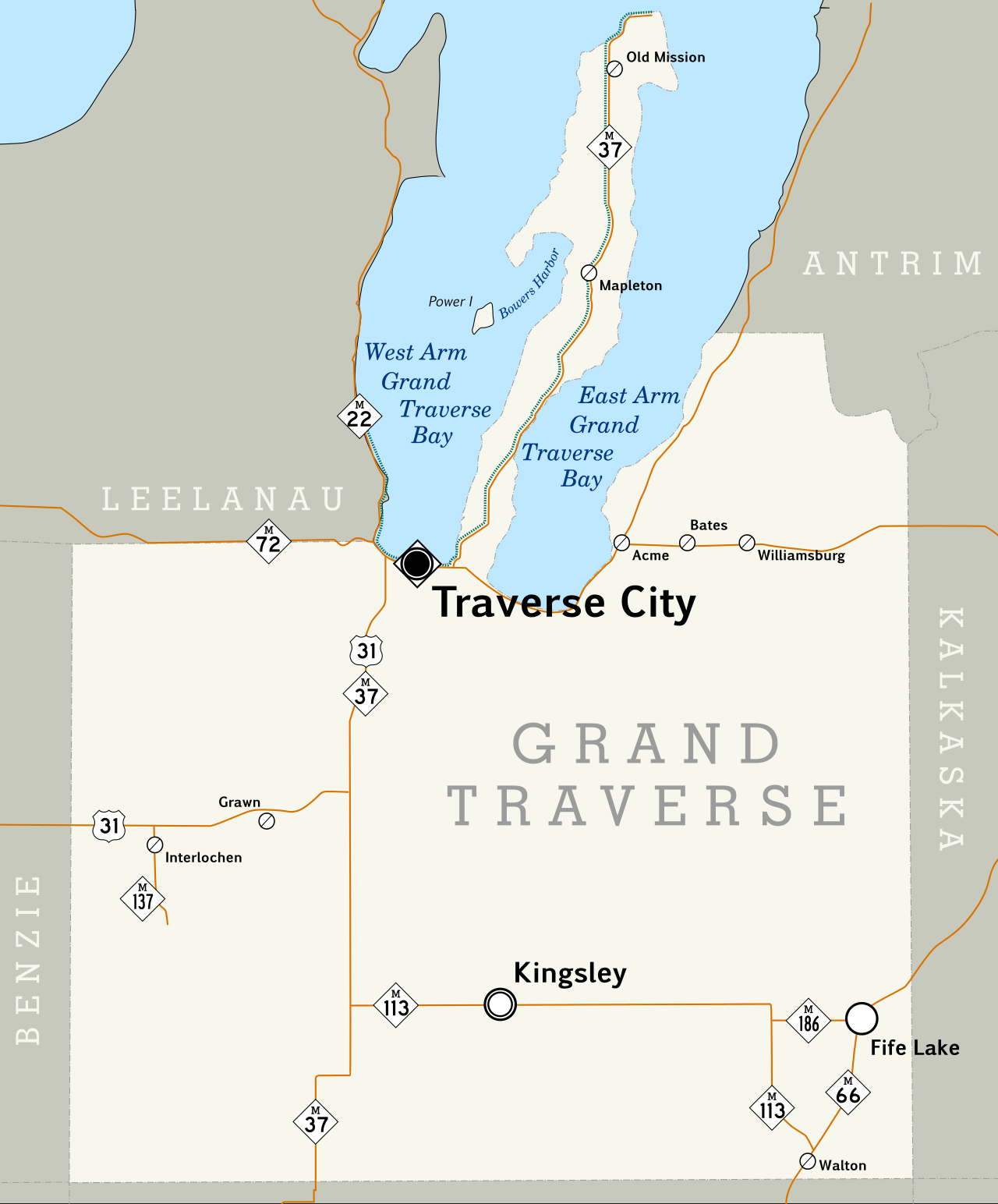
The reason it landed here specifically is Grand Traverse County, and specifically two places inside it: Garfield Township, which includes part of Traverse City, and neighboring Kalkaska. One of those fights is finished. The other doesn’t resolve until a week after Michiganders vote.
What already happened in Kalkaska
Start with the win, because it’s real and it’s over.
In late 2025, a company called Rocklocker LLC — a Traverse City-based subsidiary of the oil-and-gas firm Reefworks, operating jointly with an entity called Kalkaska Go — proposed a large data center on 1,440 acres of Michigan Department of Natural Resources land in Kalkaska County, roughly four times the 250-acre footprint of the Oracle/OpenAI “Stargate” project underway on the former Saline “Barn” site in Washtenaw County (see below). The plan included an on-site natural-gas power plant, carbon capture, and closed-loop geothermal cooling.
Residents showed up. A public forum on November 17, 2025 drew sustained opposition over electricity and water use and the environmental footprint of the gas plant. Three days later, Rocklocker withdrew the proposal outright. Company president Matt Rine put it in writing: “We heard you. That is why my company and Kalkaska Go will end its pursuit of a data center.” He added: “We sought public input because we want to be partners with the community we live and work in.” A planned follow-up meeting in neighboring Coldsprings Township was cancelled. Trade press (Data Center Dynamics) and local outlets (UpNorthLive, Interlochen Public Radio) all confirmed the withdrawal independently, and there’s no sign the project has come back since.
That’s a closed story, and it’s worth stating plainly what it shows: organized local opposition, applied early and loudly enough, can kill a hyperscale data-center proposal before it gets to a permit hearing. It doesn’t need a moratorium ordinance or a court fight. It needs enough residents at enough meetings that the company decides the fight costs more than the project is worth.
One more detail from Kalkaska matters for the primary framing, because it cuts against the instinct to read this purely as a Democratic-primary story. Ryan Wagner, the Kalkaska County Republican Party chair, spoke at an anti-data-center rally in Traverse City in April 2026. His quote, as recovered from the Drop Site/Barn Raiser reporting on the race: “I feed my kids off this land. I don’t want Big Tech to poison it.” A county GOP chair and the Democratic primary voters two townships over are, on this specific issue, saying close to the same thing — a big part of why this became a primary issue rather than staying a township-meeting issue.
What hasn’t happened yet, ten miles away
Garfield Township’s fight isn’t over — and won’t be by the time anyone votes.
Under the township’s current zoning ordinance, a data center needs only administrative approval — no special permit, no board hearing required. The Garfield Township Planning Commission voted in early July to recommend changing that: an ordinance amendment giving the township board the power to impose a temporary moratorium, up to 12 months and extendable to 18, on new data-center applications, permits, rezonings, and approvals. Hundreds of residents packed the July 8 hearing. Of roughly 40 people who spoke publicly, reporting found none opposed the moratorium; many wanted an outright ban.
No single company’s project drove that hearing — the moratorium is preemptive, aimed at forestalling something rather than answering a specific application already on file. But one is now in the pipeline: a developer has submitted a site-plan application for a small data center at a former Sara Lee plant site on Sybrandt Road, proposed as adaptive reuse of existing industrial buildings rather than new construction. Township planning director John Sych has confirmed the application is incomplete and can’t be considered for approval until updated engineering, lighting, and landscaping plans come in.
The Township Board is scheduled to hold a public hearing on the ordinance amendment on August 11 — a week after the primary — with a possible vote the same night. That vote would only grant the board the power to declare a moratorium in the future; actually imposing one on a specific project would take a separate, subsequent action. So the honest way to describe Garfield Township’s status on primary day is: unresolved, procedurally mid-fight, outcome unknown. Any coverage that treats this as a settled local win is ahead of the record. As of this writing, the board hasn’t voted.
That timing is itself a kind of frame. Grand Traverse County residents will cast primary ballots on a candidate for U.S. Senate one week before their own township board decides whether to give itself the authority to say no to the next data center. The electoral and local-government tracks are running on parallel, staggered clocks, and neither one waits for the other.
The candidates, and the binary that doesn’t hold up
It would be tidy to write this as El-Sayed versus Stevens, anti-data-center versus pro-data-center. It would also be wrong. Neither candidate supports an outright moratorium on data centers. The real divide is how aggressively each would regulate the industry that’s building them — not whether to allow them at all.
El-Sayed has been the more vocal and more specific of the two since January, when he released an eight-point “terms of engagement” framework for data centers: job guarantees, commitments from utilities not to pass construction costs onto ratepayers, community-benefit agreements, lower water-usage requirements, and compliance with state clean-energy law. He’s called the current buildout a “race to the bottom” and argued, per Bridge Michigan’s reporting, for regulating AI companies as public utilities, “similar to federal banking oversight” — language that puts him closer to Bernie Sanders-style public-ownership arguments than to a ban. His stated reasoning isn’t that data centers shouldn’t exist; it’s that developers and utilities have shown, in his words, “so little transparency” that residents have no reason to trust voluntary commitments.
Stevens has taken the more accommodating position, but it’s not silence on cost. Her stated top priority, per Bridge Michigan, is “making sure costs don’t go up for Michigan families and that we are protecting good-paying union jobs.” She’s argued AI companies “need to have real skin in the game in supporting our tax base and making sure that all Americans share in the wealth we’re seeing created,” and at a July debate she connected data-center construction to manufacturing jobs, framing growth and consumer protection as compatible rather than opposed. A quote attributed to her in an email statement to Barn Raiser — “we cannot allow utility companies like DTE to pass new costs onto consumers while these projects move forward” — names DTE Energy, the state’s largest utility, directly.
That DTE reference matters beyond the quote itself. DTE is the utility at the center of a separate, statewide rate fight — a $474.3 million rate-hike request tied to the timeline of a large Oracle/OpenAI data-center project in Saline Township, in Washtenaw County, roughly three hours south. No Grand Traverse-specific DTE rate case tied to the Traverse City fight has turned up in reporting; the cost-shift argument both candidates are gesturing at is a statewide mechanism, not a local one, and shouldn’t be conflated with the zoning fights in Garfield Township or Kalkaska, which are about land use and local control rather than rate cases.
So: not a moratorium candidate against a growth candidate. A candidate proposing utility-style regulatory enforcement against a candidate proposing cost-protection guardrails within continued growth. Both are running toward the issue, not away from it — which is itself the more interesting fact than who’s “for” or “against” data centers.
Polling on the primary has been volatile enough that neither position’s popularity is settled. Emerson College’s late-July poll had El-Sayed ahead of Stevens 54 to 39 percent; an earlier Detroit News/WDIV poll had shown Stevens with an edge. A mid-April Emerson poll, cited by CNBC, found 55 percent of likely Democratic primary voters opposed to data centers being built in or near their community, against 27 percent support — a lopsided number that helps explain why both campaigns have felt the need to address the issue directly rather than let it pass.
That polling gap is more striking set against the money. On their own campaign committees, El-Sayed has actually outraised Stevens — roughly $14.5 million to $11.9 million, per FEC filings through mid-July. Once outside spending is added, the picture flips hard: American Israel Public Affairs Committee’s super PAC, United Democracy Project, has put roughly $30 million into opposing El-Sayed and supporting Stevens, according to FEC filings reported by Al Jazeera and Bridge Michigan — UDP’s largest single-race investment on record. CBS News tallied Stevens’ campaign and the outside groups backing her at more than $61 million combined; El-Sayed’s campaign and its outside support came to roughly $15 million. Almost none of the outside money came from Michigan donors. If a four-to-one spending disadvantage were going to sink a candidate, the polling suggests it hasn’t yet — which makes this less a story about who has more money than about whether money still buys what it used to in a primary this online.
Not just Michigan
The pattern showing up around Traverse City has counterparts in at least three other states this cycle. In Texas — on track, per AP and Fortune reporting, to overtake northern Virginia as the country’s largest data-center market by 2030 — Democratic gubernatorial candidate Gina Hinojosa is campaigning against AI data-center buildout in rural Republican districts, hitting water and land use. Virginia Governor Abigail Spanberger made data centers’ grid demands a plank of her 2025 campaign, arguing tech companies should pay their “fair share.” In Georgia, Democrats Alicia Johnson and Peter Hubbard won Public Service Commission seats in 2025 running against sweetheart deals for developers paid for by resident rate hikes.
None of those races map exactly onto Michigan’s, but the shape repeats: an industry expanding faster than the zoning and utility-rate frameworks built for a slower-moving grid, landing in districts where residents notice their water pressure or their electric bill before they notice a press release about jobs. Michigan’s primary is simply the first place that pattern has fully surfaced inside a marquee statewide race.
What to watch after August 4
Whoever wins the Democratic nomination goes on to face Rogers in November, and the data-center question doesn’t go away either way. Garfield Township’s board still has to vote on August 11, and residents there will find out whether their planning commission’s recommendation becomes actual policy regardless of what happens in the Senate race. If the ordinance passes, Garfield Township joins Kalkaska as a place where organized local opposition changed the outcome. If it doesn’t, the administrative-approval pathway that let the Sybrandt Road application move forward with no board review stays open.
The broader question — whether opposition to data-center buildout is durable enough to move a statewide electorate, not just a township meeting — won’t have a clean answer on primary night either. A primary win for the more aggressively regulation-minded candidate would be suggestive, not dispositive; primaries turn on more than one issue, and El-Sayed’s and Stevens’ differences extend well past data centers. But the fact that both campaigns treated the issue as worth a detailed position paper, in a Senate primary, is itself the story.
Two years ago, the fight over what to do about a hyperscale data center belonged to a planning commission.
In Michigan this summer, it belongs to a U.S. Senate campaign — and to whoever shows up at the microphone in Garfield Township on August 11.
Sources
CNBC, “AI, data center fears could be key in closely watched Michigan Democratic Senate primary,” July 10, 2026
Bridge Michigan, “From AI to AIPAC: 6 issues defining Haley Stevens, Abdul El-Sayed race,” July 29, 2026
Michigan Public/NPR (Stateside), “How Michigan’s Democratic U.S. Senate candidates differ on immigration, healthcare, data centers,” July 25, 2026
Detroit News, “Michigan Senate hopefuls Stevens, El-Sayed differ on key issues,” July 25, 2026
Roll Call, “Contentious Democratic Senate contest dominates Michigan’s primary season,” July 28, 2026
Planet Detroit, “Why data centers are key issue in Michigan’s Democratic Senate primary,” June 11, 2026; “Senate candidate Abdul El-Sayed presents ‘terms of engagement’ for data centers,” January 8, 2026
Michigan Advance, “El-Sayed lays out policy ‘terms of engagement’ with AI data centers in U.S. Senate hunt,” January 2026 (date on this specific piece is a likely match, not fully confirmed — verify before publish); “Garfield Township inches closer to a possible data center moratorium,” July 9, 2026; “How easily could a big data center set up in northern Michigan?,” June 23, 2026
WJR-AM, “‘Race to the Bottom:’ MI Senate Candidate El-Sayed Pushes for Data Center Regulations,” June 9, 2026
9&10 News (WWTV/WPBN), “Garfield Township planners recommend moratorium power aimed at data centers after hundreds pack public hearing,” July 8, 2026
The Ticker (Traverse City), “Garfield Township Tees Up Data Center Moratorium; Incomplete Application Submitted for Project,” July 24, 2026
Charter Township of Garfield, Board Meeting Handouts, July 28, 2026 (official government record)
Data Center Dynamics, “Opposition leads developer to withdraw data center proposal in Kalkaska County, Michigan,” November 2025
UpNorthLive (WPBN/WGTU), “Proposed Kalkaska County data center halted after public feedback, company president says,” November 20, 2025; “Traverse City protest targets proposed data centers, citing land and water concerns,” April 13, 2026
Interlochen Public Radio, “Community input sought next week on idea for Kalkaska data center,” November 12, 2025
Drop Site News / Barn Raiser Media, “Data Centers Divide Democrats in Michigan Primary,” July 29, 2026 (content recovered via convergent search excerpting; primary text 403-blocked as of drafting — see fact-check flags; no accessible URL to link)
Baltimore Sun (AP wire), “Democrats seize on AI data center backlash that’s dividing rural Republicans in places like Texas,” July 23, 2026
Fortune, “‘There are no rules. It is the wild west of data centers’: Texas Democratic candidates pounce on AI data center projects in Republican strongholds,” July 24, 2026
Emerson College Polling, Michigan 2026 Senate primary poll, fielded July 26–27, 2026, released July 30, 2026
Ballotpedia, “United States Senate election in Michigan, 2026 (August 4 Democratic primary)”
Al Jazeera, “How much has AIPAC spent against Michigan’s Abdul El-Sayed, and why?,” August 2, 2026 (UDP total spending figure)
CBS News, “In final Michigan Senate Democratic debate, Stevens and El-Sayed spar over outside spending and personal attacks,” July 27, 2026 (combined per-candidate spending totals)
FEC filings, El-Sayed for Michigan and Stevens for Michigan campaign committees, through July 15, 2026 quarterly filing; United Democracy Project, FEC Committee ID C00799031 (candidate committee and independent-expenditure totals)
Bridge Michigan, “Outside spending floods Michigan’s US Senate race, most for Haley Stevens,” July 13, 2026 (UDP support/oppose spending breakdown)