

Making It Visible: Bringing the Detention Crisis Into the Light
The journalists, whistleblowers, and communities forcing the system into the light
The journalists, whistleblowers, and communities forcing the system into the light
Part 7 of 7 in the “After the Arrest” series
The system was designed for darkness.
Military jurisdiction to avoid civilian oversight. Autopsy shopping to prevent homicide rulings. Witness deportation to eliminate testimony. Congressional lockouts to block investigation. Court orders ignored by the dozen.
And yet we know.
We know about the homicide at Camp East Montana. We know about the 96 court order violations in Minnesota. We know about the $1.24 billion contract awarded to a company with 39 employees and a residential address. We know about the transfer flights that moved Victor Manuel Diaz 1,500 miles in hours before he died eight days later.
We know because people made it visible.
This is the story of how light enters a system designed for darkness — and what happens next.
The Journalists
Eyes on ICE
In the months since January 2025, a Substack newsletter called Eyes on ICE has become the most comprehensive public tracker of detention infrastructure.
The newsletter documents warehouse purchases before they’re announced, facility capacity expansions as they’re contracted, shell company structures behind billion-dollar contracts, death counts as families confirm them, and court filings as they’re docketed.
The reporting model: aggregate public sources — SEC filings, congressional testimony, local news reports, real estate records, court documents — into a single narrative that shows the system’s scale.
When the Surprise, Arizona, warehouse purchase was revealed before the city council knew, Eyes on ICE had already documented the transaction. When Acquisition Logistics LLC won the Camp East Montana contract, the newsletter traced the company’s registration to a single-family home in Henrico County, Virginia.
The darkness relies on dispersion. Different journalists cover different facilities. Local reporters see local contracts. National outlets focus on politics. The system exploits the fragmentation.
Eyes on ICE aggregates the fragments into architecture.
Jenn Budd
Jenn Budd was a Border Patrol agent from 1995 to 2001. She knows the culture from inside — the racism, the violence, the code of silence. She left. She wrote a memoir, Against the Wall. She started a Substack, Borderland Talk.
When DHS launched its $100 million “wartime recruitment” campaign — geofencing gun shows, UFC fights, and military bases, while posting Halo-themed memes on social media — Budd warned what it meant: the 102-year-old culture of Klan-origin brutality was being replenished.
When the Pretti shooting happened, when CBP agents fired 10+ rounds into a man with palms raised, Budd wasn’t surprised. She’d been describing the agency’s culture for years.
Her analysis provides context that institutional journalists can’t: what the training teaches, how the cover-ups work, what the internal culture protects. She knows because she lived it.
Whistleblowing isn’t just leaking documents. It’s providing the institutional memory that allows outsiders to interpret what documents mean.
Local Reporters
The national story depends on local reporting.
El Paso Matters documented the three deaths at Camp East Montana and the autopsy switch to the Army hospital. Minnesota Reformer tracked the Minneapolis operations and the 96 court order violations. San Diego Union-Tribune reported on the transfer flights. Denver Post covered the congressional lockout at Aurora.
Each reporter covers their geography. Together, they cover the system.
The pattern of local-to-national reporting has emerged as essential: local reporters have the sources, the court access, the relationships with families. National outlets have the platform. The ecosystem works when both layers function.
When ICE denies access and FOIA requests languish, local reporters use what’s available: public records, court filings, family interviews, facility observations. The darkness can’t be total as long as local journalism survives.
The Lawyers
Democracy Forward
The nonprofit legal organization has filed multiple class-action lawsuits challenging ICE’s warrantless arrests and courthouse detention tactics. Their complaints compile evidence that would otherwise remain scattered across individual cases.
The lawsuits serve multiple purposes: they create a public record, force disclosure through discovery, establish precedent for contempt findings, and demonstrate the scale of lawlessness.
Even if the suits ultimately fail — even if courts lack enforcement mechanisms — the filing itself makes visible what was designed to be invisible.
ACLU and Immigrant Rights Groups
On December 8, 2025 — before the second and third deaths at Camp East Montana — a coalition of eight organizations sent ICE a letter containing 45 detainee interviews and 16 sworn declarations documenting abuse.
The organizations were: ACLU, Human Rights Watch, Texas Civil Rights Project, Las Americas Immigrant Advocacy Center, ACLU of Texas, ACLU of New Mexico, New Mexico Immigrant Law Center, and Estrella del Paso.
The letter warned that additional deaths were imminent.
Two more men died.
The warning went unheeded. But it exists. It’s documented. When ICE claims it didn’t know about conditions, the December 8 letter proves they did know — and chose to continue anyway.
Legal advocacy creates evidence. Even when it doesn’t change outcomes immediately, it builds the record that future accountability requires.
Immigration Defense Attorneys
Individual defense attorneys represent individual clients. But collectively, they document the system.
Every filed motion describes conditions. Every habeas petition records transfers. Every emergency stay request chronicles violations. The docket becomes the archive.
Judge Patrick Schiltz’s finding of 96 court order violations came from aggregating individual cases — each one filed by a defense attorney doing their job.
The darkness depends on isolation. Legal representation creates connection.
The Families
Hannah Silveira checked the detainee locator. Her husband’s name showed “no longer in the system.” She called the facility: “We don’t know where he is,” they said.
He’d been granted voluntary departure. Instead, ICE held him at Otay Mesa Detention Center in San Diego, unreachable.
Hannah went public. She talked to reporters. She documented what happened.
Her husband’s case became evidence of the broader pattern: the system that is supposed to track millions of detainees of all kinds can’t — or won’t — tell families where their loved ones are. They are left in limbo as their hope of seeing them again fades.
The families of the Camp East Montana dead: Geraldo Lunas Campos’s family is filing a wrongful death lawsuit. Victor Manuel Diaz’s brother publicly questioned the “suicide” explanation. Francisco Gaspar-Andrés’s death prompted two dozen members of Congress to document months of medical neglect.
Each family that speaks breaks the silence. Each lawsuit creates discovery. Each public statement becomes part of the record.
The darkness counts on grief silencing people. But grief also creates determination.
The Whistleblowers
The most dangerous form of visibility comes from inside.
Internal sources have leaked facility condition reports, confirmed contract irregularities, documented use-of-force incidents, described training protocols, and revealed internal communications.
Whistleblower protection has been weakened. NSPM-7 authorizes investigation of “funding networks” that support opposition to enforcement. The risks of speaking are higher than ever.
And yet people speak.
The December 8 letter’s detainee declarations came from people in custody — vulnerable, isolated, facing deportation. They signed sworn statements anyway.
Former employees talk to journalists. Current employees leak documents. Contractors reveal corruption.
The system’s size creates its vulnerability: 22,000 ICE employees, thousands of contractors, tens of thousands of local partners. Not everyone believes in the mission. Not everyone stays silent.
The First Closure
On March 4, 2026, as this series was being published, Washington Post reported that ICE is drafting a letter to terminate its $1.2 billion contract at Camp East Montana. The tent city that anchors this investigation — the facility where three men died in 44 days, where a homicide was ruled and an autopsy was rerouted, where 60+ federal standards were violated in the first 50 days — may be closing.
DHS says “no decisions have been made.” But the internal document says otherwise.
If Camp East Montana closes, it won’t be because the system self-corrected. It will be because the El Paso County Medical Examiner ruled a death homicide and wouldn’t be silenced. Because eight organizations sent a letter warning of imminent deaths — and were proven right. Because journalists at El Paso Matters and Texas Tribune documented what the Army hospital wouldn’t release. Because Rep. Escobar demanded the witnesses not be deported. Because a federal judge documented 96 violations in a single month.
Visibility didn’t prevent the deaths. But it may be forcing the closure of the facility where they happened.
The system’s response to light is not reform. It’s relocation. The people inside Camp East Montana won’t be released — they’ll be transferred to the warehouse conversions and military bases documented in Part 3. The darkness moves. The infrastructure persists.
But the principle holds: when light enters, the system has to respond.
The Communities
Minneapolis
After the Pretti shooting, Minneapolis didn’t retreat.
Community organizations documented ICE operations neighborhood by neighborhood, provided know-your-rights training, created rapid response networks, supported families of detainees, and organized public pressure.
The city council held hearings. State legislators introduced accountability bills. The legal community coordinated defense.
Minneapolis became a test case: what happens when a community organizes against federal enforcement operations? The operations continued. But they were visible. Documented. Contested.
Visibility alone doesn’t stop abuse. But invisibility guarantees it.
The Unexpected Resistance
Not all resistance comes from blue cities.
In Social Circle, Georgia — a deeply conservative community of 5,400 — residents and officials are fighting a federal plan to convert a $128 million warehouse into an ICE detention center holding up to 10,000 people. In Mississippi, New Hampshire, and Tennessee, ICE abandoned detention projects after conservative residents objected.
Visibility creates coalitions across partisan lines. When people see what’s being built in their community — the scale, the conditions, the cost — the politics of opposition stop being about ideology and start being about reality. A MAGA voter in Georgia and a progressive in Minneapolis may disagree on immigration policy. But they may agree that a 10,000-bed warehouse two miles from a school isn’t the answer.
The administration’s warehouse strategy depends on speed and secrecy — purchasing properties before communities learn about them, using federal preemption to override local objections. Even when communities find out in time, even conservative ones say no.
The Rapid Response Networks
Across the country, community rapid response networks have formed. Observers document raids. Hotlines track arrests. Legal teams coordinate. Families receive support. Information centralizes.
When ICE arrives at a workplace, observers appear. When agents enter a neighborhood, phones light up. When someone is detained, their family isn’t alone.
The networks can’t prevent arrests. But they prevent disappearance. They create documentation. They maintain connection.
The transfer-as-disappearance strategy depends on isolation. Community networks break isolation.
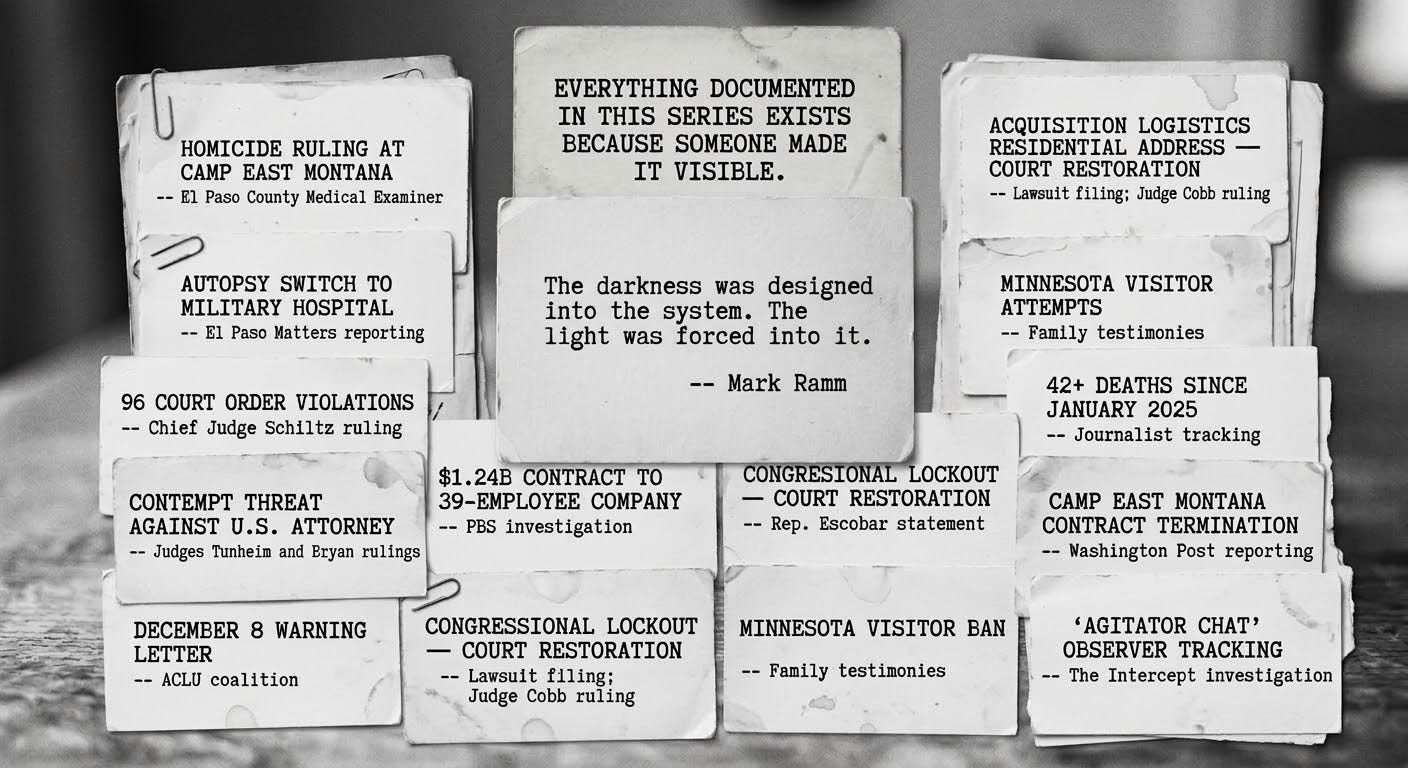
The Record
Everything documented in this series exists because someone made it visible.
Homicide ruling at Camp East Montana — El Paso County Medical Examiner
Autopsy switch to military hospital — El Paso Matters reporting
96 court order violations — Chief Judge Schiltz ruling
Contempt threat against U.S. Attorney — Judges Tunheim and Bryan rulings
December 8 warning letter — ACLU coalition
$1.24B contract to 39-employee company — PBS investigation
Acquisition Logistics residential address — Richmonder reporting
Congressional lockout — then court restoration — Lawsuit filing; Judge Cobb ruling
Witness deportation attempts — Rep. Escobar statement
Minnesota visitor ban — Family testimonies
42+ deaths since January 2025 — Journalist tracking
Camp East Montana contract termination — Washington Post reporting
“Agitator chat” observer tracking — The Intercept investigation
Each fact required someone to reveal it, document it, publish it.
The darkness is systematic. The light is human.
What Visibility Enables
Visibility without consequences can feel futile. Courts rule; agencies ignore. Reports publish; conditions continue. Families speak; their loved ones remain detained.
But visibility enables what darkness prevents:
Historical Record
Future accountability requires evidence. The documentation happening now, lawsuits, reports, journalism, testimony, creates the archive that future prosecutions, truth commissions, and historical judgment will require.
The Nuremberg trials relied on Nazi documentation. South Africa’s truth commission relied on testimony. Future accountability for what’s happening now will rely on what’s being recorded today.
Coalition Building
Isolated incidents remain isolated. Documented patterns create coalitions.
When local reporters cover local facilities, they see discrete events. When Eyes on ICE aggregates those events, patterns emerge. When patterns emerge, coalitions form.
The faith communities organizing against enforcement. The legal organizations coordinating defense. The community networks providing rapid response. These coalitions exist because visibility created shared understanding.
Political Pressure
Elections still happen. Public opinion still matters. Politicians still respond to constituent pressure.
The visibility of what’s happening inside detention creates the conditions for political response: even if that response is insufficient, delayed, or partial.
Without visibility, there’s nothing to respond to. With visibility, response becomes possible.
The Risks
Making it visible isn’t safe. And the risks are escalating.
On March 5, 2026, The Intercept reported that federal agents in Minneapolis have been tracking legal observers to their homes. Agents used facial recognition, license plate readers, and an internal database called the “Agitator chat” to identify people engaged in constitutionally protected observation. A former state senator was followed home by agents who blocked his driveway. A grandmother found federal vehicles outside her home. A Marine veteran was pursued on the road and called 911 fearing for his life.
The surveillance infrastructure documented in Part 5 — Palantir’s databases, facial recognition tools, commercial data brokers — is now being aimed at the people who make things visible.
Meanwhile, the transfer-as-disappearance pattern continues. In early March, a DACA recipient (Deferred Action for Childhood Arivals– also known as the ‘Dreamers’) receiving psychiatric care at M Health Fairview hospital in Minnesota was transferred by ICE to a detention facility in Texas despite an ongoing legal appeal. Pulled from active psychiatric treatment and sent 1,500 miles away.
Whistleblowers face retaliation and prosecution. Journalists face access denial and legal pressure. Legal advocates face NSPM-7 investigation threats. Community organizers face surveillance, intimidation, and home visits from federal agents. Legal observers face facial recognition identification and tracking. Families face the system’s power over their loved ones.
The administration understands that visibility is the threat. That’s why congressional access was blocked, oversight offices furloughed, ethics officials fired — and why the surveillance tools are now pointed at observers, not just the observed.
Every person who makes something visible accepts risk. The people cited in this series — by name or anonymously — have chosen to accept that risk.
The Last Light
This series has documented:
Three deaths in 44 days — one ruled homicide, one autopsy routed to a military hospital
The transfer system — 1,500 miles in 24 hours, 5,322 domestic shuffle flights in nine months
The facilities — tent cities, warehouses, giga-jails approaching 135,000 capacity
The fiscal architecture — $165 billion funded by cutting student loans and Medicaid
The closed loop — one company that monitors, hunts, and detains
The darkness — systematic dismantling of every oversight mechanism
The story is incomplete. New deaths happen. New contracts are signed. New court orders are violated.
But the architecture is now visible.
The tent cities and warehouses have names and addresses. The contractors have SEC filings and earnings calls. The deaths have medical examiner reports and wrongful death lawsuits. The violations have court rulings and complaint documentation.
The darkness was designed into the system. The light was forced into it — by journalists, lawyers, families, whistleblowers, and communities who refused to accept that what’s done in their name should be done in secret.
The question isn’t whether visibility is sufficient.
The question is what we do with what’s now visible.
What You Can Do
The people who made this system visible need support — and the work isn’t finished.
Fund the journalists doing this work: Eyes on ICE, Borderland Talk (Jenn Budd), El Paso Matters, and your local newspaper. Paid subscriptions sustain independent reporting.
Fund the lawyers filing the cases: ACLU, Democracy Forward, Human Rights Watch, Texas Civil Rights Project, Las Americas Immigrant Advocacy Center, and Florence Project. Every habeas petition costs money.
Join a rapid response network. They exist in most major metropolitan areas. Attend a know-your-rights training. Become an observer. Contribute to bail funds.
Contact elected officials. Congressional access is blocked — but Congress can still legislate. Electoral consequences are still possible. Visibility becomes pressure when constituents demand action.
Share what you know. The darkness depends on people not knowing. Every person who knows and tells someone diminishes it
I want to make a personal request.
Transparency Cascade Press is dedicated to covering the systems of power and the erosion of democratic accountability. But we need your help.
I build tools like capturecascade.org (a 4000+ event timeline of institutional capture) and pyrite.wiki (a tool for managing knowledge bases of information).
I am funding this work out of my savings because I feel like this is the most valuable work I can be doing.
The only way I can sustain this work is with the support of readers like you.
Series: After the Arrest
This is Part 7 of a 7-part series tracing what happens after ICE operations disappear from the cameras.
Autopsy Shopping — One came back homicide. The next body went somewhere else.
1,500 Miles in 24 Hours — The transfer system that turns an arrest into a disappearance
The Tent City and the Warehouse — Inside the facilities America is building to hold 135,000 people
The $165 Billion Machine — How Congress cut student loans to fund detention
The Closed Loop — One company monitors, hunts, and detains
The Darkness — The system wasn’t designed to fail oversight
Making It Visible — The journalists, whistleblowers, and communities ← You are here.
Sources
Journalism: Eyes on ICE (eyesonice.substack.com) · Jenn Budd / Borderland Talk (jennbudd.substack.com) · El Paso Matters (elpasomatters.org) · PBS: Fort Bliss contract investigation · Richmonder: Acquisition Logistics residential address
Legal Organizations: Democracy Forward (democracyforward.org) · ACLU: December 8, 2025 letter and ongoing litigation · Human Rights Watch: Facility documentation · Texas Civil Rights Project: Camp East Montana advocacy
Court Filings: Chief Judge Patrick J. Schiltz ruling (January 2026) · Judges Tunheim and Bryan: Contempt proceedings against U.S. Attorney Daniel Rosen (March 2026) · Judge Jia Cobb: Ruling blocking Noem congressional access policy (March 2, 2026) · Democracy Forward: Aceituno v. USDHS — NC warrantless arrests class action (February 24, 2026); Advocates for Human Rights v. DHS — Minnesota access-to-counsel TRO (February 12, 2026); BIA appellate rule challenge (February 2026) · Congressional lawsuit on facility access (July 2025; TRO granted February 2, 2026)
Observer Intimidation and Surveillance: The Intercept: “Federal Agents Are Intimidating Legal Observers at Their Homes” (March 5, 2026)
Camp East Montana Closure: Washington Post: “Trump administration to close Fort Bliss detention center” (March 4, 2026)
Transfer Cases: Sahan Journal: “Family fears for mental health of patient moved by ICE from Minnesota to Texas” (March 3, 2026)