

In early February, days after the Department of Homeland Security bought a $70 million warehouse in Surprise, Arizona, for a planned 1,500-bed processing center, Mayor Kevin Sartor told a crowd of protesters at a council meeting that the facility was out of the city’s hands. Federal law, he said, takes precedence: “as far as I am aware, the federal government has the supreme law of the land. So any city codes, zoning, any state law that we have, just doesn’t apply.” (Surprise, my May 7 piece, reported that the city learned of the sale six days after it closed, from the Arizona Republic, with no notice from DHS.)
That was the mayor’s reading of what a city can do once the deed records. I found no court ruling on Surprise’s zoning. A deed does not exempt the agency from the National Environmental Policy Act, or NEPA, and Arizona has sued under that law over the Surprise warehouse. What the record shows, warehouse by warehouse, is below.
Eleven bought, seven for sale, four in play
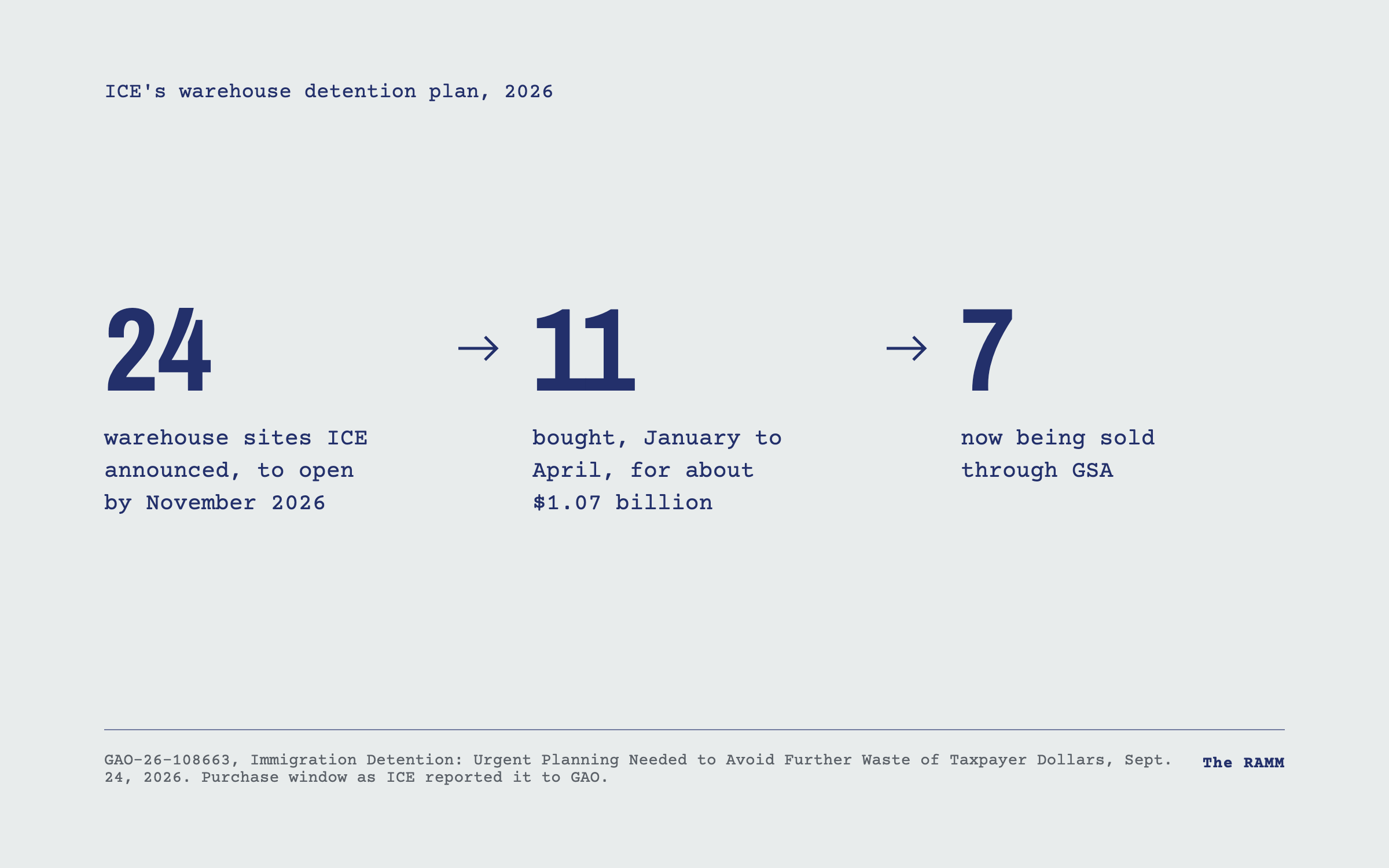
A memo sent to New Hampshire Gov. Kelly Ayotte, and released by her office on February 12, laid out ICE’s “Detention Reengineering Initiative.” Spotlight PA read it as eight large-scale detention centers and 16 regional processing centers: 24 sites, at a cost of about $38.3 billion under the One Big Beautiful Bill Act. It is a planning document. The $38.3 billion is what the plan said it would spend, not what has been spent.
What has been spent is documented by the Government Accountability Office. In report GAO-26-108663, dated September 24, GAO says ICE “announced plans to open 24 warehouse facilities by November 2026,” and that ICE reported buying 11 of them between January and April for about $1.07 billion. GAO’s November report, GAO-27-108665, puts the purchases between January and March, and found that ICE paid at least 50 percent above the state or local assessed value for nine of the 11, and at least double for six of the seven it plans to sell; GAO notes that tax assessments are “not always a reliable indicator of fair market value.” In June, ICE officials told GAO they were working with the General Services Administration to sell seven of the 11. GAO puts what ICE paid for the seven it now intends to sell at $707 million; it does not name them. ICE reported $7.7 million in costs it cannot recover on the seven, plus about $12.8 million through August on utilities, security and other services at them. GAO reports that Secretary Markwayne Mullin told House appropriators in June that DHS was re-evaluating the warehouse model; in GAO’s words, the department “had not conducted appropriate due diligence and planning.” That is the only reason from DHS that GAO reports, and it covers the whole program, not any one site.
GAO also counts “the four remaining warehouses it intends to use.” One of them is in Roxbury, New Jersey, which DHS told a federal court on November 16 it would keep and renovate to some level of detention capacity. Outside the warehouses, DHS told the *New York Times* in June that it “is moving swiftly to utilize EXISTING detention space with our state and county partners.” GAO says that in July ICE bought two operating detention facilities for about $1.5 billion; its November report counts four existing detention facilities bought in July and August, for about $2.2 billion.
On September 30, Commercial Observer reported that GSA and the brokerage Cushman & Wakefield were seeking buyers for the seven at bids starting at about $600 million, roughly 15 percent below the $706.8 million the government paid, according to Green Street as relayed by Commercial Observer. Its list: Romulus, Michigan; Salt Lake City; Social Circle, Georgia; Socorro, Texas; Tremont and Upper Bern, Pennsylvania; and a building at 6505 Atlanta Highway in Flowery Branch, Georgia. Bidding was set to end Thursday, November 12, according to CBS News Atlanta and WABE. As of November 22, I found no report of a closed sale.
The seven changed between June and September:
June: the Times reported that ICE “appears to still be moving forward with four of the warehouses,” and Reason, summarizing the Times, put New Jersey among the seven to go. Roxbury in, Socorro out.
September: Commercial Observer’s list. Socorro in, Roxbury out. Roxbury came off the sale track in July, when DHS told the court it was reconsidering. Socorro was dropped in August, its three buildings sent to GSA.
Of its four, GAO’s September report names Hagerstown (the Williamsport warehouse in Washington County, Maryland) and Surprise. Its November report names the other two: as of July, officials said ICE planned to award renovation and operating contracts for the Roxbury and San Antonio, Texas, facilities.
What was filed or ordered against each of the 11, and where each stands as of November 22:
The seven for sale (Tremont and Upper Bern count as two)
Romulus, Mich. Filed: State and city suit, NEPA among its claims, March 24. Now: on the list marketed for sale, though on Nov. 9 the government said the excess-property process with GSA was not complete. Case stayed since July 7.
Salt Lake City Filed: City and county NEPA suit, June 8. Now: stay extended ninety days by an Oct. 19 order; the government’s Oct. 18 report said it had taken steps toward selling the property, which was listed on the Cushman & Wakefield website.
Social Circle, Ga. Filed: Water meter locked, March; city suit under NEPA and state nuisance law, May 13. Now: case stayed, Sept. 10.
Tremont and Upper Bern, Pa. (two warehouses) Filed: State water and sewer orders. Now: ICE’s letters, released July 22, said they would not be detention centers.
Socorro, Tex. Filed: nothing. Now: transfer to GSA announced Aug. 11.
Flowery Branch, Ga. Filed: nothing; the city of Oakwood said in July it would sue if renovation or land disturbance began. Now: no case.
The four still in play
Williamsport, Md. Filed: State NEPA suit, Feb. 23. Now: preliminary injunction, April 15.
Surprise, Ariz. Filed: State NEPA suit, April 24. Now: paused by stipulation; draft environmental assessment published Nov. 9.
Roxbury, N.J. Filed: State and township NEPA suit; pause stipulated May 12. Now: DHS told the court Nov. 16 it would keep it; New Jersey said Nov. 19 it will move to enforce the May 12 order.
San Antonio, Tex. Filed: City suit under NEPA and the Administrative Procedure Act, Oct. 13. Now: injunction request held in abeyance; advisory due Nov. 30.
Before the deed
The memo’s sites did not all become purchases. In February, the Associated Press reported that owners of warehouses in Woodbury and Shakopee, Minnesota, Kansas City and Hutchins, Texas had pulled out of possible ICE deals after public outcry or pressure, according to local officials, the owners or the AP’s own reporting. Opus Holding sent a letter saying it was not negotiating with federal officials over a property in Merrillville, Indiana. Oklahoma City’s mayor, David Holt, said the owners there were no longer in talks with DHS about an “acquisition or lease.” Jim Pattison Developments said a sale near Richmond, Virginia “will not be proceeding” after boycott threats.
In Byhalia, Mississippi, Sen. Roger Wicker posted on February 6 that he had relayed local officials’ opposition to Secretary Kristi Noem and “appreciate[d] her for agreeing to look elsewhere.” In late March, the Choctaw Nation of Oklahoma confirmed that it had bought the former Big Lots distribution center in Durant, a site that had been floated for an ICE detention facility.
None of these needed a lawsuit. Owners stepped back, by their own word or the AP’s reporting; in Oklahoma City, by the mayor’s account. In Byhalia, by Wicker’s account, the buyer agreed to look elsewhere. In Durant, the Choctaw Nation bought the building itself.
After the deed
The only court ruling I found on local power against a federal contractor comes from Elkridge, Maryland, which is not one of the 11. The building is a GSA lease-back that a private developer, Genesis GSA Strategic One, was renovating for DHS: mostly office space, plus less than 1,100 square feet of temporary holding cells. On February 2, with the renovation more than 90 percent complete, Howard County revoked its building permits under a Maryland law that requires 180 days’ public notice and at least two public meetings before a permit for a building that “any private entity” will use as an immigration detention facility. On August 10, Judge Adam Abelson of the District of Maryland granted a preliminary injunction reinstating the permits. Genesis, he wrote, had shown “a likelihood of success in proving that § 1-102 was applied to the Elkridge Property in violation of the Supremacy Clause.” The county appealed; on October 13, Abelson refused to stay the injunction pending appeal. I found no appellate ruling. A lease-back with a small holding area, under a law written for private operators, is not a bought warehouse. It is still the nearest test: the one ruling I found in which a court has weighed a local permit against a building owned by its contractor that the federal government planned to run.
On May 5, Surprise’s council wrote to Secretary Mullin asking him to ensure ICE complies with state law and local zoning.
Seven of the 11 bought warehouses have drawn a federal lawsuit, and every one of those suits includes a claim under NEPA. The law requires a federal agency to take a “hard look” at environmental consequences before it acts. A deed does not exempt the agency from it.
Water and sewer
Water and sewer figure in the record at several sites. At Williamsport, ICE’s own environmental paperwork described a facility “designed to accommodate up to 542 detainees”; Judge Brendan Hurson’s opinion in Maryland’s suit describes the building as “a cargo-processing facility with four toilets and two water fountains.” Pennsylvania’s environmental department told ICE in February to show how Tremont and Upper Bern could be served; the plans, WITF reported, never came, and state administrative orders blocked the connections. Social Circle locked the warehouse’s water meter in March “until ICE indicates how water and sewer will be served without exceeding our limited infrastructure capacity.” In Socorro, El Paso Matters reported, the opposition was on moral grounds and over the town’s small water system. Those three are among the seven for sale. Williamsport, whose four toilets figured in the injunction opinion, is one of the four ICE kept. Rep. Veronica Escobar, announcing Socorro’s transfer to GSA on August 11, said she did not believe the water concerns alone were the “silver bullet.”
The seven
Romulus, Michigan. Michigan and the city sued on March 24, with NEPA among the claims. A September 8 status report says ICE began the excess-property process on June 22. Since a stipulated order of July 7, the case has been stayed 60 days at a time; the September 17 extension repeats that “Defendants SHALL NOT take any action to convert the Romulus Warehouse into an immigration detention center during this stay.” The stay lifts early, on either side’s request, if the government’s intentions change. In a November 9 joint status report, the government said it “still intend[s] to designate the Romulus Warehouse as excess property for disposition by the General Services Administration,” but that the process “has not been fully completed yet,” and the parties asked for another 60 days.
Salt Lake City. The city and Salt Lake County sued on June 8 under NEPA. A joint motion to stay, filed August 19, says the government told the plaintiffs on July 17 that it would designate the warehouse excess property for GSA. On October 19 the court stayed the case for ninety days and ordered that the defendants shall not take any action to convert the facility into an immigration detention center during the stay. The government’s October 18 report said it had taken steps toward selling the property, which was listed on the Cushman & Wakefield website.
Social Circle, Georgia. After locking the meter, the city sued on May 13 under NEPA and Georgia nuisance law. On June 18 the city announced that DHS was no longer pursuing the site. On September 10 the court stayed the case.
Tremont and Upper Bern, Pennsylvania (two warehouses). No lawsuit; the state’s water and sewer orders, above. In letters to the state released July 22, ICE confirmed in writing that the warehouses would not be detention centers, and withdrew its appeal. Gov. Josh Shapiro’s office said the state’s orders remain in place.
Socorro, Texas. No lawsuit found. Escobar announced the transfer to GSA on August 11.
Flowery Branch, Georgia. No lawsuit or order found. The city of Oakwood, which asked DHS in March to put the warehouse project on hold, said in July it “stands ready to file a lawsuit against DHS upon seeing any type of building renovation or land disturbance activity” (CBS News Atlanta). The first public record I found naming the site for sale is Commercial Observer’s September 30 list, though GAO’s June statement may cover it. Around the start of October, DHS sent letters to Flowery Branch and Oakwood saying it was proposing to sell the property (CBS News Atlanta).
Three of the seven drew a federal NEPA suit, one of them also with a locked water meter and a Georgia nuisance claim. Two drew state water and sewer orders. For two, nothing was filed. DHS’s stated reason, as GAO reports it, covers the whole program: due diligence and planning. The record shows what was filed and when ICE let go. It does not show which filing, if any, decided it.
The four
Each of the four is tied up in a NEPA case: an injunction, two stipulated pauses and a complaint whose request for an injunction is on hold. The money on them, from USAspending as of November 22: at Williamsport, $113.05 million obligated to KVG LLC on a renovation-and-operations task order, $29.1 million of it in outlays; at Surprise, $313.36 million obligated to GardaWorld Federal Services in March, with a potential value of $704 million and $3.9 million in outlays; at Roxbury, $31.8 million obligated to SK2 LLC on November 5, with a potential value of $998 million.
Maryland sued on February 23 over the warehouse near Williamsport, which DHS had bought on January 16. After an April 15 hearing, Hurson granted a preliminary injunction in part. It bars construction and renovation of the warehouse for use as a detention and processing facility; it leaves security cameras and lighting, HVAC and roof repairs, wiring and interior drywall work, and minor office-space renovations, and the court said an eight-foot security fence was not barred. His April 17 opinion called the case “a crystal-clear example of a federal agency failing to comply with the basic requirements” of NEPA. ICE had invoked a categorical exclusion to skip an environmental assessment. Even under what Hurson called the “highly deferential” arbitrary-and-capricious standard, he found the state likely to win. The injunction is in force as of the latest docket entries I could read (October 28): in a joint status report, the government told the court it was complying and that the only activity at the site since October 7 supported security and maintenance.
Arizona sued on April 24. Also in April, a stop-work order went to GardaWorld; AZPM reported that its reason was not listed. On June 30 the state and DHS jointly moved to stay the case, and Attorney General Kris Mayes announced the stipulation on July 1: DHS and ICE would neither detain anyone at the Surprise site nor convert it until the environmental review is finished. GAO attributes the hold to the suits: its September 24 report said ICE’s plans for Hagerstown and Surprise “are largely on hold, as of September 2026, due to legal challenges brought by the Maryland and Arizona Attorneys General.”
On October 13, San Antonio sued under the Administrative Procedure Act and NEPA “to halt Defendants’ unlawful decision to establish a massive immigration detention facility within the City’s limits.” The complaint says that “on or about February 5, 2026,” DHS and ICE “confirmed that they had purchased a 640,000 square foot commercial warehouse” to convert into a facility of as many as 1,500 beds, and that “no NEPA process has taken place whatsoever.” On October 16 Judge Jason Pulliam ordered the city to put any request for a restraining order or injunction in a separate motion. On October 22, on the city’s unopposed motion to vacate that order, he held the request for injunctive relief in abeyance and ordered the parties to file an advisory by November 30. I found no ruling on the merits.
Maryland is a ruling. In Arizona and New Jersey, the government agreed to pause pending review. Texas has neither yet.
In New Jersey, the government agreed on May 12 (ECF No. 36) to pause the state’s injunction motion. On June 29 the government told the court it intended to sell the warehouse. On July 10 it filed notice (ECF No. 44) that DHS, “upon reconsideration,” intends “to move forward with plans to consider the retrofitting.” On July 20 it said (ECF No. 46) it would “continue to assess whether to proceed.” On September 15 it told the court (ECF No. 50): “At present, there is no timeline for reaching that decision.”
May 12, the order, as New Jersey later quoted it: the government “shall not undertake any activities at the Roxbury Warehouse site for purposes of converting it into a detention center” beyond site security and maintenance until it completes an environmental assessment and issues a decision.
September: ICE used the warehouse’s parking lot to initially process 14 detainees on two occasions, a DHS official confirmed in October, NPR reported; DHS said no one was brought inside.
November 5: ICE awarded SK2 its task order to maintain the Roxbury warehouse, design its renovation into a processing and detention facility and provide wraparound services for its operation (USAspending). In a sworn declaration, DHS’s contracting officer, Sarah A. West, said ICE has committed to paying $31,777,231 for the first set of tasks: maintenance, a design for some level of detention capacity and environmental analysis of that design. The second set of tasks is optional; if ICE obligated all of it, which would cover five years of operational costs, the contract would total $998,285,252.59. New Jersey says the contract commits over $31 million to renovating the warehouse into a detention center.
November 6: New Jersey told the court (ECF No. 51) that DHS’s lawyers had advised it, “for the first time,” that DHS had decided to proceed with pursuing a detention facility there.
November 16: in a joint report (ECF No. 55), DHS wrote that it “decided to retain the Roxbury facility,” and that on November 6 it had told the plaintiffs ICE “intends to retain the Roxbury facility and renovate it to some level of detention capacity, among other uses.”
What is open
The four: Arizona’s attorney general’s office is reviewing the Surprise draft assessment. At Roxbury, the plaintiffs said DHS gave them 178 pages of contracting documents on November 17. On November 19 New Jersey said it would move to enforce the court’s May 12 order, and on November 20 the judge signed the briefing schedule it proposed. DHS asked him to reconsider, saying the contract bars renovations for housing aliens until the NEPA process is complete. To the state’s knowledge, DHS has not completed an environmental assessment.
The seven: no order yet on the Romulus request for another 60-day stay. In Social Circle a status report was due November 9; the public docket I can reach shows no such filing, but it lists an order on a motion to stay dated November 21, which I could not read. Nothing I read says whether disposal through GSA carries any restriction on future use as a detention site.
The money: GAO warns that any sale below what ICE paid for the seven adds to the waste. DHS’s inspector general said in OIG-26-37 that it began a separate review of ICE’s warehouse procurement in May 2026.
Back in Surprise
In February, Mayor Sartor told protesters that city codes, zoning and state law “just doesn’t apply” to the federal government. No court has ruled on that in Surprise.
What the record shows binding the Surprise warehouse today is a stipulation in federal court, in a suit Arizona brought under a federal law. Under that law, DHS published its draft environmental assessment on November 9, AZPM reported. The public can comment on it until December 9.
Before we continue, one quick ask.
A single raid is a headline. The pipeline behind it is a story nobody’s funding.
At The RAMM I connect the dots that don’t fit in one article: the federal contracts, the 287(g) deals, the quiet real-estate moves, the county-by-county buildout of detention capacity.
The receipts:
4,776+ sourced events at CaptureCascade.org
1,988 counties with signals of detention expansion at detention-pipeline
129 community fights over detention capacity, tracked
This is self-funded. Subscriptions are the only thing that keeps it alive
Sources
Court filings
Complaint, *City of San Antonio v. Mullin*, No. 5:26-cv-06542 (W.D. Tex.), ECF No. 1 (filed 2026-10-13); ECF No. 5, standing order (2026-10-15)
*State of Maryland v. Mullin*, No. 1:26-cv-00733 (D. Md.), ECF No. 42, order granting preliminary injunction in part (2026-04-15) and ECF No. 43, memorandum opinion (2026-04-17); ECF No. 72, joint status report (2026-10-28); Clearinghouse copy and docket summary
*State of Arizona v. Mullin*, No. 2:26-cv-02857 (D. Ariz.), ECF No. 18, joint motion to stay (filed 2026-06-30) and ECF No. 20, status report (2026-09-04)
State of New Jersey and Township of Roxbury v. ICE, No. 2:26-cv-02884 (D.N.J.): ECF No. 36, stipulation and order (2026-05-12); ECF No. 44, notice (2026-07-10); ECF No. 46, status report (2026-07-20); ECF No. 50, joint status report (2026-09-15); ECF No. 51, plaintiffs’ status report (2026-11-06); ECF No. 55, joint status report (2026-11-16); ECF No. 56, joint status report (2026-11-17) with ECF No. 56-1, declaration of Sarah A. West; ECF No. 57, plaintiffs’ letter requesting expedited briefing (2026-11-19); ECF No. 58, the same letter, so ordered (2026-11-20); ECF No. 59, defendants’ letter seeking reconsideration (2026-11-20)
City of San Antonio v. Mullin (W.D. Tex.): ECF No. 12, order (2026-10-16); ECF No. 14, unopposed motion, and text order holding injunctive relief in abeyance (2026-10-22)
USAspending task orders: 70CDCR26FR0000035 (KVG LLC, Williamsport), 70CDCR26FR0000043 (GardaWorld Federal Services, Surprise, signed 2026-03-06), 70CDCR27FR0000002 (SK2 LLC, Roxbury, 2026-11-05); figures as of 2026-11-22
State of Michigan and City of Romulus v. DHS, No. 2:26-cv-10968 (E.D. Mich.): ECF No. 1, complaint (filed 2026-03-24); ECF No. 44 (2026-09-08); ECF No. 45, stay order (2026-09-17); ECF No. 46, joint status report (2026-11-09)
Salt Lake City Corporation v. Mullin, No. 2:26-cv-00528 (D. Utah): ECF No. 1, complaint (filed 2026-06-08); ECF No. 27, joint motion to stay (filed 2026-08-19); ECF No. 29, joint status report (2026-10-18); ECF No. 31, stipulated order staying case (2026-10-19)
City of Social Circle v. ICE, No. 3:26-cv-00054 (M.D. Ga.): ECF No. 1, complaint (filed 2026-05-13); ECF No. 20, stay order (2026-09-10); docket page (entry dated 2026-11-21, order on motion to stay, text not read)
Genesis GSA Strategic One, LLC v. Howard County, No. 1:26-cv-00915 (D. Md.): ECF No. 69, memorandum opinion (2026-08-10); ECF No. 71, preliminary injunction (2026-08-10); ECF No. 81, order denying stay pending appeal (2026-10-13)
Government reports
GAO-26-108663, *Immigration Detention: Urgent Planning Needed to Avoid Further Waste of Taxpayer Dollars* (2026-09-24); product page
GAO-27-108665, *Immigration Detention: ICE Should Determine Cost Effectiveness of New Initiatives Before Continuing* (November 2026; released by Sen. Dick Durbin on 2026-11-19)
DHS OIG-26-37 (2026-09-28)
Reporting
Spotlight PA, ICE memo sheds light on timeline, purpose of new detention centers (2026-02-20)
Commercial Observer, Cushman & Wakefield Tapped to Market Properties Once Slated for Detention Centers (2026-09-30)
Hamed Aleaziz, New York Times, ICE spent $700M on 7 warehouses. Now it wants to get rid of them (syndicated 2026-06-20); Reason, ICE largely abandons plan (2026-06-19)
Associated Press via Boston.com, some owners are backing out of deals (2026-02-22); Public Radio Tulsa, Choctaw Nation (2026-03-30)
KJZZ, Surprise warehouse purchase (2026-01-30); KOLD, Surprise mayor (2026-02-04); KTAR, Surprise letter (2026-05-05, the letter’s date)
WITF, ICE withdraws appeal (2026-07-23)
El Paso Matters, DHS scraps plans for mega ICE detention center in Socorro (2026-08-11)
CBS News Atlanta, Social Circle water meter (2026-03-16) and Oakwood still awaiting DHS (2026-07-15), plus on the portfolio sale and DHS’s letters (2026-11-12), and on the Flowery Branch and Oakwood letters (2026-10-06); WABE, on the bidding deadline (2026-11-11); AZPM, on the Surprise draft environmental assessment (2026-11-16) and on the stop-work order (2026-04-27); WRDW, DHS no longer pursuing Social Circle (2026-06-18)
NPR via KPBS, Jasmine Garsd, “ICE has quietly used this warehouse as a detention facility all summer, neighbors say” (2026-10-08, updated 2026-10-15): neighbors’ reports of activity at the Roxbury warehouse; DHS later confirmed ICE used the parking lot to process 14 detainees on two occasions in September, with no one brought inside
Capture Cascade context
Last week, the Department of Homeland Security purchased the GEO Owned Detention Center for $495 million. That is 6 times its assessed value and $3,000 per square foot. According to GEO’s own press release, the the company expects to net $340 million from the sale. The State of Washington will no longer be able to regulate the facility. The constitution does not allow the federal government to be regulated by State or local jurisdictions.
GEO is a private prison company that has just signed a 10yr contract to run the Tacoma facility. The contract will pay GEO $1.5 billion over the10 years of operation.
The sales price is a give away to GEO. The purchase allows DHS to operate beyond the control of the state of Washington, Pierce County and the city of Tacoma. Under GEO, numerous abuses have occurred. (from the Seattle Times article published on 11/18/26).
Tacoma For Washington