

“I May Have Said Too Much”: Epstein Knew Too Much about Trump's Finances
Epstein, the Muller report and the Money Trail Behind Trumps 95$ Million Dollar Mansion
The witness is dead. The testimony exists. Congress could release it any day.
In June 2019, Michael Wolff published “Siege,” his second book about the Trump White House. Buried in the reporting was an extraordinary claim:
Jeffrey Epstein told Wolff that Donald Trump was “fronting for the mansion’s real owners” in the 2008 sale to Russian oligarch Dmitry Rybolovlev—the $95 million transaction I’ve documented.
Epstein was in Paris when the book came out. He read it. Then he called Wolff with alarm.
“He was afraid he might have said too much.”
Three weeks later, federal agents arrested Epstein on the tarmac at Teterboro Airport in New Jersey.
Six weeks after that, Epstein was dead.
The witness who could explain the mansion sale—who knew Trump’s business model, who understood the fronting scheme, who threatened to expose it publicly—never testified.
But his testimony exists. In FBI files. In sealed court records. In the documents that H.R. 4044 would release.
Let me show you what died with Jeffrey Epstein—and why recovering it matters.
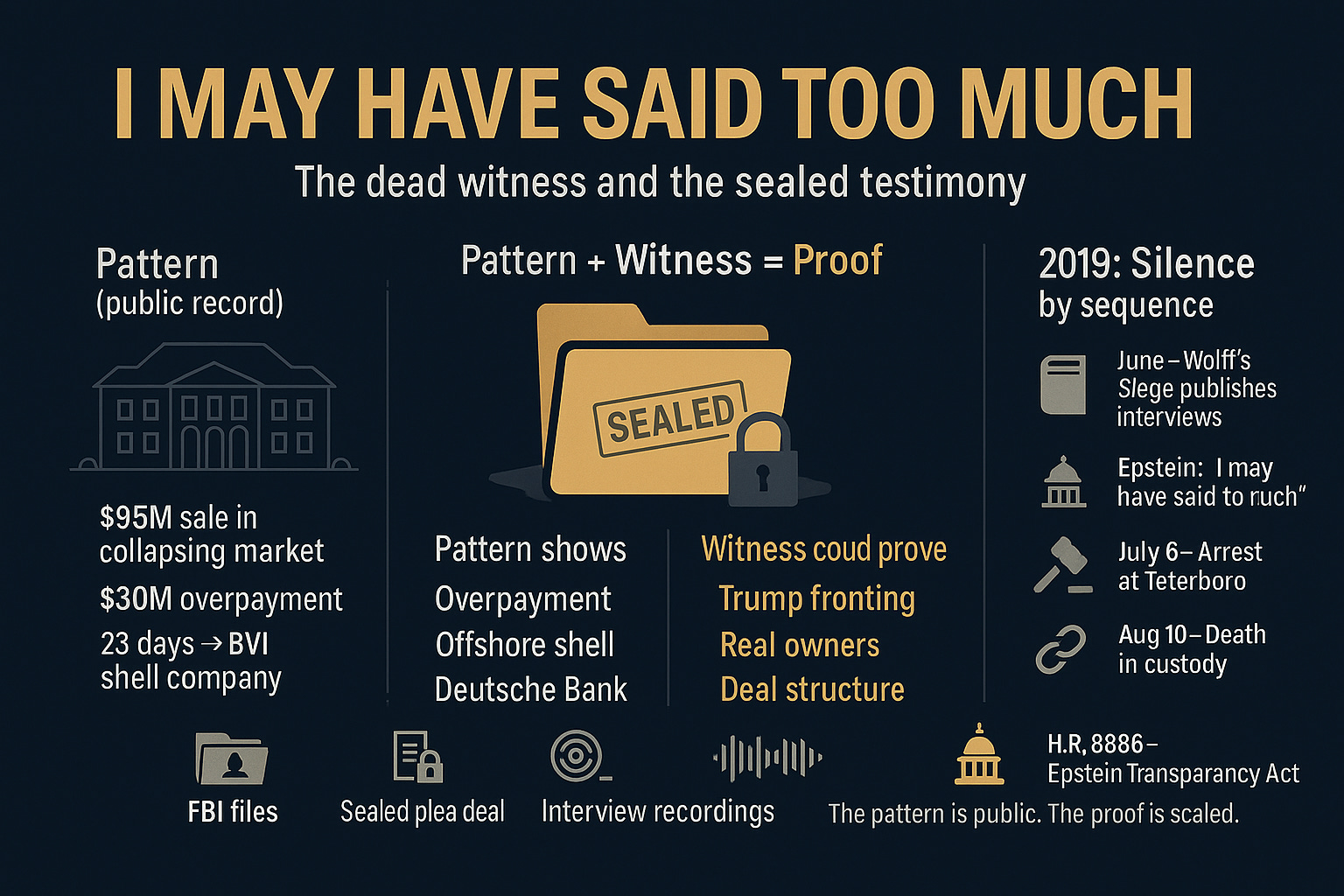
What Epstein Knew
The publicly released Epstein files now contain an email sent TO Epstein on May 29, 2019—just weeks before his arrest. It’s a news article about Wolff’s book, specifically highlighting the mansion allegations:
“The billionaire financier knew Trump had been loaning out his name in real estate deals for a fee, and he suspected the freshly minted reality TV star was fronting for the mansion’s real owners.”
This wasn’t speculation. Epstein had direct knowledge because:
Epstein showed Trump the property - He took Trump to see the Palm Beach mansion in 2004, planning to bid $36 million at the bankruptcy auction
Trump outbid him - Trump bid $40 million, won at $41.35 million with 100% Deutsche Bank financing
Epstein knew Trump’s finances - After decades of friendship, Epstein understood Trump couldn’t raise that capital himself
Epstein knew Trump’s business model - “Loaning out his name in real estate deals for a fee” wasn’t new—it was systematic
According to reporting on Wolff’s interviews, Epstein was “furious” about the betrayal. He threatened lawsuits. He threatened to go to the press. He threatened to expose Trump as “a frontman for a money laundering deal.”
Back in 2005 the Palm Beach police investigation began. Then federal prosecutors got involved (2006). Then Alex Acosta offered the extraordinary plea deal (June 2008).
Twenty-one days after that plea deal: The mansion sold for $95 million.
Twenty-three days after the sale: Trump Tower Capital Ltd. incorporated in the British Virgin Islands.
Epstein had been silenced at exactly the moment his threat could have prevented the transaction.
What Mueller Couldn’t Prove
Robert Mueller’s investigation (2017-2019) examined the mansion sale as part of the Russia probe.
We know this because:
Bloomberg reported Mueller was examining transactions between Trump and Russians, including the Palm Beach mansion
Senator Ron Wyden requested Treasury Department Suspicious Activity Reports on the sale
Congressional reporting confirmed Mueller’s team sought wire transfer records and banking documents
But the publicly released Mueller Report (April 2019) contains zero findings about the mansion sale.
The Constraints on Mueller
Mueller faced obstacles Epstein’s testimony could have overcome:
What Mueller Could Document:
The transaction occurred (public property records)
$30 million overpayment above county assessment
Deutsche Bank financed Trump’s purchase
Offshore entity incorporated 23 days after sale
Rybolovlev’s suspicious behavior (never lived there, denied ownership, demolished structure)
What Mueller Could NOT Prove:
Who beneficially owns Trump Tower Capital Ltd. (BVI secrecy laws)
Whether Trump was fronting for shadow owners (no witness)
Where the $95 million actually went (foreign bank records require MLAT)
What Deutsche Bank knew (limited by ongoing investigations)
The connection to Acosta’s plea deal (sealed by agreement)
What Epstein Could Have Provided:
Direct testimony that Trump was fronting
Explanation of the business model (”loaning out his name for a fee”)
Knowledge of who the real buyers were
Understanding of Trump’s financial inability to purchase independently
Context for the timing (plea deal → silence → transaction)
Epstein was the missing witness. He had knowledge Mueller couldn’t obtain through financial records alone.
And then Epstein read Wolff’s book and realized he’d exposed himself.
“I May Have Said Too Much”
The timeline of Epstein’s final weeks documents the mechanism of silence:
June 2019: The Book
Wolff’s “Siege” publishes, containing 100+ hours of Epstein’s interviews about Trump’s world. The mansion fronting scheme goes public.
Weeks Later: The Panic
Epstein, in Paris, reads the book. He calls Wolff. “He was afraid he might have said too much.”
This is the critical moment. Epstein—who had survived the 2008 plea deal, who had maintained silence for over a decade—realized that breaking that silence made him a target.
July 6, 2019: The Arrest
Three weeks after expressing fear, federal agents arrest Epstein at Teterboro Airport when his plane lands from Paris. The charges: sex trafficking, conspiracy.
Prosecutors immediately move to keep him detained, arguing he’s a flight risk and danger to the community. Bail denied.
August 10, 2019: The Death
Epstein found dead in his cell at Metropolitan Correctional Center. Official ruling: suicide by hanging.
The witness who knew about the mansion fronting scheme—who could explain Trump’s business model, who understood the shadow owners, who had threatened to expose it all—would never testify.
What the Sealed Files Contain
The publicly released Epstein files contain only the May 29, 2019 email—a news article sent TO Epstein about Wolff’s reporting. That email proves the government had documentation of Epstein’s mansion allegations.
But Epstein’s own testimony—the evidence he gathered, the communications he had, the knowledge he possessed—remains sealed.
What We Know Exists (But Can’t Access)
From FBI investigation files (2005-2008):
What Epstein told investigators about Trump
Whether FBI examined Trump’s finances based on Epstein’s claims
Epstein’s evidence of the fronting arrangement
Communications between Epstein and Trump about the mansion
From Acosta’s plea deal negotiations (2008):
Whether the mansion sale was discussed
What Epstein agreed to keep quiet about
Why the deal protected unnamed co-conspirators
Whether timing (21 days before the sale) was related
From sealed court records:
Epstein’s communications about the transaction
Evidence of Trump’s “loaning out his name for a fee”
Knowledge of who the shadow owners were
Understanding of Deutsche Bank’s role
From Wolff’s interview materials:
The full 100+ hours of recordings
Epstein’s detailed knowledge of Trump’s business
Specific claims about the Rybolovlev transaction
Context for “I may have said too much”
This isn’t speculation. These documents exist. The government has them.
H.R. 8886—the Epstein Transparency Act—would release them.
The Gap Between Pattern and Proof
Yesterday’s post (”Twenty-Three Days Later”) established the pattern:
✓ $30 million overpayment in a collapsing market ✓ Buyer who never lived in the mansion ✓ Buyer who denied ownership under oath ✓ Offshore entity appearing 23 days after sale ✓ Deutsche Bank at every connection point ✓ Acosta’s plea deal 21 days before the transaction
The pattern is suspicious. The timing is precise. The infrastructure is professional.
But pattern isn’t proof. Witness testimony is proof.
Epstein had that testimony:
He knew Trump was fronting
He understood the business model
He could identify the shadow owners
He threatened to expose it publicly
He was silenced at a critical moment
He died before he could testify
The testimony exists in sealed files. Recovering it is the difference between:
Circumstantial evidence (suspicious but deniable) Documentary proof (direct witness testimony that Trump was fronting)
Why “I May Have Said Too Much” Matters
Epstein’s panic—his fear that he’d disclosed too much—proves he understood the information was dangerous.
He was right.
Three weeks later: arrested. Six weeks later: dead.
Whether you believe he was murdered or driven to suicide, the result is the same: The witness who could prove the fronting scheme is gone.
But unlike most cases where death ends the possibility of testimony, Epstein’s knowledge was documented:
In FBI files from the 2005-2008 investigation
In sealed plea deal materials from 2008
In Wolff’s interview recordings from 2017-2018
In communications now held by the government
This is why the Epstein Transparency Act matters.
It’s not about satisfying curiosity. It’s about recovering testimony from a dead witness—testimony that fills the gaps Mueller couldn’t publicly address, that proves the systematic nature of money laundering infrastructure, that connects:
2004: Trump’s fronting arrangement
2008: Acosta’s deal silencing the witness
2008: The mansion transaction closing
2008: The offshore entity incorporating
2017: Trump appointing Acosta to Cabinet
2019: Epstein’s panic about disclosure
2019: Epstein’s death before testimony
Every piece is documented. Every connection is real. The proof exists.
The only question is whether Congress releases it.
The Two-Part Case
These posts together make the complete argument:
Part 1: The Pattern (”Twenty-Three Days Later”)
Transaction economics that don’t make sense
Behavior proving it wasn’t real estate investment
Offshore infrastructure appearing with suspicious timing
Multiple money laundering mechanisms at work
Part 2: The Witness (”I May Have Said Too Much”)
Direct testimony that Trump was fronting
Knowledge of the business model
Understanding of shadow ownership
Evidence of systematic operation
Timeline of silence: threatened → plea deal → transaction → exposure → death
Pattern + Witness = Proof
The pattern is public. The witness is dead. The proof is sealed.
H.R. 8886 recovers the testimony.
What You Can Do
The House could vote on the Epstein Transparency Act any day this week.
Contact your Representative: Tell them you support H.R. 8886 and transparency about Epstein’s network.
📞 Call the Capitol Switchboard: (202) 224-3121 🌐 Find your Representative: https://www.house.gov/representatives/find-your-representative 📧 Contact form: https://markramm.github.io/Epstein-Transparency/
Verify the evidence yourself:
🔍 ICIJ Offshore Leaks Database (Trump Tower Capital Ltd.): https://offshoreleaks.icij.org/nodes/10135758
📂 House Oversight Epstein Files (including HOUSE_OVERSIGHT_030989): https://github.com/markramm/EpsteinFiles
📰 Michael Wolff reporting (Epstein’s fronting allegations): https://news.meaww.com/michael-wolff-says-epstein-blamed-trumps-real-estate-betrayal-for-their-falling-out-he-was-furious
📊 Mueller investigation reporting (mansion sale examination): https://www.bloomberg.com/news/articles/2017-07-21/mueller-said-to-expand-probe-to-trump-business-transactions
The witness is dead. The testimony exists. The vote is pending.
What Epstein knew about the mansion sale could prove systematic money laundering. What he feared disclosing got him killed—or at minimum, made him so dangerous he chose death over testimony.
Either way, his knowledge survives in sealed documents.
Congress can release them. The question is whether they will.
This is the second in a series investigating the infrastructure of money laundering, political capture, and offshore secrecy. Read Part 1: [”Twenty-Three Days Later: The Offshore Entity That Appeared After the $95 Million Mansion Sale”](LINK TO PREVIOUS POST)
Every claim in this investigation is sourced to primary documents, government records, or verified news reporting. No speculation. No conspiracy theories. Just documentation of systematic mechanisms.
A detailed analysis of something else in the Epstein files about Trump's shady business dealings.