

The Violence Loads Automatically. The Truth Requires a Click.
It’s not just about how the facts are framed, it’s what facts get to exist at all
Commentary | Mark Ramm
She voted for him three times.
She never saw the lies. Not because she wasn’t paying attention—she was. Not because she didn’t care—she did. The lies simply never reached her. Her information environment was optimized to ensure they wouldn’t.
When she finally broke out of the bubble—Epstein was what did it, a story too big and too connected to be fully absorbed by the usual filters—her first question was the one that should haunt us all:
“When did you know he was evil?”
She wasn’t asking for a date. She was asking how we had lived in different realities. How the same years had delivered to her a coherent world that happened to be false, while delivering to others the information that made his malevolence obvious. She was asking how her attention had been managed without her knowing it was being managed at all.
That question is not about one woman’s media diet. It’s about the architecture of perception in the twenty-first century.
“Provisos of equal time are not served by one viewpoint having media access to two hundred million people in prime time while opposing viewpoints are provided with a soapbox on the corner.”
—Harlan Ellison, “The Deathbird” (1974)
A trillion dollars.
That’s what the global advertising industry will spend in 2025 buying human attention. Not earning it. Not requesting it. Buying it—treating consciousness itself as inventory to be acquired and resold.
Human attention is not property. Therefore it cannot be inventory. Therefore it cannot be bought or sold.
And yet.
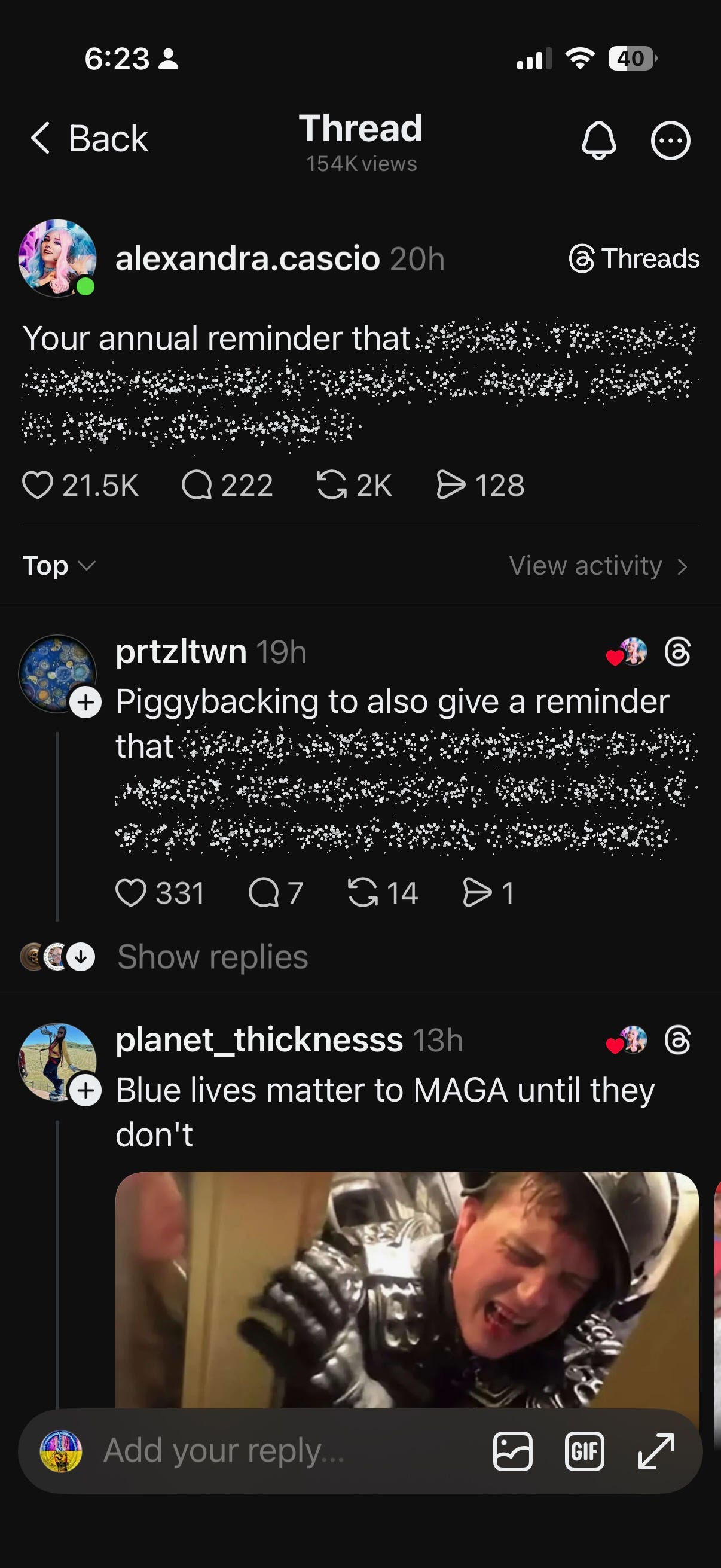
Yesterday I was scrolling Threads on the January 6th anniversary when I noticed something. A post stating the obvious—that J6 was a violent insurrection incited by Trump to overturn a fair election—appeared garbled on my screen. Obscured. Rendered as static until I clicked through a “sensitivity filter.”
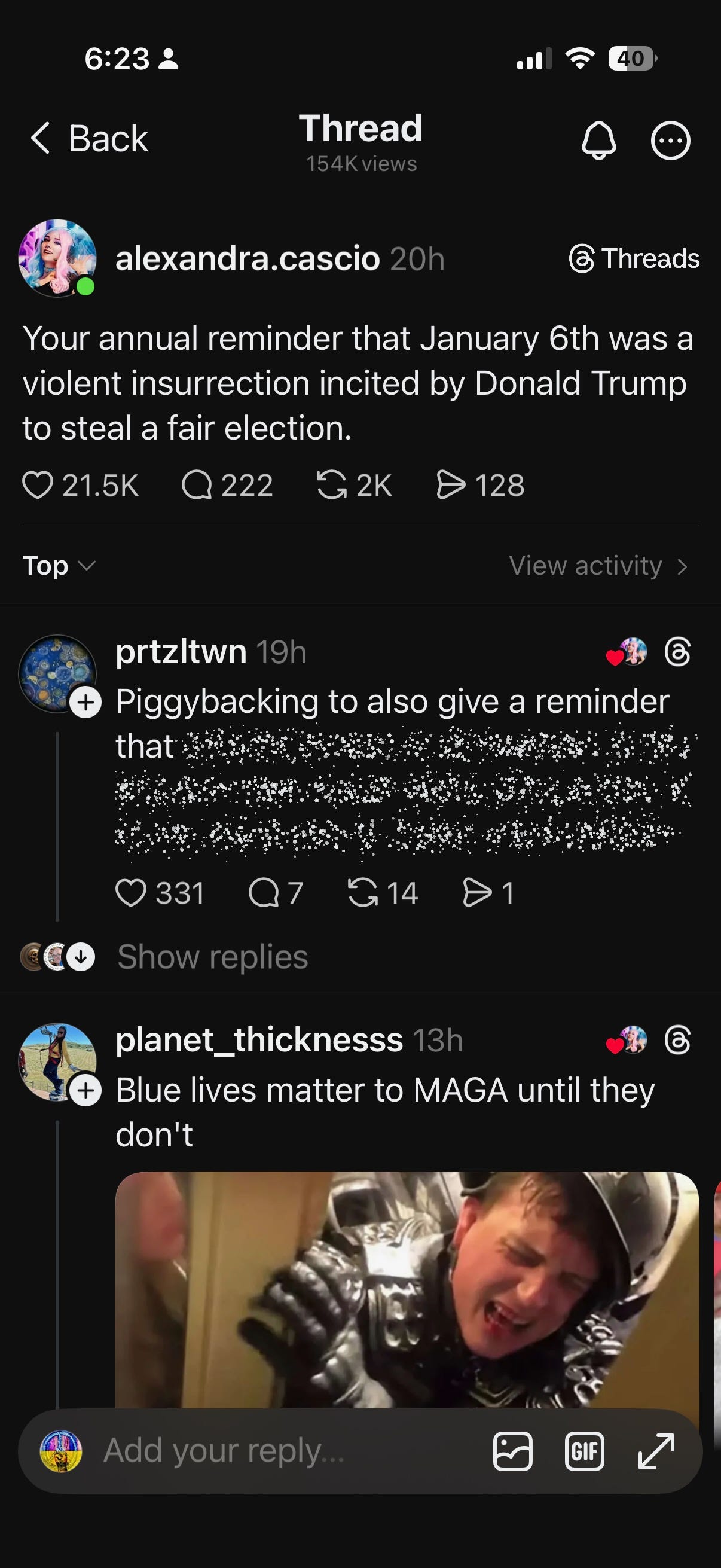
The image of actual violence in the comments? That displayed automatically.
Think about what that means. The words describing what happened require an extra click. The footage of the violence itself loads without friction.
The system has decided that language—specifically, the accurate political framing of an event—is more dangerous than images of the event. The statement of fact needs a content warning. The content doesn’t.
If the concern were trauma, you’d filter the violent imagery. If the concern were misinformation, you’d need to evaluate the claim—which happens to be factually accurate and legally established through multiple court proceedings.
What’s actually being filtered is the interpretive frame.
See the event. Don’t name it. Experience the spectacle. Don’t receive the analysis.
This isn’t a bug. It’s what the commercial logic demands.
Follow the incentives: naming J6 accurately alienates a market segment. Showing the violence engages that same segment—they’ll watch, rage-share, comment. The footage is content. The interpretation is liability.
The sensitivity filter isn’t protecting users from harm. It’s protecting the platform from advertiser flight and user churn. Friction is applied precisely where it minimizes commercial risk, not where it minimizes actual harm.
This is what a “universal solvent for institutional integrity” looks like at the implementation layer. Threads doesn’t need a policy saying “obscure accurate descriptions of January 6th.” It just needs engagement metrics, advertiser pressure, and an algorithm optimizing for time-on-platform. The political effect emerges from the commercial logic without anyone having to decide it.
Content moderation becomes a machine for producing plausible deniability. “We’re just protecting users from sensitive content.” Meanwhile, sensitivity is defined by what makes advertisers nervous, which is defined by which user segments they can’t afford to lose, which maps onto political divisions.
The old propaganda critique told us that mass media shaped what we thought about events—manufacturing consent for wars, for policies, for the existing order. Consent implied a subject who is presented with options and agrees.
But what I’m describing is prior to that. This is the construction of the perceptual field itself. Which facts feel real. Which connections seem obvious. Which interpretations require effort to access and which arrive frictionlessly.
Not “here’s what to think about January 6th” but “here’s what January 6th is in the texture of your experience”—an image without a name, violence without a cause, something that happened rather than something that was done.
Doc Searls, who has been fighting this battle since Cluetrain Manifesto, put it bluntly: “Like the economies of slavery, farming, and ranching, the advertising economy relies on mute, passive, and choice-less participation by the sources of the commodities it sells.”
The advertising model doesn’t need you to agree with a position. It needs you to be a certain kind of subject: distractible, reactive, emotionally activated but analytically passive. A subject who consumes rather than concludes.
Not manufacturing consent.
Manufacturing worldview.
The woman who voted for him three times wasn’t stupid. She wasn’t lazy. She wasn’t morally deficient. She was enclosed—living inside an epistemic structure that showed her a coherent world that happened to be missing crucial facts.
The attention economy built those walls. Advertising revenue paid for them. And she didn’t know she was inside until one story finally broke through.
Three elections. Years of relationships strained by what felt like political difference but was actually perceptual difference. A family divided not by values but by which facts were allowed to arrive.
“When did you know he was evil?”
She wasn’t the one who failed. The information infrastructure failed her. It was designed to.
This is the epistemic layer of capture.
We can document the capture of regulatory agencies, courts, legislatures, and elections. But beneath all of these lies something more fundamental: the capture of the conditions under which citizens can know things, process things, deliberate about things.
The attention economy isn’t one more captured institution. It’s the captured substrate that makes all other capture possible—and invisible.
The Kochs can fund think tanks, but those think tanks need distribution. Thiel can build surveillance infrastructure, but it requires a population habituated to being watched. The whole machinery of institutional capture exploits a system that already optimizes for manipulability.
Campaign finance reform won’t fix this. You can limit political ad spending, but if the entire information ecosystem is already optimized for manipulability, you’ve regulated the symptom while leaving the disease intact. Politicians don’t just buy ads. They optimize for an electorate that’s been shaped by decades of attention-harvesting—trained to respond to emotional triggers, primed for tribal activation, habituated to spectacle over analysis.
The campaign finance problem assumes a subject who could deliberate if only the messaging were balanced. The attention economy problem recognizes that the subject’s capacity for deliberation has been systematically degraded.
Campaign finance reform says: “Let’s have a fair fight for public opinion.”
Ending the sale of attention says: “Let’s rebuild the public capable of having opinions worth fighting for.”
But advertising-funded media isn’t inevitable. We chose this model through policy. We can choose differently.
Shakespeare’s audience paid at the door. Public libraries exist. The BBC proves public information infrastructure works. Patreon, subscriptions, cooperative ownership—the technology for direct funding exists. The only thing preventing it is policy choice.
A trillion dollars a year spent buying human attention.
What if we simply… stopped selling it?
This is the beginning of something.
I’m attempting to document the full architecture of capture—how attention economies, institutional corruption, and democratic erosion connect as a single system. It’s audacious. It may be necessary.
If this framework clarifies something you’ve been sensing but couldn’t name, I want to hear from you. The comments are open. The work continues.