

Hegseth Removed The Circuit Breakers
Pete Hegseth and the Trump Administration have the guardrails as threats escalate.
On April 2, 2026 — day 34 of a war with Iran — Defense Secretary Pete Hegseth fired the Army’s top general.
Gen. Randy George was confirmed by the Senate 96-1. He was eighteen months from completing his four-year term. He was actively working to get equipment and people into the Iran theater to protect U.S. forces in an active combat zone. An unnamed official told NBC News: “Here is a four-star general who is actively working to get equipment and people into theater — to protect U.S. forces — and you fire him? In the middle of a war?”
The trigger wasn’t operational. According to the New York Times, citing eleven current and former officials, Hegseth had pressed George to remove four officers — two Black men and two women — from a list of 29 being promoted to brigadier general. George and Army Secretary Daniel Driscoll refused, citing the officers’ “long and exemplary service.” Hegseth unilaterally struck the names. When George requested a meeting to discuss his concerns, Hegseth refused to take it.
Hegseth’s chief of staff, Ricky Buria, reportedly told Driscoll that “Trump would not want to stand next to a Black female officer at military events” — referring to Maj. Gen. Antoinette Gant, a combat engineer who served in Iraq and Afghanistan.
Driscoll replied: “The president is not a racist or sexist.”
George was the thirteenth senior military leader removed since January 2025.
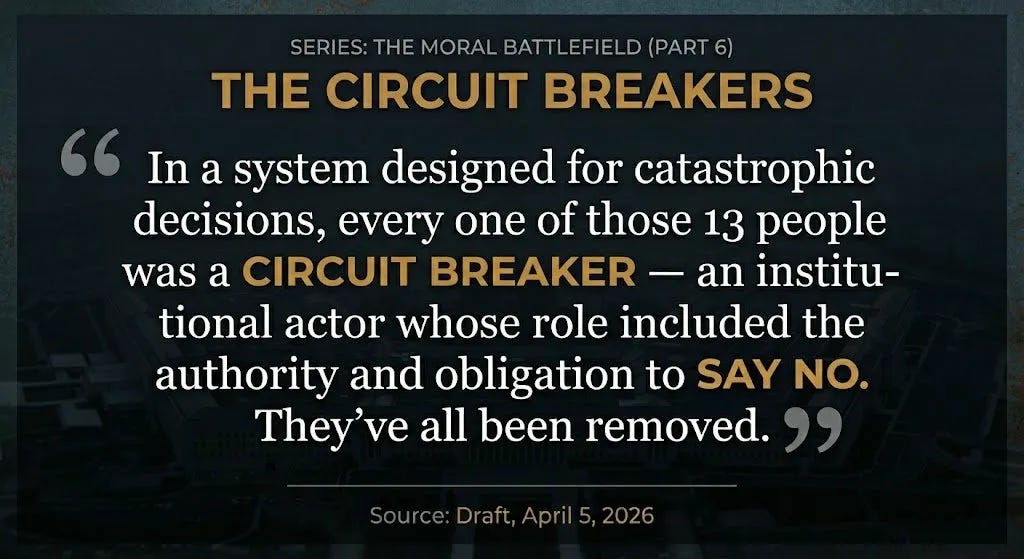
In a system designed for catastrophic decisions, every one of those 13 people was a circuit breaker — an institutional actor whose role included the authority and obligation to say no. They’ve all been removed.
I. The Military Purge
The count begins on Trump’s second day.
January 21, 2025. Admiral Linda Fagan, Commandant of the Coast Guard. First woman to lead any branch of the U.S. armed forces. Forty years in uniform. She started as a deck watch officer on the heavy icebreaker Polar Star, served on all seven continents, and was confirmed unanimously by the Senate. She was the first commandant to be fired in the Coast Guard’s 235-year history. She was also the first woman to lead it.
February 22, 2025. The largest single-day military leadership purge in modern American history. General Charles Q. Brown Jr., Chairman of the Joint Chiefs of Staff — the second African American to hold the position after Colin Powell, and the first to lead a military branch as Air Force Chief of Staff. Call sign “Swamp Thang,” earned after his jet was struck by lightning, caught fire, and he ejected into the Florida Everglades. Three thousand flight hours, 130 in combat. After George Floyd’s killing in 2020, Brown recorded a video about “a history of racial issues and my own experiences that didn’t always sing of liberty and equality.” Being the only Black student in his elementary school. Being asked “Are you a pilot?” while wearing the same flight suit and wings as his white peers. His son had called him to ask: “Dad, what are you going to say?”
On the same day: Admiral Lisa Franchetti, Chief of Naval Operations — first woman to lead the Navy and first woman on the Joint Chiefs. General James Slife, Air Force Vice Chief of Staff. And the top military lawyers for the Army, Navy, and Air Force.
The lawyers matter. Judge Advocate General officers are the military’s legal conscience. They advise commanders on the lawfulness of orders — including whether a strike constitutes a war crime, whether a detainee’s treatment violates the Geneva Conventions, whether “no quarter, no mercy” is an illegal directive under the Hague Convention of 1907, the Geneva Conventions, and the Pentagon’s own Law of War Manual. When Hegseth made that declaration in March 2026, there were no JAGs at the top of the chain whose institutional role required them to say: that is a war crime.
April 3, 2025. General Timothy Haugh, director of the National Security Agency and head of U.S. Cyber Command. Thirty years of service. No official cause stated. He was fired hours after political activist Laura Loomer visited the Oval Office. Loomer — who has no security clearance, no government role, no military experience — publicly claimed she had urged Trump to fire officials she considered disloyal. The director of the National Security Agency was removed at the suggestion of a social media personality. His civilian deputy, Wendy Noble, was fired the same day.
May 5, 2025. Hegseth signed a memo ordering a 20% reduction of four-star general and admiral positions across all services. This is a different kind of removal. Firing an individual removes a person. Eliminating the billet removes the position. A fired general can be replaced. An eliminated billet cannot be filled at all — not without an act of Congress. This converts a personnel action into a structural redesign: ensuring the circuit breakers cannot be reconstituted even under a future administration.
August 22, 2025. Lt. Gen. Jeffrey Kruse, director of the Defense Intelligence Agency. His agency had produced an assessment finding that U.S. and Israeli airstrikes had set back Iran’s nuclear program by only a few months — contradicting Trump’s claim that Iran’s capabilities were “completely and fully obliterated.” The White House didn’t challenge the finding. They complained about the leak.
And then Gen. George. April 2, 2026. Mid-war. Fired for refusing to strip promotions from qualified officers because of their race and gender.
His replacement: Lt. Gen. Christopher LaNeve, Hegseth’s former personal military aide. Trump, at the Commander-in-Chief Ball: “Is this man central casting, or what?” Pentagon spokesman Sean Parnell: “Completely trusted by Secretary Hegseth to carry out the vision of this administration without fault.”
The official Pentagon statement used “Department of War” rather than “Department of Defense.”
Of the Joint Chiefs who held their posts in January 2025, only the Marine Commandant and Space Force chief remain.
Five former defense secretaries — Lloyd Austin, William Perry, Chuck Hagel, Leon Panetta, and Jim Mattis — issued an extraordinary joint statement: “We write to urge the US Congress to hold Mr. Trump to account for these reckless actions and to exercise fully its Constitutional oversight responsibilities.”
Senator Tammy Duckworth — who lost both legs piloting a Black Hawk in Iraq — said what the letter was too diplomatic to say: “Installing loyalists at the top of the military is the kind of thing autocrats do when they are trying to seize control of government.”
II. The Intelligence Purge
The same pattern ran through the intelligence community. But here the distinction between the fired and the complicit matters.
May 14, 2025. Director of National Intelligence Tulsi Gabbard fired Michael Collins and Maria Langan-Riekhof — the acting chair and vice chair of the National Intelligence Council, both career officials with decades of experience. Their offense: the NIC had produced an assessment finding that the Venezuelan gang Tren de Aragua does not take orders from the Maduro regime. This contradicted the administration’s rationale for invoking the Alien Enemies Act. The assessment represented the consensus of every intelligence agency except the FBI. Collins and Langan-Riekhof did exactly what their positions required. They were fired for it.
August 20, 2025. Gabbard revoked security clearances from 37 current and former intelligence officials, including three currently serving officers, accusing them of “politicizing intelligence” without providing evidence. Gabbard acknowledged Trump personally directed the revocations.
Then something quieter.
In May-June 2025, Gabbard replaced the Intelligence Community Inspector General’s general counsel with one of her own advisers — placing her loyalist inside the office designed to investigate her. Congressional leaders wrote: “Your actions violate both the letter and the spirit of the law.” In October, the Senate confirmed Christopher Fox, Gabbard’s former subordinate, as the new IC Inspector General. The person now overseeing the Director of National Intelligence (DNI)’s conduct was someone who had worked for the DNI.
This sequence matters because of what came next.
A whistleblower complaint — filed in May 2025, legally required to be shared with congressional intelligence committees within 21 days — alleged that the NSA had intercepted a conversation between foreign nationals discussing Jared Kushner in connection with Iran. Instead of distributing the intelligence through proper channels, Gabbard brought a paper copy to White House Chief of Staff Susie Wiles and directed the NSA to limit distribution.
Congress didn’t see the complaint for eight months. When they did, it was heavily redacted. The Inspector General reviewing it was Gabbard’s former subordinate.
Every mechanism that would have processed the complaint had been compromised before the complaint arrived.
March 17, 2026. Joe Kent resigned as director of the National Counterterrorism Center. Kent was a decorated Green Beret who deployed to combat eleven times. His first wife, Shannon Kent, a Navy cryptologic technician, was killed in Syria in 2019 in a suicide bombing. He carried singular credibility within the MAGA base on national security issues.
His resignation letter:
“As a veteran who deployed to combat 11 times and as a Gold Star husband who lost my beloved wife Shannon in a war manufactured by Israel, I cannot support sending the next generation off to fight and die in a war that serves no benefit to the American people nor justifies the cost of American lives.”
Trump dismissed Kent as “not a serious person.”
The day after Kent resigned, Gabbard testified before the Senate Intelligence Committee. Her written statement included the finding that Iran had made “no efforts” to rebuild its nuclear enrichment capability after the 2025 strikes. She did not read that portion aloud during her televised oral testimony. When pressed, she said she didn’t have enough time.
Senator Mark Warner: “You chose to omit the parts that contradict Trump.”
Gabbard is the ambiguous case. She warned about nuclear conflagration. She protected Kent and refused to condemn him after his resignation. She was absent from a subsequent cabinet meeting. She is also the person who routed the Kushner intercept to the White House instead of distributing it. She intermittently resisted the war while simultaneously shielding the financial architecture that produced it.
III. The Legal Purge
April 2, 2026 — The same day Hegseth fired Gen. George — Trump fired Attorney General Pam Bondi.
Bondi was not a circuit breaker. She weaponized the Department of Justice aggressively: she eliminated the KleptoCapture unit, rescinded journalist protections, established the Weaponization Working Group, and targeted the president’s political opponents. She said yes to everything Trump asked.
But she said it inadequately. Fabricated prosecutions of James Comey and Letitia James were dismissed. Charges against six congressional Democrats were rejected by a grand jury. The legal system retained enough structural integrity that the weaponization kept failing. And the Epstein files became a sustained liability — Bondi had claimed an Epstein client list was “sitting on my desk right now to review,” only for the DOJ to later insist no such list existed.
Trump didn’t fire Bondi for the weaponization. He fired her for failing to make it work.
Her replacement: Deputy Attorney General Todd Blanche, Trump’s former personal criminal defense lawyer during two federal cases and the New York hush money trial. His primary qualification for the nation’s top law enforcement position is having personally defended the president in criminal proceedings.
Hours after taking over, Blanche made his position clear: “To the extent the Epstein files was a part of the past year of this Justice Department, it should not be a part of anything going forward.”
Bondi had been subpoenaed by Republican House Oversight Chairman James Comer to testify April 14 on the Epstein files. Now that she’s been fired, the administration is attempting to quash the subpoena, arguing that she’s a private citizen. The firing is the coverup mechanism. Fire the person whose name is on the accountability, then argue the accountability died with the position.
Note the pattern. The three institutional mechanisms designed to prevent unchecked executive action — an Attorney General with independent prosecutorial authority, military JAGs who advise on the lawfulness of orders, and an Inspector General who investigates complaints — have all been removed or compromised. The expendable positions — Fagan, Franchetti, Chatfield, Noem, Bondi — skew female. The replacements — LaNeve, Blanche, Caine — are loyalty appointments.
Not all of these people were circuit breakers. Some were shields — people who said yes until the yes became a liability, then were thrown under the bus to protect the principals. The distinction matters. Bondi wasn’t removed because she would have said no. She was removed because she knows too much about what happened when she said yes. And the subpoena fight ensures she never has to say it under oath.
IV. What the Circuit Breakers Would Have Done
This section requires no editorial. It requires only description.
A functioning Defense Intelligence Agency (DIA) director produces honest assessments of strike damage. His name goes on the finding. When the finding contradicts “obliterated,” the institutional record shows who said what and when. Accountability attaches.
A functioning counterterrorism director assesses whether a threat is imminent. His assessment — or his refusal to produce one that supports the political narrative — creates the institutional paper trail. The question “Did intelligence support the war’s justification?” has an answer. Someone signed it.
A functioning DNI distributes intelligence through proper channels. When the NSA intercepts foreign nationals discussing the president’s son-in-law’s financial entanglements with the governments lobbying for the war, that intelligence reaches the congressional committees whose oversight function depends on seeing it. It does not go to the White House chief of staff to be buried.
A functioning JAG advises whether “no quarter, no mercy” constitutes a war crime. Her legal opinion creates institutional liability — for the commander who issues the order, for the chain that transmits it, for the subordinates who carry it out. The opinion exists on paper. It is discoverable.
A functioning Attorney General investigates corruption with independent authority — including corruption that reaches the president’s family. She does not serve as the president’s personal lawyer, and her replacement is not the president’s former criminal defense attorney.
A functioning Inspector General investigates whistleblower complaints within 21 days, not eight months. He is not the former subordinate of the person being investigated.
A functioning Army chief of staff manages force deployment during wartime based on operational need. He does not strip promotions from qualified officers because they are Black or female. And when a subordinate says the president would not want to stand next to a Black woman at military events, the system treats that as a firing offense — for the subordinate, not the general who objected.
Each one is a point where the system was designed to self-correct. Where someone’s name would have been on the document. Where accountability would have attached.
Each one has been removed.
V. The Man on the Submarine
October 27, 1962. The most dangerous day of the Cuban Missile Crisis.
Soviet submarine B-59 was being depth-charged by American destroyers in the Caribbean. The submarine’s batteries had run critically low. Its air conditioning had failed. Temperatures exceeded 100 degrees. The crew had been submerged for days with no communication from Moscow.
Captain Valentin Savitsky believed war had started. Political officer Ivan Maslennikov agreed. B-59 was armed with a nuclear torpedo. Soviet protocol required all three senior officers aboard to authorize its use.
Two said yes.
He persuaded Savitsky to surface and await orders from Moscow, thus preventing a bombing that could have ended the world..
At the Cuban Missile Crisis Havana Conference in 2002, marking the crisis’s 40th anniversary, Thomas Blanton of the National Security Archive called it what it was: “A guy called Vasili Arkhipov saved the world.”
Arkhipov was just a naval officer doing his job. His job required his authorization. If he had been purged — if the Soviet system had removed every officer who didn’t automatically agree with the captain — the torpedo would have launched. Not because someone chose nuclear war, but because there was no one left in the chain whose institutional role required them to prevent it.
The president’s approval rating is 35%. His allies have refused to join the war. His own vice president is positioning for the aftermath. The war’s stated justification contradicts the war’s stated success.
Every circuit breaker has been removed.
The question is what happens when the current surges.
The RAMM documents the connections that beat reporting can't see — 4,776+ sourced events at capturecascade.org.
Free subscribers get every investigation.
Paid Subscribers fund this important work.
Sources
Timeline Events (capturecascade.org):
Primary Reporting:
NBC News: Hegseth forces out Army’s top officer (Apr 2, 2026)
PBS News: Hegseth asks Army’s top officer to step down amid Iran war (Apr 3, 2026)
Washington Post: Hegseth forces out Army’s top general (Apr 2, 2026)
Axios: The other regime change — 13 military officials who departed (Apr 3, 2026)
NPR: Trump fires Joint Chiefs Chairman CQ Brown (Feb 22, 2025)
Washington Post: NSA and Cyber Command chief ousted (Apr 3, 2025)
CNN: Hegseth fires DIA director after Iran assessment (Aug 22, 2025)
PBS: Hegseth directs 20% cut to four-star officers (May 5, 2025)
Washington Post: Gabbard fires Venezuela intelligence officials (May 14, 2025)
CBS News: DNI whistleblower complaint includes NSA intercept details (Mar 2026)
NPR: Joe Kent resigns as counterterrorism chief (Mar 17, 2026)
Al Jazeera: Gabbard says Iran was not rebuilding enrichment (Mar 18, 2026)
Axios: Lawmakers vow to force Bondi to testify on Epstein files (Apr 2, 2026)
Military.com: Trailblazing Coast Guard Commandant fired (Jan 21, 2025)
The Hill: Hegseth removes 2 Black and 2 female officers from promotion list
Congressional Statements:
Sen. Duckworth: Why Trump’s pattern of purging military officers is dangerous
Sen. Warner: Congressional leaders press Gabbard on ICIG interference
Historical:
Prior Moral Battlefield Series:
What could make this more clear? Bodi's replacement, you wrote, "Deputy Attorney General Todd Blanche, Trump’s former personal criminal defense lawyer during two federal cases and the New York hush money trial. His primary qualification for the nation’s top law enforcement position is having personally defended the president in criminal proceedings.
Hours after taking over, Blanche made his position clear: “To the extent the Epstein files was a part of the past year of this Justice Department, it should not be a part of anything going forward.”
They keep saying the quiet part out loud!
If they can be removed they're not circuit breakers. If they maintain silence afterwards they never were. If their is an actual fire behind all this smoke and they say nothing, they are coconspirators.