

Fees Collected – Service Not Rendered
USCIS Takes Money From Legal Immigrants to Stall Their Cases. The System Deports Them Anyway.
In January 2026, a 25-year-old man who had lived in the United States since he was two years old lost his job.
He had done everything the government told him to do. He filed his work-permit renewal roughly four months early — well inside the window U.S. Citizenship and Immigration Services recommends. He paid the fee. And then he waited. The renewal did not come, and his existing permit expired, and on the day it expired his employer was required by federal law to let him go.
His name is Cesar. He had been a video-game tester — his dream job, he told NBC News, until the renewal stalled and it was gone. He can no longer legally drive. “My family keeps telling me to stay positive,” he said, “but there’s nothing to be positive about right now.”
Cesar is not the victim of a denial. No one at USCIS reviewed his application and decided he did not qualify. No one reviewed it at all. He is the victim of a decision not to decide — and that distinction is the whole story.
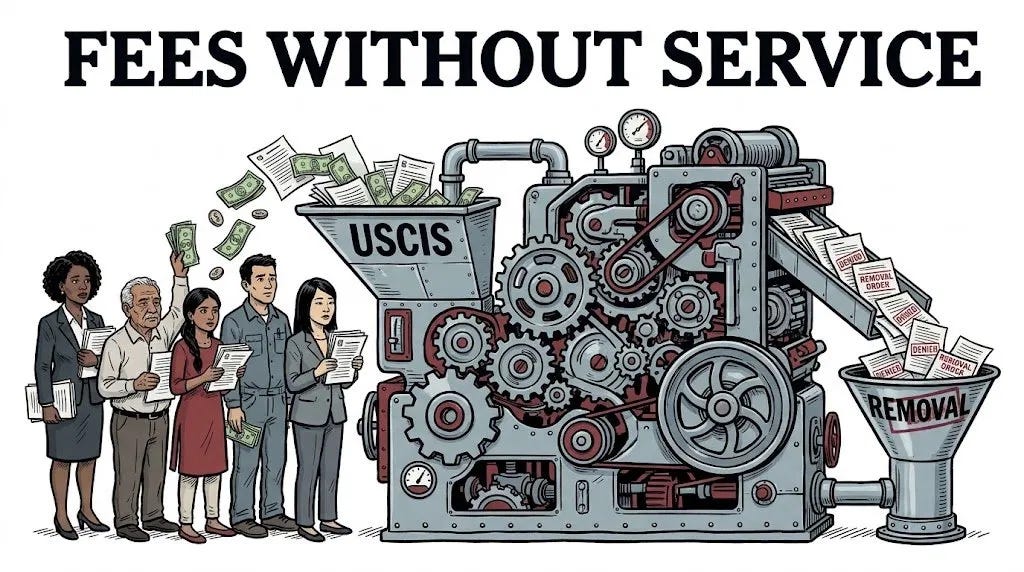
Because here is what almost no one is saying: USCIS is collecting fees from legal immigrants for applications it has chosen not to process. It is taking money for a service it is not delivering and has no plans to. And it is an agency that runs almost entirely on those fees.
That framing — fees without service — does not come from a member of Congress or an advocacy group. It comes from Jenn Budd, a former Border Patrol agent turned whistleblower, who put it plainly on social media in May 2026: USCIS is “taking millions in processing fees from legal immigrants… but not processing.” The delay has been reported. The fee relationship underneath the delay has not. This is an attempt to fix that.
Accepted, paid for, never decided
It is all documented, in the government’s own writings.
On December 2, 2025, USCIS issued Policy Memorandum PM-602-0192, which placed an indefinite “adjudicative hold” on every pending immigration benefit request filed by a national of an initial set of 19 designated countries. On January 1, 2026, a follow-on memo, PM-602-0194, expanded the hold to 39 countries.
Hold. Not “denial.” Not “additional review with a deadline.” Hold. Under both memos, USCIS continues to accept the applications. It continues to accept the filing fees that come with them. And then it does nothing — it neither approves nor denies, it simply holds the case in an indefinite pending state with no adjudication timeline attached.
The memos do not hide this. PM-602-0192 says the hold is “necessary to allow the agency to conduct a comprehensive review of its screening, vetting, and adjudication procedures.” It concedes that applicants will be burdened, and argues the burden is “necessary and appropriate when weighed against” national security. The administration’s good-faith case is roughly this: a vetting system it considers inadequate is worth pausing to rebuild, and a temporary backlog is the acceptable price. USCIS Director Joseph Edlow allowed that “there may be short-term pain” — while promising the agency would bring the backlog down “at a steady clip.”
But the country hold is only the sharpest edge of a larger pattern. USCIS ended fiscal year 2025 with roughly 11.6 million pending cases — plus a “frontlog” of around 248,000 applications physically received but not even entered into the system. Completions declined through the first three quarters of the second Trump administration even as new filings rose. And in October 2025, USCIS terminated the automatic extension that used to keep work-permit holders authorized while their renewals were pending — widening the gap between the moment a person’s status lapses and the soonest a renewal could possibly be processed.
The end result, by every one of these routes, is the same: a legal immigrant who becomes deportable without doing anything wrong. For a DACA (Deferred Action for Childhood Arrivals) recipient, the mechanics are precise. The renewal that used to take about fifteen days now takes a median of 122 days, by USCIS’s own data — and DACA confers no lawful status, only a promise not to act. When it lapses, the work authorization tied to it becomes invalid and the unlawful-presence clock starts again.
DHS has made its position explicit: DACA does not confer legal status, and a recipient whose grant has lapsed may be arrested and removed like any other person without status. The filing does not matter. The fact that USCIS is holding the money and the application does not matter. The moment the old card expires, the person is — in the government’s own framing — deportable.
An agency funded by the applications it won’t touch
Here is the part that turns a story about bureaucratic delay into something worse.
USCIS is roughly 96 percent fee-funded. Unlike most federal agencies, it does not run on congressional appropriations — it runs, almost entirely, on the fees applicants pay. The money legal immigrants hand over for work permits, green cards, and renewals is not incidental revenue. It is the agency’s operating budget.
Set that next to the fee schedule. Under the rule that took effect April 2024, USCIS charges $1,440 for a green-card application and $520 to renew a work permit on paper. The DACA renewal package runs around $555. And none of it comes back: USCIS fees are non-refundable by the agency’s own policy. You pay for a decision. If you don’t get one, the money stays.
How much money, in total?
The honest answer is that no one can tell you precisely. No audit, no inspector-general finding, no lawsuit has put a number on how many applications are being held or how much fee revenue is attached to them. Any figure has to be built from what the government itself has already disclosed — its own 11.6 million pending cases, its own published fee schedule. Run a conservative slice of those against even the lowest gas renewal fee and the number reaches the hundreds of millions. That is the piece’s own arithmetic, not an estimate handed down by an authority. But the order of magnitude is not in doubt. Budd said “millions.” The disclosed inputs say she was, if anything, low.
And then there is the asylum fee — the cleanest expression of the whole pattern, and a live one. In July 2025, the reconciliation law created an Annual Asylum Fee: a charge levied on a pending asylum case every year it stays pending, now set at $102. A federal court in Maryland briefly stayed it in Asylum Seeker Advocacy Project v. USCIS; that stay was lifted in February 2026.
Then, on April 28, 2026, DHS issued an interim final rule that gave the fee the teeth its first version lacked — a hard consequence for nonpayment. Under the rule, miss the payment and the asylum application is rejected, and the applicant, if they have no other lawful status, is referred for removal. For most affirmative asylum applicants the application is the only basis they have, so the practical effect is the plain one. The rule takes effect May 29, 2026 — days from now.
The government is billing a person recurringly, by the year, specifically because it has not processed their case — and the April rule wired in the consequence that makes the bill impossible to ignore: failure to keep paying for the privilege of remaining in limbo converts that limbo into a deportation referral.
“A decision must be made”
Federal courts have now examined the government’s national-security rationale, and have not been persuaded.
In Doe v. Trump, in the U.S. District Court for the District of Massachusetts, Judge Julia Kobick first enjoined the hold on April 30, 2026, then — after the consolidation of two related cases — extended the injunction on May 7 to cover 266 plaintiffs. She found the hold a likely violation of the Administrative Procedure Act, and found the government’s rationale rested on what she called “thin reeds”: the government had made no argument as to how two serious but isolated violent crimes, planned by two people from a single country, was rationally connected to halting adjudication for the nationals of dozens of countries.
The legal heart of her ruling is a single principle, stated in two places. Congress and USCIS, she wrote, “have specified that, at a certain point, investigations must end and a decision must be made.” The charge to conduct investigations, she held, “does not give USCIS authority to perpetually delay adjudication of applications.”
A parallel injunction followed in Maryland — Saghafi v. Edlow, before Judge George Levi Russell III — covering 83 plaintiffs, among them eight cancer doctors and researchers, each with an approved employment-based petition. People the United States had already, formally, decided it wanted. Held anyway. Fees collected anyway.
Why nobody calls it what it is
So if courts are enjoining this, and 86 members of Congress have written letters about it, why say nobody is covering the story?
Because of which story is being told. The delay has been covered — NBC News and NOTUS have run the human stories; NPR reported the logjam. On April 9, 2026, Representatives Jesús “Chuy” García and Lou Correa led 86 House members in a letter about renewal delays; Correa called it “a train wreck.” Senator Dick Durbin said letting USCIS “sit on renewal applications while DACA holders lose their protections” was “the President’s latest tactic to destroy DACA.”
Every one of those interventions frames the problem as delay. As backlog. As dysfunction.
What almost none of them name is the fee — and the distinction matters because of what it does to the available excuses. Delay can be explained away: incompetence, caution, an agency overwhelmed. Charging for the delay cannot. An agency that takes a non-refundable $1,440, or a recurring annual $102, and then declines to render the decision the payment was for is not failing to provide a service. It is running a racquet that is effectively stealing from applicants.
The injunctions are preliminary. They cover 266 people, 83 people — not the millions in the broader backlog. And none of the litigation, on its current trajectory, touches the fee structure at all, because no one has yet filed the case that frames this as money taken for a service not delivered. That case does not exist.
In the meantime, the engine runs. Cesar filed early. He paid. He followed every rule the government wrote. He cannot legally drive, his dream job is gone, and somewhere in USCIS’s 11.6-million-case pending pile is his application, and his money, and no decision.
At a certain point, the judge wrote, a decision must be made. The whole apparatus is built on the bet that it doesn’t have to be.
The RAMM documents the connections that beat reporting can’t see:
4,776+ sourced events at capturecascade.org.
1,988 Counties with signals of potential detention center expansion (Federal contracts, 287(g), real estate traces, etc) at detention-pipeline.transparencycascade.org my site that tracks signals of potential cooperation with ICE and Border Patrol.
129 Community fights over detention capacity built out tracked.
All of this is self-funded, and paid subscriptions are the only way I can continue to do this long term.
Sources
Primary Timeline Events:
USCIS Places Indefinite Adjudication Hold — PM-602-0192 (Dec 2, 2025)
USCIS Ends Automatic Deportation Protection for Child Immigrants — SIJS (May 10, 2026)
Primary Documents:
USCIS Policy Memorandum PM-602-0192 (Dec 2, 2025); PM-602-0194 (Jan 1, 2026)
Doe v. Trump, 1:25-cv-13946 (D. Mass.) — preliminary-injunction orders, Judge Julia Kobick (Apr 30 & May 7, 2026)
Saghafi v. Edlow (D. Md.) — preliminary injunction, Judge George Levi Russell III (Apr 24, 2026)
USCIS 2024 fee rule schedule; USCIS H.R.1 fee alert and Federal Register 2025-13738 (asylum fees, effective Jul 22, 2025)
USCIS FY26 Congressional Budget Justification (fee-funding structure); USCIS published processing-time data
García / Correa letter to DHS and USCIS leadership, 86 House members (Apr 9, 2026)
Reporting:
DACA recipients say monthslong renewal delays prevent them from working (NBC News)
Logjam of U.S. immigration applications puts millions at greater risk of deportation (NPR, Apr 17, 2026)
DACA Renewal Delays Are Pushing People Out of Work (NOTUS); Doe v. Trump coverage (The Hill, US News, Newsweek)
The lead: Jenn Budd, former U.S. Border Patrol agent and whistleblower, surfaced the fee-extraction framing publicly in May 2026.
Thank you!