

BORTAC: America’s Interior Occupation Force
How a detention riot squad became a domestic counterterrorism deployment — and why we now know who’s inside the masks
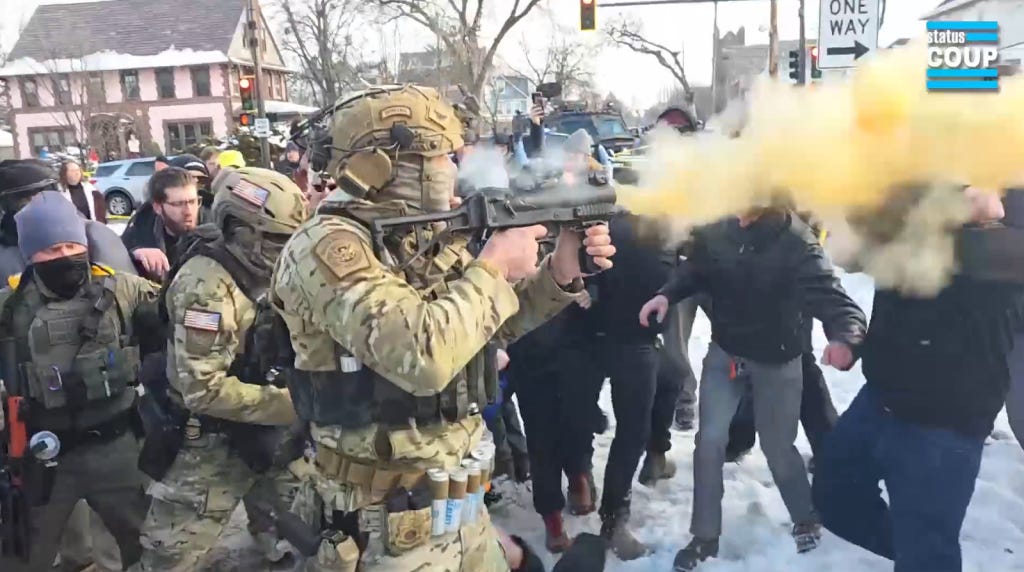
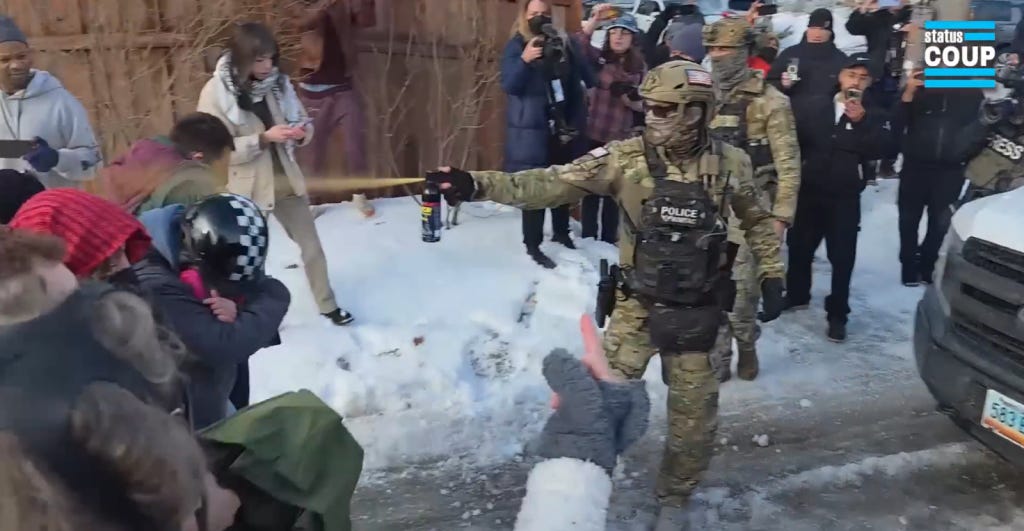
On January 7, 2026, the day ICE agent Jonathan Ross shot Renée Good through her windshield in Minneapolis, two Border Patrol agents from El Paso arrived at the scene. One of them, Edgar Vazquez, used his 40mm launcher to fire tear gas canisters into the crowd; five times in five minutes. The other, Michael Sveum, pepper-sprayed bystanders and lobbed a tear gas canister into the crowd as they left. Both men wore masks and tactical gear. Both carried military-style weapons. They were not identified by name on the scene.
They didn’t have to be. That was the point.
Vazquez and Sveum belong to BORTAC — the Border Patrol Tactical Unit — a Tier 1 federal law enforcement tactical unit that has trained with Navy SEALs and Delta Force, deployed to Iraq and Afghanistan, and operated in 28 countries. Investigative outlet Unraveled identified both agents on February 4 through analysis of CBP incident reports and over 70 hours of body-worn camera footage released by a federal judge. The same two agents had been documented deploying the same tactics against crowds in Chicago months earlier. They traveled to Minneapolis as part of former commander-at-large Gregory Bovino’s caravan.
BORTAC was created in 1984 to handle prison riots, and now is tear gassing civilians.
The mismatch between BORTAC’s origins, its evolution, and its current deployment tells us something important about what’s happening in Minneapolis — and what the administration intends for sanctuary cities nationwide. You don’t send a unit that trained with Navy SEALs to serve civil immigration warrants unless enforcement isn’t really the point.
Terror is the point. Now we know who’s delivering it.
The Mariel Boatlift and a Gap in Federal Capabilities
BORTAC exists because of a crisis forty years ago.
In 1980, roughly 125,000 Cuban refugees arrived in the United States during what came to be known as the Mariel Boatlift. Approximately 4,000 ended up incarcerated in federal facilities — some for lacking documentation, others for crimes committed after arrival. A series of riots and hostage-taking incidents at Immigration and Naturalization Service detention centers revealed a critical gap: no specialized federal tactical unit existed to handle such situations.
The original mission was narrow. BORTAC was established in 1984 to provide the INS with a specially trained unit “to address unusual situations within the service by use of special techniques” — specifically civil disturbances and hostage rescues at detention facilities. Prison riots. Hostage situations. That was the mandate.
The unit’s first major test came during the November 1987 Atlanta Federal Penitentiary riot, when Cuban detainees held over 100 hostages for 11 days. BORTAC participated alongside FBI SWAT, U.S. Marshals SOG, and Army special operations units. The crisis was resolved through negotiations. The unit had proven its value for exactly what it was designed to do.
Then mission creep began.
From Detention Facilities to Cocaine Labs to Combat Zones
By the late 1980s, BORTAC’s role expanded dramatically into counter-narcotics operations. The unit joined the DEA’s Operation Snowcap (1987-1995), conducting raids on clandestine cocaine laboratories and airstrips across nine Latin American countries including Bolivia, Peru, Ecuador, and Colombia.
This international experience established BORTAC’s credentials as a force capable of operating far beyond U.S. borders — and far beyond its original detention-facility mandate. The unit subsequently trained with Navy SEALs, Army Special Forces, and Delta Force, adopting military special operations methodologies that continue to shape its culture.
The September 11 attacks accelerated the transformation. BORTAC’s stated purpose shifted to “respond to terrorist threats of all types anywhere in the world in order to protect our nation’s homeland.” Between 2005 and 2011, BORTAC agents deployed to Jordan, Iraq, and Afghanistan. From 2008-2011, they advised and operated alongside Iraqi border police officers as members of Department of Defense Security Transition Teams.
By 2007, BORTAC had been placed under the newly formed Special Operations Group (SOG), headquartered at Biggs Army Airfield within Fort Bliss, El Paso, Texas. The unit that started as a detention riot squad was now a globally deployable counterterrorism force with combat zone experience.
Today, BORTAC maintains approximately 250 agents who undergo selection training with a 75-80% failure rate. The three-week selection course at Fort Bliss includes over 80 miles of rucking with 75-100 pound loads in a single week, 500-meter swims, drown-proofing tests, and sleep and food deprivation. Military.com describes it as “a combo of BUD/S Hell Week and SF selection,” referencing Navy SEAL and Army Special Forces training.
As a Tier 1 federal tactical unit — the same elite classification as FBI’s Hostage Rescue Team — BORTAC maintains joint training relationships with FBI HRT, U.S. Marshals SOG, DEA FAST teams, Navy SEALs, Army Special Forces, Delta Force, and DEVGRU.
This is what’s being deployed to Minneapolis neighborhoods.
Elián González: The First Domestic Controversy
The unit’s domestic capabilities, and the controversy that attends them, were demonstrated long before Minneapolis.
On April 22, 2000, at 5:15 a.m., six BORTAC agents executed a pre-dawn operation at a Miami home, retrieving six-year-old Cuban refugee Elián González from his relatives in approximately three minutes. The iconic photograph of a terrified child facing a helmeted, MP-5 wielding agent became one of the most controversial images of federal law enforcement action in the pre-9/11 era.
The operation was tactically flawless — three minutes, no casualties, objective achieved. But the image of a counterterrorism unit deployed against a family home to seize a child raised questions that would recur with each subsequent domestic deployment.
What is this unit for? And what are we saying when we deploy it?
Portland 2020: The Template
The 2020 Portland deployment answered those questions.
As part of “Operation Diligent Valor” during the George Floyd protests, 114 federal agents including BORTAC operators deployed to downtown Portland in July 2020, with 2,000 DHS officers on standby nationwide. The stated justification was protecting the federal courthouse. The reality was something else.
Agents in camouflage without clear identification detained protesters in unmarked vans without explanation. On July 11, BORTAC agents shot protester Donavan La Bella in the head with a “less-lethal” round, causing skull fractures requiring reconstructive surgery. Mark Pettibone was pulled into an unmarked van by unidentified agents, blindfolded, then released without charges. On July 18, Navy veteran Christopher David was beaten while standing passively, suffering a broken hand.
Portland Mayor Ted Wheeler called the deployment an “unconstitutional occupation.” He was personally tear-gassed while standing in a protest crowd.
Former CBP Commissioner Gil Kerlikowske — who led the agency under Obama — offered pointed criticism: “They’re clearly the wrong group to be doing this... This is not something they’re trained to do.”
The April 2021 DHS Inspector General report validated that assessment. Over the course of the three-month operation, 755 total DHS agents deployed at a cost of $12.3 million — and they were “unprepared.” The key finding: only about 10% received riot and crowd control training. Equipment was inadequate. DHS lacked a “comprehensive strategy” for such deployments.
A unit trained for hostage rescue and combat zones. Deployed for crowd control. With virtually no training for that mission.
The report documented 689 officer injuries from June 13-July 30, 2020. It did not document injuries to protesters — that wasn’t the IG’s mandate.
No one was held accountable. The template was established. And the personnel who execute it cycle from deployment to deployment with institutional memory intact and enthusiasm undiminished.
Sanctuary Cities: From 100 Agents to Occupation
In February 2020 — months before Portland — the administration had already signaled where BORTAC was headed.
One hundred agents, including BORTAC members, deployed to Atlanta, Boston, Chicago, Detroit, Houston, Los Angeles, Newark, New Orleans, New York, and San Francisco for three months of interior immigration enforcement support. Acting CBP Commissioner Mark Morgan revealed BORTAC had joined “over 70 operations” with ICE the previous year.
The ACLU characterized the deployment as sending “Special Forces-style Agents into Pro-Immigrant Cities” for “intimidation tactics.”
The second Trump administration has dramatically escalated that deployment. “Operation Metro Surge” in Minneapolis and “Operation Midway Blitz” in Chicago have flooded sanctuary cities with thousands of agents. In July 2025, the “One Big Beautiful Bill” reconciliation package allocated $170 billion over four years for immigration enforcement — the largest single infusion of enforcement spending in U.S. history. The administration has requested over 20,000 National Guard troops for interior enforcement support.
In Los Angeles, BORTAC deployed alongside 4,100 federalized National Guard troops and 700 active-duty Marines during 2025 unrest — at an estimated cost of $134 million. A federal judge ruled the deployment illegal, finding it violated the Posse Comitatus Act, the first such injunction since the law’s enactment in 1878. Governor Gavin Newsom, Mayor Karen Bass, and the LAPD chief all opposed the deployment.
Illinois and Chicago filed suit arguing BORTAC is a “SWAT team trained to operate as a quasi-military arm of federal law enforcement,” not trained for urban interior enforcement. A federal judge issued a preliminary injunction restricting agents’ use of force.
In Minnesota, BORTAC is on the ground as part of the 3,000-agent surge that has transformed Minneapolis into what Mayor Jacob Frey calls an “occupying force.”
The Agents
Federal operations depend on anonymity. Masked agents in unmarked vehicles, identification patches instead of names, body cameras that malfunction at convenient moments. The architecture of unaccountability is also the architecture of terror — you cannot hold accountable what you cannot name.
On February 4, 2026, investigative outlet Unraveled broke through that architecture. Reporters Steve Held and Raven Geary, both named plaintiffs in Chicago Headline Club v. Noem, identified members of an El Paso BORTAC unit that has been documented attacking civilians with chemical weapons in both Chicago and Minneapolis.
The identification method was straightforward. In November 2025, Judge Sara L. Ellis released CBP incident reports and over 70 hours of body-worn camera footage from Chicago-area operations. The reports contain full names, ages, service dates, and training records. Unraveled matched those reports to video footage, cross-referencing equipment markings, described actions, and in one case, an agent’s phone lock screen showing a photo from an Arizona ultrarunning event that matched his public social media. Open source investigators at Bellingcat independently documented the same agent’s use of force in Minneapolis, identifying him only by his patch number, EZ-17.
Two agents emerged as central figures.
Edgar Vazquez (EZ-17), 39, has been with Border Patrol since 2007. He is BORTAC-qualified and BORSTAR-trained, a certified firearms instructor, and trained in crowd control through the Mobile Field Force program. On January 7 in Minneapolis — the day Renée Good was killed — Bellingcat documented Vazquez firing his 40mm launcher at people five times within five minutes. Multiple shots targeted people’s heads. CBP’s own use-of-force policy explicitly prohibits targeting “the head, neck, groin, spine, or female breast” with projectiles and limits their use to subjects “offering active resistance.” The people Vazquez fired at were bystanders and protesters, not subjects under arrest, not individuals posing physical threats to agents.
Michael Sveum (EZ-2), 41, a supervisory agent since 2008. A BORTAC-qualified, BORSTAR-trained emergency medical technician, he is trained in vehicle pursuits and crowd control. At the same January 7 scene, Sveum pepper-sprayed bystanders and deployed CS gas. In Chicago on October 14, as agents prepared to gas a crowd in the East Side neighborhood, his body camera captured him telling a fellow agent: “Dude, this shit just motivates me.”
Unraveled also identified three additional members of their El Paso unit present at significant incidents: Oscar Meza, Derrick Flores, and Bryan Belen Lleras, along with senior agent Chad Hickman.
The same agents. The same tactics. Chicago in October. Minneapolis in January. Traveling with Bovino’s caravan from city to city, deploying chemical weapons against residents who gathered to witness what was being done to their neighbors.
The policy violations are not ambiguous. The training records show these agents completed Mobile Field Force crowd control certification. They know the rules. The rules don’t apply when no one enforces them.
The Accountability Vacuum
Who oversees a unit whose cost and effectiveness are, in the DHS Inspector General’s own words, “unknown”?
That’s the title of a 2016 DHS Office of Inspector General audit of the Special Operations Group — which found CBP had no formal performance measures for SOG and did not track the program’s total cost. Eight years later, the criticism persists. BORTAC does not have a distinct public budget line item, and is funded through CBP’s Operations and Support appropriation under Border Security Operations. The unit’s actual budget is unknown to the public — and possibly to Congress.
In January 2022, ten House and Senate committee chairs jointly requested a GAO audit and congressional investigation into CBP “Critical Incident Teams” following allegations the teams covered up agent misconduct. CBP Commissioner Chris Magnus subsequently terminated Critical Incident Teams in May 2022, transferring duties to the Office of Professional Responsibility.
But the accountability mechanisms remain weak. A 2024 GAO report found OPR needs strengthened independent guidance for investigators. Internal review boards exist on paper. Meaningful oversight is elusive.
The body camera record tells its own accountability story. When Unraveled analyzed footage from the October 23 Little Village incident in Chicago, agent Oscar Meza’s videos excluded a twelve-minute window — precisely the period during in which he fired his weapon at bystanders. Agent Edgar Vazquez had no camera footage available at all from the same incident. Agent Chad Hickman’s camera, however, captured Meza firing. The gap in Meza’s own record was filled only because a colleague’s equipment happened to be running.
This is the accountability vacuum operating at the level of evidence preservation. Cameras that go dark when weapons are fired. Reports that describe actions no available video can corroborate.
When an ICE agent killed Renée Good in Minneapolis on January 7, 2026, the FBI took over the investigation and immediately cut off state investigators. The Minnesota Bureau of Criminal Apprehension announced that the FBI had “reversed course” on a joint investigation — the state “would no longer have access to the case materials, scene evidence or investigative interviews necessary to complete a thorough and independent investigation.”
Minnesota’s state investigators have been locked out of a shooting that happened on Minnesota soil, involving a Minnesota resident, witnessed by Minnesota citizens. The same federal government that controls which body camera footage exists and which doesn’t will investigate itself.
The Chain of Command
The chain runs from the masked agents on Minneapolis streets directly to DHS Secretary Kristi Noem — the same official who stood at a podium reading “ONE OF OURS, ALL OF YOURS” after Renée Good’s killing. The policy decisions that put a combat-trained tactical unit in Minneapolis neighborhoods — conducting warrantless arrests based on how people look and sound — flow from her department.
In the field, BORTAC operated under Gregory Bovino — the Border Patrol Commander-at-Large who reports directly to Noem, and who a federal judge found had lied under oath about use of force during Chicago operations. The unit that trained with Delta Force operated under a commander who told agents to “go hard” and “hammer” protesters.
On January 28, Bovino was removed from command in Minneapolis. It is unclear whether Sveum, Vazquez, and other members of their El Paso BORTAC unit remain in Minnesota. DHS has not responded to Unraveled‘s request for comment. The command changed. The culture that motivates these agents has not.
Why This Unit? Why Here?
Return to the central question: Why deploy a unit trained for hostage rescue, counter-narcotics raids, and combat zones to Minneapolis neighborhoods for immigration enforcement?
The answer is not operational efficiency. BORTAC isn’t trained for this mission. The DHS IG established that. The lawsuit from Illinois and Chicago argues that. Former CBP Commissioner Kerlikowske stated it directly: “They’re clearly the wrong group to be doing this.”
The answer is not public safety. Minneapolis is not a combat zone. Immigrant communities are not terrorist cells. Renée Good was not a hostage-taker.
But the agents don’t distinguish between combat zones and American neighborhoods — because the deployment itself erases the distinction.
On October 14 in Chicago, after BORTAC agents gassed a crowd in the East Side neighborhood, agent Derrick Flores sat in an SUV with a man handcuffed in the backseat. CS gas seeped into the vehicle. The man began choking.
“Holy shit! Please!” he pleaded.
“Relax,” Flores replied. “They expose us to this shit all the time. You’ll be fine.”
They expose us to this shit all the time. The training. The selection course at Fort Bliss. The 75-80% attrition rate and the drown-proofing tests. Flores reached for his frame of reference and found BORTAC training — a frame in which chemical exposure is routine, something you endure to prove you belong. He applied that frame to a handcuffed civilian choking in the back of a truck.
This is what happens when you deploy a unit trained for combat zones into American communities. The agents carry their training with them. The people they encounter become the environment they trained for. Every neighborhood is a deployment. Every bystander is a potential threat. Every crowd is a situation requiring the application of force.
The answer is terror.
Collective punishment requires disproportionate response. The slogan on Noem’s podium — “One of Ours, All of Yours” — announces the framework. BORTAC is the instrument that makes the threat credible.
You send a unit that trained with SEALs and deployed to Afghanistan because you want the community to know what you’re capable of. You send operators in tactical gear with military-style weapons because you want families to understand that resistance will be met with overwhelming force. You deploy a counterterrorism unit against immigrant neighborhoods because you want those neighborhoods to feel like they’re being treated as enemy territory.
The mission isn’t enforcement. The mission is intimidation at scale. The mission is teaching entire communities a lesson — the same lesson the Klan taught during Reconstruction, the same lesson the Texas Rangers taught at Porvenir, the same lesson white mobs taught at Tulsa and Wilmington and Rosewood.
One of ours. All of yours.
BORTAC is how you deliver that message with federal authority and Tier 1 capabilities. And now, thanks to Unraveled, we know some of the names behind the masks.
The Trajectory
From 1984 to 2026:
A unit created for detention facility riots became a counter-narcotics force in Latin America, then a counterterrorism force in the Middle East, then a domestic deployment against protesters in Portland, then an occupation force in sanctuary cities.
At each stage, the mission expanded. At each stage, accountability failed to keep pace. At each stage, the mismatch between training and deployment widened.
Now BORTAC operates in Minneapolis under a Secretary who announced collective punishment doctrine from an official podium, commanded by officials who have been found to have lied under oath, investigating themselves after killing an American citizen, with a budget that remains unknown and oversight that remains inadequate.
The unit has the capabilities. The question is whether anyone can constrain how those capabilities are used.
The answer, so far, is no. But the anonymity they depend on is beginning to crack.
Mark Ramm is an investigative journalist and publisher of The RAMM on Substack. This piece follows his analysis of the “One of Ours, All of Yours” slogan and its American white supremacist genealogy. Tomorrow: “The Brotherhood” — how the 102-year-old culture that produced these agents works.
Sources
BORTAC History and Structure
U.S. Customs and Border Protection: Special Operations Group — Official description of SOG and BORTAC
Wikipedia: “Border Patrol Tactical Unit” — Comprehensive history and operational details
Military.com: “Border Patrol Tactical Unit (BORTAC)” — Selection process details, “combo of BUD/S Hell Week and SF selection” quote
1984 Founding and Early Operations
CBP Historical Reference: BORTAC established 1984 in response to Mariel Boatlift detention facility riots
Atlanta Federal Penitentiary riot (November 1987): Multi-agency response including BORTAC
Counter-Narcotics and International Deployments
Operation Snowcap (1987-1995): DEA-led counter-narcotics operations across nine Latin American countries
Iraq and Afghanistan deployments (2005-2011): Security Transition Teams advising Iraqi border police
CBP: BORTAC has conducted operations or training in 28 countries
Elián González Raid (2000)
Multiple news sources document April 22, 2000 pre-dawn raid
AP photograph by Alan Diaz became iconic image of federal tactical deployment
Portland 2020 Deployment
DHS Office of Inspector General: “DHS Had Authority to Deploy Federal Law Enforcement Officers to Protect Federal Facilities in Portland, Oregon, but Should Ensure Officers Can Effectively Respond to Civil Disturbances” (OIG-21-31, April 2021) — Key finding: only ~10% received riot training, 689 officer injuries, $12.3 million cost
Oregon Public Broadcasting: Coverage of Donavan La Bella shooting, Mark Pettibone detention, Christopher David beating
Former CBP Commissioner Gil Kerlikowske quote: “They’re clearly the wrong group to be doing this”
Portland Mayor Ted Wheeler: “unconstitutional occupation” characterization
Sanctuary Cities Deployments
ACLU: “DHS is Deploying Special Forces-style Agents into Pro-Immigrant Cities” (February 2020)
Acting CBP Commissioner Mark Morgan: BORTAC joined “over 70 operations” with ICE
February 2020 deployment: 100 agents to 10 sanctuary cities
2025-2026 Operations
Illinois/Chicago lawsuit: BORTAC characterized as “SWAT team trained to operate as a quasi-military arm of federal law enforcement”
Los Angeles deployment: 4,100 federalized National Guard, 700 active-duty Marines (2nd Battalion, 7th Marines), $134 million estimated cost (Pentagon testimony)
CNN: “Judge says Trump administration’s use of US military in LA violated federal law” — Judge Charles Breyer, first Posse Comitatus Act injunction since 1878
“One Big Beautiful Bill Act” (H.R. 1, P.L. 119-21): $170 billion over four years for immigration enforcement (signed July 4, 2025)
ACLU lawsuit Tincher v. Noem: Filed December 17, 2025 challenging ICE/CBP conduct in Minnesota
Uvalde Response (2022)
Texas House Investigative Committee Report on Robb Elementary shooting
Multiple news sources document BORTAC arrival at 12:15 p.m., breach at 12:50 p.m.
Finding: agents suffered “same decision-making paralysis” as local police
Cavalcante Manhunt (2023)
Pennsylvania State Police: BORTAC K9 “Yoda” subdued escaped murderer September 13, 2023
Multi-sector BORTAC deployment from Buffalo, Detroit, Blaine, Swanton, and SOG headquarters
Accountability and Oversight
DHS OIG Audit: “CBP’s Special Operations Group Program Cost and Effectiveness Are Unknown” (OIG-16-34, January 2016)
GAO Report (GAO-24-106148, 2024): OPR needs strengthened independence guidance
January 2022: Ten congressional committee chairs request GAO audit of Critical Incident Teams
May 2022: CBP Commissioner Chris Magnus terminates Critical Incident Teams
Chain of Command
DHS Secretary Kristi Noem: Confirmed January 2025
CBP Commissioner Rodney S. Scott: Confirmed June 2025
Chief, U.S. Border Patrol Michael W. Banks: Appointed January 16, 2025
SOG headquarters: Biggs Army Airfield, Fort Bliss, El Paso, Texas
CNN: Federal judge finds Bovino “admitted that he lied” under oath (November 6, 2025)
Bovino removed from Minneapolis command: January 28, 2026 (KSTP reporting)
Minneapolis/Renée Good
ABC News: “Minneapolis ICE shooting: A minute-by-minute timeline”
Minnesota AG lawsuit: Documents 3,000+ agents deployed, racial profiling allegations
FBI takeover of investigation: Minnesota BCA “would no longer have access to the case materials”
Mayor Jacob Frey: “occupying force” characterization
Identification of El Paso BORTAC Agents
Unraveled: “Identified: the El Paso BORTAC crew rampaging through the Midwest” (Steve Held, February 4, 2026) — Identification of agents Michael Sveum (EZ-2), Edgar Vazquez (EZ-17), Oscar Meza (EZ-13), Derrick Flores, Bryan Belen Lleras, and Chad Hickman through analysis of CBP incident reports and body-worn camera footage
Bellingcat: “Five Shots in Five Minutes: Analysing One Federal Agent’s Use of Less-Lethal Launcher in Minneapolis” (Trevor Ball, January 16, 2026) — OSINT analysis documenting EZ-17 (later identified as Vazquez) firing 40mm launcher five times in five minutes on January 7
CBP incident reports and body-worn camera footage released November 20, 2025 by Judge Sara L. Ellis in Chicago Headline Club v. Noem
Status Coup: Livestream footage from January 7, 2026 Minneapolis scene
Pacific Antifascist Research Collective: Initial public identification of Sveum (January 14, 2026)
CBP Use of Force Policy: Handbook — Prohibits targeting head, neck, groin, spine; limits projectiles to active resistance
Selection and Training
Selection course attrition: 75-80% failure rate
Documented example: 77 agents started, 18 finished, 12 selected
Three-week selection at Fort Bliss: 80+ miles rucking, 500m swim, drown-proofing
Eight-week certification course following selection
Unit strength: approximately 250 active agents
Equipment and Capabilities
Tier 1 federal tactical unit classification (same as FBI HRT)
Weapons: H&K USP Compact, UMP, M4 Carbines, precision rifles, Remington 870 shotguns
Training partnerships: FBI HRT, USMS SOG, DEA FAST, Navy SEALs, Army SF, Delta Force, DEVGRU
K9 units: Belgian Malinois
Related Coverage
One of Ours, All of Yours — The collective punishment doctrine BORTAC carries
Here Am I, Send Me — How DHS recruited an army using holy war and video game aesthetics
The Hammer: Gregory Bovino — The commander with the highest use-of-force ratio in Border Patrol
The Four Thresholds — The escalation framework from enforcement to occupation
Tomorrow: “The Brotherhood” — The 102-year-old culture that produced these agents
I saw Edgar Vazquez point a pistol at the heads of unarmed protesters at the Whipple Building the day after Renee’s murder. I watched it happen and couldn’t believe what I’d seen. There’s a video of the incident on Instagram here:
https://www.instagram.com/reel/DTRvMMbjjwc/
He had hundreds of feet of open space behind him and was also holding a “less lethal” rubber bullet or pepperball gun which he switched to his non-dominate hand in order to wield the pistol.
There is another video of him on reddit pointing some sort of rifle, not sure if lethal or “less lethal” at the heads of more unarmed civilians:
https://www.reddit.com/r/minnesota/comments/1q8lvmg/i_was_taught_trigger_discipline_when_i_was_13/
I am very surprised to learn that he has any amount of experience or training with either firearms or crowd control. Judging by his absolutely crazed, disassociated behavior on the day I encountered him, I assumed he was very new. I ended up face to face with him for a period of time staring into his eyes, so I got a good read on his state of mind. He was terrified.
It is an enormous relief to know his name. Thank you.
Great work, and thank you.
We have so many ways of excusing our treatment of urban citizens, and justifications built on cultural/racial stereotypes, which are built on urban legends that are untrue and concocted by populations with similar motivations of Steven Miller and Trump himself.
Whatever acronyms or initialisms are used, these are the dogs of war, released on our civilian neighborhoods, and the results were not only predictable, but actually predicted. Now we hear Trump calling to nationalize our elections, and Bannon stating they will be deployed at our polling places.
We all should be able to recognize the difference between a mishap predicted and a reign of terror implemented.