

JD Vance Thought He Could Weaponize Augustine against the Pope.
Vance uses the saint to sanctify the administration’s harshest policies. Two different Popes fought back.
On April 14, 2026, Pope Leo XIV said Mass at the Basilica of St. Augustine in Annaba, Algeria — the ground above ancient Hippo, where Augustine served as bishop for thirty-four years and wrote the texts that founded the Western tradition of just-war theory.
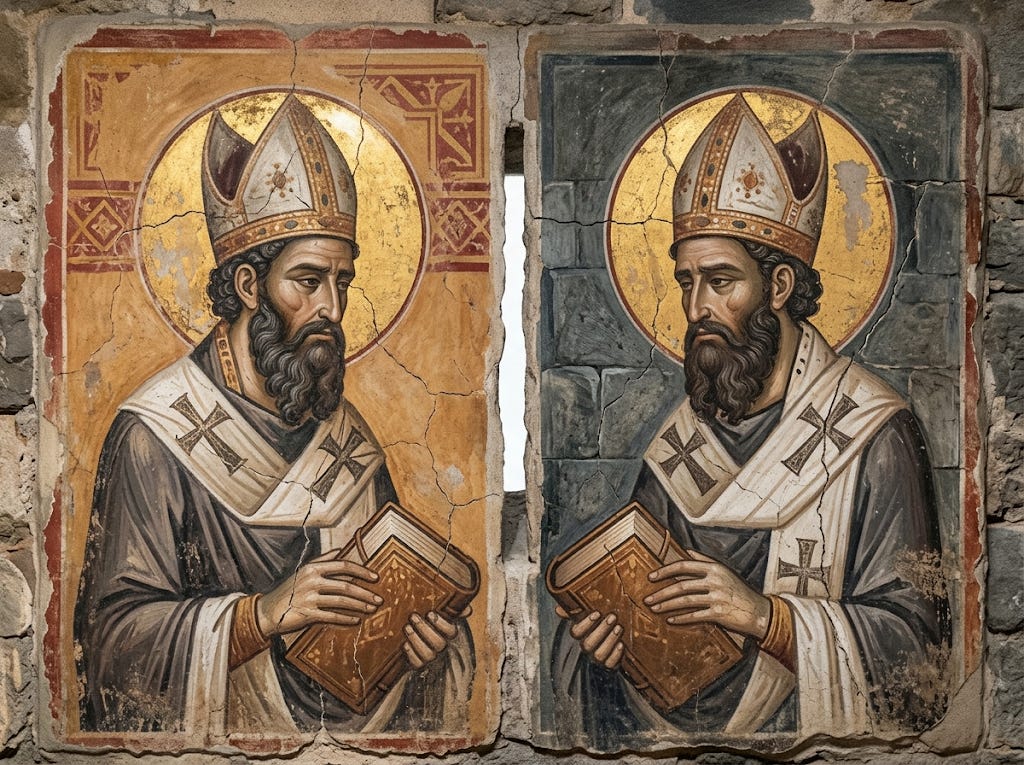
That same day, in Athens, Georgia, the Vice President of the United States stood at a Turning Point USA event and warned that pope to “be careful” when he talks about “matters of theology” — citing, against him, “the more than 1,000-year tradition of just war theory.”
JD Vance’s Catholic confirmation name is Augustine. He chose it himself, six years ago, when he converted — citing a chapter of Augustine’s City of God he found relevant to his policy thinking.
So here is the tableau, the two halves of a single day: a convert Vice President invokes Augustine to correct the Pope on the morality of a war, while the Pope — the first Augustinian to hold the office — celebrates Mass on the floor of Augustine’s own church. Neither man planned the symmetry. That is what makes it worth reading. It is the second time in fourteen months that the same thing has happened — Vance reaching for the Catholic tradition’s own vocabulary to sanctify the hardest thing his administration was doing, and the papacy answering him with that same vocabulary turned the other way.
Hold onto the detail that he is a convert, because it is the whole argument. Vance does not attack the Church from outside it. He fights from within, with the tradition’s own weapons — ordo amoris, just-war theory, Augustine himself. And that is precisely why he keeps losing: a captured tradition cannot win an argument inside the tradition’s own authority, because it has no language of its own. It borrowed the language. And the lender keeps showing up.
One frame governs everything below, so let me set it once. This piece reads documented events through an interpretive lens, and the line between the two has to stay visible. What is documented: what Vance said, what the popes said in reply, the dates, the USCCB’s correction. What is mine: the claim that these episodes form a single pattern, that the popes were “answering” Vance, that any of it was coordinated. Where a specific reading is contestable — and several are — I will say so at the moment it matters. The strength of the pattern is that it survives the disclaimers.
February 2025: The First Front — Ordo Amoris
It started with immigration.
In late January 2025, on Fox News with Sean Hannity, Vance reached for theology to defend the administration’s program of mass deportation. “There’s this old school — very Christian — concept,” he said, “that you love your family, then you love your neighbor, then you love your community, then you love your fellow citizens in your own country, and then after that, you can focus and prioritize the rest of the world.”
He later named the concept: the ordo amoris. The order of love. Rightly-ordered love. It is a real category in the tradition — and it is, specifically, Augustine’s, from the City of God, where Augustine offers it as a definition of virtue itself.
It was an unusually fluent move for a sitting Vice President: not just defending a policy, but reaching past the policy into the deep grammar of Catholic moral theology to claim the policy was the ordered thing, the virtuous thing, the thing rightly-ordered love required.
On February 10, 2025, Pope Francis answered. In a letter to the United States bishops expressing concern over the deportation program, Francis took up the exact concept Vance had deployed and turned it inside out: “Christian love,” he wrote, “is not a concentric expansion of interests that little by little extend to other persons and groups.” The true ordo amoris, he said, “is that which we discover by meditating constantly on the parable of the ‘Good Samaritan’” — “the love that builds a fraternity open to all, without exception.”
Read that against Vance’s “and then after that, you can focus and prioritize the rest of the world.” One man says love radiates outward in widening, prioritized rings, with the stranger last. The other says the whole point of the parable Jesus told is that the stranger — the Samaritan, the foreigner, the wrong kind of person — is exactly where the obligation begins.
A necessary caveat, per the frame above: Francis did not name Vance. He answered a use of ordo amoris, not a person — though the timing, and how the entire Catholic press read it, leave little doubt about the target. And on its face this is an ordinary thing for a pope to do; popes have always taught on the treatment of the stranger. Taken alone, it is not exotic.
What makes it the opening of a pattern is what happened the very next day — and what the man at the center of it did again, a year later, with a different doctrine and a different pope.
February 11, 2025: The Second Front Opens — One Day Later
The day after Francis’s letter, Vance was in Paris.
At the Artificial Intelligence Action Summit, in his first major policy address abroad, he delivered the administration’s signature statement on AI. Its defining line: “I’m not here this morning to talk about AI safety, which was the title of the conference a couple of years ago. I’m here to talk about AI opportunity.”
He warned that “excessive regulation could kill” the industry, and laid out four priorities — American AI “dominance,” freedom from regulation, freedom from “ideological bias,” a “pro-worker growth path.” It was a full-throated rejection of the precautionary, safety-first posture, recast as hand-wringing that would let foreign competitors win.
At the time, this looked like a separate story. Immigration was the theology fight; AI was the tech-policy speech. They were a day apart and they did not obviously touch.
Hold that thought. The day-apart adjacency is a documented coincidence, not a plan — Vance did not link the two, and I am not claiming he did. But keep the Paris speech in view, because fifteen months later a pope would answer it almost line for line, and the two fronts — immigration and AI — would turn out to be the same war fought on two fields.
The RAMM documents the connections that beat reporting can’t see:
4,500+ sourced events at capturecascade.org.
~2000 Counties with signals of potential detention center expansion (Federal contracts, 287(g), real estate traces, etc) at detention-pipeline.transparencycascade.org my site that tracks signals of potential cooperation with ICE and Border Patrol.
129 Community fights over detention capacity built out tracked.
All of this is self-funded, and paid subscriptions are the only way I can continue to do this long term.
Round Two — Just War
The pattern proved it was a pattern fourteen months later, with a different doctrine, a different war, and a different pope.
By the spring of 2026, the war was no longer a metaphor. The administration’s military operations against Iran were underway, and Pope Leo XIV — Francis’s successor, elected May 8, 2025 — had been escalating against them. He had called the threat to “annihilate Iranian civilization” “truly unacceptable.” On April 10, speaking to Chaldean Catholic bishops in Rome, he went further: “God does not bless any conflict,” he said; whoever is a disciple of Christ “never stands on the side of those who yesterday wielded the sword and today drop bombs.”
Trump answered on Truth Social, calling the pope “weak on crime” and “terrible for foreign policy.” That was the political response. The theological response came four days later, from the Vice President.
At a Turning Point USA event at the University of Georgia on April 14, Vance told the Pope to “be careful” — “it’s very, very important for the pope to be careful when he talks about matters of theology” — and invoked “the more than 1,000-year tradition of just war theory” to argue the Pope had it wrong. Border czar Tom Homan added that the Church should “stay out of politics.”
The just-war tradition Vance reached for is, again, Augustine’s — Augustine first articulated the conditions under which a Christian could licitly take up the sword. And again the magisterium answered in its own vocabulary. The next day, Auxiliary Bishop James Massa of Brooklyn, chairman of the U.S. Conference of Catholic Bishops’ Committee on Doctrine, issued a corrective: when “Pope Leo XIV speaks as supreme pastor of the universal Church, he is not merely offering opinions on theology, he is preaching the Gospel.” And the thousand-year just-war tradition Vance invoked, Massa noted, actually requires that a nation take up the sword only “in self-defense, once all peace efforts have failed” — which is to say, the tradition Vance cited cut against him.
And as Vance spoke in Georgia, Leo was in Annaba, saying Mass in Augustine’s own basilica.
This is the move, twice now — and the second time reveals what the first only suggested. Immigration and a war; ordo amoris and just-war theory; Francis and Leo. Two issues, two doctrines, two popes — and the same structure underneath each: Vance reaches for a Catholic concept to make a hard policy feel ordered, just, righteous, and the holder of that concept’s authority answers in the concept’s own terms. Because the dispute is intra-Catholic — a fight over who gets to say what the tradition means — the captured side faces a problem it cannot solve: it speaks the tradition’s language because it has no other, so when the tradition’s own authority answers in the same language, there is no separate ground to retreat to. Vance cannot say “that’s your theology, this is mine.” Ordo amoris and just war and Augustine were never his. He borrowed them. The lender keeps answering.
May 2026: The Encyclical Answers Paris
Which brings us back to the speech in Paris.
On May 25, 2026, Pope Leo XIV released his first encyclical, Magnifica Humanitas — 42,300 words “on safeguarding the human person in the time of artificial intelligence.” It calls for AI to be “disarmed” from “logics of domination, exclusion and death.” And read against the four pillars Vance had announced in Paris fifteen months earlier, it is almost a point-by-point rebuttal.
Vance had said he was not there to talk about safety; he was there to talk about opportunity. The encyclical’s organizing concern is the opposite: the protection of the human person, and the duty to slow down. Where Vance warned that “excessive regulation could kill” the industry, Magnifica Humanitas (§5) holds that “it is necessary to establish adequate regulatory tools capable of upholding justice and curbing the distorting effects of technological power.” Regulation, in Leo’s grammar, is not the threat to be cleared away. It is the duty.
Where Vance promised AI kept “free from ideological bias,” the encyclical worries about a different distortion entirely — algorithms that, as Leo writes, when “new forms of property” like “algorithms, digital platforms” stay concentrated in a few hands (§67), “widen the gap between the included and the excluded.” Where Vance promised a “pro-worker growth path,” Leo reaches back to Rerum Novarum, Leo XIII’s 1891 encyclical on the exploitation of workers in the Industrial Revolution, and casts AI as a comparable threat to the dignity of labor — the worker as the one to be protected from unrestrained technology, not the beneficiary of its deregulation. And where Vance celebrated American AI “dominance,” Leo names the danger by its structure: “the main drivers of development are private, often transnational, parties” (§5) now steering technological power beyond the reach of states; platforms that “define conditions for access, rules of visibility, forms of interaction, and even economic opportunities” (§71).
The encyclical names no Vice President. It names no company. It is a general document of Catholic social teaching on a new technology. The claim that it “answers” Vance is my framing, not Leo’s — the speech and the encyclical are fifteen months apart, and the encyclical addresses the world, not a man. But the content opposition is not framing. It is on the page, on both pages, in black and white: opportunity versus safety; deregulation versus “adequate regulatory tools”; dominance versus “the distorting effects of technological power.”
The Tell: Anthropic Stands With the Pope
There is one more detail from May 25 that turns this from a two-body problem into a three-body one.
When Leo presented Magnifica Humanitas at the Vatican Synod Hall, he did not present it alone. Beside him stood Chris Olah, a co-founder of Anthropic — one of the frontier AI labs — calling, with the Pope, for a partnership between the Church and the tech industry to build safeguards on AI. “We need informed critics who will tell the labs when we are failing,” Olah said. “We need moral voices that the incentives cannot bend.” The Washington Post headlined the moment plainly: “Anthropic aligns with Vatican over White House.”
This is not Anthropic’s first break with the administration over exactly this question. The company had already refused a Pentagon ultimatum over its safety red-lines; the administration had retaliated by designating it a “supply-chain risk”; Anthropic had sued the Department of Defense. The Vatican alignment extends that fight from the procurement world into the religious one.
And it matters here for a specific reason — one you can only see by looking at the theology underneath the tech-right, the part it would prefer to keep coded.
What the Pattern Reveals: The Captured Tradition
It is not subtle, once you have heard it. In a four-part private lecture series in late 2025 — recorded, and reviewed by UC Berkeley digital-forensics expert Hany Farid, who judged the audio probably authentic — Peter Thiel, Vance’s mentor and early funder, inverted the Christian story. The Antichrist, in Thiel’s telling, is not the technologist. The Antichrist is the luddite — the one who scares the world into surrendering control of science and technology in the name of safety. The figures he names as that lawless, restraining force are the people who would constrain the technological project: climate activist Greta Thunberg, AI-safety researcher Eliezer Yudkowsky. And the category — the safety-invoking restrainer as the lawless one — is precisely where a pope who teaches AI ethics lands. (I take that christology apart on its own terms in a companion piece tomorrow; here, the frame is enough.)
Now hold it up against the stage at the Vatican on May 25. Thiel’s theology has two archetypal luddites: the AI-safety advocate, and the pope who teaches AI ethics. On that one stage, on that one day, both of them stood together — an AI-safety lab and the Pope, allied in public, calling for exactly the moral limits Thiel’s theology is built to discredit. The legitimation layer’s two designated villains, shoulder to shoulder. It is the precise photographic negative of the story the tech-right needs to be true.
And it tells you what the Vance-versus-Pope arc actually is. It is not a culture-war sideshow. It is the place where that legitimation layer — the theological cover that makes the deportations and the AI buildout and the war feel righteous to the people running them — collides with the actual authority whose language it borrowed.
A note on what this is not, because the discipline matters. This is not evidence of a plot to fuse church and state. Thiel, on the same tapes, warns explicitly against that fusion — he is on record saying Vance is “too close to the Pope,” and naming caesaropapism, the merger of religious and political authority, as exactly the danger his framework opposes. The tech-right is not marching toward a confessional state. The honest finding is sharper and stranger than a theocracy plot: the legitimation layer is a borrowed grammar, drawn on selectively for the sanctification it provides — and this arc is precisely where the borrowing fails, where the lender calls in the loan. You can hear the failure inside the movement’s own house. First Things — the flagship magazine of the postliberal-Catholic project that Vance’s whole framework runs through — published, in the days after the just-war confrontation, an essay titled “Trump, Leo, and the Death of Integralism.” The integralists themselves understood what had been exposed: a movement that invokes Catholic authority to govern liberalism, but refuses Catholic authority the moment the Pope actually exercises it.
What Comes Next
The arc is not finished. Leo is still young for a modern pope, and he has made AI and war the signature concerns of a pontificate that is barely a year in. Vance is the frontrunner to inherit the movement. The two fronts — who belongs, and who may be killed — are not going away; if anything the encyclical raised the stakes by making the AI fight magisterial.
So watch for the next round. Watch whether Vance answers the encyclical, and in what vocabulary. Watch whether more of the Church’s institutional weight — the USCCB has now corrected him once, on the record — accumulates into something that looks less like individual rebukes and more like the slow formation of a confessing position. And watch the tell: watch which way the safety-minded parts of the tech industry break, now that one of them has stood at the Pope’s side against the White House.
But the deepest thing the arc has already shown does not depend on what happens next. It is this. A man can capture an institution’s vocabulary. He can learn its words, take its saint’s name, deploy its deepest concepts with real fluency in the service of power. What he cannot do is capture the institution’s authority to say what those words mean. That stays with the office. And so the captured tradition keeps walking into the same trap: it reaches for Augustine to bless the thing being done, and Augustine — by way of the Good Samaritan, by way of just war’s actual conditions, by way of a pope saying Mass in his basilica — keeps answering back.
You can borrow the words. You cannot borrow the right to define them. That is the one thing capture cannot reach.
Sources
Primary Timeline Events:
Vance rebukes Pope Leo XIV on just war; USCCB corrects (Apr 14, 2026)
Pope Leo XIV’s encyclical Magnifica Humanitas (May 25, 2026)
Anthropic co-founder Olah presents the encyclical at the Vatican (May 25, 2026)
Capture Cascade Context:
Reporting:
“Vance warns the pope should ‘be careful’ when talking about theology” (NBC News, Apr 15, 2026) — https://www.nbcnews.com/politics/trump-administration/vance-warns-pope-careful-talking-theology-rcna331881
“US bishops’ doctrine chair defends church’s just war tradition after JD Vance comments” (America Magazine, Apr 15, 2026)
“Pope Francis takes aim at Vance’s definition of ‘ordo amoris’” (Religion News Service, Feb 11, 2025)
“In his first encyclical, Pope Leo XIV says AI must serve humanity, not the powerful few” (Religion News Service, May 25, 2026)
“Anthropic aligns with Vatican over White House as Pope Leo addresses AI fears” (The Washington Post, May 25, 2026)
“Remarks by the Vice President at the AI Action Summit in Paris” (White House transcript / American Presidency Project, Feb 11, 2025)
Primary Document:
Leo XIV, Magnifica Humanitas (encyclical, signed May 15, 2026; §§5, 7, 67, 71) — vatican.va
Companion piece: “The Antichrist as Luddite” — on the christology Peter Thiel articulated on tape, and why it has to stay coded.