

After Anthony Burns, No Fugitive Was Ever Returned from Massachusetts: Minneapolis Is Writing Its Chapter Now
The 1850s: federal marshals hunting escaped slaves in northern cities. Anthony Burns marched to the ship through 50,000 Bostonians.
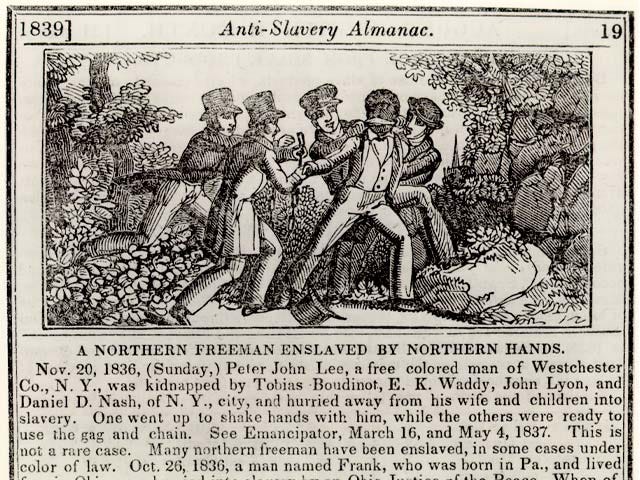
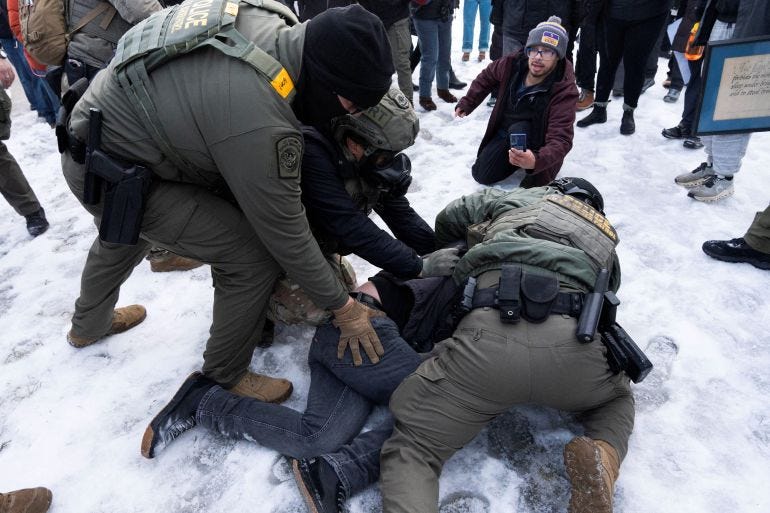
Now: 3,000 federal agents in Minneapolis — the institutional descendants of the slave patrols, the Klansmen who founded Border Patrol in 1924. Two citizens dead in 17 days. Both called “domestic terrorists” before their bodies were cold.
On January 28, 2026, ICE agents attempted to enter the Ecuadorian consulate in Minneapolis. Consulates have diplomatic immunity under international law — entering one without permission is an act against a foreign nation.
They were blocked.
The Fugitive Slave Act violated state sovereignty. The Burns rendition required federal troops to override local resistance.
Now they’re testing whether international law will hold.
The pattern is escalation. When one boundary holds, they push the next.
Boston, 1854
On May 24, 1854, federal marshals arrested Anthony Burns, a man who had escaped slavery in Virginia and was living in Boston. Under the Fugitive Slave Act of 1850, the federal government was authorized to hunt escaped slaves in free states — and required local authorities to assist.
The law was designed to make resistance impossible. Federal commissioners who ruled that a person was a fugitive received $10; if they ruled the evidence insufficient, they received only $5. Citizens could be deputized on the spot to assist in captures. Anyone who aided a fugitive — with food, shelter, or information — faced six months in prison and a $1,000 fine (equivalent to nearly $40,000 today). State and local authorities were required to cooperate.
Boston refused.
The Vigilance Committee
The Boston Vigilance Committee had been organizing since 1850 — a coalition of Black residents and white abolitionists who understood that unjust laws are not self-enforcing. Withdraw participation, and the system strains.
Their tactics would be familiar to anyone watching Minneapolis today: networks and safe houses moving fugitives to Canada. Warning systems tracking slave catchers. Lawyers filing suits charging conspiracy to kidnap. Documentation ensuring everyone involved in returning a human being to slavery would be known. And when legal methods failed, direct action.
The Rescue of Shadrach Minkins
On February 15, 1851, federal agents arrested Shadrach Minkins at a Boston coffeehouse — minutes after he had served them coffee. He was the first person seized in New England under the new Fugitive Slave Act.
The Vigilance Committee didn’t wait for legal proceedings.
A group of about 20 Black activists, led by Lewis Hayden, stormed the courthouse and freed Minkins by force. They carried him to Beacon Hill, hid him in an attic until nightfall, and smuggled him out of town. With the help of the Underground Railroad, he eventually reached Canada.
President Millard Fillmore was furious. He called on Boston citizens to respect the law and demanded Minkins be recaptured. He threatened to use the army.
Minkins was never caught.
The Failure with Thomas Sims
The federal government learned from the Minkins rescue. When Thomas Sims, another escaped slave, was captured in April 1851, they were prepared.
Over 100 police officers armed with double-edged swords, plus another 100 volunteers with clubs, drilled for days. They wrapped chains around the courthouse and stationed guards at every entrance. They built a covered walkway from the courthouse to the ship so protesters couldn’t reach him.
At 4 a.m. on April 12, 1851, they marched Sims to the harbor before the city was awake. The Vigilance Committee couldn’t save him.
He was returned to Georgia and publicly whipped.
Anthony Burns: The Breaking Point
Three years later, Anthony Burns was arrested.
This time, everything escalated.
The Vigilance Committee split between those who wanted peaceful protest and those who wanted direct action. The militant faction, led by minister Thomas Wentworth Higginson, gathered axes and other weapons. On the night of May 26, they attacked the courthouse with a battering ram.
The rescue failed. In the chaos, a federal marshal named James Batchelder was killed. Burns remained in custody.
But the attack changed the political calculation. President Franklin Pierce, determined to prove the federal government could enforce the law even in abolitionist Boston, sent federal troops. Not local militia — the U.S. Army and Navy.
On June 2, 1854, Anthony Burns was marched from the courthouse to the harbor. The force required to move one man:
1,500 Massachusetts militiamen
The entire Boston police force
145 federal troops with cannon
100 special deputies
U.S. Marines and infantry
Fifty thousand Bostonians lined the streets in protest.
Businesses along State Street closed for the day. Buildings were draped in black mourning fabric. American flags hung upside down — the signal of distress. Someone strung a coffin above the intersection with the word “LIBERTY” inscribed on it.
The crowd hissed, booed, and jeered the procession. They shouted “Shame!” and “Kidnappers!” as Burns passed.
The federal government spent between $40,000 and $100,000 to return one man to slavery — equivalent to $1.4 million to $3.5 million today.
What Boston Proved
It was the last fugitive slave rendition from Massachusetts.
Not because the law changed — the Fugitive Slave Act remained on the books until 1864. It stopped because the cost became unsustainable.
The political cost: Amos Lawrence, a wealthy conservative Whig who had supported the Fugitive Slave Act, wrote: “We went to bed one night old-fashioned, conservative, Compromise Union Whigs and waked up stark mad Abolitionists.”
The operational cost: In the three years after Sims was returned, the Vigilance Committee helped more than 300 fugitives escape.
The legal cost: In 1855, Massachusetts passed the Personal Liberty Act — prohibiting state officials from assisting in fugitive slave cases, disbarring attorneys who participated, authorizing impeachment of collaborating judges.
After the law passed, no fugitive was ever again returned from Massachusetts.
The Vigilance Committee didn’t end slavery. They didn’t save everyone. But they made enforcement so expensive, so politically poisonous that the system broke — at least in that place, at that time.
Minneapolis, 2026
On January 7, 2026, ICE agent Jonathan Ross shot Renee Nicole Good three times as she sat in her SUV in Minneapolis. One bullet entered her left temple. Her last words: “That’s fine, dude. I’m not mad at you.”
On January 24, 2026, Border Patrol agents shot Alex Pretti while he was on the ground. The Washington Post confirmed agents had already removed his legally-carried handgun from his waistband before they opened fire.
Within hours of each killing, administration officials called both victims “domestic terrorists.”
The videos showed a woman turning away. A man with a phone in his hand, palm raised.
Hours after Pretti was killed, Attorney General Bondi sent a letter to Governor Walz: we’ll withdraw ICE if you hand over Minnesota’s unredacted voter rolls. Driver’s licenses. Social Security numbers. Every voter.
Arizona’s Secretary of State: “This is blackmail. This is the way organized crime works. They move into your neighborhood, they start beating everybody up, and then they extort what they want.”
The Fugitive Slave Act compelled compliance through threat of federal force. Now they’re putting the extortion in writing.
The Parallels
The Fugitive Slave Act required local cooperation. States are now pressured to assist deportation operations.
The Boston Vigilance Committee built networks of warnings, safe houses, and legal defense. Minneapolis has Signal chats, 3D-printed whistles (volunteers drop them off by the bagful at coffee shops), legal observer trainings, sanctuary networks.
Boston businesses closed and draped their buildings in black mourning. More than 700 Minneapolis businesses closed in coordinated economic shutdown.
Fifty thousand Bostonians lined the streets in protest. Tens of thousands marched in Minneapolis in subzero temperatures.
Moving one man to the harbor required the U.S. Army, Navy, and Marines. Minneapolis required 3,000 federal agents — more than MPD and St. Paul police combined.
The federal government spent $40,000 to $100,000 to return Anthony Burns. The cost of indefinite occupation: unknown but mounting.
Massachusetts passed the Personal Liberty Act to nullify federal enforcement. Minnesota has TROs, state lawsuits, evidence preservation orders.
Amos Lawrence, the conservative who supported the Fugitive Slave Act, wrote that he “waked up stark mad Abolitionist.” Chris Madel, the Republican who was providing legal counsel to the agent who killed Renee Good, called ICE operations an “unmitigated disaster” and dropped out of the governor’s race.
One federal marshal was killed in the Burns resistance. Two citizens have been killed by federal agents in Minneapolis.
The Fugitive Slave Act used violence to compel compliance. Bondi’s letter offers to withdraw ICE in exchange for voter rolls.
After the Burns rendition, no fugitive was ever returned from Massachusetts.
Minneapolis: pending.
The playbook is the same. The resistance is the same. The question is whether the outcome will be the same.
The Difference Is the Cameras
In 1854, news of the Burns arrest spread by word of mouth and newspaper. The 50,000 who lined the streets came because of broadsides posted on walls and announcements read from pulpits.
In 2026, video of Alex Pretti’s death was circulating within minutes. Witness declarations were filed in federal court within hours. The administration’s lies were debunked in real-time, with multiple camera angles contradicting every official claim before the press conference was over.
Governor Walz: “Thank God, thank God, we have video.”
The infrastructure of resistance that Boston built over years, Minneapolis activated in days. A federal judge demanding ICE leadership appear in court — the modern equivalent of Massachusetts lawyers charging slave catchers with conspiracy to kidnap.
Boston’s resistance didn’t prevent Anthony Burns from being returned to slavery. It didn’t save Thomas Sims. It couldn’t protect everyone. But it made a stand. It drew a line. It said: this will not happen here without cost.
Minneapolis has already buried Renee Good and Alex Pretti. It may bury more before this ends. The federal government has resources the Vigilance Committee couldn’t imagine — surveillance technology, armored vehicles, thousands of agents, a propaganda apparatus that can label the dead as terrorists before their families are notified.
But it also faces something the slave catchers of 1854 didn’t: a city that learned from George Floyd, that built infrastructure, that has video rolling at all times, and that has already demonstrated it will not comply.
The Conversions
Chris Madel is a Republican attorney who was running for governor of Minnesota. When Renee Good was killed, he agreed to provide pro bono legal counsel to Jonathan Ross, the ICE agent who shot her — helping him file for DOJ representation.
He was inside the apparatus.
On January 26, 2026 — two days after Alex Pretti was killed — Madel dropped out of the race. He called the ICE operation an “unmitigated disaster.” He blamed national Republicans for making it “nearly impossible” for Republicans to win in Minnesota.
That’s more dramatic than Amos Lawrence. Lawrence watched from the crowd. Madel was inside the apparatus — and converted while still advising the agent.
He’s not alone. The Associated Press documented growing Republican calls for deeper investigation. Even Maria Bartiromo pushed back on Kash Patel: “How was he threatening Border Patrol? He was filming it.”
The conversions are happening in real-time.
The Awakening
People who thought the system worked are watching federal agents shoot citizens, lie about it on camera, and investigate themselves. They went to bed thinking this was a policy dispute. They’re waking up understanding it’s something else.
At the Timberwolves game, the crowd broke a moment of silence for Alex Pretti with chants of “Fuck ICE.” The National Guard handed out coffee to protesters while federal agents inside the Whipple Building processed arrests.
The violence is spreading. On January 27, Rep. Ilhan Omar was physically attacked at a town hall by a pro-Trump felon. The pattern escalates: verbal threats to physical assault on elected officials.
Governor Walz: “a campaign of organized brutality against the people of our state.”
Mayor Frey: “bullshit” — “a federal agent recklessly using power that resulted in somebody dying.”
Minnesota school superintendents issued a joint statement condemning ICE operations. The resistance is no longer just activists — it’s institutions.
The Woman Who Saved the Agent
On January 27, 2026, a woman detained by ICE watched an agent collapse from a seizure.
She didn’t hesitate. She performed first aid. She kept him breathing until paramedics arrived. She saved his life.
After he recovered, she was still processed for deportation.
The Fugitive Slave Act couldn’t recognize the humanity of those it targeted. The system saw only property to be returned, not people to be protected. The slave catchers who dragged Anthony Burns through Boston didn’t see a man who had built a life, learned to read, found work and community. They saw $1,200 in property value.
This system can’t see humanity either.
A woman saves an agent’s life, and the paperwork continues. The deportation proceeds. The system cannot compute mercy because mercy isn’t in the code.
That’s what Minneapolis is fighting. Not just bad policy. Not just brutal enforcement. A system designed to be blind to the humanity of its targets — even when that humanity is saving the life of the person processing their removal.
The slave power didn’t accept Boston’s resistance gracefully. The tensions that exploded there would explode across the nation within seven years.
But in that place, at that time, the resistance held. The networks endured. The lawyers kept filing. The witnesses kept documenting. And no fugitive was ever again returned from Massachusetts.
Minneapolis is writing its chapter now.
Previous: Minneapolis Banned Chokeholds After George Floyd. Federal Agents Used Them 40+ Times. — What the city built after 2020, and what the feds brought.
Next: The Conversions — The Republican cracks are spreading.
The complete documented timeline of events is available at capturecascade.org/viewer
Series Navigation
The Resistance Arc — Documenting the infrastructure of resistance in Minnesota.
Part 1: Minneapolis Banned Chokeholds After George Floyd. Federal Agents Used Them 40+ Times.
Part 2: The 100-Year Storm: Boston 1854 / Minneapolis 2026 (this article)
Part 3: The Conversions (coming next)
This series follows The Gamergate Army Gets Badges and Guns (8 parts) documenting the pipeline from 4chan to federal law enforcement.
Excellent, insightful (and hopeful) piece, Mark. Thank you - Keep up the great work.
Interesting parallels! Thanks for the historical perspective.