

Epstein Explains Trump and Russia. A Senator Just Said It Out Loud.
He's right. And the documented network leads from an FSB intelligence contact to the man negotiating Ukraine's future.
On March 5, 2026, Senator Sheldon Whitehouse took the Senate floor and did something unusual: he connected, on the congressional record, the Epstein files to Russia, and Russia to the current president.
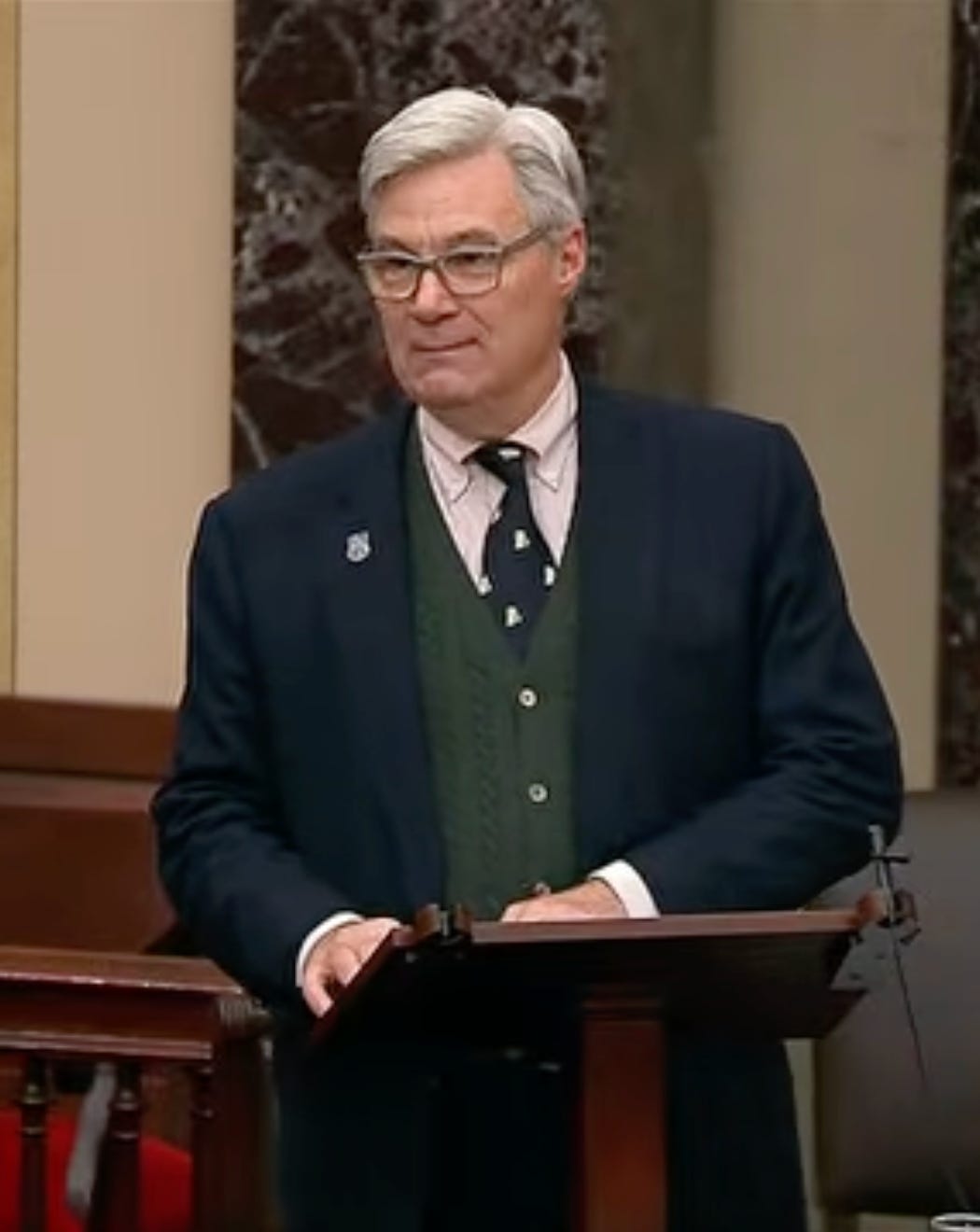
The speech was meticulous. Whitehouse read emails from the Epstein file releases, cited investigative reporters by name, and submitted a full bibliography into the record. He laid out the case that Epstein’s extensive Russian connections may illuminate Trump’s otherwise inexplicable subservience to Vladimir Putin.
I’ve spent the past year building a comprehensive independent analysis of the Epstein files: from building an open-source search engine for the House Oversight documents to tracing the $95 million Rybolovlev transaction and Epstein’s claim that Trump was “fronting for the mansion’s real owners.” When I watched Whitehouse’s speech, I was struck by how closely his research parallels my own — and by how much further the documentary record goes than what he was willing to say on the Senate floor.
What follows validates Whitehouse’s core Russia narrative with additional documentary evidence, then extends it into territory the Senator didn’t touch: a documented network of relationships traceable from Epstein’s Russian intelligence contacts to the institutional infrastructure now shaping Trump’s White House foreign policy.
Every claim is sourced to DOJ document releases, House Oversight Committee documents, congressional testimony, or verified public reporting.
The Speech
Whitehouse’s argument has a clean structure. He opens with a reminder of how Bill Barr’s misleading summary of the Mueller report effectively inoculated Trump against the Russia narrative in 2019. He lists ten recent Trump administration actions that serve Russian interests. Then he pivots: So, what is it about Trump and Russia? And could it have any connection with Trump’s close friendship with the deceased pedophile Jeffrey Epstein?
From there, Whitehouse walks through the Epstein files’ Russian connections: the Robert Maxwell intelligence lineage, the Trump-Epstein social partnership, the $95 million Palm Beach mansion sale to Russian oligarch Dmitry Rybolovlev, Epstein’s contacts with Russian officials, the Russian women trafficked through his operation, the billion-dollar money trail through sanctioned Russian banks, and the hidden camera surveillance infrastructure that made the entire blackmail operation possible.
Critically, Whitehouse also put Epstein’s intelligence connections squarely on the congressional record. He cited the former US attorney for the Southern District of Florida, Alexander Acosta, who reportedly claimed that Epstein “belonged to intelligence” and that “the decision to let him off easy in 2008 was made above his pay grade.” He cited journalist Vicky Ward’s sources — “former arms dealers” and “former spies” — who told her Epstein “decided to compromise influential people by recording them doing things they wouldn’t want made public” and that Epstein “was known in the intelligence world as a hyperfixer.” And he noted that the prime minister of Poland has opened an official investigation into Epstein’s ties to Russian intelligence, saying “more and more leads” point to the suspicion that “this unprecedented pedophilia scandal was co-organized by Russian intelligence services.”
He’s careful. He caveats appropriately — Epstein was a liar, the intelligence world is murky, we may never have definitive answers. He concludes by noting what independent journalist Roger Sollenberger has documented as active suppression of Epstein documents related to Trump by the MAGA Department of Justice — a pattern I’ve been documenting since the first file releases and through Bondi’s combative testimony before the House Oversight Committee.
This is serious independent work. Whitehouse and his staff have clearly been living in these documents, and a senator and an independent journalist arriving at converging conclusions through different methods strengthens the case for both. That convergence matters — especially when the executive branch is actively suppressing evidence.
But a Senate floor speech and an independent investigation operate under different constraints. Whitehouse has to be defensible line by line; everything he says becomes part of the congressional record. My job is different — to map the connections the documentary record supports, follow inferential chains further than a senator can on the floor, and put the full picture in front of the public. Both functions are necessary. Here’s where the journalism goes further than the speech.
What Whitehouse Got Right
Before extending the analysis, it’s worth noting where Whitehouse’s speech aligns precisely with what the documentary record shows.
The Churkin connection is real and significant. Whitehouse cited Epstein’s email (EFTA00934357) that Russian UN Ambassador Vitali Churkin “understood Trump after our conversations.” The files confirm extensive Epstein-Churkin contact. But Whitehouse didn’t mention the most striking detail: the guest list.
October 7, 2016
According to scheduling documents in the Epstein file releases (EFTA02041031, EFTA02040190), on October 7, 2016 — the day the Access Hollywood tape dropped, the day WikiLeaks began releasing the Podesta emails, arguably the single most consequential day of the 2016 presidential campaign — Churkin had lunch at Epstein’s home with Peter Thiel, the tech billionaire who had secretly funded the Gawker lawsuit and was one of Trump’s most important Silicon Valley backers.
The Russian ambassador to the UN. The tech billionaire bankrolling Trump. At the home of the man Whitehouse told the Senate “belonged to intelligence.” On that specific day.
A caveat: scheduling documents show intent, not necessarily execution — meetings get cancelled, dates shift. Whether this lunch took place as scheduled is not confirmed by the documentary record. But a scheduling document placing these three men at the same table on the most consequential day of the 2016 campaign is the kind of detail that warrants further investigation.
The financial trail is real. Whitehouse cited the JP Morgan suspicious activity report: 4,725 wire transfers totaling over $1 billion, flagged for being “consistent with alleged sex trafficking of minors,” with accounts linked to sanctioned Alpha Bank and Sberbank.
What Whitehouse didn’t say is that JP Morgan was just one bank. The Senate Finance Committee’s investigation, led by Ron Wyden, found transactions across JP Morgan, Deutsche Bank, Bank of America, and BNY Mellon. The total documented transaction volume exceeds $1.5 billion. The wire activity was strongly correlated with the movement of women and girls from Russia, Belarus, Turkey, and Turkmenistan.
The surveillance infrastructure is real. Whitehouse cited Virginia Giuffre’s account of Epstein’s video library, the hidden cameras in tissue boxes (a 2014 email from DOJ file releases documents their procurement — Epstein wrote “Let’s get three motion detected hidden cameras, that record,” and an aide replied “I’m installing them into Kleenex boxes now”), the cameras found by police in clocks, and the New York Times photographs of cameras in Epstein’s bedroom. He quoted Epstein: “I collect people. I own people. I can damage people.”
All confirmed. And the surveillance infrastructure is more extensive than what Whitehouse described. The Palm Beach police found covert cameras in 2005. Professional surveillance tapes — Maxell T-160 format, the kind professionals use — were seized from Epstein’s properties. They were logged into evidence. The notation in the DOJ evidence list:
ITEM WAS NOT SCANNED
Physical surveillance tapes from the home of a man who, according to multiple survivors, systematically recorded sexual encounters with powerful men for the purpose of blackmail. Tapes that were seized by law enforcement. Not scanned.
The Network Between the Nodes
Whitehouse’s speech touched something he didn’t assemble — and couldn’t, given the constraints of a congressional address.
Sergei Belyakov is the key figure. Whitehouse mentioned him: FSB Academy graduate, former Russian Deputy Minister of Economic Development, the man Epstein warned about a “Russian girl from Moscow” attempting blackmail. Whitehouse noted that Belyakov told Epstein about his new position at the Russian Direct Investment Fund under Kirill Dmitriev.
Whitehouse put the individual nodes on the record. Mapping the network between them — tracing the documented relationships from node to node and showing where they lead — is the work of journalism, not Senate floor speeches. That’s my job. So let me do it.
I want to be precise about what I’m doing here. I am not alleging a direct operational chain from Epstein to current Ukraine policy. I am not claiming that Belyakov personally arranged any relationship in the current Trump White House. What I am documenting is network proximity: a series of verified, documented relationships that run from Epstein’s Russian intelligence contacts into the institutional infrastructure now serving as a documented channel between Putin and Trump’s envoys. Network proximity is itself the finding. Anyone who understands how intelligence networks function will recognize that as serious — not because it proves coordination, but because it shows that Epstein’s cultivation of Russian intelligence contacts fed directly into institutions that now shape American foreign policy.
Here’s what the documentary record shows.
Node 1: Belyakov and Epstein.
Belyakov graduated from the FSB Academy in Moscow in 1999 — the institution that trains Russian intelligence officers. He served as an FSB border guard. He rose to become Russia’s Deputy Minister of Economic Development. And somewhere along the way, he became what Epstein described in a 2015 email to Peter Thiel (EFTA02495275) as “my very good friend.”
That friendship was substantive and reciprocal. When Epstein needed help with an alleged Russian blackmail attempt against “a group of powerful businessmen in New York,” Belyakov provided a dossier on the woman in question, along with Russian visa assistance and intelligence on targets Epstein identified. And when Belyakov asked Epstein in February 2016 to set up a meeting with “a renowned hacker,” Epstein replied, “I will do anything that is helpful to you.”
An FSB-trained Russian intelligence official, running dossiers and counter-blackmail operations with a convicted sex offender who collected kompromat on the world’s most powerful men. And that sex offender was describing the FSB man to Peter Thiel as “my very good friend” in a 2015 email. (Thiel’s extensive Epstein connections across the House Oversight documents are a separate thread worth their own analysis.)
Node 2: Belyakov moves to RDIF.
In 2016, Belyakov told Epstein he had a new position at the Russian Direct Investment Fund (RDIF) — Russia’s sovereign wealth fund. This wasn’t a lateral move. RDIF is one of the Kremlin’s most important financial instruments, designed to channel investment into strategic Russian interests.
And the head of RDIF? Kirill Dmitriev.
Node 3: Dmitriev and the Trump White House.
Dmitriev has been a key intermediary between the Kremlin and the Trump orbit since before Trump took office the first time. In January 2017, Erik Prince — Blackwater founder, brother of Trump’s Education Secretary Betsy DeVos — met secretly with Dmitriev in the Seychelles, a meeting that Robert Mueller investigated as a potential back channel between the Trump transition team and Moscow.
Fast forward to the current administration. In leaked phone calls reported in 2025, Dmitriev and Steve Witkoff — Trump’s special envoy — were caught coordinating closely on a peace deal for Ukraine that critics say is heavily favorable to Russia. The calls revealed a working relationship between Trump’s envoy and Putin’s fund manager that went well beyond diplomatic protocol. (For those tracking the broader pattern of Trump-era Russia accommodation, Fiona Hill testified in 2019 that Russia proposed a Venezuela-for-Ukraine swap — the same spheres-of-influence framework that now appears to be driving Witkoff’s negotiations.)
The network map.
Read the documented relationships end to end. Verified connections between individuals and institutions — not alleged coordination:
Jeffrey Epstein — cultivated a substantive relationship with
Sergei Belyakov (FSB Academy graduate, Russian Deputy Minister) — who moved to
Russian Direct Investment Fund (RDIF) — headed by
Kirill Dmitriev (Putin’s fund manager, Seychelles back channel) — who coordinates with
Steve Witkoff — Trump’s special envoy, shaping current US foreign policy on Ukraine
Epstein is dead. But the institutional infrastructure he helped cultivate — the connective tissue between Russian intelligence networks and American power — is alive and shaping policy today. That’s what network analysis looks like when you follow the documented relationships.
What Remains
Senator Whitehouse concluded his speech by saying that “sometimes with a little imagination, you have the chance to see what’s right in front of your face.”
He’s right. But it doesn’t take imagination anymore. It takes the willingness to look at what the documents already show.
The surveillance tapes marked “ITEM WAS NOT SCANNED” — what’s on them? The documents the Justice Department is withholding from the Epstein releases — what do they contain? The Poland investigation into Epstein’s ties to Russian intelligence — what will it find?
And the network I’ve mapped here — from an FSB-trained intelligence official, through Russia’s sovereign wealth fund, to the man on the phone with Trump’s envoy negotiating Ukraine’s future — why isn’t anyone with subpoena power following it?
Whitehouse said it on the Senate floor. The documentary record says it louder. Russia is one dimension of the Epstein network that’s still operating — but it may be the one that explains the most about this presidency.
Pam Bondi has been subpoenaed by the House Oversight Committee.
Independent Journalists will continue to dig. International probes have been launched.
This story will be impossible to suppress.
The author has been investigating the Epstein files for the Cascade Series since 2025.
Sources
The Speech
Senator Sheldon Whitehouse, Senate floor speech, March 5, 2026. Announced on X. Full transcript available at whitehouse.senate.gov.
Intelligence Connections
Vicky Ward, “Jeffrey Epstein’s Sick Story Played Out for Years in Plain Sight,” The Daily Beast, July 9, 2019. Source for Acosta telling Trump transition team Epstein “belonged to intelligence.”
Vicky Ward, “Was Jeffrey Epstein a Spy?” Rolling Stone, April 7, 2022. Source for Epstein as intelligence-world “hyper-fixer.”
“Government sets up task force to probe Epstein scandal,” Office of the Prime Minister of Poland, February 2026.
“Poland to probe Russia-Epstein links,” France 24, February 2026. Source for PM Tusk’s “co-organized by Russian intelligence services” statement.
Barr / Mueller
Robert Mueller, letter to Attorney General William Barr, March 27, 2019. Mueller wrote that Barr’s summary “did not fully capture the context, nature, and substance” of the report’s findings.
DOJ Suppression
Roger Sollenberger, “DOJ Removed Record of Multiple FBI Interviews,” Sollenberger Substack, February 2026.
“Epstein files: Trump accusation,” NPR, February 24, 2026. Independent review confirming ~53 pages of interview documents appear missing.
Churkin–Thiel–Epstein October 7 Lunch
DOJ/EFTA document releases: EFTA02041031 (Groff scheduling email: “12:30pm LUNCH w/Peter Thiel and Vitaly Churkin”), EFTA02040190 (staff coordination: “Peter Thiel and Vitaly Churkin will be coming”).
“Jeffrey Epstein’s Calendar Contained Multiple Meetings With Peter Thiel,” Rolling Stone, September 2023.
DOJ/EFTA document EFTA00934357: Epstein email stating “churkin was great. he understood trump after our conversations.”
“It’s True: WikiLeaks dumped Podesta emails hour after Trump video surfaced,” PolitiFact, December 18, 2016.
Financial Trail
“JPMorgan allegedly notified government of $1 billion in suspicious Epstein transactions,” NBC News, September 2023. Source for 4,725 wire transfers, $1B+ total.
Senate Finance Committee, “Wyden Lays Out ‘Follow the Money’ Investigation,” July 2025. Source for multi-bank investigation.
Senate Finance Committee, “Wyden Expands Epstein Investigation with Probe of BNY Mellon Transactions,” January 2026. Source for BNY Mellon’s $378M via 270 wire transfers.
Surveillance Infrastructure
“Video shows inside Epstein’s house during 2005 search,” CBS12. Source for Palm Beach police finding covert cameras.
Vanessa Grigoriadis, “The Curious Sociopathy of Jeffrey Epstein,” Vanity Fair, August 2019. Source for “I collect people. I own people. I can damage people.”
DOJ evidence list PDF. Source for Maxell T-160 tapes and “ITEM WAS NOT SCANNED” notation.
Belyakov and Russian Network
“Epstein sought help of ex-Russian official linked to FSB,” Al Jazeera, February 12, 2026.
“Epstein’s Top Secret Relationship With Trained Russian Spy Revealed,” The Daily Beast, February 2026. Source for FSB Academy background and RDIF move.
“DOJ files reveal Epstein’s efforts to build Russian ties,” France 24, February 17, 2026. Source for Belyakov as “very good friend” in email to Thiel.
“Epstein built ties to Russians and sought to meet Putin,” The Washington Post, February 6, 2026. Source for blackmail counter-operations.
Dossier Center, “Jeffrey Epstein’s Russian Connection,” Navalny Foundation investigation. Source for Belyakov–RDIF–Dmitriev institutional chain.
DOJ/EFTA document EFTA02495275: June 30, 2015 email, Epstein introducing Belyakov to Thiel as “my very good friend.”
Dmitriev, Prince, and the Trump White House
“Mueller gathers evidence that Seychelles meeting was effort to establish back channel to Kremlin,” The Washington Post, March 7, 2018.
“Leaked call transcripts reveal U.S. envoy coaching Putin aide on pitching peace plan,” NPR, November 26, 2025. Source for Dmitriev–Witkoff coordination on Ukraine.
Epstein is dead. The network isn't.